
Renault Scenic E-Tech New Battery in Portugal: 642 km Range, Faster Charging
Published: 06/09/2026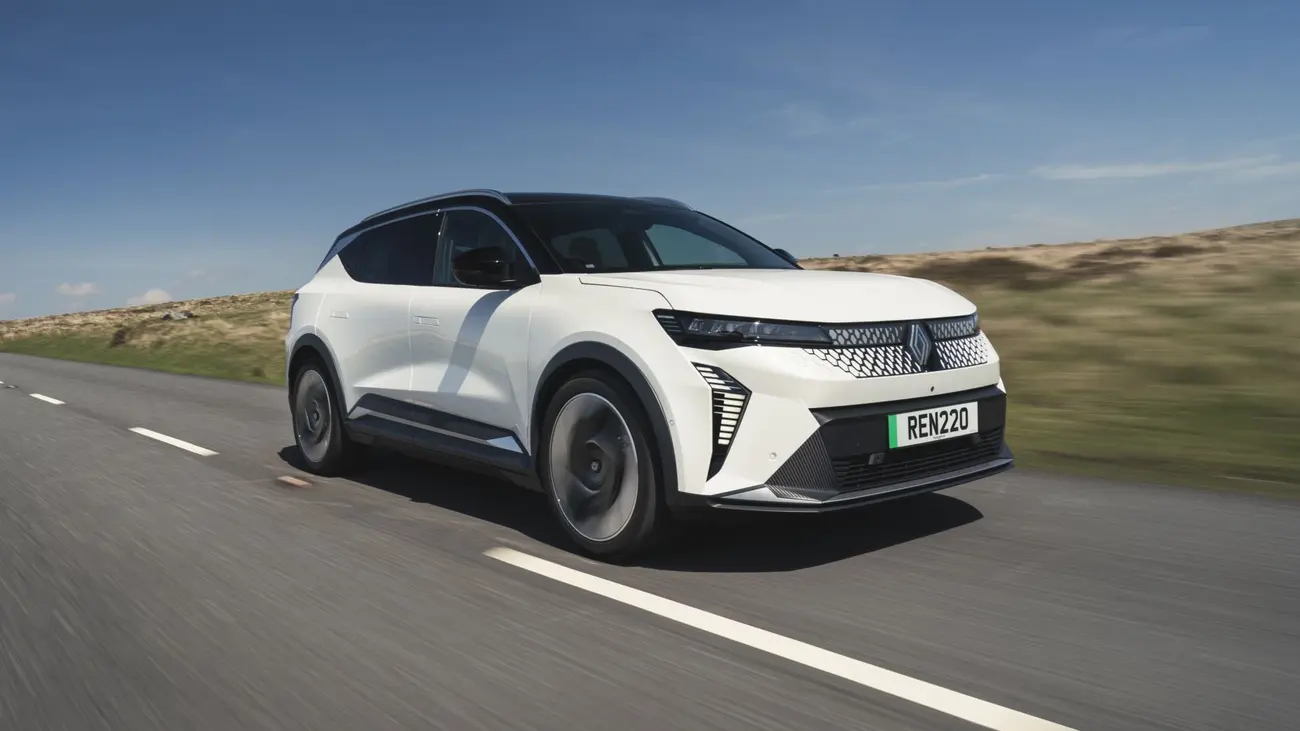
Renault Scenic E-Tech: new battery, 642 km of range and less time plugged in
Nine minutes. That is what the Scenic E-Tech claws back at every fast-charging stop after the update Renault announced on 1 September 2026. Charging from 15 to 80% drops from 37 minutes to 28 — and peak power did not go up at all.
The headline of this Renault Scenic E-Tech new battery update is the pack itself: the NMC unit grows from 87 to 89 kWh, pushing WLTP range from 625 to 642 km. This is not a facelift. The restyled nose with the faux grille already seen on the Megane comes later in the model cycle; the work here went into batteries, the charging curve and the software.
How you gain nine minutes without more power
DC peak power stays at 150 kW. What Renault reworked is the curve: instead of hitting the peak and tailing off quickly, the Scenic now holds high power for longer through the session. In round numbers, charging is about 25% faster.
Put that on a real journey. A stop at a motorway services on the A1 with 28 minutes on the clock is a coffee and a sandwich. And with 642 km WLTP you would do Lisbon to Porto without stopping anyway — fast charging matters more for the return leg the same day, or for the run down to the Algarve in August.
Comfort Range: the 67 kWh LFP battery that lowers the entry price
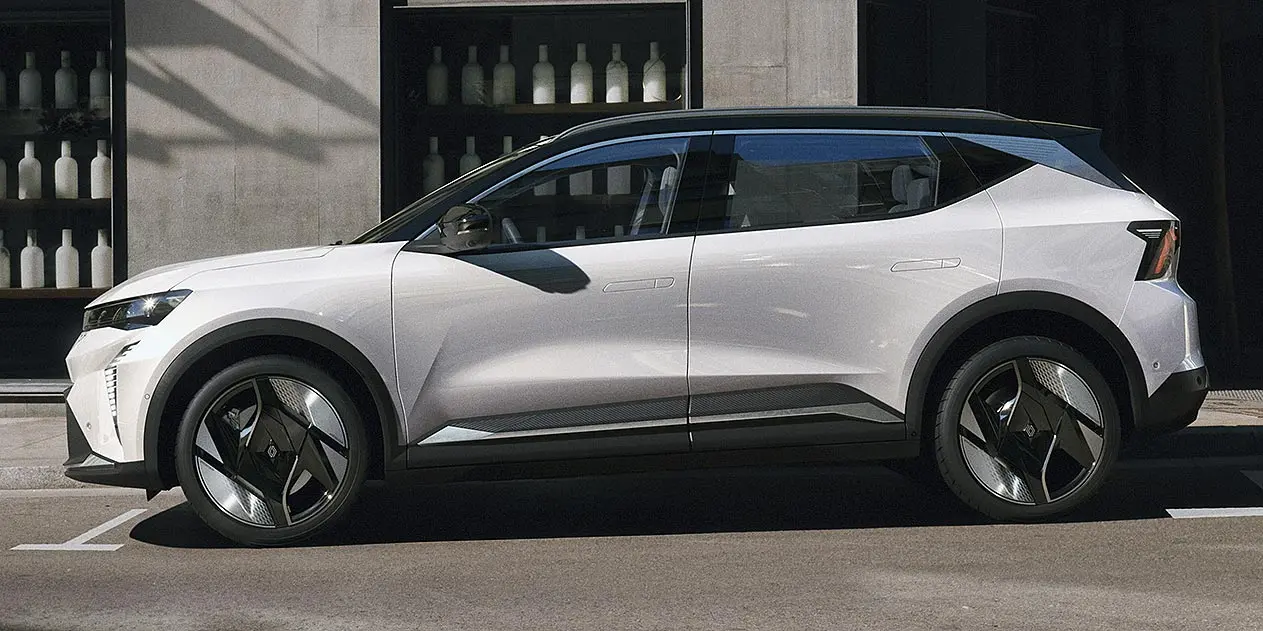
The second half of the update arrives later — autumn 2026 in France. It is the Comfort Range version, with a 67 kWh LFP battery replacing the old entry-level NMC pack.
The numbers are strong for a cheaper chemistry:
- 467 km WLTP — 37 km more than the version it replaces
- 165 kW DC peak, more than the big battery manages
- 15 to 80% in 24 minutes — four minutes quicker than the Long Range
- Cell-to-pack architecture with 232 pouch cells and 53% packing efficiency
Yes, the smaller battery charges faster and at higher power than the larger one. That is typical of modern LFP cells, which take high currents with less heat build-up.
NMC or LFP: which one to pick
The choice is not just about range. LFP tends to survive more cycles, uses no cobalt, and does not mind being charged to 100% every day — something you are advised to avoid with NMC. In exchange it is more sensitive to cold and less energy-dense, hence 467 km rather than 642 km.
In practice: if you mostly drive in and around the city and charge at home, Comfort Range is the rational buy. If the family does Lisbon-Porto-Algarve several times a year, the extra 175 km of the Long Range earns its keep.
One powertrain, 220 hp across the range
The range simplifies. According to Renault's official press release, the Scenic E-Tech now has a single motor: front-mounted, 220 hp (164 kW, 223 PS). The 125 kW / 170 hp entry version is gone — Italian coverage confirms the whole line-up is now 220 hp.
The rest of the spec sheet carries over: 4.47 m long, under 1,900 kg kerb weight, a 545-litre boot (855 litres with the rear seats folded) and the AmpR Medium platform, recently renamed RG Medium 1.0. The car is still built in Douai, France, at the ElectriCity cluster, with the battery assembled on site from Polish cells and the motor coming from Cleon in Normandy.
Google Gemini in openR link, and a car that recognises its driver
The openR link system gains Gemini as its voice assistant, replacing Google Assistant. In day-to-day use that means natural-language requests instead of memorised commands. The built-in Google Maps has also moved on: you can now filter charging stops by network, by charger power and by payment method — genuinely useful in Portugal, where MOBI.E aggregates several operators with different tariffs.
Renault includes 2 GB of data a month for three years for Google Play Store apps. The wireless phone charger is now Qi2 with MagSafe compatibility, magnetic and ventilated.
On the driver assistance side:
- Adaptive cruise control standard on every version
- Active Driver Assist with a Multi Target function that tracks several vehicles at once to anticipate cars cutting in
- Temporary lateral repositioning, active up to 70 km/h
- Emergency Stop Assist, bringing the car to a complete halt if the driver stops responding
- Predictive eco-driving, using map data to read curves, junctions and roundabouts and cut consumption by up to 6%
- Driver monitoring camera as standard, with driver recognition that restores personal settings automatically
There is also a Smart mode in Multi-Sense that switches between Eco, Comfort and Sport on its own, based on how you are driving.
Pricing: what we know, and it is not from Portugal
This part needs to be plain. Renault Portugal has not published pricing for the updated Scenic E-Tech. What exists are French and Italian figures, and neither transfers directly to a Portuguese price list.
In France, Renault quotes EUR 38,750 for the 89 kWh Techno Long Range (or EUR 270/month) and EUR 31,750 for the 67 kWh Comfort Range (or EUR 240/month). Those figures are calculated after a theoretical maximum French incentive of EUR 8,240 — the "Prime Coup de pouce CEE" — so they are not list prices and have no Portuguese equivalent. Before this update, the same French market asked EUR 43,000 for the 60 kWh version and EUR 48,000 for the 87 kWh.
In Italy, where the published figures are list prices, it looks like this:
| Version | Price (Italy) |
|---|---|
| Techno 220 CV Comfort Range | EUR 32,500 |
| Esprit Alpine 220 CV Long Range | EUR 39,950 |
| Techno Long Range (fleet) | EUR 47,950 |
The relevant point: the Italian entry price was EUR 40,200 and is now EUR 32,500. That is nearly EUR 8,000 off a car that gained range and faster charging. If Renault Portugal follows the same positioning logic — and it usually does — the electric Scenic should land noticeably cheaper here than it is today.
Worth remembering the Portuguese tax picture too: EVs remain exempt from ISV (the vehicle registration tax) and pay a reduced IUC (annual road tax), so the gap to an equivalent petrol car is smaller than list prices suggest.
Frequently Asked Questions
Renault Portugal has not yet published prices for the Scenic E-Tech with the new batteries, so any national figure would be guesswork. The only official numbers are foreign ones: in France, Renault quotes EUR 38,750 for the 89 kWh Techno Long Range and EUR 31,750 for the 67 kWh Comfort Range — but note that those French figures are already net of a theoretical maximum EUR 8,240 'Prime Coup de pouce CEE' incentive and are not list prices. In Italy, where the published figures are list prices, the range starts at EUR 32,500 (Techno Comfort Range) and reaches EUR 47,950 for the fleet Techno Long Range, an entry price nearly EUR 8,000 below the previous EUR 40,200.
The official figures are 642 km WLTP for the 89 kWh Long Range and 467 km for the 67 kWh Comfort Range LFP. In real use, an electric SUV of this size typically returns 20% to 30% below WLTP on the motorway and in cold weather, which suggests roughly 450 to 510 km for the Long Range and 330 to 375 km for the Comfort Range. The Comfort Range's LFP chemistry is more sensitive to low temperatures than NMC, though a Portuguese winter is far gentler than one in central or northern Europe. The new predictive eco-driving system, which reads curves and roundabouts from map data, claws back up to 6% of consumption.
The 89 kWh Long Range covers 15 to 80% in 28 minutes, down from 37 minutes on the previous version — roughly 25% faster. The interesting part is that DC peak power did not increase at all and remains 150 kW: the gain comes from an optimised charging curve that holds high power for longer during the session. The Comfort Range LFP is quicker still, with a 165 kW peak and 15 to 80% in just 24 minutes, helped by its cell-to-pack architecture with 232 pouch cells and 53% packing efficiency.
Renault has not confirmed Portuguese dates. The 89 kWh Long Range has been orderable in France since 1 September 2026, which normally means the announcement for Portugal is a matter of weeks rather than months. The Comfort Range with the 67 kWh LFP pack only reaches France in autumn 2026, and availability in other markets, Portugal included, remains unconfirmed. Worth noting: both the car and its battery are assembled in Douai, France, at the ElectriCity hub, with the motor coming from Cleon in Normandy.
With the new battery, the Scenic Long Range takes a clear range advantage: 642 km WLTP against roughly 576 km for the Skoda Elroq 85, which uses a 77 kWh usable pack. The Elroq hits back with more power, 286 hp versus the Scenic's 220 hp, and a slightly higher charging peak of around 175 kW against 150 kW. The Scenic counters with family practicality — 4.47 m long, a 545-litre boot that grows to 855 litres with the rear seats folded — and its Car of the Year 2024 title. Without Portuguese prices for the updated Scenic, the comparison that actually decides it cannot be made yet.
Is it worth waiting for the new Scenic?
If you are shopping for a Scenic E-Tech right now, yes — wait for the Portuguese prices. The 89 kWh Long Range is already orderable in France, which means the announcement here is a matter of weeks rather than months. The LFP Comfort Range only reaches France in autumn, and other markets have no dates yet.
Against the Skoda Elroq 85, its most direct rival in this class, the Scenic now arrives with a serious WLTP range argument. What the prices do here is still open — and that is the number that settles it. Keep an eye on Renault's announcements over the coming weeks.