
Renault Mégane E-Tech Facelift in Portugal: More Range, LFP Battery, New Look
Published: 23/06/2026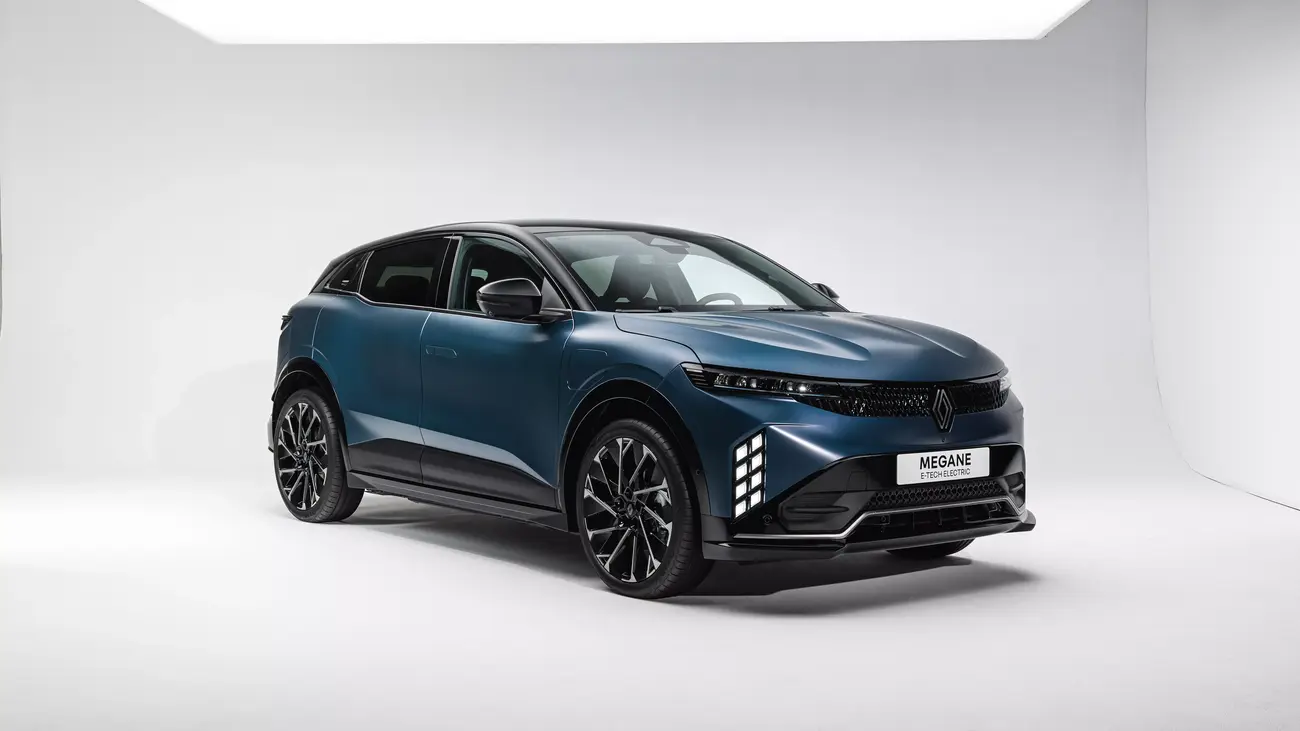
What the Renault Mégane E-Tech facelift changes for Portugal
Five hundred kilometres. That's the line Renault set out to cross with the mid-life facelift of the Mégane E-Tech, and it wasn't an arbitrary target. "Our studies show that 500 km is the psychological level where customers think 'okay, this can be my main vehicle'," says Benjamin Kotlowski, the Mégane's product manager. To get there, the Renault Mégane E-Tech gets a bigger battery, a different chemistry, and noticeably faster charging.
The backstory explains the urgency. Mégane E-Tech sales in France halved in 2025 — 8,752 units against 16,800 the year before — in an EV market that itself kept growing. This facelift is, in practice, a relaunch.
The 67 kWh LFP battery: the big technical change
The most important change is one you can't see. The Mégane swaps its old 60 kWh NMC battery for a 67 kWh LFP (lithium iron phosphate) pack, with cells supplied by LG and a cell-to-pack design. Renault calls the choice "the best ratio between price, range, and chargeability."
The upsides of LFP chemistry are well known: longer lifespan, better thermal stability, and lower cost. The trade-off is lower energy density — roughly 15% below NMC. That's why the car grows 2 cm taller (now 1.52 m): the pack needs more room to hold the same energy. Length stays at 4.20 m and the boot at 440 litres.
One detail matters for incentive-minded buyers: battery production has moved to Poland, which can make the car eligible for extra support depending on the market.
Renault Mégane E-Tech 500 km range — how much of it is real?
WLTP range climbs to up to 500 km, against roughly 468 km for the previous model — a gain of around 30 to 50 km depending on the source. It's not a transformation; it's measured progress.
It's worth being honest about efficiency. With the new battery, consumption gets slightly worse: 4.6 miles per kWh (about 13.6 kWh/100 km) versus 4.75 mi/kWh for the NMC pack. In real-world terms, the 500 km on paper more likely translates to 380-420 km in mixed driving, and less at 120 km/h on the motorway. That's still enough to do a Lisbon-Porto run with a single short charging stop.
165 kW charging: ten minutes less at the stop
This is the most tangible practical gain. Peak DC charging power rises from 130 to 165 kW, and 15-80% now takes 24 minutes — about ten minutes quicker than before. On a long trip, that's the difference between a coffee and a lunch.
For context: the VW ID.3 Neo with its larger battery accepts 183 kW, so the Mégane isn't the segment leader here, but it closes the gap. On AC it keeps 11 kW as standard, with 22 kW optional for anyone with access to a three-phase charger.
One addition worth flagging: V2L and V2G are now standard across the range. V2L lets you power external 220V devices — handy for camping or tools. V2G goes further: the car can return energy to the grid, opening the door to cutting your home-charging bill by leaning on cheaper off-peak hours.
Motor and dynamics: continuity
Mechanically, little changes. The wound-rotor synchronous motor keeps its 220 hp and 300 Nm, front-wheel drive. The 0-100 km/h sprint now takes 7.6 seconds — two-tenths slower than before, penalised by the roughly 70 to 100 kg the new battery adds (total weight is around 1,772 kg).
To compensate, Renault reworked the suspension with a new multi-link rear axle and retuned the steering for more precision. It isn't a faster car; it's one that should feel more composed on the road.
| Specification | Value |
|---|---|
| Battery | LFP 67 kWh (was NMC 60 kWh) |
| WLTP range | up to 500 km |
| Power / torque | 220 hp / 300 Nm, front-wheel drive |
| 0-100 km/h | 7.6 s |
| DC charging (peak) | 165 kW (was 130 kW) |
| Charging 15-80% | 24 min |
| AC charging | 11 kW standard, 22 kW optional |
| Weight | around 1,772 kg |
| Length / height | 4.20 m / 1.52 m (+2 cm) |
| Boot | 440 L |
Design and tech: a new face and Gemini on board
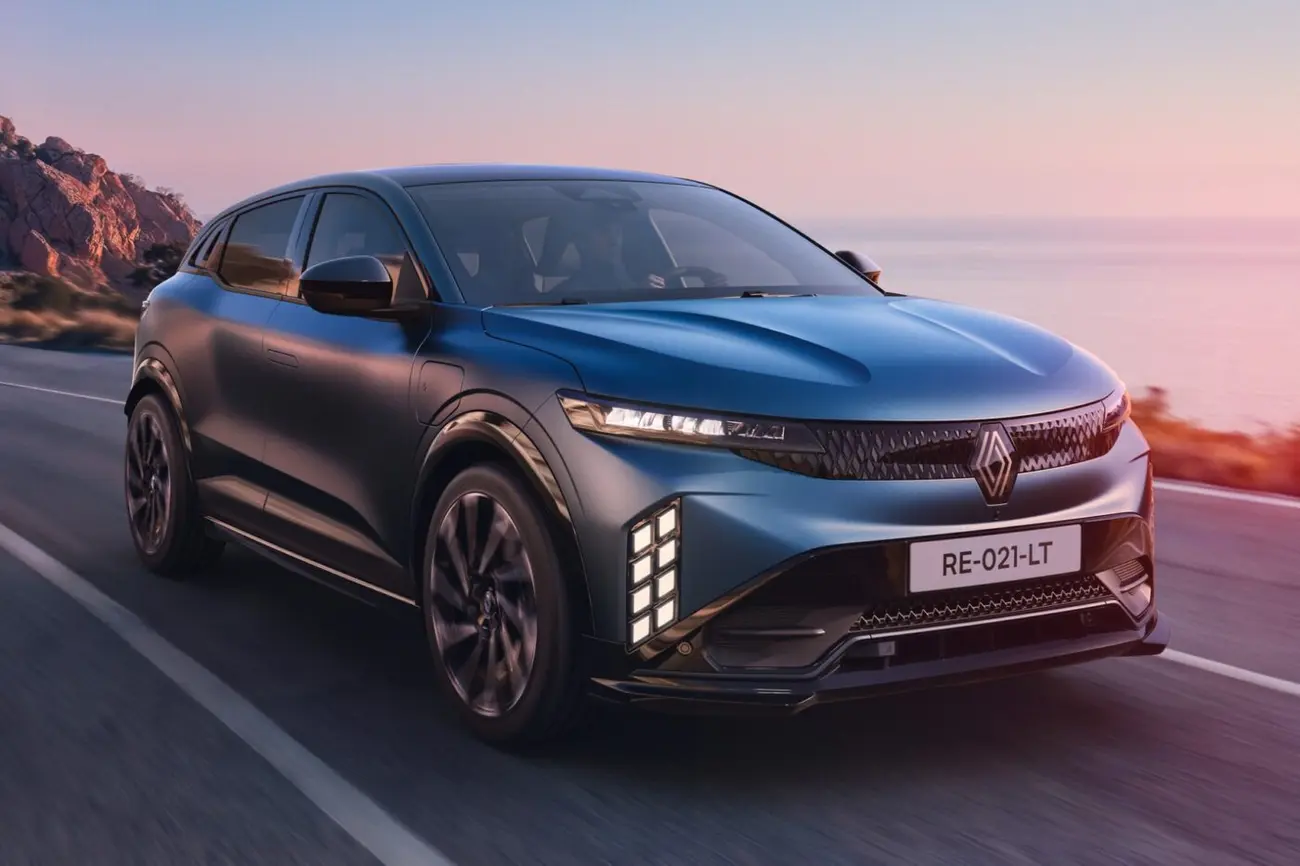
The styling update is almost entirely up front. Inspired by the Scénic E-Tech, the new nose trades round shapes for a sharper look: a black diamond-pattern grille, eight diamond-shaped LED daytime running lights at the bumper ends, and the Renault logo repositioned beneath the bonnet line. At the rear, the light bar gains a 3D effect. There are seven colours, including a new Satin Blue, and 19-inch (Techno) or 20-inch (Esprit Alpine) wheels.
Inside, the headline change is technological. The OpenR Link system built with Google now integrates the Gemini voice assistant, with an improved route planner and new apps. Add a magnetic inductive phone charger (Qi2/MagSafe-style) and a facial-recognition system that automatically adjusts settings for up to five driver profiles, with the data stored locally in the car. The dual 12.3-inch and 12-inch screens are now standard.
The range simplifies from three trims to two: Techno (entry) and Esprit Alpine (top), the latter with suede-effect upholstery, tricolour stitching, and a Harman Kardon sound system.
New Renault Mégane E-Tech: price in Portugal and when it arrives
Renault has warned there won't be big price cuts — the brand talks about figures equivalent to the pre-facelift Mégane. In France, the entry version is pencilled in at around €35,000 with incentives, and international sources cite a €30,000 to €35,000 bracket. The savings from the new LFP battery are, according to Renault, what makes the upgrades financially painless.
There's no official Portuguese price yet. Taking the French starting point of around €35,000 as a reference, and given that EVs in Portugal are exempt from ISV (the vehicle purchase tax) and pay reduced IUC (the annual road tax), it's reasonable to expect the Techno to land somewhere in the €36,000 to €39,000 range — always subject to the incentive policy in force at launch. Anyone shopping for a compact electric hatchback in Portugal gets one more option to weigh alongside the VW ID.3 Neo and the Kia EV4.
The calendar: orders open in early July 2026, first deliveries are expected in October, and the public debut takes place at the Paris Motor Show (Mondial de Paris) 2026.
Mégane E-Tech vs VW ID.3 and Kia EV4
On paper, the facelifted Mégane does well in a head-to-head on range.
| Model | Battery | Range |
|---|---|---|
| Renault Mégane E-Tech facelift | 67 kWh LFP | around 500 km |
| VW ID.3 Neo | 58 kWh LFP | around 494 km (peaks 183 kW DC) |
| Kia EV4 (standard range) | — | around 439 km |
| Kia EV4 (larger battery) | — | over 610 km |
The Mégane beats the ID.3 Neo on range but loses to it on charging speed. The Kia EV4 with the big battery offers more kilometres, though its entry version trails the field. The right choice depends heavily on how you drive: for mostly-city use and medium trips, the Mégane's balance makes sense.
Frequently Asked Questions
There's no official Portuguese price yet. Using the French entry point of around €35,000 for the Techno version as a reference, and given that EVs are exempt from ISV and pay reduced IUC, it's reasonable to expect a position between €36,000 and €39,000, always subject to the incentives in force at launch. Renault has warned there won't be big cuts versus the pre-facelift Mégane.
Orders open in early July 2026 and the first deliveries are expected in October 2026. The public debut takes place at the Paris Motor Show (Mondial de Paris) 2026. Portugal's timeline should track the European one closely, though Renault Portugal has not yet confirmed local dates.
WLTP range climbs to up to 500 km, against roughly 468 km for the previous model, thanks to the new 67 kWh LFP battery. In real mixed driving you're more likely to see 380 to 420 km, and less at 120 km/h on the motorway, since efficiency dropped slightly to about 13.6 kWh/100 km. Even so, that's enough for a Lisbon-Porto run with a single short charging stop.
Swapping the 60 kWh NMC battery for a 67 kWh LFP (lithium iron phosphate) pack, with LG cells and cell-to-pack construction, brings longer lifespan, better thermal stability and lower cost. The trade-off is lower energy density (about 15% less), which forced the car to grow 2 cm taller. For most drivers the added durability and faster charging make it worthwhile, and battery production in Poland could also open the door to extra incentives.
The facelifted Mégane beats the VW ID.3 Neo on range (around 500 km versus 494 km), but the ID.3 charges faster, peaking at 183 kW against the Renault's 165 kW. The Kia EV4 with the big battery offers over 610 km, though its entry version (around 439 km) trails the Mégane. For mostly-city use and medium trips, the balance of range, 165 kW charging (15-80% in 24 min) and onboard tech makes the Mégane a strong option.
The Mégane E-Tech facelift doesn't reinvent the formula — it sharpens it. More range, faster charging, and a more assertive face arrive just as rivals tighten the screws. The one number that will decide everything is still missing: the final price for Portugal. The July announcements are worth watching.