
Renault Scenic E-Tech vs Skoda Elroq Portugal: Compact Electric SUV Showdown
Published: 07/04/2026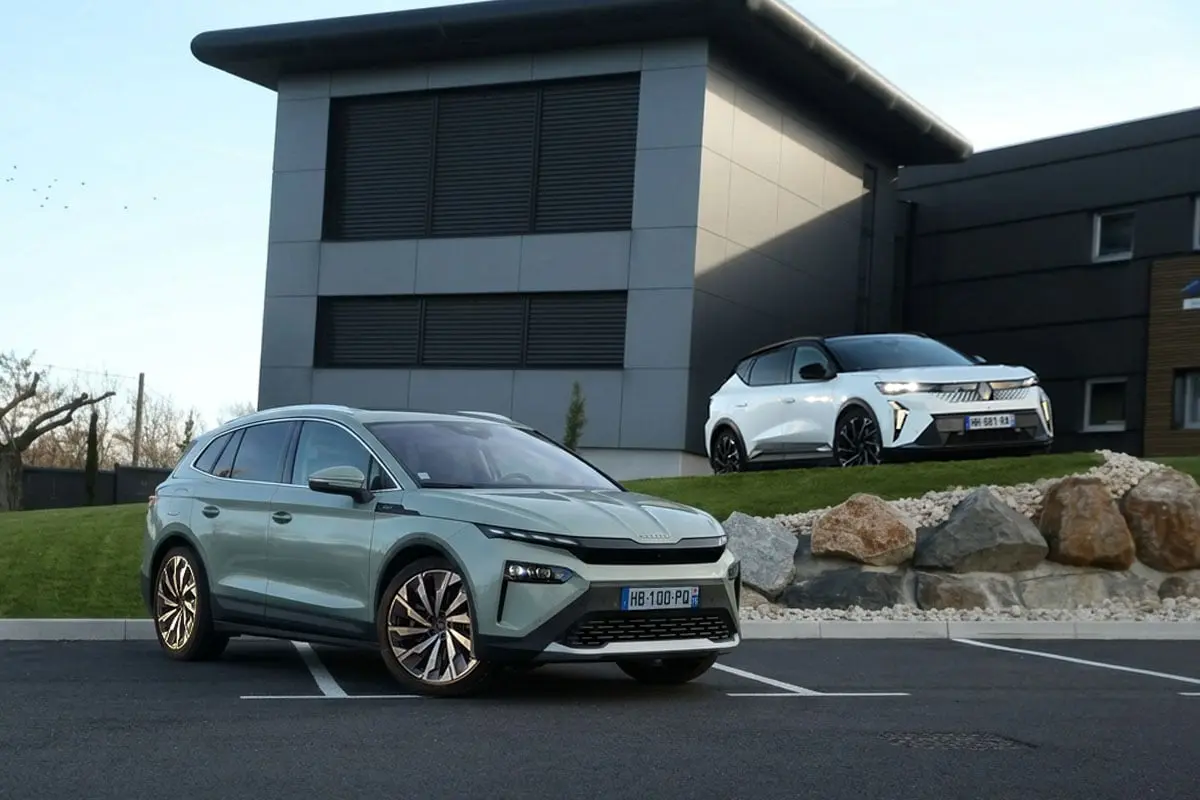
Renault Scenic E-Tech vs Skoda Elroq Portugal: which compact electric SUV wins?
Two family-sized electric SUVs, similar price brackets, and completely different philosophies. The Renault Scenic E-Tech bets on a bigger battery and raw range. The Skoda Elroq answers with efficiency, faster charging and rear-wheel drive. For anyone hunting the best compact electric SUV in Portugal for 2026, this is probably the most relevant head-to-head on the market right now — and the answer is not obvious.
Here is how the two stack up in the real world, how much they cost in Portugal, and which one makes more sense depending on how you actually drive.
The numbers that matter
The Scenic E-Tech 220 tested by the European press (one of the most recent bets from Renault) packs a 87 kWh usable battery, 218 hp and 300 Nm, front-wheel drive and up to 625 km WLTP. The top Elroq 85 uses a 77 kWh usable battery, delivers 286 hp and 545 Nm, rear-wheel drive and 544–581 km WLTP. So the Renault carries 10 kWh more and promises 50 to 80 km more on paper. The Skoda counters with more power and a MEB platform designed from scratch for rear drive.
| Spec | Renault Scenic E-Tech 220 | Skoda Elroq 85 |
|---|---|---|
| Platform | CMF-EV (Renault-Nissan Alliance) | MEB (VW Group) |
| Usable battery | 87 kWh | 77 kWh |
| Power | 218 hp / 300 Nm | 286 hp / 545 Nm |
| Drive | Front | Rear |
| 0-100 km/h | 7.9-8.3 s | 6.5 s |
| WLTP range | 610-625 km | 544-581 km |
| Real mixed consumption | 18.2 kWh/100 km | 16.9 kWh/100 km |
| Highway 130 km/h | 25.4 kWh/100 km | 23.3 kWh/100 km |
| Max DC charging | 150 kW | 135 kW |
| 10-80% DC | ~38 min | ~27 min |
| Boot | 545 L (1,670 L) | 470 L (1,580 L) |
| Kerb weight | 1,866 kg | 2,044 kg |
| Heat pump | Standard | €1,100 option |
Real-world range and consumption
This is where the Elroq surprises. Despite having 10 kWh less battery, it is the more efficient of the two in every tested scenario — 16.9 against 18.2 kWh/100 km in mixed driving, and 23.3 against 25.4 at a steady 130 km/h. In plain terms, the Elroq 85 burns about 10 to 12% less energy than the Scenic on the same trip.
In practice, that means the on-paper range gap between the two shrinks quickly. In a 500 km motorway test by Automobile Propre, the Skoda arrived in 4h53 and the Renault in 4h58 — effectively tied, despite the Renault's bigger battery. Why? Because the Elroq charges faster.
Fast charging: a clear win for the Skoda
The Scenic accepts more DC power on paper (150 kW vs 135 kW), but in reality the Elroq manages its charging curve better. From 10 to 80% it needs about 27 minutes; the Scenic takes 38. On a typical 15-minute stop at a MOBI.E or Ionity charger on the A1 motorway, the Skoda recovers enough for another 150 km — the Renault only 125 km. (MOBI.E is Portugal's unified charging network, present on all major highways.)
If you drive Lisbon-Porto-Algarve several times a month, this matters. Less time plugged in is always better, and Portugal's fast-charging infrastructure already covers the main routes well — but during summer peaks, every minute saved waiting counts.
Prices in Portugal
The price comparison is less clean than it looks, because each brand structures its lineup differently.
The Skoda Elroq starts in Portugal from around €28,500 + VAT on fleet terms, or roughly €34,947 retail for the Elroq 50. The top Elroq 85 compared here sits around €43,078. It is a solid electric SUV under €45,000 — one of the most competitive bets from Skoda in Portugal.
The Renault Scenic E-Tech kicks off at €40,690 for the 170 hp version with the 60 kWh battery — cheaper on entry but with less car under you. The iconic 220 hp version with the big battery, the only one directly comparable to the Elroq 85, climbs to around €52,990.
In other words: if you want the Scenic with the big battery and the on-paper range, be ready to pay roughly €10,000 more than the equivalent Elroq 85. If your budget sits around €35,000-40,000, the Elroq 50 lines up against the 170 hp Scenic and the decision hinges more on equipment and personal taste.
Space, comfort and daily use
On paper the Scenic wins the boot battle: 545 litres against 470, and 1,670 against 1,580 with the seats folded. That is about 75 litres of advantage — nothing dramatic, but real enough when you are trying to fit a pram and weekend luggage.
The Elroq is taller (1.65 m vs 1.57 m), giving more headroom and a higher driving position — the classic "SUV feel" many buyers are after. It also has a noticeably tighter turning circle (9.3 m vs 10.92 m), which makes a difference in tight garages and narrow historic streets in Lisbon or Porto.
One point in the Renault's favour: cabin climate. It heats the cabin in about 6 minutes versus 13 for the Skoda, and uses less energy doing it (1.8 vs 2.5 kWh/h). For anyone who climbs in at dawn on a winter morning in Bragança or Guarda, that is a tangible difference. It helps that the heat pump is standard in the Scenic — on the Elroq it is a €1,100 option you will want to tick.
On the motorway the Skoda is the quieter of the two: 67 dB at 130 km/h against 70 dB in the Renault. The numbers look close, but the decibel scale is logarithmic and the gap is audible on long trips.
Rear wheel drive vs front wheel drive
The Scenic rides on the CMF-EV platform from the Renault-Nissan Alliance and sends all power to the front wheels. The Elroq uses the VW Group's MEB, with the motor at the back. For relaxed daily driving, the difference is subtle. Under hard acceleration or on a fast corner with the throttle open, the Elroq's rear drive pays off: better balance, less torque steer, and the 6.5-second 0-100 km/h time is noticeable.
Anyone coming from a Skoda Octavia or VW Tiguan will feel at home with the Elroq's ergonomics. Anyone who prefers the more lounge-like feel of the Renault interior — with its vertical 12-inch screen and nicer materials — will lean Scenic.
Tax incentives in Portugal
Both are pure BEVs, so both qualify for the ISV exemption (ISV is Portugal's vehicle registration tax) and the reduced IUC (annual road tax) regime for electric cars. This is one of the main reasons why an electric SUV in Portugal remains price-competitive against a comparable petrol or diesel model, even before counting the purchase incentives the Fundo Ambiental renews each year — worth checking the current amounts when you are ready to buy, because they change annually.
For company-car drivers, the more favourable autonomous taxation on BEVs is a serious argument. Either of these two makes sense in a fleet.
Frequently Asked Questions
For most Portuguese buyers looking for a family electric SUV under €45,000, the Skoda Elroq 85 is the more rational choice thanks to its better efficiency (16.9 vs 18.2 kWh/100 km), faster charging (10-80% in 27 min vs 38 min) and rear-wheel drive layout. The Renault Scenic E-Tech 220 makes sense if you prioritise headline WLTP range (up to 625 km), a bigger boot (545 L vs 470 L) and a standard heat pump, but the top trim costs around €10,000 more.
The Skoda Elroq starts at around €34,947 retail for the Elroq 50, with the top Elroq 85 sitting near €43,078. The Renault Scenic E-Tech opens at €40,690 for the 170 hp version with the 60 kWh battery and climbs to about €52,990 for the iconic 220 hp version with the larger 87 kWh battery. Both qualify for the full ISV exemption and the reduced IUC road tax that Portugal applies to BEVs.
In mixed driving the Skoda Elroq 85 averages around 16.9 kWh/100 km, translating to roughly 450 real-world kilometres from its 77 kWh usable battery. The Renault Scenic E-Tech 220 uses about 18.2 kWh/100 km and delivers close to 480 real kilometres from its larger 87 kWh battery. On the motorway at 130 km/h consumption rises to 23.3 kWh/100 km for the Skoda and 25.4 kWh/100 km for the Renault, narrowing the Scenic's advantage on longer trips.
On DC the Elroq 85 peaks at 135 kW and completes a 10-80% top-up in about 27 minutes, versus 38 minutes for the Renault Scenic E-Tech despite the Renault's 150 kW peak figure. In a typical 15-minute stop at an Ionity or MOBI.E station the Skoda recovers energy for around 150 extra kilometres while the Renault adds about 125 km. On a Lisbon-Porto-Algarve loop this can save more than half an hour of waiting per trip.
Both the Renault Scenic E-Tech and the Skoda Elroq are pure BEVs and benefit from full ISV exemption at registration plus a reduced IUC road tax band reserved for electric cars. Company-car buyers also enjoy lower autonomous taxation, which makes both models particularly attractive for fleets. Direct purchase grants from the Fundo Ambiental for private buyers are reviewed every year, so the exact amount should be confirmed at the time of purchase.
Which one should you buy?
Go for the Skoda Elroq 85 if you want efficiency, fast charging, rear-wheel drive and the best price-performance balance. Around €43,000, it is hard to find a more rounded compact electric SUV on the Portuguese market. This is the car for high-mileage drivers who want to minimise time spent plugged in.
Go for the Renault Scenic E-Tech 220 if you value maximum headline range, a bigger boot, a standard heat pump and a more sophisticated cabin. You pay around €10,000 more for the top version, but you get extra comfort margin on long winter trips and more cargo space for a family.
For most Portuguese and expat buyers shopping for a good family electric SUV under €45,000, the Elroq 85 is the more rational pick. For anyone who wants the premium feel and is not counting euros, the Scenic iconic earns its premium. As always, the right answer depends on how you actually use the car — and both deserve a test drive before you sign anything.