
Polestar 4 SUV in Portugal: Price, Range and Boot Space vs the Coupé
Published: 07/09/2026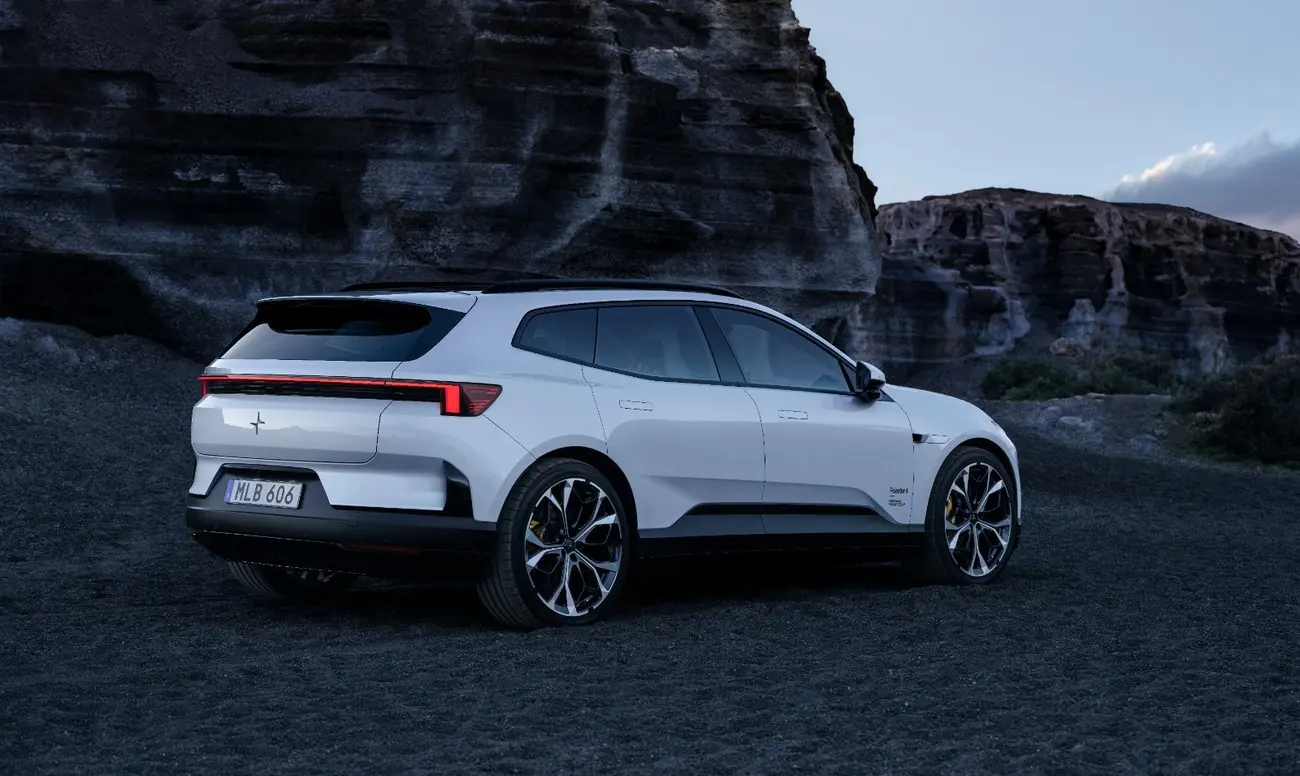
Polestar 4 SUV price in Portugal: from €55,600
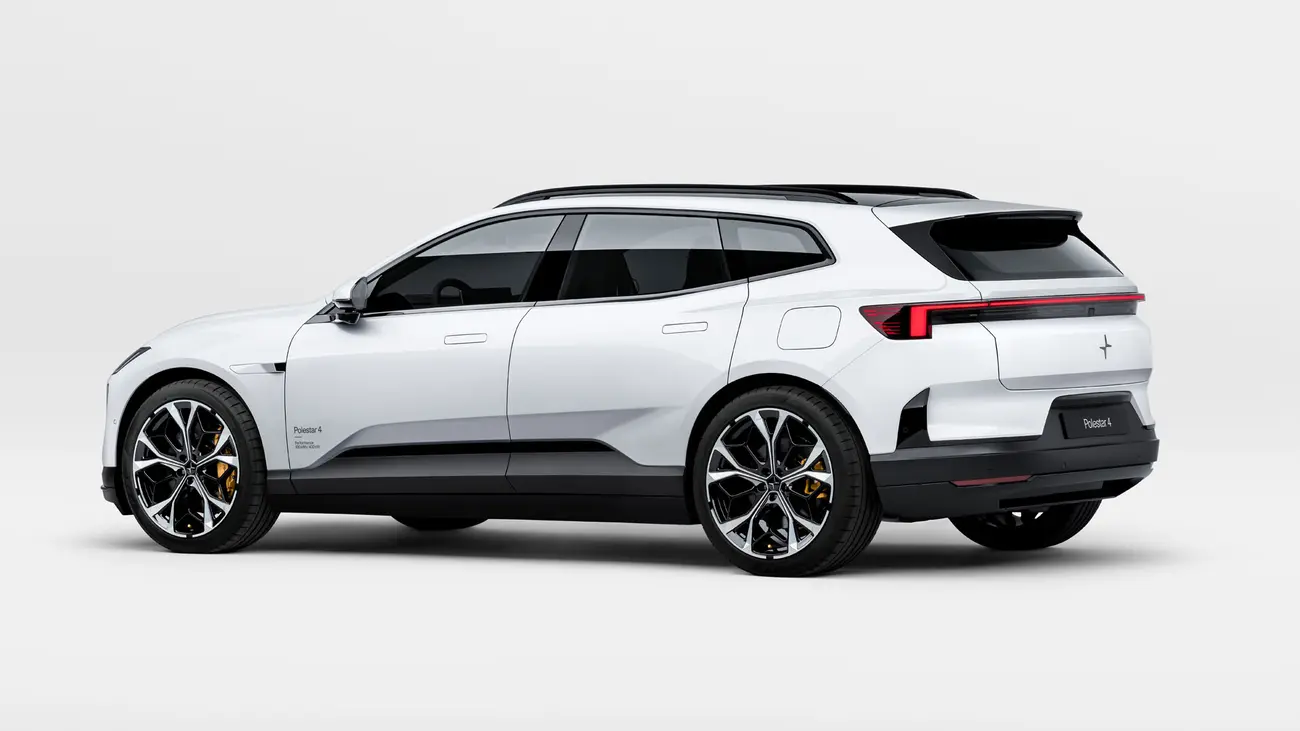
Polestar has done something few brands do — quietly conceded that the car without a rear window didn't win everyone over. The Polestar 4 SUV, revealed on 2 September 2026, uses the same mechanical package as the coupé but adds a straighter roofline, an upright tailgate and, yes, a conventional rear window.
The Polestar 4 SUV price in Portugal starts at €55,600 for the Rear Motor version. That's not an estimate: orders are already open here and the national price list is published. It puts the SUV below what most people expected the equivalent coupé to cost, and makes it one of the strongest range-per-euro premium EVs you can currently buy in Portugal.
Every version and price for the Polestar 4 SUV in Portugal
The Portuguese range follows the usual Polestar logic: a base car, then Business, Prime and Performance packs layered on top.
| Version | Price in Portugal |
|---|---|
| Rear Motor | €55,600 |
| Rear Motor Business | €57,800 |
| Dual Motor | €58,600 |
| Rear Motor Prime | €59,900 |
| Dual Motor Business | €60,800 |
| Dual Motor Prime | €62,900 |
| Dual Motor Performance Prime | €67,400 |
One detail deserves a closer look: only €3,000 separates the Rear Motor from the Dual Motor. In Germany, where the SUV opens at €57,900 in rear-wheel-drive form, the jump to Dual Motor costs €8,000 (€65,900). Portuguese buyers pay a fraction of what German buyers pay to go from 272 hp to 544 hp. If that €3,000 gap holds through the year, the Dual Motor becomes the rational pick for a lot of people — which is rare in this segment.
Worth noting: Portuguese prices already include VAT and reflect the ISV exemption for fully electric vehicles (ISV is Portugal's vehicle registration tax, and EVs pay none of it). IUC — the annual road tax — is also among the lowest available for an EV here, which narrows the gap against an equivalent diesel SUV over five or six years of ownership.
The rear window is back — and it wasn't only about looks
When the Polestar 4 arrived in 2023, the missing rear window became its most talked-about and most divisive feature. Polestar justified it with the extra rear headroom and the larger panoramic roof it allowed, with visibility handled by a roof-mounted camera feeding a digital rear-view mirror.
The SUV reverses that call. Rear window and conventional mirror are standard. Anyone who liked the camera system isn't shut out — the digital mirror stays on the options list. It's a quiet course correction, but it removes the single biggest objection that stopped buyers at the test-drive stage.
The panoramic glass roof remains standard and is larger than the coupé's, running back to the tailgate. Exclusive to the SUV: an optional electrochromic version that dims the glass from the centre display.
Boot space and room: where the Polestar 4 SUV beats the coupé
The squarer body turns into real numbers, not marketing talk.
| Measurement | Polestar 4 SUV | Polestar 4 coupé |
|---|---|---|
| Boot (to seat backs) | 530 L | — |
| Boot (to roof) | 655 L | — |
| Seats folded | 1,665 L | 1,536 L |
| Frunk | 15 L | 15 L |
| Height | 1,556 mm | 1,534 mm |
| Rear headroom | plus 25 mm | reference |
That's 129 litres more with the seats down and 2.5 cm more headroom for rear passengers. Ground clearance hasn't moved: 166 mm front and 186 mm rear, exactly as on the coupé. In practice this is a tall estate rather than a jacked-up SUV — and for Portuguese use that's good news: less frontal area, lower consumption, and it still fits in the underground garages of older Lisbon and Porto buildings.
The rest of the useful figures: 4,840 mm long, 2,999 mm wheelbase, 11.64 m turning circle. Standard roof rails take 100 kg dynamic load (300 kg static), and towing capacity runs to 1,500 kg on the Rear Motor and 2,000 kg on the Dual Motor.
Polestar 4 SUV specs: 630 km from 100 kWh
Both versions share the same 100 kWh gross battery, built cell-to-pack with 110 cells.
| Specification | Rear Motor | Dual Motor |
|---|---|---|
| Drivetrain | Rear-wheel drive | All-wheel drive |
| Power | 200 kW / 272 hp | 400 kW / 544 hp |
| Torque | 343 Nm | 686 Nm |
| 0-100 km/h | 7.3 s | 3.9 s |
| Top speed | 200 km/h | 200 km/h |
| WLTP range | 630 km | 600 km |
| WLTP consumption | 17.8 kWh/100 km | 19.0 to 21.6 kWh/100 km |
| Kerb weight | 2,265 kg | 2,375 kg |
The Rear Motor's 630 km WLTP figure is the range's strongest argument. Translated into real Portuguese motorway conditions — A1 at 120 km/h, air conditioning on, two adults and luggage — expect somewhere between 440 and 480 km. That covers Lisbon to Porto without stopping, with enough left to reach your destination and charge at leisure. Add the Performance pack and its 22-inch wheels and range drops to around 520 km, the price of Pirelli P Zero tyres and active ZF dampers.
Charging at 200 kW: the 400-volt architecture starts to show
Here's the compromise. The Polestar 4 SUV keeps the 400-volt architecture of Geely's SEA platform, peaking at 200 kW on DC and covering 10-80% in around 30 minutes. AC charging goes up to 22 kW, filling the battery in 5.5 hours instead of the 11 hours an 11 kW charger needs.
Thirty minutes at a motorway stop isn't bad — coffee and a bathroom break, no stress. But the new BMW iX3, built on an 800-volt architecture, charges roughly twice as fast. Within Polestar's own range, the Polestar 3 already runs 800 V with much higher peaks. If you drive Lisbon to the Algarve every week you'll notice; if you charge at home overnight, almost never.
3.3 kW V2L and camping mode: the car as a power socket
Two functional additions change what the car does when parked. Vehicle-to-Load delivers up to 3.3 kW single-phase through a certified adapter — enough for an induction hob, a camping fridge, power tools or an outdoor projector. Homologation started in Germany and is rolling out across the rest of Europe.
Camping mode keeps climate control, lighting and entertainment running while parked for long stretches, without the usual automatic shutdowns. Combine that with 1,665 litres of load space and folding seats and you have a car you can sleep in without much improvisation.
Both features also reach the coupé via an over-the-air update. Inside, Google Gemini replaces Google Assistant as the voice assistant, across 22 countries and 16 languages.
Polestar 4 SUV vs BMW iX3: where it wins and where it loses
The direct rival in Portugal is the new BMW iX3, with the electric Mercedes GLC, Volvo EX60, Audi Q6 e-tron and Tesla Model Y closing in.
The Polestar clearly wins on cargo volume — 1,665 litres seats-down against the iX3's 520 litres seats-up — and on entry price. It loses on the frunk (15 litres against the BMW's 58, which is where the cable lives) and, above all, on DC charging speed. It also loses on badge appeal, which still carries real weight in Portuguese resale values.
One last point worth factoring in: the network. Polestar has far fewer service points in Portugal than BMW or Mercedes, and that affects servicing, bodywork and residual value. Not a dealbreaker, but it belongs in the maths.
Frequently Asked Questions
In Portugal only 3,000 euros separate them (€55,600 versus €58,600), an unusually small step to go from 272 hp with rear-wheel drive to 544 hp with all-wheel drive. The Rear Motor makes sense if you want maximum range: 630 km WLTP and 17.8 kWh/100 km, against 600 km and 19.0 to 21.6 kWh/100 km for the Dual Motor. If you cover long motorway distances, take the Rear Motor; if you want all-wheel drive, a 2,000 kg towing capacity (versus 1,500 kg) and 0-100 km/h in 3.9 s, the Dual Motor is one of the cheapest power upgrades in the segment right now.
No. Being fully electric, the Polestar 4 SUV is completely exempt from Portugal's ISV vehicle registration tax, and the annual IUC road tax for a pure EV is token compared with a diesel SUV of similar output. The €55,600 asked for the Rear Motor already includes 23% VAT and reflects that exemption — which is why the Portuguese price sits below the €57,900 charged in Germany for the same version.
The Rear Motor's 630 km WLTP figure translates into roughly 440 to 480 km in real Portuguese motorway conditions (A1 at 120 km/h, air conditioning on, two occupants and luggage). That covers Lisbon to Porto without a charging stop. In winter, with temperatures below 10 degrees, expect consumption to rise by another 10 to 15%. With the Performance pack and 22-inch wheels the homologated range drops to around 520 km.
The most visible difference is the conventional rear window, which the coupé does not have — it replaced it with a roof-mounted camera feeding a digital mirror, now an option on the SUV. The squarer body yields 1,665 litres of boot space with the seats folded (against 1,536 L in the coupé), 25 mm more rear headroom and 22 mm more overall height (1,556 mm). Mechanically they are identical: the same 100 kWh battery, the same 400-volt architecture and the same 166 mm ground clearance — this is a tall estate rather than a raised SUV.
It depends on the charger's output. On an 11 kW three-phase wallbox, which matches the standard onboard charger, the 100 kWh battery goes from 0 to 100% in around 11 hours — one overnight session. The optional 22 kW charger (€800, or bundled in the Prime Package) cuts that to 5.5 hours, but requires a three-phase supply that many Portuguese apartments do not have. On a typical 3.7 kW single-phase domestic socket a full charge takes over 24 hours. On DC fast charging the peak is 200 kW, with 10-80% in about 30 minutes.
When it arrives in Portugal
Orders are open here now and first deliveries are scheduled for Q4 2026. Temper expectations, though: the German configurator is already showing January-February 2027 delivery windows, and it's plausible that anyone ordering in Portugal today takes delivery in 2027.
Production started in Q2 2026 in Busan, South Korea — Polestar's first Korean plant. The model won't be sold in the United States, where the brand chose to exit rather than deal with restrictions tied to its Chinese ownership.
If you have €55,000 to €60,000 for a family EV in Portugal, this is one of those rare cases where the more practical version is also the cheaper one. The open question is how long Polestar holds that €3,000 gap between Rear Motor and Dual Motor — price lists like that usually get adjusted at the first revision of the year.