
Kia EV9 in Portugal: Price, Real-World Range and 7-Seat Electric Rivals
Published: 21/09/2026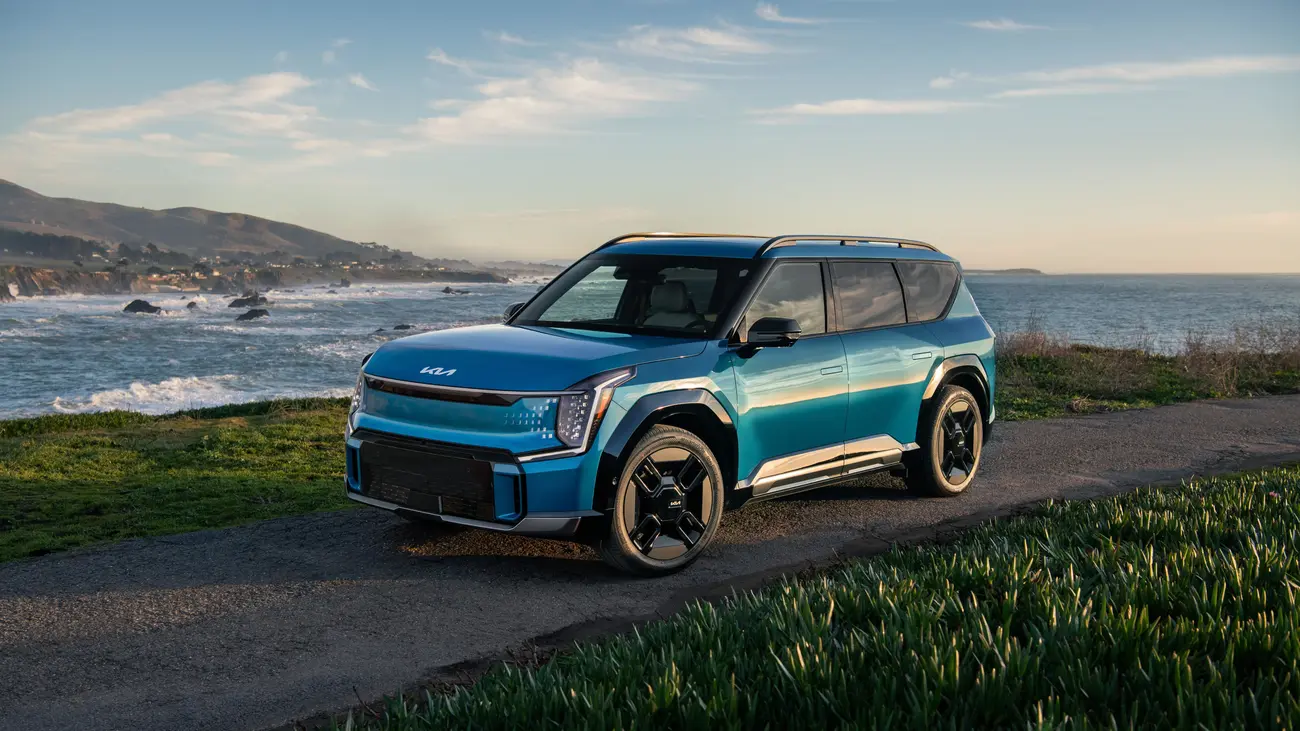
Kia EV9: 7 seats, 5 metres and 2.6 tonnes
Seven proper seats, more than five metres of car and about 2.6 tonnes on the scales. Few electric cars look like this, and recent tests in France and the UK agree that the Kia EV9 is still one of the best choices for big families, as long as you can stomach the price. That price is the tricky part if you're searching for the Kia EV9 price in Portugal: we couldn't find an up-to-date 2026 Portuguese price list, so here's what is known, with the country and date shown for every figure.
We've pulled together measured real-world range, third-row space, European prices and the 7-seat electric rivals you can buy or order today.
How much does the Kia EV9 cost in Portugal?
The current price? Not confirmed. The Portuguese figures that show up in search results date from the 2023 launch: the 1st Edition arrived at between €77,500 and €79,052, the GT-Line at €90,956 and the GT at €95,090. For business buyers, Kia quoted a price from €60,990 + VAT at the time. Those numbers are three years old and shouldn't be read as today's price list.
The most recent prices in our sources come from other European markets:
| Market | Version | Price | Source date |
|---|---|---|---|
| France | Base (RWD, 204 hp) | €73,000 | 2024 |
| France | Earth (RWD) | €78,000 | 2024 |
| France | AWD 385 hp | from €80,000 | 2024 |
| France | Range (from) | €73,000 | March 2026 |
| Germany | AWD 99.8 kWh | €68,990 | January 2026 |
| Netherlands | AWD 99.8 kWh | €72,295 | January 2026 |
| United Kingdom | Air RWD to GT AWD | £66,645 to £83,845 | May 2026 |
Put simply, a new EV9 sits around €70,000 or more across most of Europe. In Portugal, electric cars are exempt from ISV (the one-off registration tax) and IUC (the annual road tax), which stops the price from ballooning the way it would for a combustion SUV this size.
Kia EV9 as a company car: watch the thresholds
For company buyers the maths changes. VAT deduction and the favourable autonomous taxation rules for EVs in Portugal apply to cars costing up to €62,500. With European prices above that for most versions, check the exact spec with the dealer before counting on those benefits.
Used Kia EV9 in Portugal
In the UK, Carwow already lists used EV9s from £41,000. In Portugal, listings start at around €55,855 (aggregator data, September 2026). For a family that wants seven seats without paying new-car money, used is the most realistic route, and the 7-year warranty is transferable.
Kia EV9 specs
Every version uses the same 99.8 kWh battery (96 to 97 kWh usable) on the 800 V E-GMP platform. The differences come down to motors and drive.
| Spec | Value |
|---|---|
| Seats | 7 (6 optional, with swivelling 2nd-row chairs) |
| Length / width / height | 5,010–5,015 mm / 1,980 mm / 1,755–1,780 mm |
| Wheelbase | 3,100 mm |
| Weight | 2,426 kg (RWD tested) to 2,718 kg |
| Battery | 99.8 kWh gross / 96–97 kWh usable, NMC, 800 V |
| Powertrains | 150 kW (204 hp) RWD, 350 Nm; 283 kW (385 hp) AWD, 600 Nm; 374 kW (502 hp) GT AWD, 740 Nm |
| 0-100 km/h | 9.2 s measured (RWD); 6.0 s (AWD) |
| WLTP range | 563 km RWD (French data) / 541 km; AWD 497–521 km |
| DC charging | about 210 kW peak, 10-80% in 22–25 min |
| AC charging | 11 kW (0-100% in about 10h30) |
| Boot | 312–333 L (7 seats) / 828 L / 2,318–2,393 L; frunk 52–90 L |
| Towing (braked) | 900 kg RWD / 2,500 kg AWD |
| V2L / V2G | 3.6 kW V2L; V2H/V2G over AC at 11 kW |
| Turning circle | 12.4 m |
| Euro NCAP | 5 stars (2023) |
| Warranty | 7 years (150,000 km on the battery in the EU) |
RWD or AWD: which one?
Rear-wheel drive is the most efficient and goes furthest, but 204 hp feels thin for 2.4 tonnes: Automobile Propre timed 9.22 s from 0 to 100 km/h. It also tows only 900 kg, too little for most caravans. The 385 hp AWD cuts that to 6.0 s and tows 2,500 kg, at the cost of some efficiency and a higher price.
Kia EV9 real-world range and consumption at 2.6 tonnes
Automobile Propre measured a 204 hp RWD EV9 on 19-inch tyres, at 14 °C in dry weather. The results beat what the car's size would suggest.
| Driving type | Consumption | Estimated range |
|---|---|---|
| Mixed (country road, expressway, city) | 19.8 kWh/100 km | 490 km |
| City | 17.2 kWh/100 km | 564 km |
| Steady motorway at 110 km/h | 23.7 kWh/100 km | 409 km |
| Lyon-Paris motorway run (500 km) | 27.2 kWh/100 km | about 357 km |
| Steady motorway at 130 km/h | 30.0 kWh/100 km | 323 km |
| Eco driving | 13.3 kWh/100 km | about 730 km |
Going from 110 to 130 km/h pushed consumption up by 27%. On a Lisbon-Algarve run, that's the gap that matters most: easing off a little can save you a charging stop.
Motorway range with the whole family on board
The AWD version loses more. EV Database estimates 315 km (motorway at 110 km/h, -10 °C) to 625 km (city, mild weather), with 370 to 490 km in mixed use. Carwow recorded roughly 480 km with the RWD in warm weather and about 370 km with the AWD in winter.
With seven people and luggage at 130 km/h, Electra suggests expecting 20 to 35% less than the WLTP figure, which works out at 350 to 400 km for the EV9. Lisbon to Porto, about 300 km, is doable without stopping. Heading to the Algarve with the full family, plan one short stop.
Fast charging: 10-80% in about 24 minutes
This is where 800 V pays off. On a 300 kW charger, EV Database measured 22 minutes from 10 to 80%, averaging 196 kW. A 150 kW unit stretches that to 28 minutes, and a 50 kW one to 85 minutes. Along Portugal's motorways, the fast chargers on the MOBI.E public network (the national charging network that most operators plug into) make a coffee-length stop easy to fit in.
Space: can adults fit in the EV9's third row?
They can, and that's what sets the EV9 apart from most rivals. Carwow sat three adults over six feet tall in the third row, each with two USB-C ports and a cupholder. The middle row is a sliding 60:40 bench, and in the 6-seat version the chairs swivel 90° or 180° to open a path to the back.
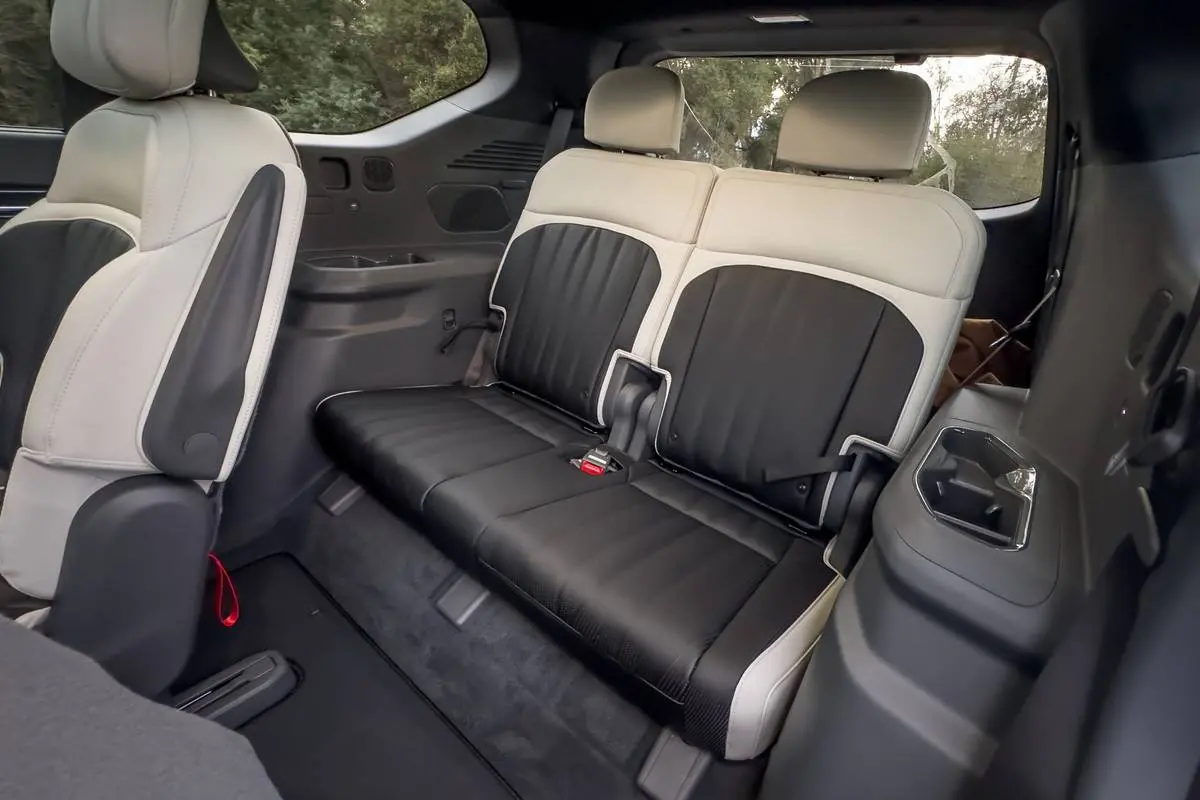
Boot space with all 7 seats up
With every seat in use, the boot holds 312 to 333 litres, enough for the weekly shop or a few weekend bags. Fold the third row and it grows to 828 L; fold everything and you get 2,318–2,393 L. There's also a 52 to 90 L frunk for cables, depending on version.
Weak points
- Size in town: 5 metres long with a 12.4 m turning circle makes Lisbon car parks a challenge.
- Noise: Automobile Propre measured 67 dB at 130 km/h, and Carwow notes audible tyre roar.
- Patchy interior: nice materials up top, cheaper plastics lower down, which stings at this price.
- Climate control screen hidden behind the steering wheel.
7-seater electric cars in Portugal: the EV9's rivals
Not long ago the EV9 had almost no competition. Now the 7-seater electric car market has several alternatives, most of them cheaper, but nearly all with a tighter third row.
| Model | Battery | WLTP range | Max DC | Boot (7 seats) | Reference price |
|---|---|---|---|---|---|
| Kia EV9 | 99.8 kWh | 497–563 km | 210 kW | 312–333 L | €73,000 (FR) |
| Peugeot e-5008 | 73/98 kWh | 502–668 km | 160 kW | 259 L | €46,690 (FR) |
| Mercedes EQB | 70.5 kWh | about 419 km | 100 kW | about 130 L | €59,200 (FR) |
| BYD Tang | 108.8 kWh | up to 530 km | about 120 kW | n/a | €72,000 (FR) |
| Volvo EX90 | 111 kWh | 580–615 km | 250 kW | about 310 L | €89,500 (FR) |
| VW ID. Buzz LWB | 86 kWh | 469 km | 200 kW | about 306 L | €59,350 (FR) |
| Skoda Peaq | 86 kWh | up to 370 miles | 199 kW | n/a | from £51,980 (UK) |
| Hyundai Ioniq 9 | 106–110 kWh | up to 385 miles | 250 kW | 300 L | from £65,000 (UK) |
Euro prices are French (March 2026) and pound prices are from the UK. They're useful for comparing models against each other, not as Portuguese prices.
Kia EV9 vs Peugeot e-5008
The price gap is big: about €26,000 in France. The e-5008 Long Range claims up to 668 km WLTP, but charges more slowly (160 kW, 20-80% in 30 min) and offers only 259 L of boot space with seven seats up. Its third row suits children better than adults. If the back seats are for occasional use, the Peugeot is the rational pick. If teenagers or adults ride back there every week, the EV9 earns its price.
Kia EV9 vs Skoda Peaq and Mercedes GLB
The Skoda Peaq is essentially an electric Kodiaq: 86 kWh, up to 370 miles WLTP and an entry price well below the EV9 in the UK. The new electric Mercedes GLB is a big step up from the EQB, with 85 kWh, 800 V and 320 kW charging. Both are more compact, and according to Electrifying the Korean pair still offer more usable space. The Hyundai Ioniq 9, the EV9's close cousin, has a bigger battery and a nicer cabin.
Frequently Asked Questions
There is no confirmed 2026 Portuguese price list. At its 2023 launch, the 1st Edition was priced between €77,500 and €79,052, the GT-Line at €90,956 and the GT at €95,090, with a business offer from €60,990 + VAT. For more recent reference, the EV9 AWD costs €68,990 in Germany and €72,295 in the Netherlands (January 2026), while used EV9s in Portugal are listed from around €55,855 (September 2026).
Thanks to its 800 V architecture, the EV9 charges from 10 to 80% in about 22 minutes on a 300 kW charger, peaking at around 210 kW. On a 150 kW charger it takes about 28 minutes, and on a 50 kW unit about 85 minutes. At home, an 11 kW AC wallbox fills the 99.8 kWh battery in roughly 10.5 hours.
In testing at 130 km/h, the EV9 RWD used 30.0 kWh/100 km, giving about 323 km, compared with 409 km at 110 km/h (23.7 kWh/100 km). With seven people and luggage, expect 20 to 35% less than the WLTP figure of up to 563 km, so roughly 350 to 400 km. Lisbon to Porto is doable without stopping, but a family trip to the Algarve needs a short charging stop.
It depends on the drivetrain: the 204 hp RWD version tows just 900 kg braked, too little for most caravans. The 385 hp AWD version tows up to 2,500 kg and does 0-100 km/h in 6.0 s, versus 9.2 s measured for the RWD. If you need to pull a boat or caravan, choose the AWD and accept higher consumption and a higher price.
The Peugeot e-5008 is the most affordable alternative, from €46,690 in France (March 2026), about €26,000 less than the EV9, with up to 668 km WLTP. Next come the VW ID. Buzz LWB (€59,350) and the Mercedes EQB (€59,200), both at French prices. The trade-off is space: with 7 seats up, the e-5008 offers a 259 L boot and the EQB around 130 L, versus 312 to 333 L in the EV9, whose third row fits adults.
Is the Kia EV9 worth it?
For families who really need seven seats that adults can use, the EV9 still has few true rivals: a big battery, 800 V charging, 2,500 kg towing on AWD and a 7-year warranty. The catch is price, which sits around or above €70,000 new across Europe. Before deciding, ask Kia Portugal for its current price list and compare it with used EV9s, which are already appearing well below 2023 launch prices.