
Chery Q Price in Portugal: Specs, Real Range and Arrival Date
Published: 23/10/2026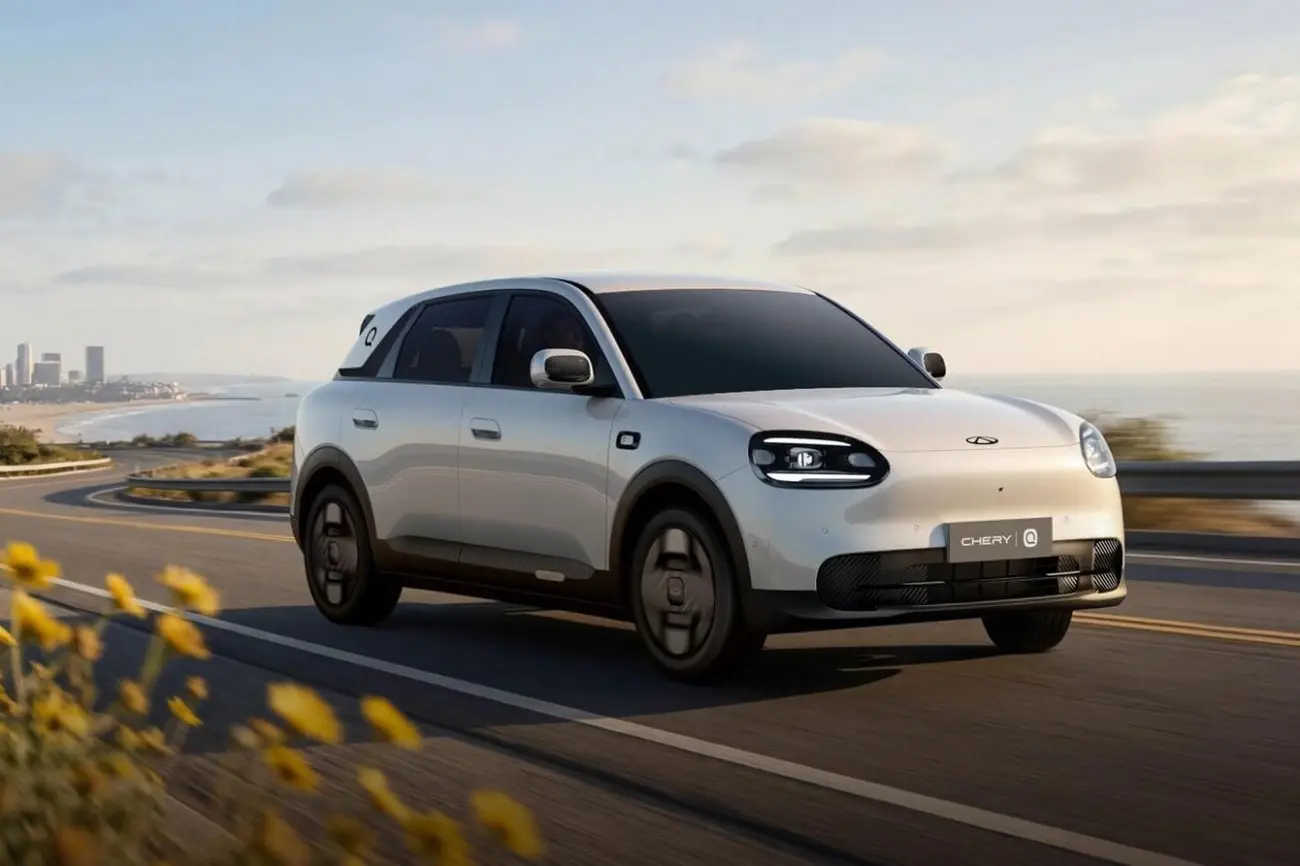
Chery Q: the brand's first fully electric car for Europe
Chery has been China's top passenger car exporter for 23 years running, yet in Europe it has only ever sold hybrids. The Chery Q, unveiled at the 2026 Paris Motor Show, changes that: a 4.19-metre compact with rear-wheel drive and a 41 kWh battery, and the first EV to reach the European Union wearing the Chery badge. If you're wondering about the Chery Q price in Portugal and when it might arrive, there's real substance here — but it pays to separate what's official from what's still guesswork.
The good part: the dimensions, space and tech are serious for a car aimed at the cheapest end of the EV market. The less good part: there's no European price yet, and the headline range figure was measured on a test cycle Europe stopped using years ago.
Chery Q specs: 4.19 m, 41 kWh and rear-wheel drive
The Q is the European version of the QQ3, the small EV Chery launched in China in March 2026. The measurements are virtually identical and put it somewhere between a city car and a compact SUV.
| Specification | Chery Q (manufacturer data) |
|---|---|
| Length / width / height | 4,190–4,195 / 1,811 / 1,560–1,573 mm |
| Wheelbase | 2,700 mm |
| Motor | 89 kW (121 hp), rear-mounted |
| Drive | Rear-wheel drive (RWD) |
| Battery | 41 kWh LFP |
| Range | up to 400 km NEDC (WLTP not yet published) |
| DC charging 30–80% | under 17 minutes |
| V2L | Yes |
| Boot / frunk | 375 L / 70 L |
| Storage compartments | 38 |
Torque, acceleration, top speed and AC charging power haven't been released. That's a long list of blanks for a car already on a motor show stand, and it tells you how early in the process this is.
A 375-litre boot and a 70-litre frunk
The 2.70-metre wheelbase is the most interesting number on the sheet. It's longer than a Renault 5's (2,540 mm) and pays off in rear-seat space — something even the harshest QQ3 review, from the UK's Auto Express, acknowledges. Add a 375-litre boot, a 70-litre front trunk with a hydraulically assisted lid, and 38 storage compartments dotted around the cabin.
Chery is clear about who it's for: urban driving, new drivers and young families. Eric Zheng, CEO of Chery Auto Deutschland, puts it simply: "our electric vehicles are affordable, safe and reliable."
From the Chinese QQ3 to the European Chery Q
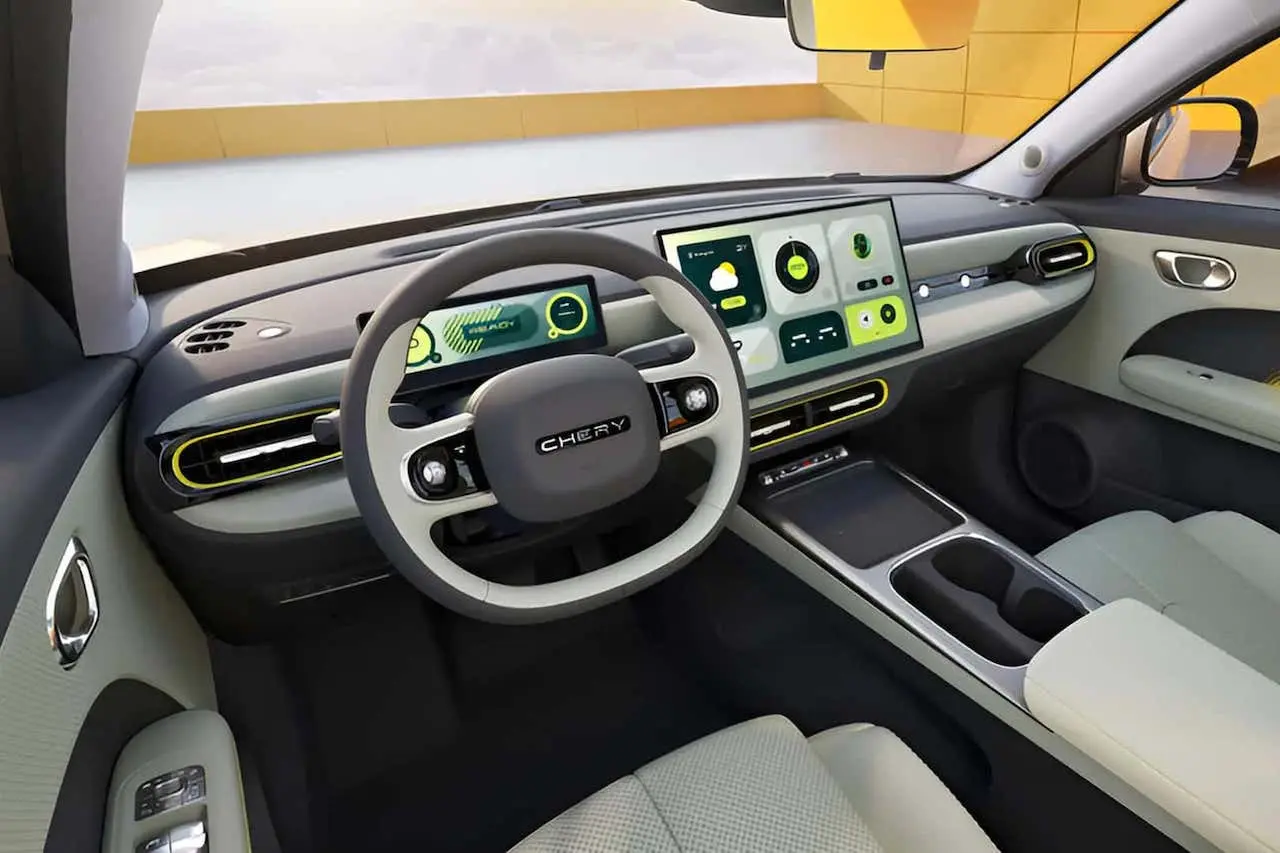
In China, the QQ3 comes with two LFP batteries (29.48 kWh and 41.28 kWh) and two motors (58 kW and 90 kW). Europe gets only the larger combination for now. The Chinese car also has a 15.6-inch 2.5K central screen, a Qualcomm Snapdragon 8155 chip and the Falcon 500 driver-assistance system; for the European Q, German press reports mention a 540-degree camera and a Qualcomm-based cockpit.
There are also reports of a 52 kWh battery planned for Italy. If it spreads to other markets, it would fix the car's biggest weakness — but for now, that's all it is: a version announced for one country.
Chery Q range: the 400 km is NEDC, not WLTP
This is where you need to read carefully. Chery's 400 km figure comes from the NEDC cycle, which Europe replaced with WLTP back in 2018 precisely because it was too optimistic. German outlet ecomento calls it "outdated and unrealistic." There is no official WLTP figure yet.
The estimates doing the rounds don't agree with each other:
- China-Gadgets (Germany): roughly 250–280 km WLTP
- Auto Express (UK), on the QQ3: 210–220 miles WLTP, or about 340–355 km
- In China, the same 41.28 kWh battery is rated at 420 km on the CLTC cycle
Taking all of that together, a cautious reading points to something around 280–320 km WLTP — but that's our estimate, not a Chery figure. In real Portuguese driving, with motorway stretches at 120 km/h, expect less. That's plenty for daily life in Lisbon or Porto; a Lisbon–Porto run will almost certainly need a charging stop.
Fast charging and V2L
Going from 30 to 80% in under 17 minutes is a good result for a battery this size. Chery hasn't stated the European Q's peak DC power, but the Chinese QQ3 charges at up to 85 kW and covers the same 30–80% in 16.5 minutes. At a rapid charger on Portugal's MOBI.E public network — the national charging grid you'll find at motorway service areas — that's a coffee and not much more.
V2L (vehicle-to-load) lets you power external devices from the battery — at 3.3 kW or 6.6 kW in China; in Europe, GoingElectric reports it works via an adapter.
Chery Q price in Portugal: what's known (and what's an estimate)
An official European price? There isn't one. Everything below is an estimate, and the estimates don't even line up.
| Reference | Figure | Type |
|---|---|---|
| QQ3 in China | 68,920–89,985 yuan (entry about USD 10,020) | Official Chinese price |
| China-Gadgets (Germany) | positioned in the EUR 20,000 class | Editorial estimate |
| Auto Express (UK) | only worth it below GBP 18,000 | Reviewer opinion, not a price |
The Chinese price isn't a direct guide. A China-built EV pays a 10% import duty plus EU countervailing duties — for companies that cooperated with the EU investigation, Chery among them, that's 20.7%, for 30.7% in total. Then add shipping, homologation, dealer margin and Portugal's 23% VAT.
Our reading: a Chery Q in Portugal somewhere between EUR 20,000 and 25,000 looks like the plausible window, with the lower end depending on whether Chery wants to take on the Geely E2 and MG4 Urban head-on. To be clear — that's an estimate, not an announced price. On the plus side, like any fully electric car, the Q is exempt from ISV (Portugal's vehicle registration tax) and IUC (the annual road tax), and companies can reclaim VAT on EVs up to EUR 62,500.
Chery Q vs Renault 5, BYD Dolphin Surf and Leapmotor B05
No source has yet put the Q against its direct rivals, so the table below combines published official data for the competitors with what we know about the Chery.
| Model | Battery | Power | Range | Entry price |
|---|---|---|---|---|
| Chery Q | 41 kWh LFP | 121 hp | 400 km NEDC (WLTP not yet published) | not announced |
| Renault 5 E-Tech (Five) | 36.5 kWh LFP | 110 hp | up to 305 km WLTP | EUR 24,900 (Portugal RRP) |
| BYD Dolphin Surf Boost | 43.2 kWh LFP | 88 hp | 320 km WLTP | about EUR 22,990 (Europe) |
| Leapmotor B05 Pro | 56.2 kWh | 218 hp | 401 km WLTP | EUR 26,900 (Italy) |
| Geely E2 Pro | 35 kWh LFP | 114 hp | 252 km WLTP | EUR 19,490–20,280 (Belgium/Spain) |
Where the Chery Q wins and where it falls short
On space, the Q has the edge over the Renault 5 (3.92 m) and the Dolphin Surf (3.99 m): it's longer, has a longer wheelbase and a bigger boot than the Renault's 326 litres. Rear-wheel drive and 121 hp also put it ahead of the Dolphin Surf on power.
The trouble is everything else. The Renault 5 is on sale now, has an established service network and a confirmed WLTP figure. The Leapmotor B05 plays a tier higher, with a bigger battery and more power, and it's built in Spain — so no tariffs. And Auto Express, which drove the QQ3 in China, gave it 3 out of 5: it praised the space and equipment but criticised flimsy plastics, unrefined ride and wind noise, concluding it trails the Renault 4 and European rivals. How much of that tuning changes for Europe remains to be seen.
Chery Q: when will it arrive in Portugal?
There's no date for Portugal. The known timeline starts in Germany: Chery has set up its German headquarters in Frankfurt and launches the brand there in the first half of 2027 with four hybrid SUVs — the Tiggo 4, 7, 8 and 9. The Q follows later in 2027, possibly towards year-end. France and Poland have been given the same vague timing.
The European plan is ambitious: from 20 markets and 687 sales and service outlets in 2026 to 27 markets and 1,143 outlets in 2027. In Germany, the network starts with around 30 dealers and should pass 100 by the end of 2027. If Portugal is among those 27 markets, a Chery Q here before the end of 2027 is possible — but that's an inference, not an announcement.
Warranty: 7 years in France
Since 1 September 2026, Chery has offered 7 years or 150,000 km on all models in France, plus 8 years or 160,000 km on the battery and drivetrain, with at least 75% capacity guaranteed. There's no confirmation these terms apply elsewhere, but it's a good indicator of what the brand is willing to offer to win trust.
Frequently Asked Questions
Chery has not announced a European price for the Q yet, so every figure is an estimate. German press places it in the EUR 20,000 class, but a China-built EV faces 30.7% EU import duties (10% plus a 20.7% countervailing duty for Chery), on top of shipping and 23% Portuguese VAT, making EUR 20,000 to 25,000 a more plausible range in Portugal. As a fully electric car, it is exempt from ISV and IUC road taxes.
The 400 km quoted by Chery is measured on the NEDC cycle, which Europe dropped in 2018 for being too optimistic, and no official WLTP figure has been published yet. Estimates range from about 250–280 km (China-Gadgets) to 340–355 km (Auto Express, based on the QQ3), pointing to roughly 280–320 km WLTP from the 41 kWh battery. At 120 km/h motorway speeds, real-world range will be lower.
The Chery Q is the European version of the QQ3, launched in China in March 2026, and keeps the same dimensions: about 4.19 m long with a 2.70 m wheelbase. In China the QQ3 comes with two batteries (29.48 kWh and 41.28 kWh) and two motors (58 kW and 90 kW), while Europe gets only the 41 kWh, 89 kW (121 PS) combination for now. A 52 kWh battery is reportedly planned for Italy but is not confirmed for other markets.
There is no official date for Portugal. Chery launches its brand in Germany in the first half of 2027 with the Tiggo 4, 7, 8 and 9 hybrid SUVs, and the Q is expected to follow later in 2027, possibly towards the end of the year. Chery's European plan grows from 20 markets and 687 outlets in 2026 to 27 markets and 1,143 outlets in 2027, but Portugal's inclusion and local timing have not been announced.
According to Chery, the Q charges from 30 to 80% in under 17 minutes on a DC fast charger. Peak charging power for the European model has not been disclosed, but the China-market QQ3 with the same 41 kWh battery accepts up to 85 kW and completes 30–80% in 16.5 minutes. The Q also supports V2L, which in China powers external devices at 3.3 kW or 6.6 kW.
Is the Chery Q worth waiting for?
If you need a small EV now, the Renault 5, Dolphin Surf and Geely E2 already come with confirmed prices and WLTP ranges — and that counts for a lot. The Chery Q is for buyers who can wait until 2027 and put space first: a 2.70 m wheelbase and 445 litres of combined boot and frunk volume are rare in this class. The call will come down to two numbers that don't exist yet: the WLTP range and the Portuguese price. If the first lands near 300 km and the second near EUR 20,000, the Q becomes a car worth taking seriously.