
When Will Solid-State Batteries Arrive in Portugal? The 2030 Reality Check
Published: 06/10/2026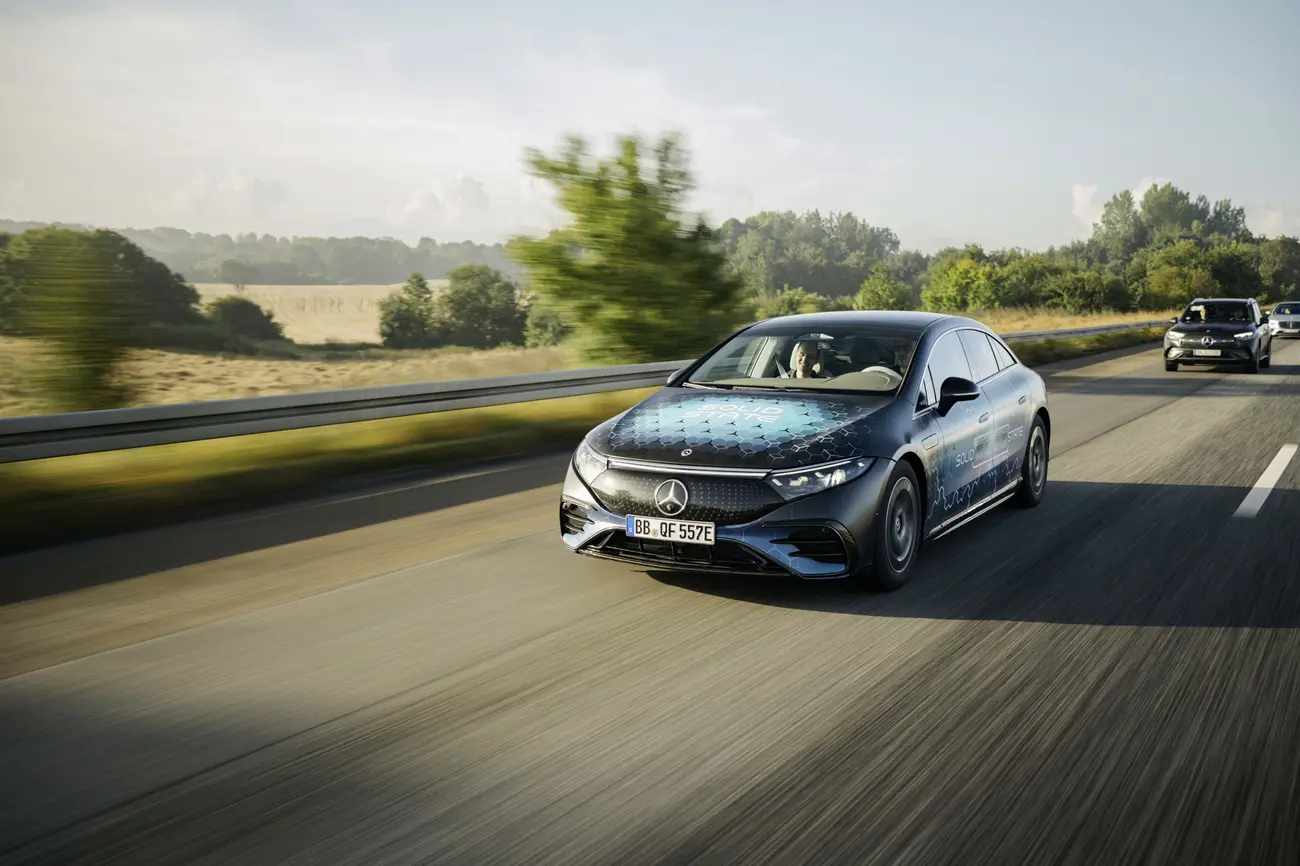
When will solid-state batteries arrive in Portugal?
"Not the holy grail everyone imagines." That line doesn't come from an EV sceptic — it comes from Robin Zeng, CEO of CATL, the world's largest electric car battery maker. Within a few weeks, CATL, BYD and Li Auto have all poured cold water on the hype: solid-state batteries are coming, but later, more selectively and with less impact than years of marketing suggested.
If you're thinking about buying an EV in Portugal, the practical question is simple: when will solid-state batteries arrive in Portugal, in cars you can actually buy? The short answer is that mass production isn't expected before 2030 — and early on, only in premium models. The technology hasn't failed. The timelines have.
What CATL, BYD and Li Auto are actually saying
All three Chinese giants have advanced projects, and all of them point to 2027 as the starting line. But there's a big gap between "starting" and "sitting in a dealership".
CATL: "not the holy grail"
In August, CATL confirmed to investors that small-scale production of solid-state cells will start in 2027. The catch is maturity: in June 2026, the company itself placed the technology at level 4 of 9 on the technology readiness level (TRL) scale. In plain terms, that means lab validation and prototype development — level 9 is mass production.
Zeng was blunt: one million vehicles with solid-state batteries by 2030 is "extremely unlikely". According to CATL, that annual volume is roughly what's needed for large-scale, cost-effective production. Meanwhile, the company is pushing hard on what already works: ultra-fast-charging LFP cells and sodium-ion batteries.
BYD: one model in 2027, but only a thousand units
Stella Li, BYD's executive vice president, said in an interview in Valencia that the brand will have a model with solid-state technology "next year". No name, date, specs or price. It's a demonstration, not a retail launch.
The roadmap from FinDreams, BYD's battery division, tells you more:
- 2027: trial batch of around 1,000 vehicles, in flagship models
- 2028 to 2030: expansion to mid-to-high-end models
- 2030: roughly 40,000 vehicles with these batteries — and large-scale commercial production
For scale: 40,000 cars is a drop in the ocean for a manufacturer that sells millions a year. The first models will be Yangwang and Denza, the group's luxury brands, where the extra cost is easier to absorb.
BYD's chief scientist Lian Yubo went further: "three years will be difficult, five years is more realistic" for widespread use. He also said liquid-electrolyte lithium-ion and solid-state batteries will coexist for 15 to 20 years. LFP isn't going anywhere.
Li Auto: 2027 or 2028 for a few, 2032 for many
Li Auto expects limited vehicle use in 2027 or 2028. Getting to mature mass production will take roughly five more years, according to Liu Zhimin, the brand's battery chief. Translation: series-production cars with this tech reaching customers in 2032 or 2033.
"Challenges remain in simultaneously meeting requirements for lifespan, charging performance and cost," Liu explained. Li Auto has developed its own cells since 2020, runs a 50/50 joint venture with Sunwoda set up in 2025, and has already validated solid-state prototypes... in a pair of smart glasses, the Livis, launched in December 2025.
Why solid-state batteries are running late
In a solid-state battery, the liquid electrolyte of a lithium-ion cell is replaced by a solid material — ceramic, polymer or glass. The promises are familiar: higher energy density, faster charging, better fire safety and longer life. Getting that from a lab bench into a car is another matter.
BYD is betting on sulfide electrolytes, with 20 Ah and 60 Ah prototypes targeting close to 400 Wh/kg at cell level. The engineering hurdles are real:
- Interface contact: solid-solid interfaces can lose contact as electrodes expand and contract, eroding capacity. Some designs need constant mechanical pressure on the pack.
- Moisture: sulfides can release hydrogen sulfide (H₂S) when exposed to water, so both factory and car need sealed environments.
- Manufacturing: the solvents used for conventional electrodes react with sulfides, pushing the industry towards "dry" electrode processes — still far from high-volume production.
- Cost: the specialised sulfide precursors cost dozens of times more than liquid-electrolyte materials.
One detail often gets lost in the headlines: a Wh/kg figure at cell level doesn't automatically translate into the same performance at pack level. A car brings vibration, temperature swings and thousands of charge cycles. That's where the technology still has to prove itself.
Solid-state battery mass production by 2030: China's plan and Europe's bets
China's new five-year plan for the battery industry, released on 28 September by seven government agencies, sets a goal of "initial large-scale use" of all-solid-state batteries by 2030. Note the wording: initial. Not even Beijing is promising widespread adoption by the end of the decade.
The same plan sets targets for today's lithium batteries — 15,000 charge cycles for long-life cells — and positions sodium-ion batteries as a complement. Alongside it, China's automotive plan targets a 70% share of new energy vehicles in domestic passenger car sales by 2030. In other words, electrification is racing ahead with the chemistry that already exists.
Mercedes is testing, but has no date
In Europe, Mercedes has shown the most. An EQS fitted with Factorial's lithium-metal cells drove 1,205 km from Stuttgart to Malmö without stopping to charge, using a pack that offers up to 25% more range than the standard battery of the same weight and size. Road testing has been under way since February 2025.
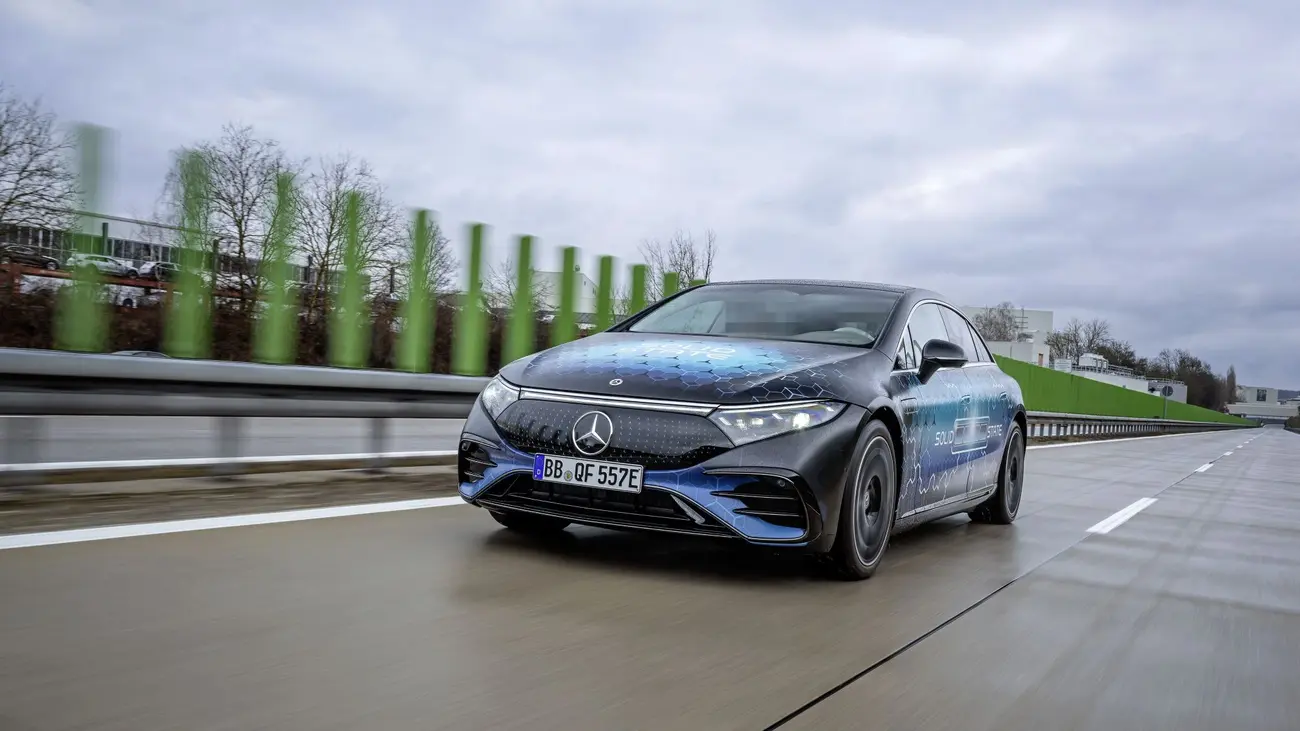
In September 2026, the brand deepened its partnership with Taiwan's ProLogium, securing priority access to test its fourth-generation ceramic cells. ProLogium is building a plant of up to 44 GWh in Dunkirk, France, to supply European customers. These are all test programmes — no production model or date has been announced.
Who's promising what: the solid-state battery timeline
| Manufacturer | Milestone | Date |
|---|---|---|
| CATL | Small-scale production | 2027 |
| CATL | Mass market | Not before 2030 |
| BYD | Trial batch (~1,000 vehicles) | 2027 |
| BYD | Large scale (~40,000 vehicles) | ~2030 |
| Li Auto | Limited vehicle use | 2027 or 2028 |
| Li Auto | Mature mass production | ~2032-2033 |
| Toyota (with Idemitsu) | Solid-state EV launch | 2027-2028 |
| Samsung SDI | Cell mass production | 2027 |
| Nissan | Solid-state EV | 2028 |
| Chery | Vehicle validation | 2027 |
| China (five-year plan) | Initial large-scale use | 2030 |
| Mercedes | Factorial and ProLogium testing | No production date |
The pattern is clear: 2027 and 2028 are years of demos and small batches. Real volume comes after 2030.
Semi-solid vs solid-state battery: the one you can already buy
It's worth keeping the terms straight. An all-solid-state battery contains no liquid at all. A semi-solid battery keeps a small amount of liquid or gel electrolyte — it's easier to make and already on sale, but falls short of the full version's safety and energy-density ceiling. Think of it as a transitional technology.
The closest example to us is the MG4 Urban with the SolidCore semi-solid battery. Its cells contain around 5% liquid electrolyte, versus roughly 20% in a conventional lithium-ion cell. The 53.95 kWh pack is rated at 530 km on China's CLTC cycle, which should translate to about 400 km WLTP in Europe. The European launch is expected at the end of 2026; in the UK, pricing is pencilled in at around £23,495, in line with the current MG4 Urban. Portuguese pricing? Not announced yet.
An honest caveat: the current MG4 Urban, with a 53.9 kWh LFP battery, already claims 258 miles WLTP (about 415 km). So in official range terms, the semi-solid version isn't a leap — the promised gains are more about safety, cold-weather performance and longevity. In China, NIO also already uses semi-solid cells from WeLion.
Frequently Asked Questions
Cars with full solid-state batteries are unlikely to be on sale in Portugal before the end of the decade. Toyota (2027-2028) and Nissan (2028) have the nearest timelines, while early Chinese batches such as BYD's are around 1,000 units and reserved for luxury brands. In Europe, ProLogium is building a plant of up to 44 GWh in Dunkirk, France, which could speed up European supply after 2030.
No prices have been announced yet, but the first models will be expensive: BYD will debut the technology in its luxury brands Yangwang and Denza. The sulfide precursors used in these cells cost dozens of times more than liquid-electrolyte materials, and CATL reckons production only becomes cost-effective at around one million vehicles a year. Until then, expect a significant premium over a comparable EV with an LFP battery.
An all-solid-state battery contains no liquid electrolyte at all, while a semi-solid battery keeps a small share in liquid or gel form — about 5% in the MG4 Urban SolidCore versus roughly 20% in a conventional lithium-ion cell. Semi-solid cells are easier to manufacture and already on sale, but they don't deliver the full energy density and safety potential of all-solid-state. They are a transitional technology, also used by NIO in China with WeLion cells.
Not any time soon. BYD chief scientist Lian Yubo expects liquid-electrolyte and solid-state batteries to coexist for 15 to 20 years and says LFP won't be eliminated. China's new Five-Year battery plan also backs current lithium chemistries, targeting 15,000 charge cycles for long-life cells, with sodium-ion as a complement, while CATL keeps investing in ultra-fast-charging LFP.
For most drivers in Portugal, waiting doesn't pay off: mass production isn't expected before 2030, and Li Auto points to 2032-2033 for mature volume production. An EV bought today already benefits from ISV and IUC exemptions, and most brands offer an 8-year battery warranty. Putting off a purchase for years means giving up those savings for a technology that will reach luxury cars first.
Solid-state battery cars in Portugal: what it means for buyers
If the first batches roll out in 2027 and 2028, in runs of a thousand units under brands like Yangwang or Denza, the odds of finding an all-solid-state car at a Portuguese dealership before the end of the decade are very low. And when it does come, it will land in the most expensive segments first.
Meanwhile, current batteries aren't standing still. Today's EVs already charge at several hundred kW and offer over 500 km of range. By the time solid-state reaches scale, conventional chemistries — LFP, sodium-ion, improved nickel — will have moved on again, shrinking the new tech's advantage. The comparison with hydrogen, which promised a lot and delivered little in passenger cars, isn't far-fetched.
Should you wait for a solid-state battery EV?
For most drivers in Portugal, no. An EV bought today already benefits from exemption from ISV (the vehicle registration tax) and IUC (the annual circulation tax), can charge overnight at home, and handles a Lisbon-Porto run with one quick stop on MOBI.E, Portugal's public charging network. Putting off a purchase for three, five or seven years to wait for a technology that will reach luxury cars first means giving up those savings the whole time.
It makes more sense to look at what's on the market and judge real-world range, charging speed and battery warranty — most brands cover 8 years. If curiosity about the tech wins out, the semi-solid MG4 Urban will be the most affordable way to try it soon.
The solid-state revolution may well happen, just more slowly and more selectively than promised. The next real test comes in 2027, when BYD, CATL and Toyota finally have cars on the road — that's when we'll see who keeps to their timelines and who pushes them back again.