
Dongfeng Semi-Solid State Battery at 350 Wh/kg: What It Means in Portugal
Published: 16/09/2026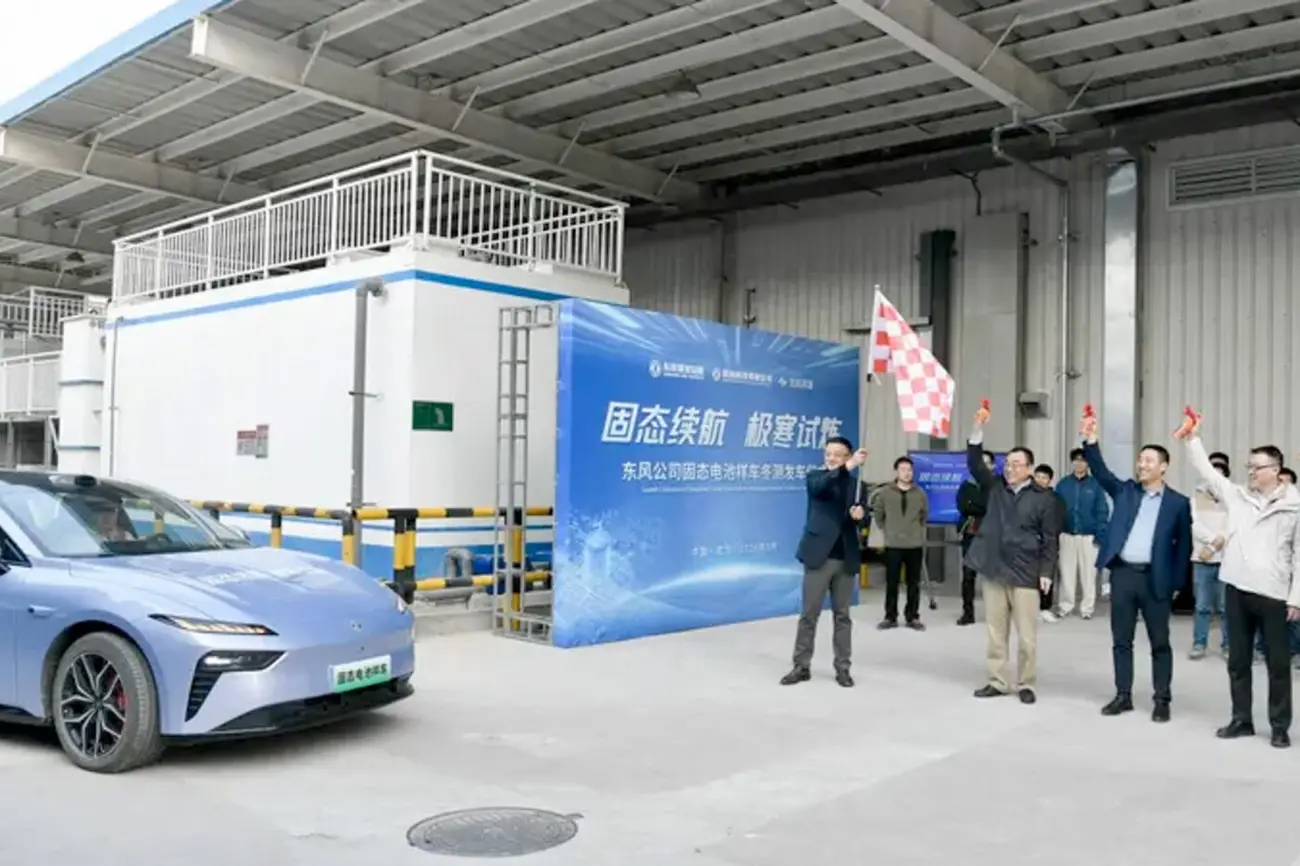
350 Wh/kg: the number Dongfeng will show in October
Twice the energy density of a standard LFP cell. That is what the Dongfeng semi-solid state battery at 350 Wh/kg promises when it debuts in October 2026, with series production starting in the fourth quarter of the same year. You Zheng, deputy general manager of the group, put the date on record on 9 September at the company's annual industry forum in Wuhan.
Some context: the LFP cells inside most affordable EVs sold in Portugal sit between 140 and 210 Wh/kg. Dongfeng claims over 1,000 km of range on a single charge and a pack roughly 30% lighter than the liquid-electrolyte equivalent.
Before you postpone an EV purchase waiting for this, three things are worth understanding. The first is that this is not a solid-state battery.
Solid-liquid battery: what it actually is
Dongfeng's chemistry uses an oxide-polymer composite electrolyte — solid electrolyte material blended with residual liquid. In China, and now in Dongfeng's own communication, it is called "solid-liquid". Elsewhere the usual word is semi-solid.
Dongfeng dropped the "solid-state" label, and not out of modesty. Since 1 July 2026 a Chinese national standard has legally defined the term: a cell only qualifies as all-solid-state if, after six hours in a vacuum chamber at 120 °C, the residual liquid electrolyte weighs less than 5% of the total cell weight. Below that threshold, it is solid-state. Above it, it is solid-liquid — and that is where Dongfeng sits.
The distinction is not paperwork. A genuinely solid cell delivers far bigger gains in safety and energy density than an oxide-polymer composite manages today. Semi-solid is the intermediate step.
Why semi-solid arrives first
Because it fits in the factories that already exist. The composite electrolyte works with current production equipment and with material supply chains that are already running, so it scales without rebuilding everything from scratch.
True all-solid-state trips over a different set of problems: solid-solid interface resistance, poor manufacturing yields, and a cost per kWh several times higher. Dongfeng itself puts small-scale all-solid-state production at around 2030 and broad adoption at around 2035. CATL, the world's largest battery maker, says much the same thing in different words: the mass market is still years out.
The tests: 170 °C, crushed to half thickness, and -30 °C
The validation numbers are Dongfeng's strongest card, and they deserve a close look:
| Test | Result | Reference point |
|---|---|---|
| Thermal chamber | 170 °C with no smoke or fire | Chinese national standard requires 130 °C |
| Compression | Cell still operational after being deformed to 50% of its thickness | — |
| Extreme cold | 72% to 74% capacity retained at -30 °C | Conventional lithium-ion retains around 60% |
| Cold campaign | Over 70 tests between -40 °C and -30 °C | Winter convoy Wuhan to Mohe, January 2026 |
The cold figure is the one that matters most to drivers. Portugal rarely sees -30 °C, but winter range loss is the same phenomenon at a smaller scale: anyone who drives to Bragança or up into the Serra da Estrela in January knows the gap between the dashboard estimate and reality. A chemistry that holds 74% at -30 °C gives up far less on a 2 °C morning in Viseu.
As for track record, Dongfeng has been at this since 2018. In December 2021 it received China's first solid-state battery approval for a passenger vehicle and put 50 demonstration cars on the road. The programme has since accumulated more than 3.2 million km of incident-free operation.
"Mass production" in 2026 means about a hundred cars
Here is the handbrake almost no coverage of this story pulls.
Dongfeng's pilot line has 0.2 GWh of capacity and has been running since June 2025. The target for the end of 2026 is 100 demonstration vehicles, all in Hubei province. Only in 2027 does the company talk about 50,000 vehicles. For scale: 0.2 GWh is enough for a few thousand cars a year, and global shipments of semi-solid and solid-state batteries worldwide came to roughly 8 GWh in 2025.
So when you read that Dongfeng enters mass production in Q4, translate it as "a few hundred instrumented cars driving around Hubei". It is a real step, but it is not a product you can buy.
There is also a technical nuance in the range gain. The 1,000 km figure assumes a pack sized for it. CarNewsChina, looking at certified 350 Wh/kg cells already being manufactured in China, reads it more soberly: keep the current pack dimensions and the practical range gain is 15% to 20%. On an EV that does a real 450 km, that is another 70 to 90 km. Good, but not the revolution the headlines suggest.
Semi-solid batteries in Europe: what actually lands here
No Dongfeng model with this battery has been announced for Europe. But semi-solid technology is arriving through other doors, and two of them matter to buyers in Portugal.
MG SolidCore. MG has already commercialised its semi-solid pack and its European arrival is set for the end of 2026. For now it is the only semi-solid battery with a firm date for European dealerships — and MG has a sales and service network in Portugal, which changes everything when it comes to warranty and maintenance.
Stellantis and Factorial. Stellantis, which has deepened industrial cooperation with Dongfeng, is road-testing Factorial Energy's FEST cells in a Dodge Charger Daytona development car. The numbers: 375 Wh/kg, more than 106 Ah per cell, and 15% to 90% charge in 18 minutes, validated from -30 °C to 45 °C. No production date has been communicated. The Solstice cells Factorial developed with Mercedes-Benz aim at 450 Wh/kg.
Since Stellantis owns Peugeot, Citroën, Opel, Fiat and Alfa Romeo — brands with enormous weight in the Portuguese market — this is the most likely route for the technology to reach a car you can actually buy here. But German and French makers are still signalling commercial introduction for the early 2030s, not 2027.
Meanwhile the Chinese competition is on timelines close to Dongfeng's: Chery is targeting Q4 2026 for its own solid-liquid pack, while CATL and BYD talk about small vehicle batches in 2027 and real volume only after 2030.
A standards note that may reach Portugal
In August 2026 the Chinese proposal for a solid-state battery application and testing standard was accepted by the IEC as the world's first international standard project dedicated to the technology, with French, South Korean and Japanese experts involved. If it goes through, the 5% residual electrolyte definition — the same rule that forced Dongfeng to change its vocabulary — becomes the European yardstick too. For buyers here that is good news: it narrows the room to sell "solid-state" on a brochure when what is inside is semi-solid.
Frequently Asked Questions
A semi-solid battery — Dongfeng calls its version solid-liquid — uses an oxide-polymer composite electrolyte that still contains residual liquid electrolyte. A true all-solid-state cell has almost none: since 1 July 2026, China's national standard only allows that label if residual liquid accounts for less than 5% of cell weight after six hours in a 120 °C vacuum chamber. Semi-solid is the intermediate step, and it arrives first because it is compatible with existing production lines and material supply chains.
Dongfeng claims over 1,000 km on a charge, but that figure assumes a large pack measured on a Chinese homologation cycle rather than WLTP. The comparative reading is more useful: at 350 Wh/kg against the 140 to 210 Wh/kg of a current LFP cell, you either gain roughly 15 to 20% more range in the same pack dimensions, or keep the same range with a pack about 30% lighter. In real-world Portuguese driving that means a few dozen extra kilometres, not a doubling of range.
For anyone buying in 2026, LFP remains the sensible option in most cases. It is the cheapest chemistry per kWh, tolerates frequent charging to 100%, and has a durability record proven across millions of cars. Semi-solid offers higher energy density and better cold-weather behaviour, but it is confined to pilot lines — Dongfeng's runs at just 0.2 GWh — and the cost per kWh is not yet competitive. Only once volumes rise will the two be worth comparing in a showroom.
Not yet, and no Dongfeng model with this battery has been announced for Europe. The closest semi-solid pack to reaching Portugal is MG's SolidCore, due in Europe by the end of 2026. Stellantis, industrially tied to Dongfeng, is road-testing Factorial FEST cells rated at 375 Wh/kg with 15 to 90% charging in 18 minutes, but European commercial introduction is still signalled for the early 2030s. Until then, what you buy in Portugal is conventional lithium-ion, either LFP or NMC.
They do, but far less than extreme lab tests suggest. Conventional lithium-ion cells retain about 60% of capacity at -30 °C, while Dongfeng's semi-solid cells held 72 to 74% across more than 70 tests between -40 °C and -30 °C. In Portugal, with typical inland-north lows between 0 °C and 8 °C, real losses usually sit between 10% and 25%, made worse by cabin heating. Preconditioning the car while it is still plugged in and using heated seats instead of blown hot air recovers much of that difference.
Should you wait for a solid-state battery before buying an EV?
If you are considering an electric car in Portugal over the next two or three years, the honest answer is no.
What exists in production today is semi-solid, in volumes of hundreds to thousands of units, and it will go into flagship models in China first. Real all-solid-state, on Dongfeng's own calendar, is 2030 for small scale and 2035 for wide adoption. Waiting five to nine years for a technology means five to nine years of paying for fuel — and risking today's EV tax breaks, from the ISV exemption (Portugal's vehicle registration tax) to reduced IUC (annual road tax), which nobody guarantees will look the same in 2032.
Resale value is the other worry, and it is overstated. An EV bought today with LFP or NMC cells still carries the typical 8-year or 160,000 km battery warranty. The technology is not going to fall off a cliff in 2030 — the used market will adjust gradually, as it always has.
What is worth watching is something else: the cost per kWh of today's batteries, which keeps falling, and MG SolidCore's arrival in Europe at the end of this year. If MG can put a semi-solid pack in a car at a market price, that tells us far more about when this technology becomes affordable than any 350 Wh/kg announcement made at an industry forum.