
New Xpeng P7 Heads to Europe: 750 km CLTC Range and What It Means for Portugal
Published: 30/10/2026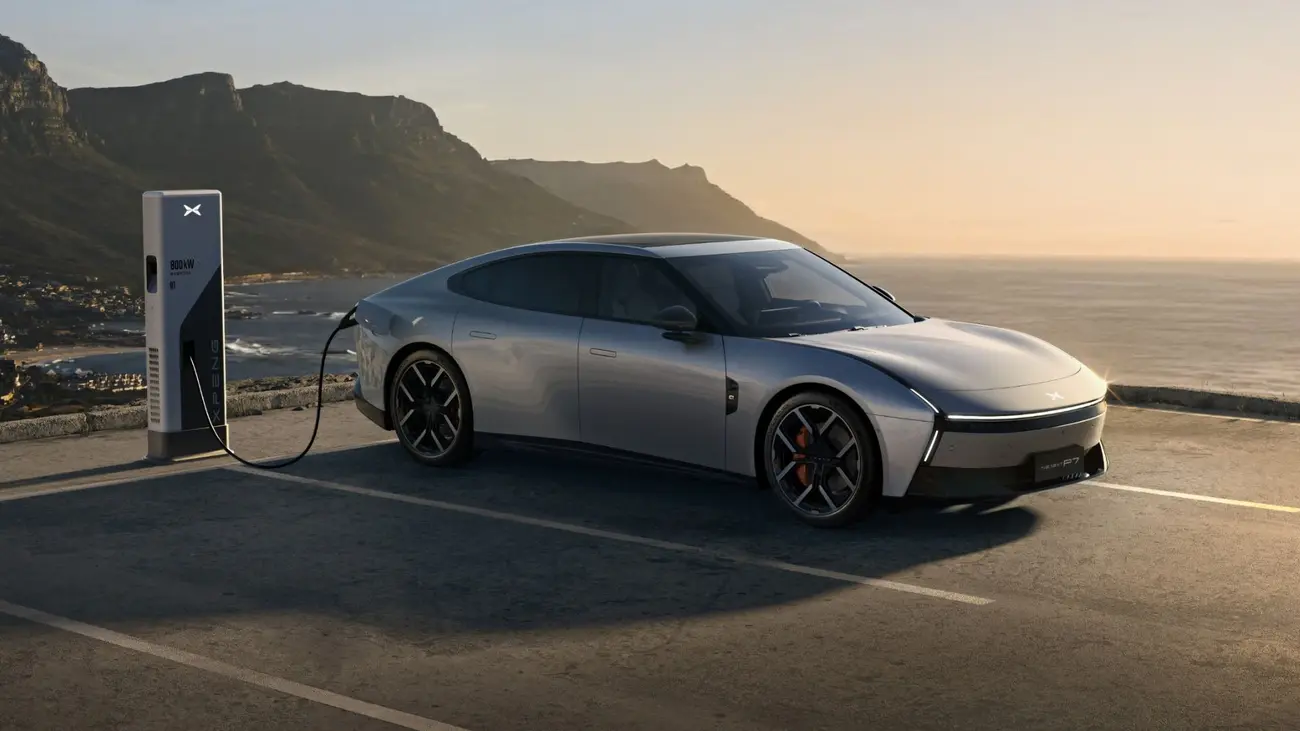
The new Xpeng P7 in Europe: what was announced and what we still don't know
Up to 750 km of range, 586 hp and 10–80% charging in about 12 minutes. Those are the numbers putting the new Xpeng P7 in headlines across Europe, with the Tesla Model 3 as its declared target. The fine print matters, though: that 750 km figure comes from China's CLTC test cycle, not Europe's WLTP. And there's another catch for anyone shopping for a new Xpeng P7 in Portugal: this is not the Xpeng P7+ that has been on sale here since 2026. It's a different car.
The news itself is thin. On 17 October 2026, Yu Tao, Xpeng's vice president and head of marketing, wrote on Weibo that the new P7 will go on sale in Europe "soon" and that the European team is "very excited". It was not an official press release.
What wasn't said matters more than what was:
- Launch date: none
- European prices: none
- Markets: no list of countries
- Equipment: not defined
Xpeng's European subsidiaries haven't confirmed anything yet either. French media report a gradual rollout, so that after-sales service is ready before the first deliveries.
The car itself isn't new. The second-generation P7 launched in China on 27 August 2025, taking 10,000 orders in 7 minutes, and made its European debut at IAA Mobility in Munich on 8 September 2025. More than a year later, Xpeng is getting ready to bring it over.
New Xpeng P7 range: the 750 km is CLTC, not WLTP
This is where most of the confusion will come from. In China, the new P7 comes in three range versions, all rated on the CLTC cycle:
| Version | Drive | Battery | CLTC range | On 21" wheels |
|---|---|---|---|---|
| 702 | Rear (RWD) | 74.9 kWh LFP | 702 km | 625 km |
| 820 | Rear (RWD) | 92.2 kWh NMC | 820 km | 735 km |
| 750 | All-wheel (AWD) | 92.2 kWh NMC | 750 km | 680 km |
The headline 750 km belongs to the all-wheel-drive version, the most powerful one. The longest-range model is actually the rear-drive 820.
CLTC is known for being far more optimistic than the WLTP cycle used in Europe. Some French outlets presented these figures as WLTP (quoting 630 to 750 km), but there is no European homologation yet. When WLTP numbers arrive, they will be lower, and real motorway range lower still.
What to expect in everyday driving
Even after discounting CLTC's optimism, there are good reasons to expect solid range. A drag coefficient of 0.201 is among the lowest on the market, and Xpeng quotes consumption from 12.0 kWh/100 km. With a 92.2 kWh battery, a non-stop Lisbon–Porto run looks realistic for the NMC versions, but only WLTP testing and the first European reviews will confirm it.
New Xpeng P7 specs: 800V, 5C charging and up to 586 hp
The technical package is ambitious for a car that costs less in China than many European compacts.
| Spec | New Xpeng P7 |
|---|---|
| Body | Liftback sedan, 5 seats |
| Length / Width / Height | 5,017 / 1,970 / 1,427 mm |
| Wheelbase | 3,008 mm |
| Drag coefficient | Cd 0.201 |
| Boot | 575 l + 56 l frunk (1,929 l seats folded) |
| Batteries | 74.9 kWh LFP / 92.2 kWh NMC |
| Architecture | 800V, silicon carbide (SiC) |
| RWD output | 270 kW (362 hp), 465 Nm |
| AWD output | 437 kW (586 hp / 594 PS), 695 Nm |
| 0–100 km/h | 5.8 s (702) / 5.4 s (820) / 3.7 s (AWD) |
| Top speed | 230 km/h |
| Suspension | Dual-chamber air suspension, standard |
10–80% charging in 12 minutes
Every version supports 5C charging on the 800V architecture. In lab conditions, Xpeng claims 10–80% in 11.3 minutes for the NMC versions and 12 minutes for the LFP, plus 525 km of (CLTC) range added in 10 minutes.
In practice, a coffee stop at a service area on the A1 motorway would be enough to refill most of the battery. The catch is finding a high-power ultra-fast charger: on MOBI.E, Portugal's national public charging network, these are still a minority outside the main corridors.
Design, space and tech
At 5.02 m long with more than 3 m between the axles, the new P7 is a big sedan, but a low one: just 1,427 mm tall. Weight distribution is 50:50, with double wishbones up front and a five-link rear, four-piston Brembo calipers and adjustable ride height (-20/+30 mm).
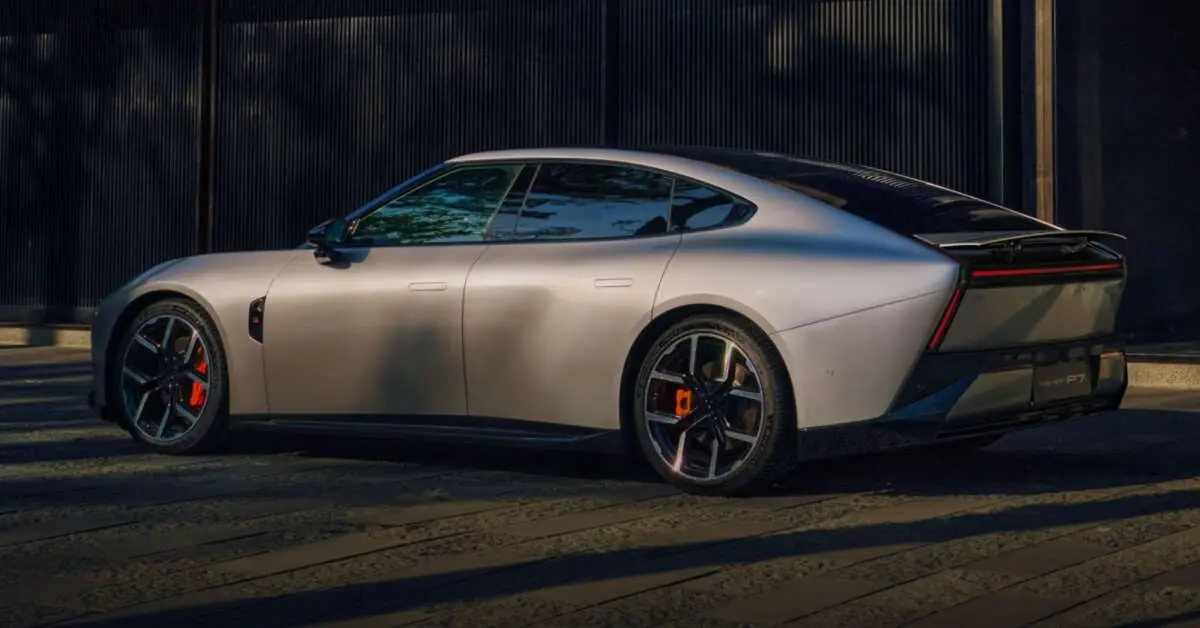
Inside, the list is long: a 15.6" rotating centre screen, an 8.8" driver display, an augmented-reality head-up display equivalent to 87 inches, 23 speakers and up to three of Xpeng's own Turing chips (2,250 TOPS) for assisted driving and infotainment. The top Chinese trim even gets scissor doors. Whether all of this makes it to Europe unchanged, nobody knows yet.
Don't mix them up: the new P7 is not the sedan Xpeng already sells here
The confusion is understandable. When the P7+ arrived in Portugal, several Portuguese sites called it the "new Xpeng P7". Now the real new P7 is coming, and they are two separate cars.
Xpeng P7 vs P7+: what are the differences?
| New Xpeng P7 | Xpeng P7+ | |
|---|---|---|
| Available in Portugal | Not yet | Yes, since June 2026 |
| Production | China (European supply unconfirmed) | Magna Steyr, Graz (Austria) |
| Height | 1,427 mm | 1,512 mm |
| Batteries | 74.9 kWh LFP / 92.2 kWh NMC | 61.7 / 74.9 kWh LFP |
| Range | 702–820 km CLTC | 455–530 km WLTP |
| Max power | 437 kW | 370 kW |
| 0–100 km/h (top version) | 3.7 s | 4.3 s |
| Top speed | 230 km/h | 200 km/h |
| Air suspension | Yes | Not stated |
| Price in Portugal | To be announced | From €46,997 |
The P7+ is the practical family sedan, taller and focused on space. The new P7 is lower, faster and more tech-heavy, with a clearly sportier brief. There's also the first-generation P7 from 2020, which is a third, different car.
New Xpeng P7 vs Tesla Model 3: the 750 km showdown
The Tesla Model 3 is the comparison the European press is already making. And there's a neat coincidence: the Model 3 Premium also claims 750 km, but on WLTP.
| New Xpeng P7 (China) | Tesla Model 3 Standard | Tesla Model 3 Premium | |
|---|---|---|---|
| Range | 702–820 km CLTC | 534–572 km WLTP | 750 km WLTP |
| 0–100 km/h | 3.7–5.8 s | 6.2 s | 5.2 s |
| Reference price | Europe TBA | €36,990 (Germany) | €44,990 (Germany) |
So anyone putting the two "750 km" claims side by side is comparing apples and oranges. Based on what we know today, the Tesla is likely to stay ahead on homologated European range.
Where the Xpeng could win is charging speed, standard air suspension and space: 575 litres of boot plus a 56-litre frunk. In China, the new P7 launched below the Model 3 (CNY 219,800 vs 235,500). In Europe, that price advantage is far from guaranteed.
Frequently Asked Questions
They are two different cars. The P7+ is the family-oriented saloon already on sale in Portugal from €46,997, assembled by Magna Steyr in Graz, with 61.7 or 74.9 kWh LFP batteries and 455 to 530 km WLTP. The second-generation P7 is lower (1,427 mm vs 1,512 mm), more powerful (up to 437 kW and 0-100 km/h in 3.7 s) and built on an 800V platform, with up to a 92.2 kWh NMC battery and standard air suspension.
No. The 750 km figure comes from China's CLTC cycle and applies to the all-wheel-drive version with the 92.2 kWh NMC battery. The Chinese line-up ranges from 702 km (74.9 kWh LFP) to 820 km (RWD NMC), also on CLTC, which is considerably more optimistic than WLTP. There is no European homologation yet, so WLTP figures are expected to be lower once published.
Xpeng has not announced European prices, so any figure is an estimate. In China it costs between 203,800 and 301,800 yuan (roughly €26,400 to €39,100), but in Portugal you add 23% VAT, shipping, dealer margin and, if built in China, EU countervailing duties. The most logical benchmark is the P7+ (€46,997 to €56,997), so the new P7 is likely to land at or above that level.
No date has been confirmed. On 17 October 2026, Xpeng vice-president Yu Tao only said on Weibo that the new P7 will go on sale in Europe "soon", without naming markets, prices or equipment. Since Xpeng already sells the P7+ in Portugal, the new P7 should join the local line-up, but first deliveries are unlikely before 2027, which is still an assumption.
For now, only the Tesla Model 3 has European pricing and range: from €36,990 for the Standard (534-572 km WLTP) and €44,990 for the Premium (750 km WLTP), based on German prices. The new P7 promises 10-80% charging in about 12 minutes, standard air suspension and a 575 l boot plus a 56 l frunk, but its 750 km is a CLTC figure. The choice will only be clear once Xpeng reveals WLTP range and European pricing.
New Xpeng P7 price in Portugal: what it might cost
There is no European price. Everything below is our own estimate, not a figure from Xpeng.
In China, the new P7 currently costs between CNY 203,800 and 301,800, roughly €26,400 to €39,100. Those prices don't translate directly: add Portugal's 23% VAT, homologation, shipping, dealer margin and, if the car is built in China, the EU's countervailing duties on Chinese-made EVs. The P7+ avoids those duties because it's assembled in Austria.
The most logical benchmark is the P7+ itself, which costs €46,997 (Standard Range), €50,997 (Long Range) and €56,997 (Performance AWD) in Portugal, VAT included. With a bigger battery, 800V, air suspension and more power, it's hard to see the new P7 undercutting it. Our estimate, which is pure speculation, puts it at or above P7+ pricing, with the all-wheel-drive versions very likely above €55,000.
Tax-wise, the usual EV rules apply: no ISV (Portugal's vehicle purchase tax) and no IUC (annual road tax). For companies, VAT is only deductible if the purchase price stays under €62,500, a threshold that could shape which trims business buyers choose.
When will the new Xpeng P7 arrive in Portugal?
There's no date. Xpeng already operates in Portugal and sells the P7+ here, so the new P7 should join the local line-up, but neither markets nor timing have been confirmed. If the gradual approach reported in France applies across Europe, the first Portuguese deliveries probably won't happen before 2027. That, too, is an assumption.
For now, anyone who needs a large electric sedan has the P7+, the Tesla Model 3 and other options available today. If you can wait, the new P7 is worth watching: its 5C charging and spec sheet are among the strongest in the segment. Three numbers Xpeng hasn't revealed yet will decide everything: the WLTP range, where European cars will be built, and the price.