
MINI Aceman JCW Real Range in Portugal: Tested at 60, 90 and 130 km/h
Published: 10/09/2026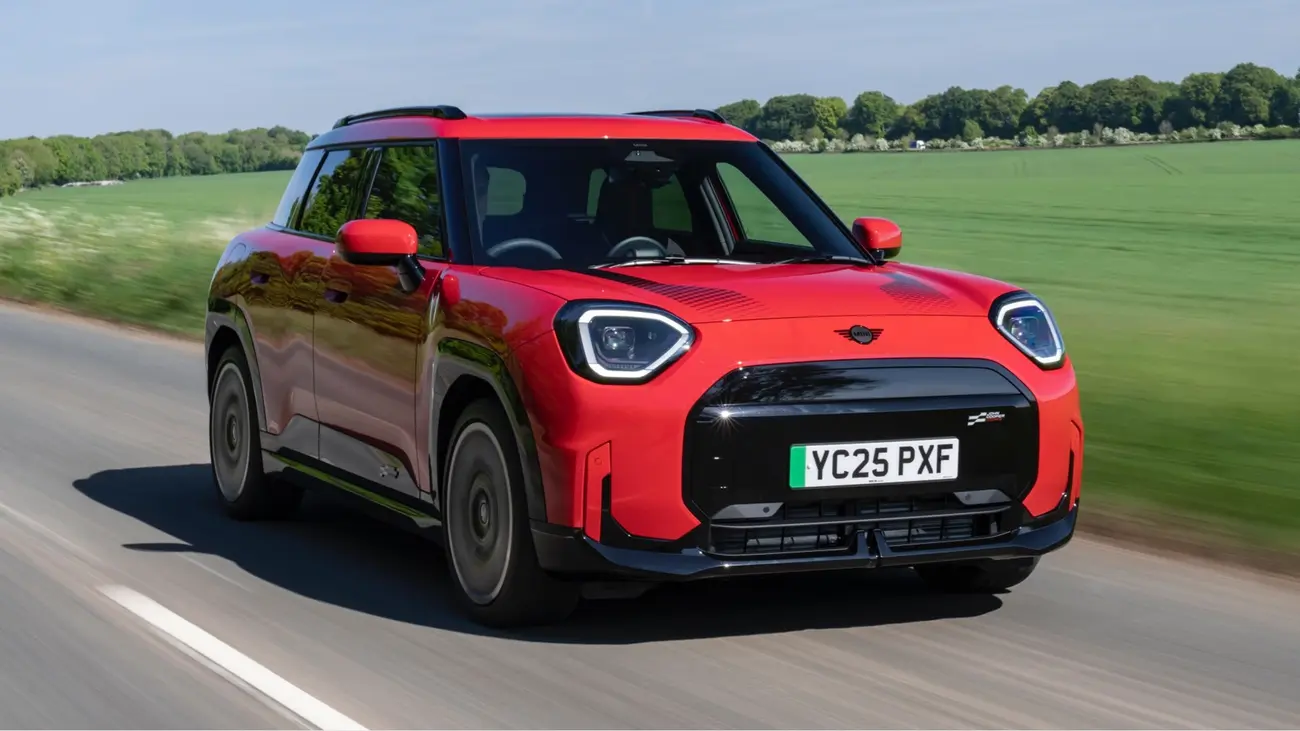
351 km at 90 km/h: the number that explains the MINI Aceman JCW
Hold a steady 90 km/h and the MINI Aceman JCW covers 351 km on a charge. Its official WLTP figure is 355 km. On a Portuguese national road at a constant cruise, in other words, this MINI does almost exactly what the brochure claims — which is rare for an EV. Push it to 130 km/h and the story falls apart.
The figures come from an instrumented constant-speed test by ArenaEV, run on 19-inch wheels with summer tyres at 21 C. That is precisely how a JCW leaves a Portuguese showroom, and precisely the temperature we drive in for half the year. So the table is worth reading closely, because the real range of the MINI Aceman JCW in Portugal depends far more on your speed than on the battery.
The table nobody publishes here
| Speed | Range | Consumption |
|---|---|---|
| 60 km/h | 473 km | 10.4 kWh/100 km |
| 90 km/h | 351 km | 14.0 kWh/100 km |
| 130 km/h | 235 km | 20.9 kWh/100 km |
Going from 60 to 90 km/h costs surprisingly little: consumption climbs from 10.4 to 14.0 kWh/100 km and you still have more than 350 km in hand. That is a strong result for a crossover this tall on wheels this big. Measured against the rest of the segment, the Aceman is genuinely one of the most efficient small electric SUVs out there.
The jump to 130 km/h is where it hurts. Consumption spikes to 20.9 kWh/100 km and range drops to 235 km — roughly a third below the WLTP claim. On the A1 between Lisbon and Porto, at 120-130 km/h with the air conditioning running, that means a charging stop is not optional. It is not bad driving, it is aerodynamics, and a tall body on wide tyres pays the full price.
Real consumption: 16.5 or 19 kWh/100 km?
Away from constant-speed runs the numbers diverge, and it is only fair to say so. Australian outlet The Driven spent two weeks mixing city, freeway and mountain roads on the same 19-inch alloys and recorded 16.5 kWh/100 km, which works out at roughly 300 km of real range. A road test published in Portugal landed on a much heavier figure: 19.0 kWh/100 km at 120 km/h, for around 258 km.
The two do not contradict each other — they measure different things. One is varied use over a fortnight, where town driving and regeneration drag the average down. The other is motorway running at Portuguese speeds, where nothing offsets the drag. The practical takeaway: budget for around 300 km in mixed use and 240 to 260 km if most of your driving is motorway.
Independent estimates from EV Database sit inside that window: 280 km real-world average, 320 km in mild weather, 235 km in the cold. In town with mild temperatures it stretches to 410 km; on the motorway in winter it shrinks to 195 km. UK tests by Auto Express and Carwow, carried out at 10-12 C, returned 3.8-3.9 mi/kWh, or somewhere between 290 and 320 km. Everything points to the same place.
Charging is the real limitation
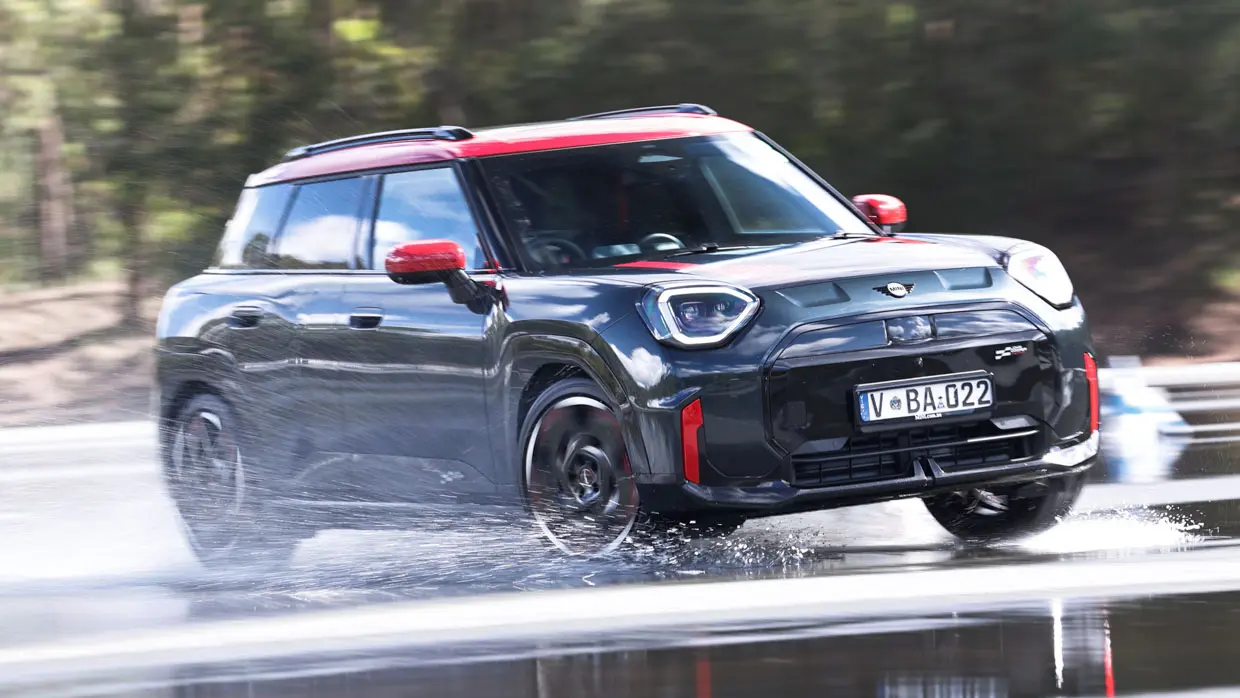
If there is one area where the Aceman JCW trails its rivals, this is it. Peak DC charging is 95 kW, averaging 75 kW across a session. A 10-80% top-up takes 29 to 31 minutes on a 150 kW rapid charger — and plugging into a 350 kW unit changes nothing at all, because the ceiling is in the car.
On a 50 kW charger, still the most common type across much of the MOBI.E network away from the motorways, that same 10-80% stretches to 54 minutes. The difference between a coffee and a full lunch.
At home, AC charging goes up to 11 kW on three-phase supply, filling the battery in 5h15m. On the 7.4 kW single-phase wallbox most Portuguese homes end up with, budget around 8 hours — fine overnight, and fine on an off-peak tariff. There is no V2L, so powering tools or a fridge from the car is off the table. A heat pump is standard, and it is what keeps January range from collapsing.
EV Database rates the Aceman JCW at 1.5 out of 5 for long-distance suitability. In practice: under average conditions it does 199 km, stops for 15 minutes, then adds another 95 km. Nearly three hours to cover 294 km.
MINI Aceman JCW specifications
| Specification | Value |
|---|---|
| Battery (gross / usable) | 54.2 kWh / 49.2 kWh |
| Chemistry and architecture | NMC, 400 V |
| Power | 190 kW (258 PS) |
| Torque | 350 Nm |
| Drivetrain | Front-wheel drive, single motor |
| 0-100 km/h | 6.4 s |
| Top speed | 200 km/h |
| WLTP range | 355 km |
| Max DC charging | 95 kW (75 kW average) |
| DC 10-80% | 29-31 min (54 min at 50 kW) |
| AC charging | 11 kW three-phase, 5h15m |
| Heat pump | Standard |
| Length | 4,079 mm |
| Wheelbase | 2,606 mm |
| Kerb weight | 1,825 kg |
| Boot | 300 L (1,005 L seats folded) |
| Braked towing | 750 kg |
| Battery warranty | 8 years / 160,000 km |
| Euro NCAP 2025 | 5 stars (83 / 87 / 77 / 79%) |
What it costs in Portugal
According to MINI Portugal's price list, the Aceman JCW starts at around EUR 47,000, with the entry-level Aceman E from about EUR 35,600. Treat those as indicative list prices and confirm them at a dealer before committing, because campaigns and equipment packs move the final number considerably.
For European context: EV Database lists the same JCW at EUR 43,150 in Germany and EUR 52,490 in the Netherlands, while the UK price opens at GBP 37,060. Portugal sits mid-table.
As an EV, the Aceman is exempt from ISV — the Portuguese vehicle registration tax that inflates the price of combustion cars — and pays only a token IUC road tax. As a company car, the reduced autonomous taxation rate remains the strongest financial argument for going electric here.
Even so, EUR 47,000 makes for a tough comparison. That money buys electric cars with bigger batteries and much faster charging. What MINI offers instead is the design, an interior that is among the best in the class with its circular display and recycled woven fabrics, and a chassis almost no rival can match, complete with Go-Kart mode and a boost paddle that unlocks ten seconds of extra power for overtaking.
Space: 300 litres, and three is a crowd
The boot holds 300 litres, below the Volvo EX30 (318 L) and well short of the Alfa Romeo Junior (400 L). Fold the rear seats and it opens to 1,005 litres, and there is no frunk under the bonnet for stashing cables.
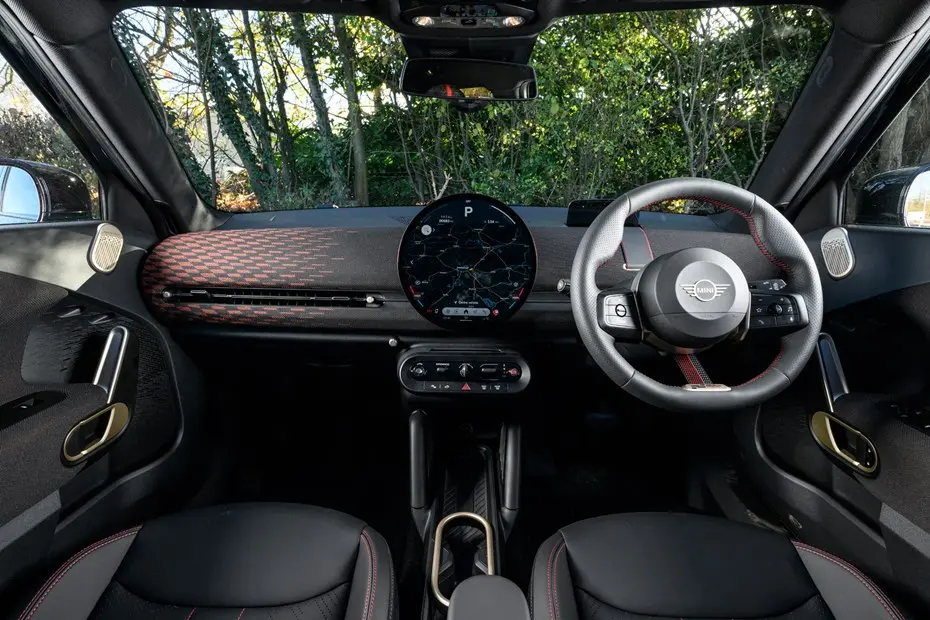
In the back, a 1.80 m adult fits, but only if whoever is in front cooperates. At 4,079 mm long with a 2,606 mm wheelbase, the Aceman is shorter than both the EX30 and the Junior, and you feel it. The JCW's suspension, firm enough that the British press calls it plainly uncomfortable over bumps and broken surfaces, does rear passengers no favours on Portuguese back roads.
Safety is not a concern: five Euro NCAP stars in 2025, with 83% for adult occupants and 87% for children.
Frequently Asked Questions
In cold weather, EV Database estimates around 235 km in combined use and just 195 km if most of the journey is motorway, compared with 320 km in mild conditions. The heat pump, standard on the JCW, keeps that loss much smaller than on EVs without one. In Portugal, where coastal winters rarely drop below 5 C, a realistic figure sits between 235 and 280 km.
Yes, but less than you might expect. ArenaEV's instrumented test was run specifically on 19-inch wheels with summer tyres at 21 C and still returned 351 km at 90 km/h, essentially matching the 355 km WLTP figure. The bigger cost of the large wheels is comfort rather than range: the JCW's firm suspension on low-profile tyres turns harsh over speed bumps and broken surfaces. The Aceman SE, on smaller wheels, delivers similar real-world range and rides better.
According to MINI Portugal's price list and Portuguese press coverage, the JCW Aceman starts at around EUR 47,000, against roughly EUR 35,600 for the entry-level Aceman E — indicative figures worth confirming at a dealer, since campaigns and option packs move the final price considerably. Being fully electric, it is exempt from ISV vehicle tax and pays only a token IUC road tax, and company cars benefit from reduced autonomous taxation. For context, EV Database lists the same JCW at EUR 43,150 in Germany and EUR 52,490 in the Netherlands.
Long journeys are not its strength. At 130 km/h range falls to 235 km, and peak charging is only 95 kW, taking 29 to 31 minutes for 10-80% at a rapid charger — or 54 minutes on a 50 kW unit, still widespread on the MOBI.E network away from the motorways. EV Database rates its long-distance suitability at 1.5 out of 5: on an average trip it covers 199 km, stops for 15 minutes and adds another 95 km. If you drive Lisbon to the Algarve regularly, other EVs make far more sense.
On space the MINI loses: a 300-litre boot against 318 litres in the Volvo EX30 and 400 litres in the Alfa Romeo Junior, and at 4,079 mm it is the shortest of the three, with tight rear seats. On efficiency and driving fun it wins — the 10.4 to 14.0 kWh/100 km measured at constant speed are among the best in the class, and the Go-Kart mode with its boost paddle has no direct equivalent. The call is straightforward: if you need family space, look at the Junior or the EX30; if you want the most entertaining and most efficient of the three, the Aceman JCW earns its price.
Who it actually suits
The MINI Aceman JCW is a city car with a good weekend road habit, not a motorway machine. Charge at home, drive under 200 km a day, and the 49.2 kWh usable battery will never feel tight — you get one of the most entertaining and most efficient EVs available at this price. Drive Lisbon to the Algarve regularly and you should look elsewhere, because 235 km at 130 km/h paired with a 95 kW charging ceiling is a poor combination for long journeys.
If budget is the deciding factor, compare it with the Aceman SE: same 54.2 kWh battery, near-identical real-world range, smaller wheels that soften the ride, and several thousand euros less. The JCW earns its premium in driving pleasure, not in numbers.