
Leapmotor B03 in Portugal: The Electric Hatchback Sibling of the B03X
Published: 24/10/2026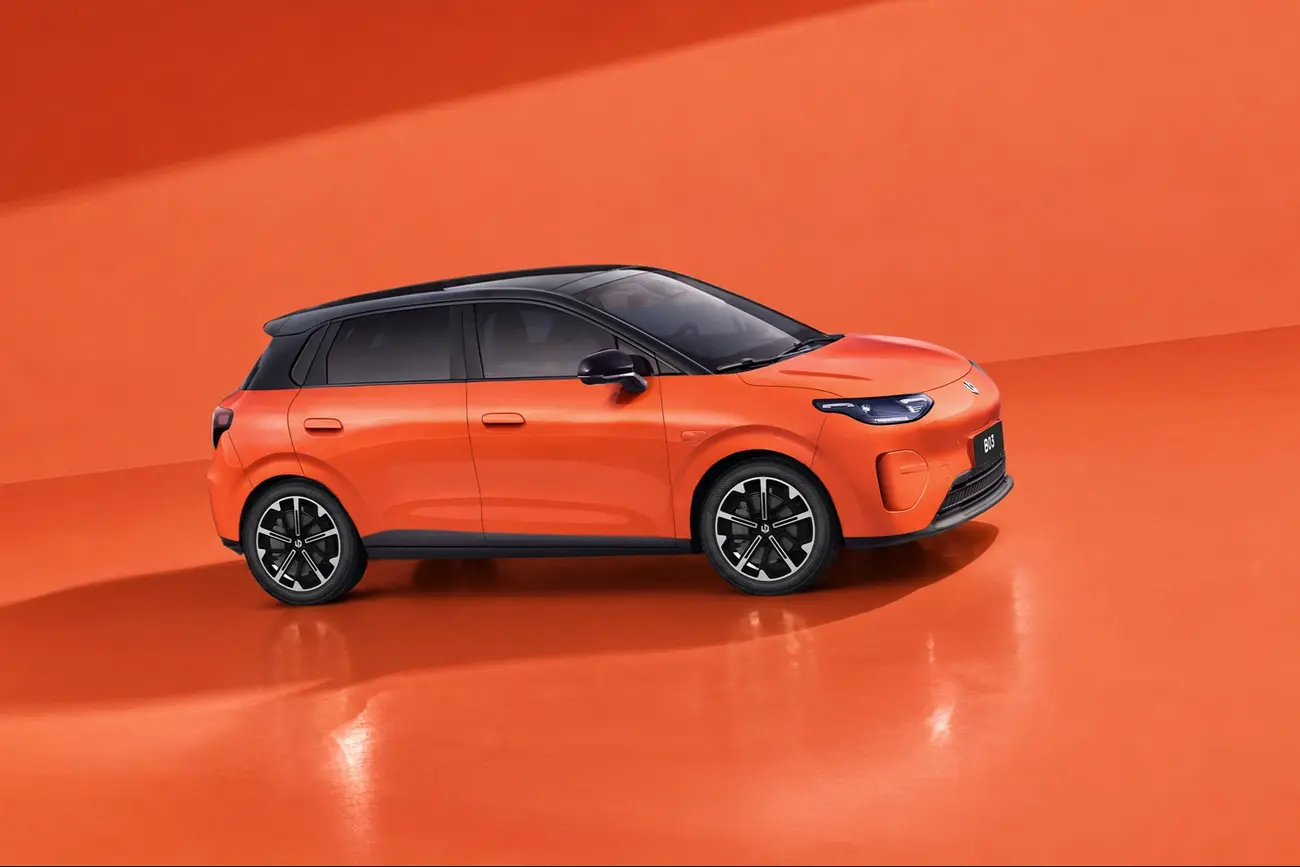
Leapmotor B03: the electric hatchback that completes the B03X
The B03X has barely reached showrooms and Leapmotor already has its lower-slung sibling ready. The Leapmotor B03 is a five-door electric hatchback that made its European debut at the Paris Motor Show (12–18 October 2026), sharing the B03X crossover's platform, 53 kWh battery and 145 kW motor. What changes is the body — lower and shorter — and with it the target: the heart of the B-segment, where the Renault 5 and the new VW ID. Polo live.
If you're tracking the Leapmotor B03 in Portugal, the essentials fit in three lines: up to 390 km of WLTP range, 10–80% charging in 21 minutes, and a price that isn't official yet. European press estimates run from €20,000 to €25,000. Let's go through the numbers properly, and tackle the obvious question: B03 or B03X?
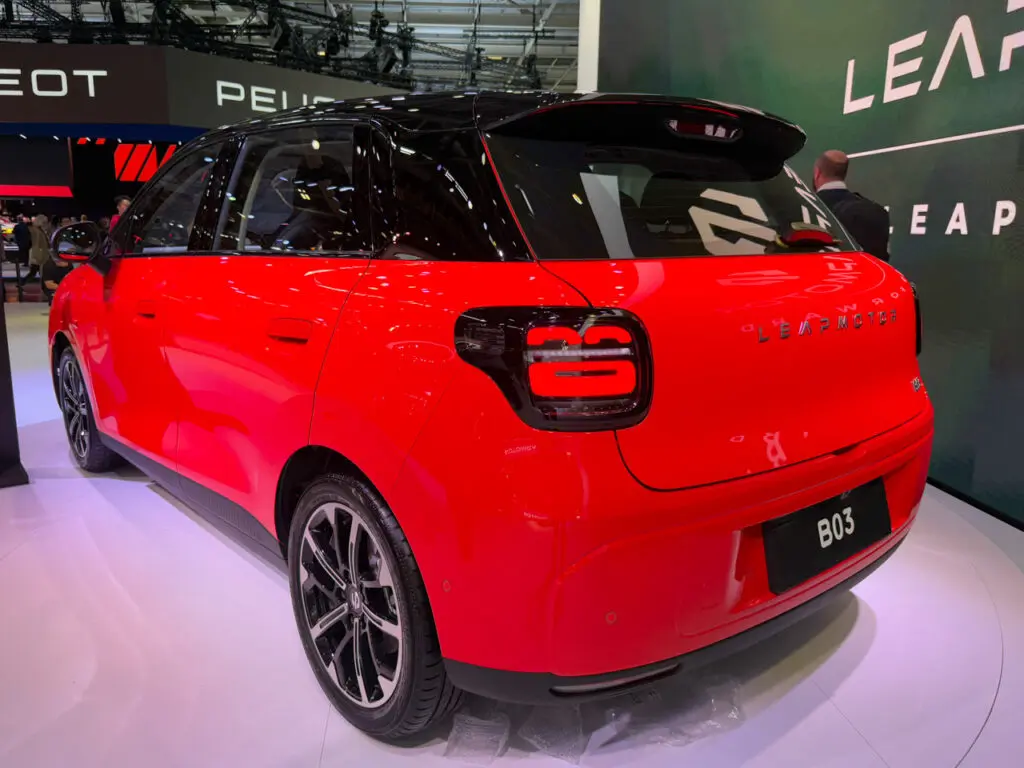
In Leapmotor's line-up, the B03 slots between the small T03 and the B03X. On the Paris stand it shared the spotlight with the T03, the B10 and C10 SUVs, the B03X and the new D19 flagship SUV.
Leapmotor B03 range and specs: 53 kWh, 390 km and 145 kW
Underneath is Leapmotor's Compact Electric Platform, the same one used by the B03X, with the battery built into the structure (Cell-to-Chassis 2.0 Plus). The chemistry is LFP (lithium iron phosphate): less energy-dense than NMC, but cheaper, happier being charged to 100% and less reliant on expensive metals.
| Specification | Leapmotor B03 |
|---|---|
| Body | 5-door hatchback (B-segment) |
| Battery | 53 kWh LFP |
| WLTP range | up to 390 km |
| Motor | front, 145 kW (194 hp / 197 PS) |
| Torque | 200 Nm |
| Drive | front-wheel drive |
| 0-100 km/h | 7.6 s |
| Top speed | around 163 km/h |
| DC charging (peak) | 133 kW |
| DC 10-80% / 30-80% | 21 min / 16 min |
| AC charging | 7.4 kW (0-100% in about 7h15) |
| Length / width / height | 4,175 / 1,790 / 1,550 mm |
| Wheelbase | 2,605 mm |
| Turning circle | 9.8 m |
| Boot | 405 L (1,305 L seats folded) + 90 L underfloor |
Two notes on the sources. Some outlets quote 143 kW (191 hp), but the official press release says "up to 145 kW". And a few reports give 145 kW as the fast-charging figure — that's a mix-up with the motor output; the announced DC peak is 133 kW.
390 km WLTP range: what it means day to day
With the same 53 kWh battery, the B03 reaches 390 km WLTP — 8 km more than the B03X's 382 km, thanks to a lower body with less drag. You may see higher figures floating around: those come from China's CLTC cycle, which is far more generous, and aren't comparable.
In the real world, expect less on the motorway and in winter. A week of commuting around Greater Lisbon or Porto fits into one charge; so does Lisbon to Coimbra, with room to spare. Lisbon to Porto at 120 km/h will most likely need a stop. The standard heat pump helps protect range on cold days.
Fast charging: 10 to 80% in 21 minutes
A 133 kW peak looks modest on paper, but the charging curve is what counts. The battery accepts 2.5C, which means 10 to 80% in 21 minutes and 30 to 80% in around 16. At a rapid charger on MOBI.E — Portugal's national public charging network — at an A1 service area, that's a coffee and a bathroom break.
At home, the 7.4 kW AC charger fills the battery in about 7h15 — overnight on a single-phase wallbox. There's also 230 V V2L, so the car can power an appliance, handy for a picnic or a job site.
Space on board: 4.18 metres that feel bigger
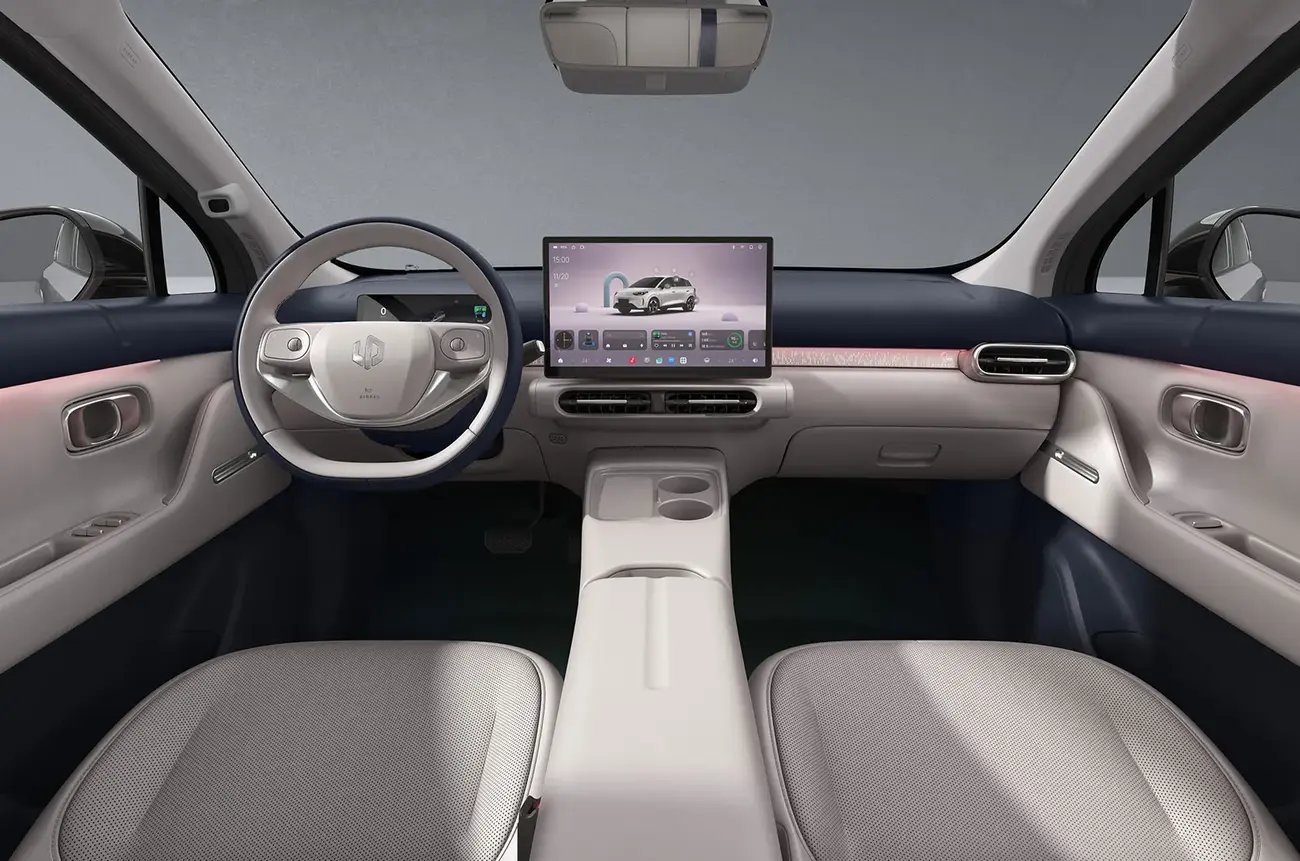
At 4,175 mm, the B03 is large for a city car — French fleet magazine Flotauto calls it "almost a compact". And the space is put to good use: 888 mm of rear legroom, which Leapmotor bills as class-leading, plus a 405-litre boot and a further 90 litres in the "Leap Box", a waterproof underfloor compartment. Perfect for charging cables or muddy boots.
The front passenger seat folds completely flat, and the brand mentions more than 30 storage spaces around the cabin. A 9.8 m turning circle helps in the narrow streets of older neighbourhoods.
As usual, Leapmotor is generous with standard kit:
- 14.6" touchscreen and 8.8" digital cluster running Leap OS 4.0 Plus
- Wireless Apple CarPlay and Android Auto
- Heated front seats and steering wheel, automatic climate control
- 21 driver assistance systems (14 sensors and cameras)
- 7 airbags, including a centre airbag between the front seats
The downside, according to Carscoops: the interior feels rather generic and physical buttons are scarce. If you like proper switches, expect to spend more time in the touchscreen menus.
Leapmotor B03 vs B03X: what separates the siblings
The differences between the Leapmotor B03 and the B03X come down to the body. Underneath, it's essentially the same car.
| Leapmotor B03 | Leapmotor B03X | |
|---|---|---|
| Body | hatchback | crossover |
| Length | 4,175 mm | 4,270 mm |
| Width | 1,790 mm | 1,810 mm |
| Height | 1,550 mm | 1,635 mm |
| Wheelbase | 2,605 mm | 2,605 mm |
| Battery | 53 kWh LFP | 39.8 kWh or 53.0 kWh LFP |
| WLTP range | up to 390 km | up to 292 km / 382 km |
| Power | 145 kW | 145 kW |
| 0-100 km/h | 7.6 s | 8.6 s |
| Price in Portugal | not announced | from €24,285 |
The B03 is 85 mm lower and almost 10 cm shorter, yet keeps the same wheelbase — so interior space should be very similar. It gains 8 km of range and a full second in the 0-100 km/h sprint.
The B03X, for its part, gives you a higher driving position and an entry version with a 39.8 kWh battery. It also has one decisive advantage: you can buy it today. If you're torn between the two, it's a trade-off between the body style you prefer and how long you're willing to wait.
Leapmotor B03 vs Renault 5 and ID. Polo
The target is obvious, and Automobile Propre doesn't mince words: the B03 "could really hurt" the Renault 5. Here's why.
| Leapmotor B03 | Renault 5 E-Tech (52 kWh) | VW ID. Polo (52 kWh) | |
|---|---|---|---|
| Length | 4,175 mm | 3,922 mm | 4,053 mm |
| Wheelbase | 2,605 mm | 2,540 mm | 2,600 mm |
| WLTP range | up to 390 km | 405-410 km | 450-454 km |
| Power | 145 kW | 110 kW | 155 kW |
| 0-100 km/h | 7.6 s | 8.0 s | 7.4 s |
| Max DC charging | 133 kW | 100 kW | 130 kW |
| Boot | 405 L | 326 L | 441 L |
The B03 is the biggest of the three: 25 cm longer than the Renault 5 and 12 cm longer than the ID. Polo. It charges faster than the French car, accelerates harder and carries considerably more luggage. Where it loses out is range — 15 to 20 km behind the Renault 5 and around 60 km behind the Volkswagen.
The other difference is image. The Renault 5 sells on its neo-retro design and a familiar badge; the Leapmotor answers with size, equipment and, if the estimates hold, price. The honest question mark is the usual one with a newly arrived Chinese brand: resale value. Distribution through Stellantis takes care of much of the servicing and parts worry.
Leapmotor B03 price in Portugal: what we know
An official price? Not yet — not for Portugal, not for any European market. What's circulating are press estimates:
- Flotauto (France): entry price of "€20,000 including VAT at most"
- Automobile Propre (France): under €20,000, but with a smaller battery good for around 300 km — the journalist's own speculation
- Carscoops: around €25,000 in Europe
- United Kingdom: expected to start "in the low £20,000s"
The best benchmark for Portugal is the B03X itself. Here the crossover costs €24,285 (LIFE, 39.8 kWh) and €28,285 (DESIGN, 53 kWh), with launch-campaign prices of €22,345 and €26,025. Since the B03 sits below the B03X in the range, it's reasonable to expect it to undercut those figures. By how much, we don't know — and we're not going to make up a number.
As an EV, the B03 will be exempt from both ISV (Portugal's vehicle registration tax) and IUC (the annual road tax). Private buyers may also be able to claim the Fundo Ambiental purchase incentive, in years when funding is available.
When is the Leapmotor B03 coming to Portugal
Leapmotor hasn't given an on-sale date. What we do know is that European sales start in 2027 — in the UK, during the first half — and that the B03 will be sold in 36 European countries through the Stellantis network. Portugal should be on that list, as it already is for the T03, B10 and B03X, but there's no official timeline yet.
There are signs the brand is gaining momentum: Leapmotor logged more than 1,100 registrations in France in September 2026, a record. Owners also get access to Stellantis's Free2move Charge network, with more than one million public charging points across Europe.
Frequently Asked Questions
There is no official price yet for Portugal or any other European market. Press estimates range from around €20,000 (Flotauto, a French starting price of "at most" €20,000 including VAT) to around €25,000 (Carscoops). The most reliable benchmark is the B03X, which costs from €24,285 (LIFE, 39.8 kWh) and €28,285 (DESIGN, 53 kWh) in Portugal; since the B03 sits below the B03X in the range, it is likely to cost less, and as an EV it will be exempt from ISV registration tax.
Leapmotor has not announced a Portuguese on-sale date yet. European sales are due to start in 2027 — in the first half of the year in the UK — and the B03 will be sold in 36 European countries through the Stellantis network. Portugal is expected to be among them, as it already is for the T03, B10 and B03X, but the local timeline has not been confirmed.
Both share the same platform, 2,605 mm wheelbase and 145 kW motor, so the decision comes down to body style and timing. The B03 is 85 mm lower and almost 10 cm shorter, offers up to 390 km WLTP (versus 382 km for the B03X with the same 53 kWh battery) and does 0-100 km/h in 7.6 s instead of 8.6 s. The B03X gives you a higher driving position, an entry-level 39.8 kWh version and the advantage of already being on sale in Portugal.
At a rapid charger, the B03 accepts up to 133 kW DC peak and goes from 10 to 80% in about 21 minutes, or from 30 to 80% in about 16 minutes. On AC, the 7.4 kW onboard charger fills the 53 kWh battery (0-100%) in roughly 7 hours 15 minutes, which makes overnight charging on a single-phase home wallbox easy.
At 4,175 mm, the B03 is around 25 cm longer than the Renault 5 E-Tech and offers a 405-litre boot (plus 90 L underfloor) versus the Renault's 326 litres. It is also more powerful (145 kW vs 110 kW), quicker (7.6 s vs 8.0 s for 0-100 km/h) and charges faster (133 kW vs 100 kW DC). The 52 kWh Renault 5 still leads on range, with 405-410 km WLTP against the B03's up to 390 km.
Is the B03 worth waiting for?
It depends on when you need the car. If it's now, the B03X is on sale at a launch price, and so is the Renault 5. If you can wait until 2027 and prefer a hatchback to a crossover, the B03 promises more space than the Renault 5, quicker charging and generous standard equipment — at a price that, if it lands between €20,000 and €25,000, would make it one of the most competitive electric city cars on the market. The figure to watch is the official Portuguese price: that's what will decide whether the B03 is a bargain or just another option.