
Hyundai Ioniq 3 in Portugal: Range, Specs and Launch Date
Published: 23/04/2026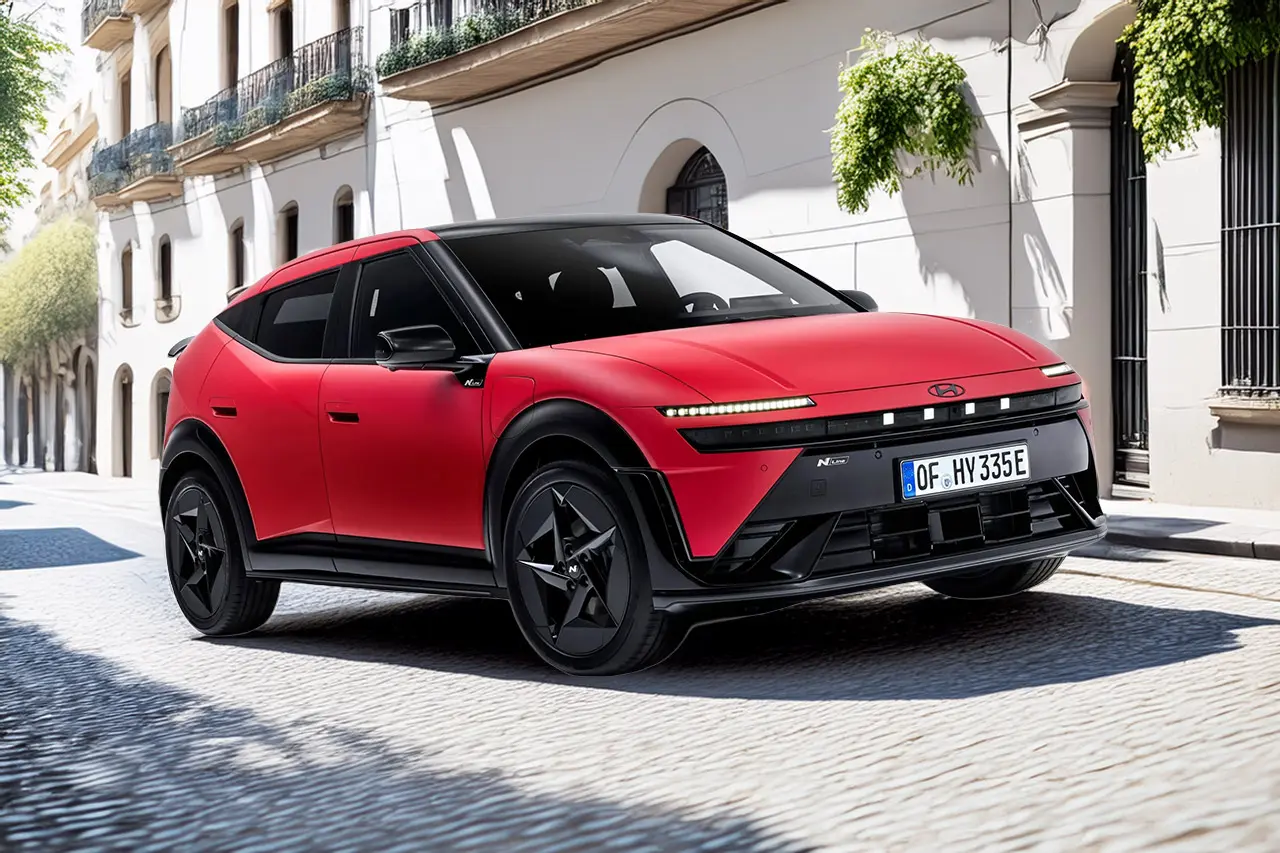
A smaller, cheaper Ioniq — built with Europe in mind
Hyundai picked Milan Design Week to unveil the Ioniq 3, the first compact hatchback in the IONIQ family. This isn't another electric SUV: it's a five-door hatch, 4,155 mm long, designed in Europe and built in Turkey, aimed squarely at the Renault 5, the MG4 and the upcoming VW ID. Polo. For a buyer in Portugal who has been waiting for a genuinely competitive compact EV, the Hyundai Ioniq 3 Portugal launch in late 2026 is one of the year's more interesting arrivals.
The pitch is simple. Up to 496 km of WLTP range in the Long Range version, a 10-to-80% DC fast charge in roughly 29 minutes, and an estimated entry price under €30,000 in Europe. In a segment where the Renault 5 tops out around 410 km and the VW ID.3, capable as it is, starts to show its age.
What the "Aero Hatch" design actually means
Hyundai is calling it an Aero Hatch and talking about a new typology. In plain terms, it's a low-slung hatchback with aerodynamic detailing aimed at a drag coefficient (Cd) of roughly 0.263 — unusual in this size class and responsible for much of the efficiency Hyundai is promising. The tail lights spell an "H" in Morse code using four dots, the roofline slopes like a coupé, and a split rear window changes the profile entirely.
The N Line trim adds 19-inch alloys (base cars get 16-inch), sportier bumpers and a mock rear diffuser. Eleven exterior colors are available from launch, including a matte Fierce Red and the usual Atlas White.
Compact EV dimensions that matter
- Length: 4,155 mm (4,170 mm for N Line)
- Width: 1,800 mm
- Height: 1,505 mm
- Wheelbase: 2,680 mm
- Weight: 1,550-1,580 kg
For reference, it's a bit shorter than a VW ID.3, shares its 2,680 mm wheelbase with the Kia EV3 (same platform), and slots between the Inster and the Kona Electric in Hyundai's own lineup. The practical result is more interior space than the outside suggests.
Hyundai Ioniq 3 range and battery: two clear choices
The spec sheet comes down to two versions, both front-wheel drive with a single motor:
| Version | Battery | Power | WLTP range | 0-100 km/h |
|---|---|---|---|---|
| Standard Range | 42.2 kWh | 147 PS (107.8 kW) | 344 km | 9.0 s |
| Long Range | 61 kWh | 135 PS (99.5 kW) | 496 km | 9.6 s |
Both deliver 250 Nm of torque and top out at 170 km/h. Quirk worth noting: the Standard version is slightly more powerful and a touch quicker off the line — the Long Range trades that for distance and likely a smoother high-speed pull, which matters on the motorway.
For the Lisbon-Porto run (around 310 km), the Long Range handles it without a stop, with margin to spare. The Standard Range needs a short top-up — at 10-to-80% in 29 minutes on DC, that's essentially a coffee break.
Fast charging in the real world
DC charging is among the fastest in the segment. Ten to eighty percent in about 29 minutes on the Standard and 30 minutes on the Long Range compares well with the Renault 5 (roughly 30 minutes too, but from a smaller battery) and beats the MG4 on partial top-ups.
Where the Ioniq 3 genuinely pulls ahead is AC: up to 22 kW on alternating current. For anyone charging at home or the office on a three-phase wallbox, that means going from nearly empty to full in under three hours. The VW ID.3 maxes out at 11 kW. The Renault 5, also 11 kW. Small detail, real impact on daily life.
The architecture is 400 volts on the E-GMP platform — the same one under the Kia EV3 and EV4. It's not the 800 V setup of the larger Ioniq 5, so don't expect those charging times. For this class, though, it's more than enough. In Portugal, the MOBI.E network (the national charging infrastructure) is well-suited to this: most fast chargers on the A1 and A2 motorways will hit the car's peak rate.
An interior that doesn't feel compact
This is the surprise. The E-GMP platform frees up the floor — completely flat — and the 2.68 m wheelbase gives real room for five adults. Boot capacity is 441 litres: 322 L in the main compartment plus 119 L in a so-called Megabox, a second underfloor storage area that doubles flexibility.
For context: the Renault 4 E-Tech sits around 420 L, the Mini Aceman at 300 L. The Ford Puma Gen-E manages 523 L total, but the Ioniq 3 wins on layered versatility.
Inside, Hyundai kept what matters: physical controls for climate and radio (the segment has been ripping these out, to the annoyance of anyone who actually drives). The gear selector moved to the steering column, freeing up the centre tunnel for storage and a wireless charging pad. The seats are called Relaxation Seats — reclining, heated and ventilated.
Pleos Connect: Android Automotive arrives at European Hyundai
The Ioniq 3 is the first European Hyundai to use the new Pleos Connect system, built on Android Automotive OS. In practice it works like a large smartphone built into the dash — native apps, Google Maps out of the box, Google account integration. Screens come in 12.9-inch (base) or 14.6-inch (top spec).
You also get Hyundai Digital Key 2 (smartphone or smartwatch entry), EV route planning with suggested charging stops, and the full SmartSense safety pack: Highway Driving Assist 2, Remote Smart Parking Assist, 360° camera and blind-spot monitor with live camera feed.
Hyundai Ioniq 3 vs Renault 5 vs VW ID.3: where it sits
Three numbers settle the comparison for anyone shopping the segment:
| Model | Max WLTP range | Estimated base price (EU) | Max AC |
|---|---|---|---|
| Hyundai Ioniq 3 Long Range | 496 km | ~€30,000 | 22 kW |
| Renault 5 E-Tech | ~410 km | ~€25,000 | 11 kW |
| VW ID.3 Pro | ~450 km | ~€35,000 | 11 kW |
| Kia EV3 | ~605 km | ~€36,000 | 11 kW |
The Ioniq 3 won't be the cheapest (the Renault 5 keeps that crown) or the longest-range (the Kia EV3 stretches further, but it's a larger, pricier SUV). It's classic Hyundai positioning: strong spec sheet, current-gen tech, a balanced price sitting mid-pack.
When it arrives in Portugal and what it will cost
Production starts in August 2026 at the İzmit plant in Turkey, with first European deliveries expected in Q4 2026. Portuguese dealer availability should track the European launch — Hyundai's local network typically gets new models a few weeks behind Spain and France.
Official prices aren't out yet. UK estimates range from £25,000 (around €29,000 at current exchange) to £30,000 (around €35,000), but those don't translate directly to the Portuguese market. A reasonable estimate for Portugal:
- Standard Range: €29,000 to €32,000
- Long Range: €33,000 to €36,000
- N Line Long Range: above €38,000
Electric cars in Portugal get full ISV exemption (ISV is the vehicle import/registration tax) and reduced IUC (the annual road tax), which keeps the Ioniq 3 competitive against equivalent petrol or diesel cars. For company fleets, reduced autonomous taxation on EVs remains a strong argument for electrification.
Not confirmed yet, but Hyundai has hinted at an Ioniq 3 N with dual motors and up to 288 hp — the same configuration already seen in the Kia EV3 GT-Line. If it happens, it would be a serious contender in the hot hatch EV niche currently owned by the Mini Aceman JCW.
Frequently Asked Questions
Official Portuguese prices have not yet been announced, but estimates are in the 29,000-32,000 EUR range for the Standard Range, 33,000-36,000 EUR for the Long Range, and above 38,000 EUR for the N Line. UK references point to 25,000-30,000 GBP (roughly 29,000-35,000 EUR). As a full EV, it qualifies for total ISV exemption (vehicle registration tax) and reduced IUC (annual road tax), improving total cost of ownership against equivalent petrol or diesel cars.
Production starts in August 2026 at the Hyundai plant in Izmit, Turkey, with first European deliveries expected in Q4 2026. Portuguese dealers should receive the model a few weeks behind Spain and France, most likely in late 2026 or early 2027. Official Portuguese prices are expected before the end of summer 2026.
Hyundai quotes 344 km WLTP for the Standard Range (42.2 kWh battery) and up to 496 km WLTP for the Long Range (61 kWh). In real-world motorway driving you should plan for 10-15% less, which still covers the Lisbon-Porto run (310 km) without a stop on the Long Range. The 0.263 drag coefficient is among the lowest in the segment and helps efficiency at highway speeds.
On DC fast charging, the Ioniq 3 goes from 10 to 80% in about 29 minutes (Standard) or 30 minutes (Long Range) — roughly a coffee-break stop. The real advantage is AC: it accepts up to 22 kW on alternating current, double the Renault 5 and VW ID.3 (both capped at 11 kW). On a three-phase home wallbox, a near-empty battery reaches full in under three hours.
The Ioniq 3 Long Range offers 496 km of WLTP range and 22 kW AC charging, versus roughly 410 km on the Renault 5 and 450 km on the VW ID.3 Pro, both limited to 11 kW AC. On base price, the Renault 5 stays the cheapest (around 25,000 EUR), the Ioniq 3 sits mid-pack (roughly 30,000 EUR), and the ID.3 Pro at the top (around 35,000 EUR). It shares the E-GMP platform with the Kia EV3, which offers more range (up to 605 km) but is a larger, pricier SUV.
What to watch next
Unlike the Ioniq 5 and Ioniq 6, which play in a premium bracket, the Ioniq 3 runs in the front of a much more crowded pack. The combination of 22 kW AC, 441 L of boot with Megabox and native Android Automotive is strong. Price will settle the argument — a Standard Range under €30,000 makes it one of the best compact EVs available in Portugal in 2026. Much above that and it starts losing ground to the Renault 5.
The wait is going to be worth it for anyone after a compact EV with a serious spec sheet and up-to-date tech. Worth keeping an eye on Hyundai Portugal's next announcements — official prices should land before the end of summer.