
The 12V Battery: The Real Reliability Weak Point of Electric Cars in Portugal
Published: 17/07/2026
The battery that strands an EV isn't the one you'd expect
An electric car's traction battery is remarkably durable: it holds roughly 90% of its health beyond 200,000 km, and in 2025 fewer than 0.2% of EVs needed a warranty replacement. Yet the component that most often leaves drivers stuck on the roadside is a humble 12V lead-acid battery — the same technology petrol cars have used for a century. That's the irony of electric car reliability: a 50-euro part nobody thinks about is enough to render a multi-thousand-euro pack, charged to 100%, completely useless.
This isn't a hunch. Across 1,702 breakdown testimonies, the 12V battery in an electric car was the number one cause, at 10.4% of cases — ahead of screen, motor, and software faults. The ADAC study, run by Europe's largest roadside assistance organisation, arrives at the same place from a different angle: it analysed 3.6 million breakdowns and pinned about 50% of EV breakdowns on the 12V battery, versus 45% for combustion cars.
Why a full pack still won't start the car
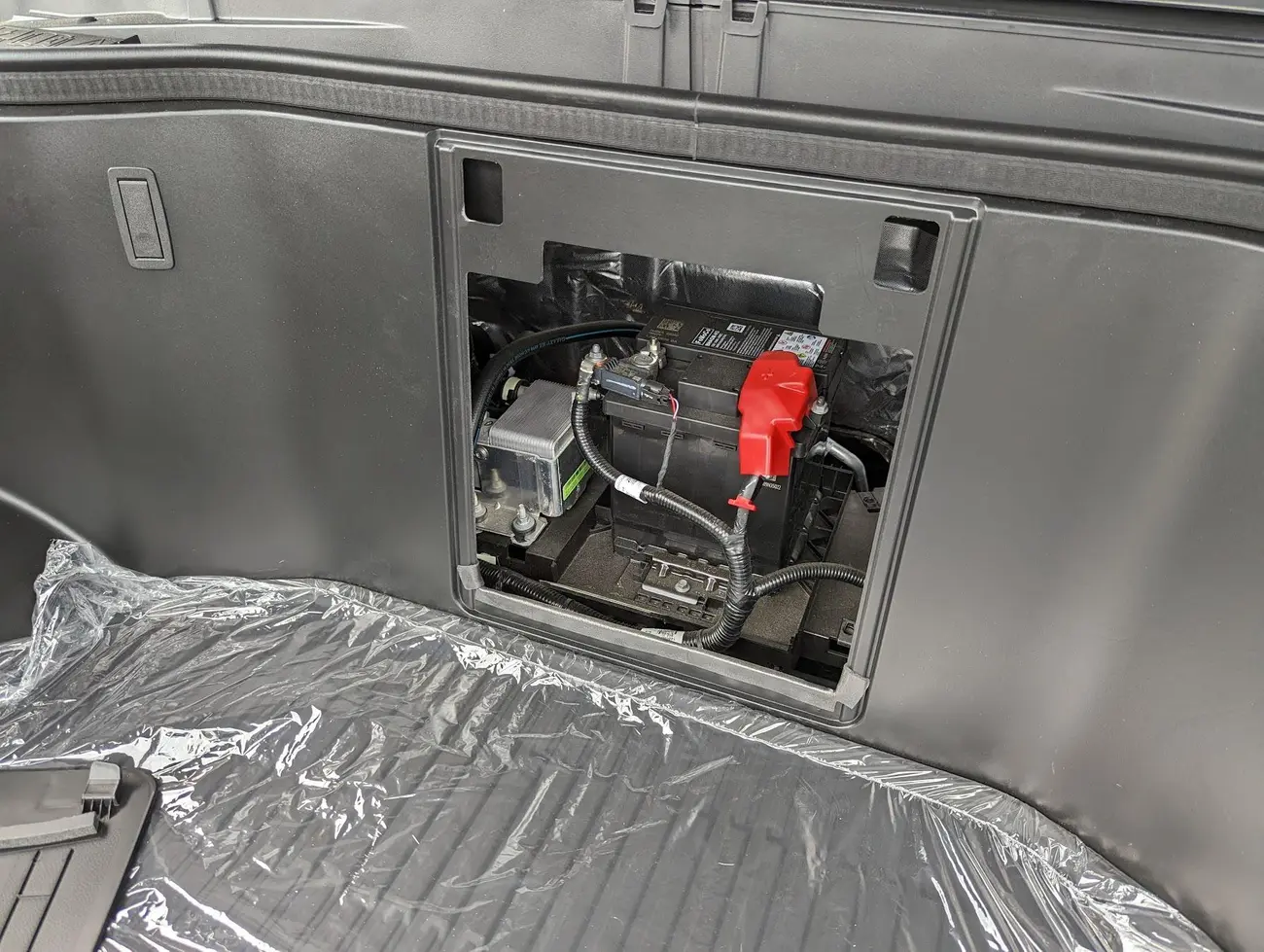
For the car to "wake up", the high-voltage contactors have to close and connect the traction battery to the rest of the system. What powers those contactors, the onboard computers, and the airbags is the 12V auxiliary battery. Without it, the main pack sits isolated — charged, intact, and entirely unreachable. The driver sees range on the screen (or the screen won't even light up) and the car refuses to shift into Drive.
Hence the disproportionate severity. Among testimonies that mention a 12V failure, 56.5% report at least one full immobilisation — against 14.5% across all breakdowns combined. When the 12V goes, it's rarely a minor annoyance. It's the car that won't leave the garage.
Why EVs are so hard on the auxiliary battery
A petrol car recharges its 12V through the alternator, driven by the engine. An EV has no alternator: it uses a DC-DC converter that steps the main pack's voltage down to the 12–14V the auxiliary needs. While the converter behaves, all is well. When it doesn't — under-charging, over-charging, or intermittent operation — the 12V either degrades or throws low-battery warnings for no obvious reason.
Then there's parasitic drain, the real silent killer. A modern EV is almost always half-awake: answering the phone app, running Sentry mode to record its cameras, downloading OTA updates, and occasionally failing to fall asleep and drawing power for hours. Each of those cycles is a deep discharge that ages a battery designed for short starts, not marathons. Heat makes everything worse — high temperatures roughly double the ageing rate, which matters in an Algarve summer. It's no coincidence that cars with 12V failures averaged model year 2020 and 79,000 km, against 2021.5 and 63,000 km for the wider panel. This is wear, not a factory defect.
The vulnerability isn't evenly spread. Among 12V failure mentions, Hyundai shows up in 27.3% of cases and Kia in 23.5%, well above Tesla at 3.8%. Models like the Hyundai Kona, Ioniq 5, Kia EV6, and early Nissan LEAF appear often in the complaints.
Signs of a failing 12V battery before you're stranded
The good news is that the 12V usually warns you first. The most common signs:
- The car won't "wake up": doors don't unlock, screens stay dark, it won't shift into Drive despite plenty of range.
- Repeated voltage warnings: messages like "low voltage battery needs service" that keep coming back.
- Odd charging glitches: AC (Level 2) charging is refused while DC fast charging still works.
- Random reboots: infotainment restarts on its own, the dashboard flickers, HVAC or seats cut out under load.
- Dead after parking: the car is unresponsive hours after you parked, often right after a software update.
- Key/app failures: the phone key won't work and you're forced back onto the physical key.
There's a pattern that fools a lot of people: a flurry of seemingly unrelated warnings — ABS, traction control, steering assist, airbags — lighting up at once. It looks like the car is falling apart. Almost always the root cause is a single one: low 12V. A weak battery makes control modules lose communication and sensors send inconsistent data, triggering false trouble codes.
How to avoid a flat 12V battery in your EV
Prevention is simple and cheap. From year three onward, do an annual 12V health check (twice a year if the car lives in the sun of the Alentejo or the Algarve). With a multimeter you can handle the basics at home: resting voltage, with the car off, should read between 12.5 and 12.8V. Below 12.2V the battery is ageing; below 12V it's in the danger zone.
Beyond that:
- Cut down on opening the app just to "check on" the car — each look wakes several modules.
- Disable or schedule Sentry mode while the car is at home.
- Don't store the car with the main pack near empty: that interrupts 12V maintenance charging.
- If the factory battery is weak, consider moving to a quality AGM or lithium unit — it lasts longer and handles cycling better.
One critical safety point: jump-starting an EV does not follow petrol-car rules. Some models allow a controlled start from a dedicated 12V point; others forbid it outright. Check the manual before improvising, and never touch orange-coloured covers or cables — those are high voltage.
What it costs to replace an EV's 12V battery
The drama is big, but the bill is usually small. A lead-acid or AGM battery runs about £80 to £200 (roughly 90 to 230 euros), though it often needs software registration at the workshop for the car to recognise it. A lithium 12V, more common in recent Teslas and premium cars, climbs to $300–$900. Only when the fault is the DC-DC converter itself does the invoice get scary: $600 to over $2,000 — but that repair may be covered under the traction system's warranty.
Keep it in perspective. ADAC found that between years two and four, EVs break down at a rate of 3.8 per 1,000 vehicles, against 9.4 for combustion cars — barely half. And running an EV costs around 23% less per year than an equivalent petrol car. Electric car reliability is real; the 12V is simply the one place where it still trips.
Frequently Asked Questions
An EV has no alternator: it recharges its 12V auxiliary battery through a DC-DC converter, and any converter fault causes under- or over-charging. On top of that, parasitic drain from always-on features (the app, Sentry mode, OTA updates) forces deep discharges on a battery built for short starts. The Portuguese summer heat roughly doubles the ageing rate. That is why the 12V battery is the number one cause of EV breakdowns, accounting for about 50% of cases according to the ADAC study.
A lead-acid or AGM battery runs about 90 to 230 euros, though it usually needs software registration at the workshop for the car to recognise it. A lithium 12V, common in recent Teslas, climbs to the equivalent of roughly 300 to 900 dollars. The bill only gets scary when the DC-DC converter itself is the problem (600 to over 2,000 dollars), but that repair may be covered under the traction system's warranty.
With a multimeter on the DC voltage scale, measure the terminals with the car fully off: a healthy battery reads between 12.5 and 12.8V at rest. Below 12.2V it is ageing and below 12V it is in the danger zone. Then switch the car to Ready mode and measure again: the voltage should climb to 13.5–14.5V, confirming the DC-DC converter is charging. From year three onward, do this check once a year (twice if the car lives in the sun of the Alentejo or the Algarve).
Yes, but only on the 12V auxiliary battery and never on the high-voltage traction battery. Many EVs have a dedicated jump-start point, often under a cover in the front compartment, but some models forbid jump-starting outright. Always check the manual before improvising, never connect while the car is charging, and never touch orange-coloured covers or cables, which are high voltage.
A 12V battery typically lasts between 3 and 8 years: around 3 to 4 years with heavy use or a hot climate, 5 to 6 years in normal conditions, and 7 to 8 or more with a quality AGM or lithium unit. In breakdown testimonies, the affected cars averaged model year 2020 and 79,000 km, a sign that this is wear rather than a factory defect. Cutting down on app checks, scheduling Sentry mode, and not storing the car with the main pack near empty all help extend its life.
If you're thinking of buying a used EV
The 12V gives quick clues on a test drive. Be wary of a slow boot-up to "Ready", persistent electrical warnings, screens freezing or rebooting, and AC charging refused while DC works. Ask the seller three things: has the 12V been replaced and when; has the car ever been immobilised or needed towing while parked; and is there any third-party electronics installed — dash cams, trackers — that drain power in the background.
Several manufacturers are already working on architectures that drop the 12V battery entirely, precisely to remove this weak link inherited from combustion cars. Until then, the best defence is the most boring one: a cheap multimeter, one check a year, and the habit of not letting the app wake your car around the clock.