
Zeekr 9X in Portugal: Price Estimate, Range and Full Specs
Published: 02/08/2026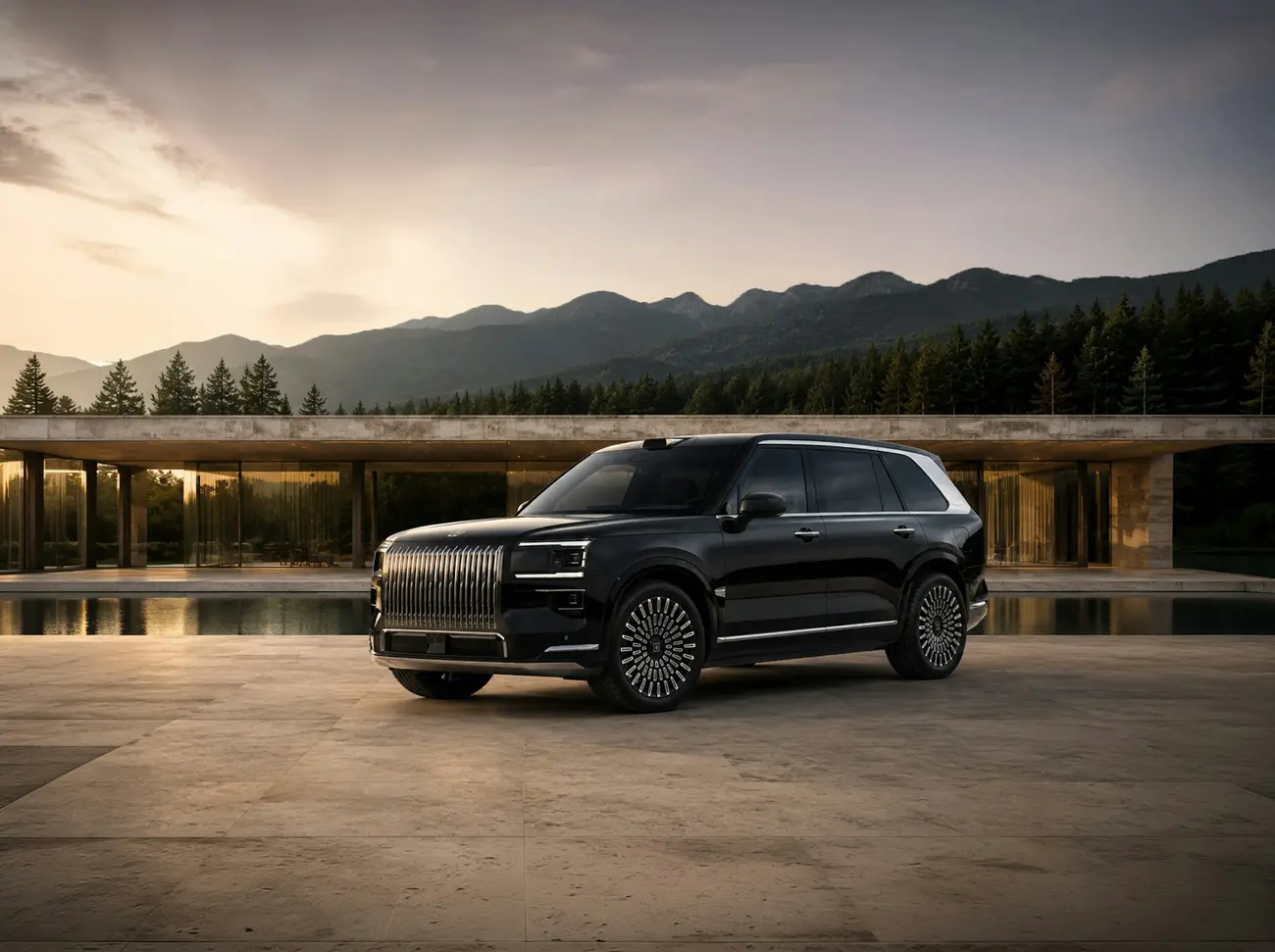
897 hp, six seats and 5.24 metres: Zeekr's new flagship
Amsterdam, 29 July. Zeekr pulled the covers off the 9X, the biggest and most expensive car the Chinese brand has ever brought to Europe — a luxury SUV measuring 5,239 mm nose to tail, longer than a long-wheelbase Range Rover, with nearly three tonnes to get moving.
It is not an EV. It is not quite a plug-in hybrid in the sense we are used to either. And it has no price yet. Even so, it is the most interesting Chinese launch of the year for anyone shopping in BMW X7, Mercedes GLS or Audi Q9 territory.
Super Hybrid: an electric car with a generator on board
Zeekr calls it "Super Hybrid". The technical term is EREV — an extended-range electric vehicle. The wheels are always driven by the electric motors; the 2.0-litre turbocharged four-cylinder petrol engine works mainly as a generator, producing electricity once the battery runs low.
That changes how you live with the car. The 55.1 kWh gross NMC battery gives roughly 179 km of electric-only range — more than plenty of small EVs, and far beyond the 60 to 90 km typical of a premium plug-in hybrid. If your week is Lisbon-Cascais or Porto-Braga, the 9X is an electric car Monday to Friday. The generator only wakes up on the Algarve run, and there the combined WLTP range reaches 737 km.
The architecture is 900 V, which explains the most impressive number on the sheet: DC fast charging peaks at 330 kW, and 10-80% takes 9.5 minutes. At an ultra-rapid charger on the A1 motorway, that is the length of a coffee stop.
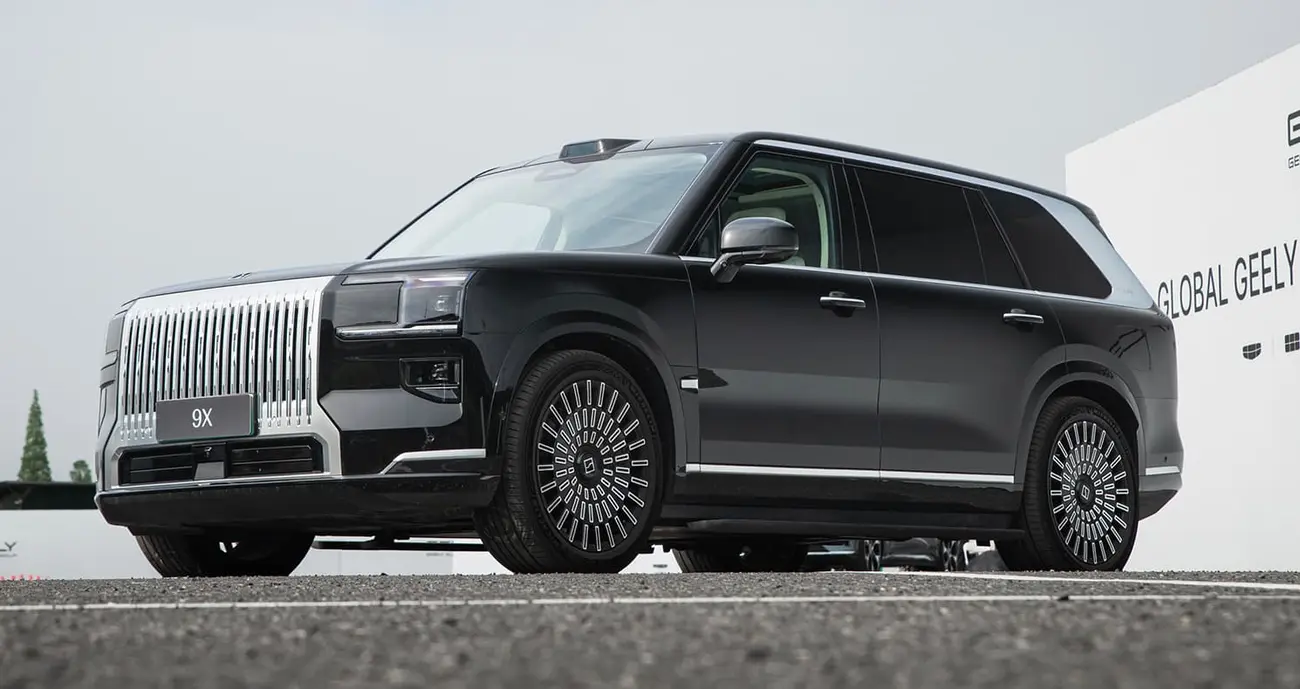
Zeekr 9X specs and range (European version)
| Specification | Value |
|---|---|
| Type | Luxury SUV, EREV (range extender) |
| Combustion engine | 2.0 turbo 4-cylinder petrol (generator) |
| Electric motors | 2 (front + rear), all-wheel drive |
| Electrical architecture | 900 V |
| System power | 897 hp (660 kW) |
| Torque | 935 Nm |
| 0-100 km/h | 4.1 s |
| Top speed | 240 km/h |
| Battery | 55.1 kWh gross (NMC) |
| Electric range | about 179 km |
| Combined range | up to 737 km (WLTP) |
| DC charging peak | 330 kW |
| Charging 10-80% | 9.5 min |
| Towing capacity | 2,000 kg |
| Length | 5,239 mm |
| Width | 2,029 mm (2,290 mm with mirrors) |
| Height | 1,819 mm |
| Wheelbase | 3,169 mm |
| Kerb weight | 2,900 kg |
| Ground clearance | 208 mm front / 200 mm rear |
| Suspension | Double wishbone front, multi-link rear; dual-chamber air with CDC |
| Wheels | 22-inch, 285/45 R22 |
| Seats | 6 (2+2+2) |
Europe gets one motor fewer than China
Worth knowing before you compare numbers with anything written about the Chinese market. In China, the 9X runs three electric motors, over 1,300 hp (1,030 kW), a 70 kWh battery, more than 300 km of electric range and 1,250 km on the CLTC cycle. It does 0-100 km/h in 3.1 seconds.
The European car loses a motor. That is a mechanical difference, not a software tune — 897 hp instead of over 1,300, 4.1 seconds instead of 3.1, 55.1 kWh instead of 70. It remains absurdly quick for something weighing nearly three tonnes, but it pays to know where the figures come from before repeating them.
Zeekr 9X price in Portugal: what we can estimate
Let us be clear: there is no official price, for Europe or for Portugal. Zeekr describes its own specifications as preliminary pending final homologation, and has not announced when order books open.
What we can do is look at the direct rivals. In Germany the Mercedes GLS starts at €102,700, the BMW X7 at €106,500 and the Audi Q9 at €108,400. Zeekr's playbook in every segment it has entered so far is to undercut the Germans. In Portugal, once ISV (the vehicle registration tax) and VAT are stacked on top of the base figure, it is realistic to expect the 9X above €100,000, most likely in a €100,000 to €120,000 band.
One tax variable could help. As a hybrid with more than 50 km of homologated electric range and low emissions, the 9X may fall into the more favourable tax treatment Portugal reserves for plug-in hybrids, which cuts the engine-capacity portion of ISV substantially. Only final homologation will confirm it, but on a car this size that difference runs into thousands of euros — which is exactly why EREVs are gaining ground here.
Zeekr 9X Portugal release date
Zeekr is already in our market. The brand is represented in Portugal by Salvador Caetano, which started in 2026 with the 001, X, 7X and 7GT. That settles the question that usually holds Chinese brands back: service network, warranty and parts.
As for the 9X, the Portuguese motoring press points to an arrival in early 2027. That is a reported expectation, not a commitment from Zeekr — the brand has not confirmed dates by market. Across Europe, first deliveries are reported for late December 2026, and part of the retail rollout shares a network with Lotus, another Geely brand.
Zeekr 9X vs BMW X7 and Mercedes GLS: where the difference lies
The 9X does not compete with the BMW X5 or the Mercedes GLE. It sits a class above, alongside the X7, the GLS, the new Audi Q9 and the Range Rover. Worth keeping in mind for price expectations: if you want a large SUV at €70,000, the X5 and GLE remain the rational choice.
Against the Germans, Zeekr's argument is twofold. First, the technology: 900 V, 330 kW charging and 179 km of electric range are numbers no X7 or GLS hybrid can match today. Second, standard equipment — the 9X arrives in a single Ultra AWD six-seat version with everything included, while at the German rivals half of what you see in the brochure photos is an option.
The counter-argument is real, and worth saying out loud: 2,900 kg is a lot of mass to stop and turn, residual values for a young Chinese brand in Portugal are an unknown, and the X7 carries 25 years of segment reputation that screens do not buy.
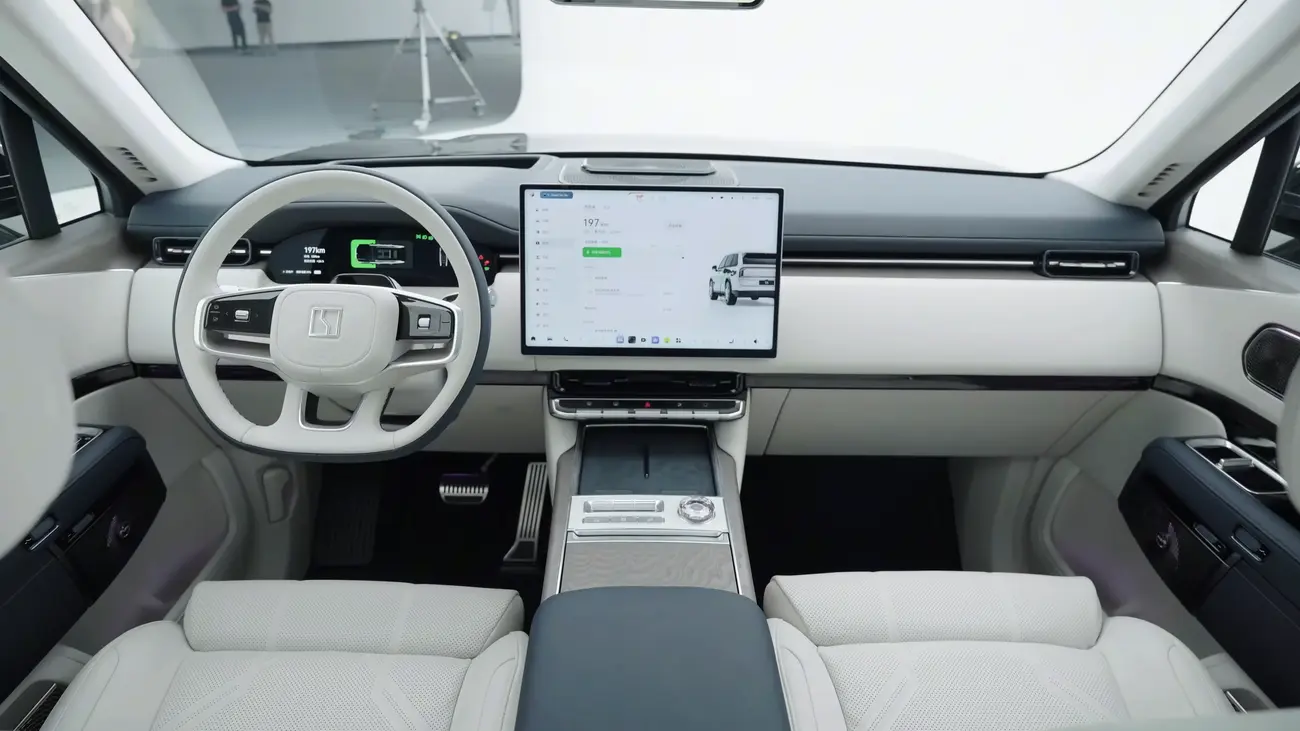
Six seats, 32 speakers and a cinema in the roof
The cabin is where Zeekr spent its ambition. There are two 16-inch 3.5K OLED screens, an augmented-reality head-up display with a 47-inch projected area, and a 17-inch 3K OLED panel that glides 88 cm down from a ceiling pod to serve as a cinema for rear passengers.
Audio is by Naim: 32 speakers, 3,868 W. Front seats are 12-way powered with memory, massage, ventilation and heating; the second row gets individual six-way captain's chairs with powered leg rests. There is a fridge in the second row, Nappa leather throughout, a micro-suede headliner and Nordic wood trim.
Less visible, more important: dual-chamber air suspension with dual-valve CDC damping, six-piston fixed front brake calipers, ten drive modes (three road, seven terrain) and LiDAR-based driver assistance running on Nvidia Drive Thor chips, calibrated for European roads. Towing capacity is 2,000 kg.
The design comes from Stefan Sielaff's team at Geely's studio in Gothenburg. Lothar Schupet, Zeekr's European boss, sums up the intent: "Despite its commanding size, this car is extroverted and elegant simultaneously."
Frequently Asked Questions
It is a range-extender electric vehicle (EREV), which Zeekr markets under the Super Hybrid name. The wheels are always driven by the two electric motors, while the 2.0-litre turbo petrol engine works almost exclusively as a generator to recharge the battery. The key difference from a conventional plug-in hybrid is electric range: around 179 km, against the 60 to 90 km typical of a premium PHEV.
There is no official price, either for Europe or for Portugal — Zeekr describes the specifications as preliminary, pending final homologation. The only reference points are its direct rivals, which in Germany start at €102,700 (Mercedes GLS), €106,500 (BMW X7) and €108,400 (Audi Q9), while Portuguese media suggest a figure around €100,000. Once Portuguese ISV and VAT are applied, a band between €100,000 and €120,000 is realistic, with the final tax treatment depending on the homologated emissions and electric range figures.
Zeekr has been operating in Portugal since 2026 through Salvador Caetano, with the 001, X, 7X and 7GT already on sale. For the 9X, Portuguese media point to early 2027, following the first European deliveries reported for late December 2026. This is a reported expectation rather than a Zeekr commitment — the brand has not confirmed market-by-market dates or the opening of orders.
The 55.1 kWh gross NMC battery delivers around 179 km of electric-only range, and combined range with the petrol generator reaches up to 737 km on the WLTP cycle. Thanks to the 900V architecture, DC fast charging peaks at 330 kW and covers 10-80% in roughly 9.5 minutes. In practice few chargers on the Portuguese network deliver 330 kW, so real-world times will depend on the ultra-rapid charger available.
The 9X plays in the full-size class alongside the BMW X7, Mercedes GLS, Audi Q9 and Range Rover — not the X5 or GLE, which sit one class below. At 5,239 mm long, with six seats in a 2+2+2 layout, 897 hp and 2,900 kg, it offers technology figures (900V, 330 kW, 179 km of electric range) that no hybrid X7 or GLS matches today, and it arrives in a single fully equipped Ultra AWD version. The German rivals counter with known residual values and a segment reputation that a young Chinese brand still has to build in Portugal.
Is it worth waiting for?
Whether the 9X is the right car for you hinges entirely on a number we do not have yet. With this level of equipment and technology, it only makes sense if it lands clearly below the X7 and the GLS — arrive in Portugal at German money and the brand does not yet have the track record to justify the switch.
What is already settled is the context: Zeekr has a network in Portugal, the Chinese luxury SUV is no longer a hypothetical, and an EREV with 179 km of electric range solves the dilemma of driving on electrons all week without depending on chargers on long trips. All that is missing is the price tag, expected in the coming months.