
Zeekr 8X in Portugal: 328 km Electric Range, Specs and Price Outlook
Published: 08/09/2026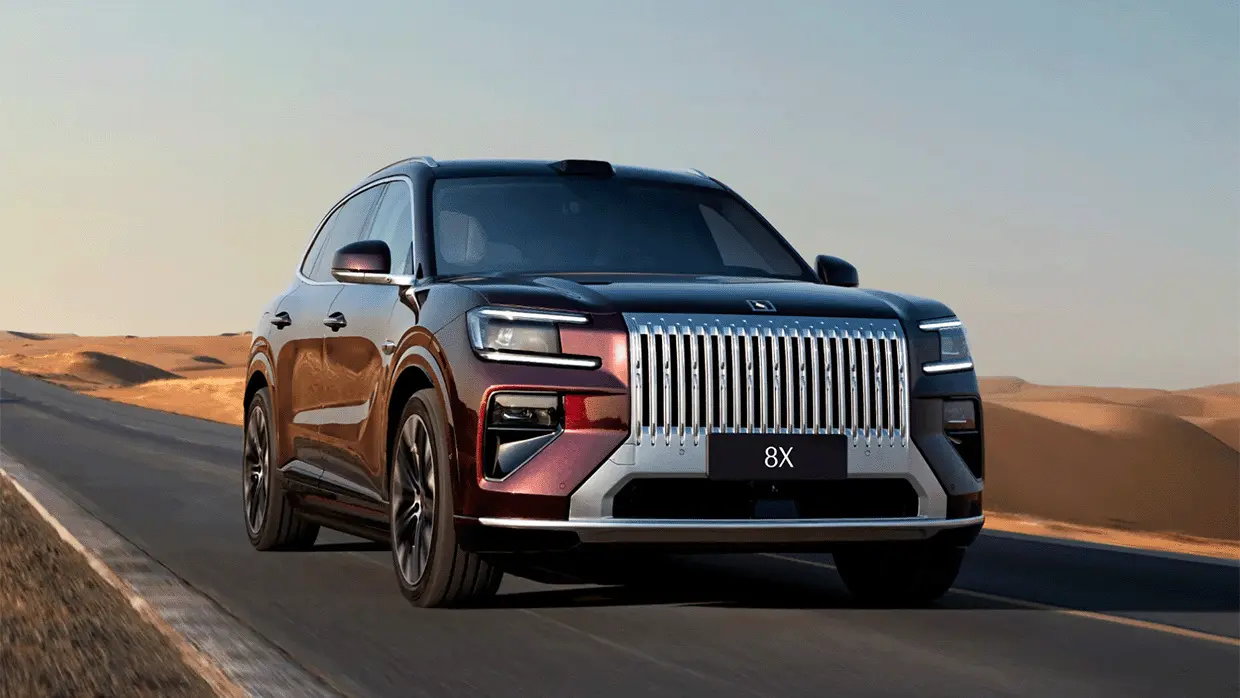
A plug-in hybrid with 328 km of electric range rewrites the rulebook
Nearly every plug-in hybrid on sale in Portugal today covers 80 to 100 km on electricity alone. The Zeekr 8X claims up to 328 km. That is not a decimal-point error: the Chinese brand essentially built a big-battery electric car and bolted on a 2.0-litre turbo petrol engine for the days when range runs short.
The engineering logic runs backwards from the norm. Instead of electrifying a combustion car with a small pack, Zeekr started with a 900 V architecture, fitted a 70 kWh battery, and demoted the engine to backup duty. Which is why the Zeekr 8X electric range will dominate the conversation in Portugal when the car arrives — if it arrives.
328 km is WLTC, not WLTP
This is where the first caveat matters. The 328 km figure comes from the WLTC cycle with the 70 kWh battery; the 55 kWh version manages 256 km. On China's CLTC cycle the same pack claims 410 km, and CLTC is famously generous.
No European figure exists yet. Auto Express drove a European-specification car and reported roughly 150 miles, about 240 km, on a European cycle. Treat that as the realistic number. It is still more than double what any mainstream plug-in sold here achieves — but it is not 328 km.
Where the 660 kW actually goes (and why it is not charging power)
The second figure that keeps getting garbled: 660 kW is combined system output, not charging power. The twin-motor version produces 660 kW, roughly 897 hp, and hits 100 km/h in 3.7 seconds. The tri-motor flagship, called Yaoying, climbs to 1,030 kW — close to 1,400 hp — with 1,400 Nm, 2.96 seconds to 100 km/h and a 220 km/h top speed.
On the combustion side sits an Aurobay 2.0-litre turbo petrol with 205 kW (279 hp) and 410 Nm, plus a 145 kW P1 generator. With a full tank and a full battery, Zeekr quotes 1,416 km of combined range.
Charging is a separate story, and an equally striking one. The 900 V architecture supports 6C rates, meaning 20-80% in around nine minutes. German outlet elektroauto-news puts the peak at 425 kW; other publications quote only the charging time, so treat the exact number as indicative until European homologation lands. For context: the handful of European plug-in hybrids that accept DC charging at all do so at a modest 50 kW.
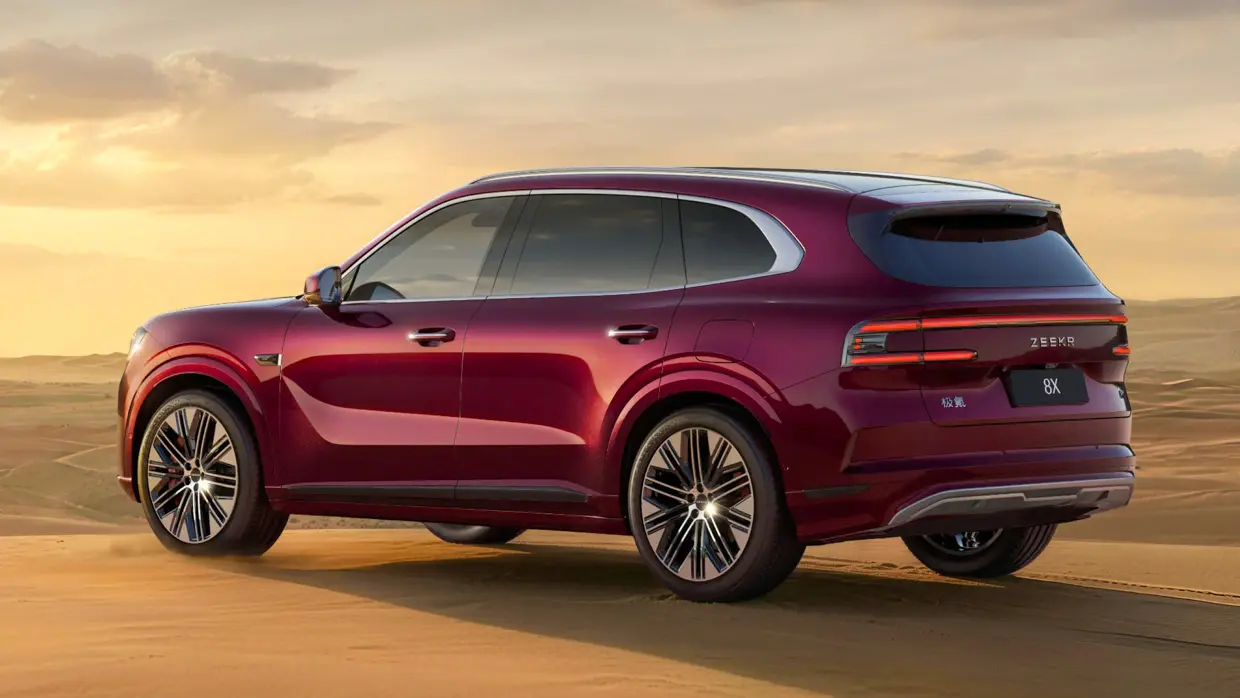
Zeekr 8X specs: the numbers that matter
| Specification | Value |
|---|---|
| Length / width / height | 5,100 / 1,998 / 1,780 mm |
| Wheelbase | 3,069 mm |
| Kerb weight | around 2.8 tonnes |
| Boot (seats folded) | 2,200 litres |
| Seats | 5 or 6 (Chinese market) |
| Platform | Geely SEA-S (Haohan-S), 900 V |
| Petrol engine | 2.0 turbo, 205 kW / 279 hp, 410 Nm |
| P1 generator | 145 kW / 197 hp |
| System output | 660 kW (twin motor) or 1,030 kW (tri-motor Yaoying) |
| 0-100 km/h | 3.7 s / 2.96 s |
| Battery | 55 kWh or 70 kWh NMC, 6C capable |
| Electric range (WLTC) | 256 km (55 kWh) / 328 km (70 kWh) |
| Electric range (European test) | around 240 km |
| Combined range | 1,416 km |
| DC charging | 20-80% in about 9 min; claimed 425 kW peak |
Suspension is double-wishbone at the front and multi-link at the rear, with dual-chamber air springs, adaptive dampers and 48 V active anti-roll bars on some versions. It lifts 5 cm in off-road mode and drops about 3 cm at motorway speeds.
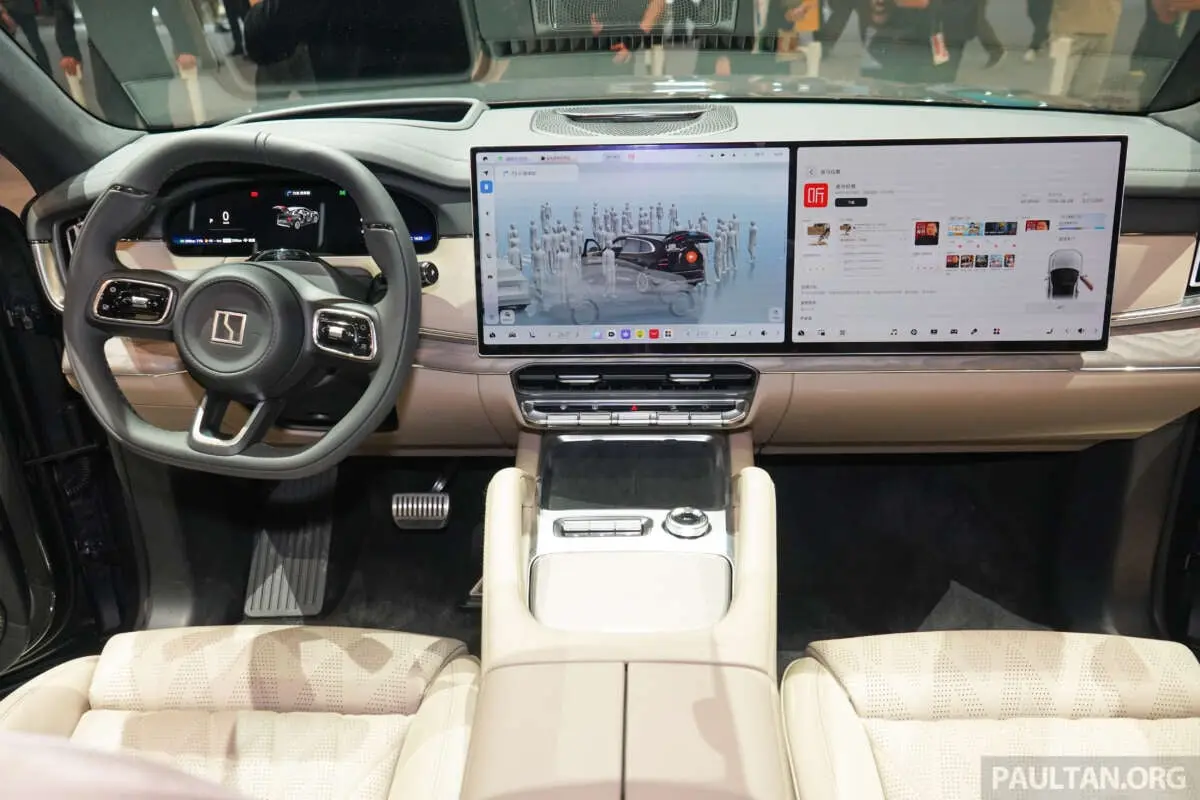
Inside, the excess continues: a 44-inch augmented-reality head-up display, a 16-inch screen for the driver and another for the passenger, a 17-inch screen for rear occupants, up to 29 speakers (Naim on European cars), a fridge and 22-point massage seats. Auto Express called the cabin "up with the best we've seen on a Chinese model" but scored the car 3.5 out of 5: the steering is over-assisted and body control does not keep pace with German rivals.
How it compares with plug-in hybrids sold in Portugal
There is no direct benchmark in our market. Europe's current long-range plug-in champion is the Lynk & Co 08 at roughly 200 km WLTP from a 39.6 kWh battery. The Mercedes GLC 300 e manages 124 km. The vast majority of plug-ins — Volkswagen, Peugeot, Toyota, Kia — sit in the 80 to 100 km bracket.
In practical terms: with 240 km of usable electric range, an 8X covers a full week of commuting in Lisbon or Porto without burning a drop of petrol, and still does Lisbon to Coimbra on electricity alone. The engine becomes what a plug-in engine should always have been — a safety net for August and the run down to the Algarve.
Tax is the other half of the equation. In Portugal, plug-in hybrids only qualify for reduced ISV (the one-off vehicle registration tax) if they meet legal minimums for electric range and emissions, and with these battery sizes the 8X sits comfortably on the right side of that line. Its 2.8-tonne kerb weight and 2.0-litre capacity, however, push the bill up from the other direction.
Zeekr 8X price and Portugal release date
In China the 8X launched on a promotional 329,800 yuan, with the official list running from 356,800 to 500,800 yuan. Auto Express estimates GBP 60,000 for the entry car in the UK and GBP 70,000 for the range-topper, which points to somewhere between 70,000 and 85,000 euros in a European market carrying VAT and ISV — our estimate, not an announced price.
On timing, it pays to be blunt: there is no confirmed Portuguese launch for the 8X. What exists are signals. Geely Auto CEO Gan Jiayue talked about overseas markets from the third or fourth quarter of 2026. CarNewsChina points to Europe after late 2026, the German press says 2027 for Germany, and Auto Express expects early 2027 in the UK.
One concrete fact works in Portugal's favour: Zeekr is already here. The 001, X, 7X and 7 GT are on sale locally, one of 16 European countries where the brand operates. The network exists and the importer exists — the car just has to make the list.
If you are shopping for a large electrified SUV right now, waiting on a model with no date, no price and no European homologation is a hard bet to justify. But the 8X is worth watching for a different reason: if a plug-in hybrid with 240 real kilometres and genuine fast charging establishes itself in Europe, the 100 km its rivals offer today will start to look thin very quickly.
Frequently Asked Questions
There is no official Portuguese price yet. In China the 8X launched with a promotional entry point of 329,800 yuan, with the official range running from 356,800 to 500,800 yuan, while UK outlets estimate roughly GBP 60,000 to GBP 70,000. Once Portuguese ISV and VAT are applied to a plug-in hybrid of this size, a starting figure north of EUR 70,000 is the realistic scenario — but that is an estimate, not a price confirmed by the brand.
The headline 328 km is a WLTC figure for the 70 kWh battery (the 55 kWh pack is rated at 256 km WLTC, and the Chinese CLTC cycle stretches to 410 km). Driving a European-specification car, Auto Express recorded around 240 km, so a homologated European WLTP number should land well below 328 km. Even so, that would still be more than double what almost every plug-in hybrid currently sold in Portugal offers.
No Portuguese launch date has been confirmed. Zeekr already sells the 001, X, 7X and 7 GT here, which smooths the path for new models, but for the 8X the only guidance is that overseas sales begin in the third or fourth quarter of 2026, with Germany mentioned for 2027 and the UK for early 2027. A Portuguese debut somewhere in 2027 is an expectation rather than a commitment.
No. The 660 kW (about 897 hp) is combined system output for the dual-motor version, good for 0-100 km/h in 3.7 seconds, while the tri-motor flagship climbs to 1,030 kW and 2.96 seconds. Charging is a separate number: the 900-volt architecture and 6C cells allow a claimed 425 kW DC peak, with 20 to 80 per cent in roughly 9 minutes — far beyond today's European plug-in hybrids, which rarely accept more than 50 kW on DC.
The longest-range plug-in hybrid on sale in Europe today is the Lynk & Co 08 at around 200 km WLTP from a 39.6 kWh battery, followed by the Mercedes GLC 300 e at about 124 km, while most mainstream models sit between 80 and 100 km. Even at the more conservative European figure of roughly 240 km, the 8X would reset the benchmark, and it adds 5.10 metres of length, a 2,200-litre boot with the seats folded and 1,416 km of combined range.