
XPeng GX in Portugal: New Six-Seat Electric SUV With 750 km Range
Published: 09/04/2026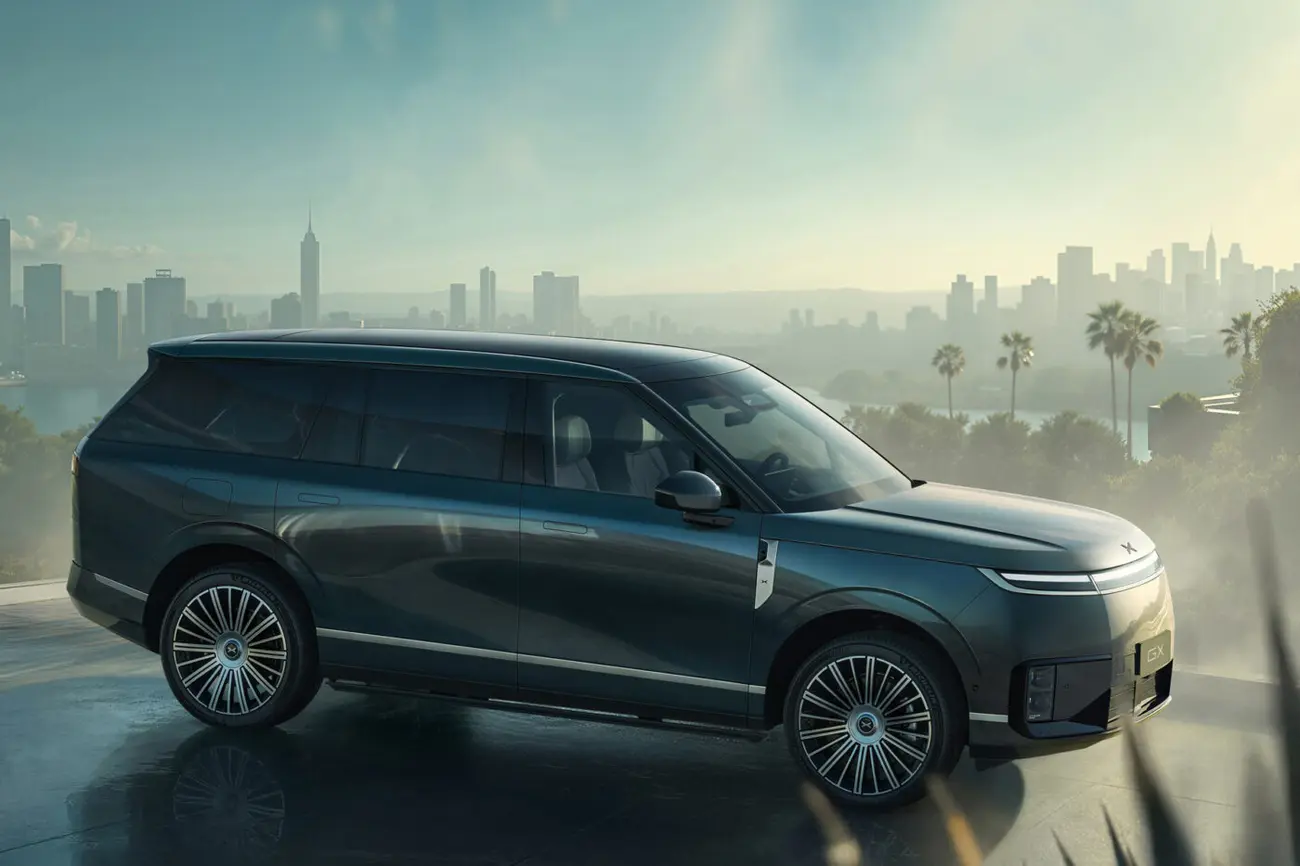
XPeng GX: the new flagship electric SUV eyeing Europe
XPeng has released the first details of the GX, a six-seat electric SUV that will become the Chinese brand's new flagship. The full reveal is set for the Beijing Auto Show in late April 2026, but what we already know is enough to explain why this model matters for buyers in Portugal.
XPeng is one of the few Chinese EV makers already building cars in Europe. The G6 and G9 have been rolling off the Magna Steyr line in Graz, Austria, since September 2025, and the P7+ joins them in April 2026. The company wants to grow from three to seven models in Europe by 2027, and the GX is the obvious candidate for that expansion. Add to that a six-seat electric SUV over 5.2 metres long with a claimed range of up to 750 km, and you have a product that fills a gap almost nobody else is covering in Portugal below 100,000 euros.
What XPeng is preparing with the GX
The GX (internal codename G01) sits on XPeng's SEPA 3.0 platform, the same "physical AI" architecture used on its most recent models. The visual reference to the Range Rover L460 is unmistakable and deliberate — slanted A and B pillars, a split two-piece tailgate, retractable door handles. It measures 5,265 to 5,270 mm long, 2,000 mm wide, 1,800 mm tall, with a 3,115 mm wheelbase. Inside, it uses a 2+2+2 layout with six individual seats.
CEO He Xiaopeng describes the project as a solution to the "impossible triangle" of three-row SUVs: boot space when the car is full, comfortable driving, and dimensions that don't turn the vehicle into a bus. It is an ambitious promise for a segment where rivals like the Li Auto L9, Huawei Aito M9, Zeekr 9X, Nio ES9 and Denza N9 already have a strong reputation in China.
Range and charging: where the GX stands out
XPeng is going with a dual powertrain strategy. The pure electric version offers two battery choices from CALB:
| Battery | Chemistry | CLTC range RWD | CLTC range AWD |
|---|---|---|---|
| 91.9 kWh | LFP | 655 km | 635 km |
| 110 kWh | NMC | 750 km | 720 km |
The top version delivers 430 kW (around 585 hp) with all-wheel drive and hits 200 km/h. The real technical advantage is the 800 V architecture combined with 5C charging — in practice, a quick 10 to 15 minute stop at a fast charger adds several hundred kilometres of range. That tackles the biggest friction point still holding Portuguese buyers back from going electric.
For drivers who don't want to rely only on a battery for long trips, there's the EREV variant built around the Kunpeng Super Electric System. A Harbin Dongan 1.5-litre petrol engine (110 kW) acts purely as a generator, with no mechanical connection to the wheels. It delivers 320 km in electric mode and exceeds 1,000 km combined. Same philosophy as the Nissan e-Power or the Mazda MX-30 R-EV, but with far bigger numbers — and it removes the range anxiety from a Lisbon-Algarve-Porto weekend without forcing long charging stops.
Technology: four Turing chips and camera-only autonomy
XPeng says the GX carries four in-house Turing chips with a combined compute budget above 3,000 TOPS. That's enough horsepower to support Level 4 autonomous driving through a camera-only vision system, with no roof-mounted LiDAR — a similar bet to Tesla's, but unusual among Chinese manufacturers.
The tech list keeps going: Bosch steer-by-wire (no mechanical link between steering wheel and front axle), rear-wheel steering, an AR head-up display replacing the traditional instrument cluster, and an AI-controlled adaptive chassis. It is the sort of equipment that European premium brands typically reserve for models well above 120,000 euros.
How much it will cost and when it might reach Portugal
In China, the expected price sits between 400,000 and 500,000 yuan, which converts to roughly 49,000 to 62,500 euros before import costs and margins. For reference, the XPeng G9 starts at 248,800 yuan in China and 59,900 euros in Portugal — the gap between Chinese and European pricing is close to 80% once logistics, homologation, distribution and tariffs are factored in.
Apply the same maths to the GX and a realistic Portuguese price for the fully electric version lands somewhere between 85,000 and 110,000 euros. Two variables will shape where it ends up:
- EU tariffs: the additional 17% to 36.3% tariffs on Chinese-built EVs imported directly into Europe are still in force. If the GX is built in Graz — like the G6 and G9 — it avoids this cost entirely.
- Portuguese tax incentives: pure electric cars are exempt from ISV (the Portuguese registration tax) and pay reduced IUC (annual road tax). The BEV version qualifies directly; the EREV, because it has a combustion engine, is treated as a hybrid and pays full ISV.
No Portugal launch date has been confirmed yet, but XPeng's roadmap points to a broader European push in 2027. Until then, China is the first market, with the local launch expected in April or May 2026, right after the Beijing reveal.
XPeng GX vs G9: where the new flagship fits
The G9 is currently the most expensive SUV XPeng sells in Portugal, with WLTP range up to 570 km and five seats. The GX sits clearly above it: 40 cm longer, six seats instead of five, bigger batteries, CLTC range up to 750 km (WLTP figures will come in lower, probably around 620–640 km) and the EREV option the G9 doesn't offer.
For larger families, or anyone who drives long distances regularly and doesn't want to depend solely on the charging network, the GX solves both scenarios at once. The G9 will still be the more sensible choice for buyers looking for a premium five-seat electric SUV — and noticeably cheaper on the bottom line.
Frequently Asked Questions
There is no official Portugal launch date yet. The GX is unveiled at the Beijing Auto Show in late April 2026 and goes on sale in China between April and May 2026. XPeng plans to grow from three to seven models in Europe by 2027, so a Portuguese launch is most likely in 2027, especially if the model enters production at the Magna Steyr plant in Graz, Austria.
In China, the expected price sits between 400,000 and 500,000 yuan, roughly 49,000 to 62,500 euros before taxes, logistics and margins. Applying the same Chinese-to-European markup as the XPeng G9 (248,800 yuan in China, 59,900 euros in Portugal), a realistic estimate for the fully electric GX falls between 85,000 and 110,000 euros — a figure that could drop if European production in Graz avoids the EU's 17% to 36.3% tariffs on imported Chinese EVs.
XPeng claims up to 750 km on China's CLTC cycle for the BEV version with the 110 kWh NMC battery (RWD), and 655 km CLTC for the 91.9 kWh LFP version. On Europe's WLTP cycle, those figures typically drop 15% to 20% — meaning realistic range between 620 and 640 km for the top variant. The EREV version with a petrol range extender delivers 320 km in pure electric mode and over 1,000 km combined.
The GX uses an 800-volt architecture compatible with 5C fast charging, the same technical generation as the XPeng G9 and Porsche Taycan. In practice, a 10 to 15 minute stop at an ultra-fast charger adds several hundred kilometres of range. In Portugal, that speed can only be fully used at 350 kW stations such as those operated by Ionity and MIIO Hyper, which are still sparse outside the main A1-A2 corridors.
The GX sits clearly above the G9: 40 cm longer (5.27 m versus 4.89 m), six seats in a 2+2+2 layout instead of five, larger batteries (up to 110 kWh versus 98 kWh on the G9), and an EREV option with a range extender that the G9 does not offer. The G9 remains the more sensible choice for buyers after a premium five-seat electric SUV at a lower price — it starts at 59,900 euros in Portugal, whereas the GX is expected to exceed 85,000 euros.
What to watch next
The Beijing reveal in late April or early May will confirm official Chinese pricing, interior photos and WLTP range figures for Europe. If XPeng confirms the GX enters production in Graz, the conversation changes completely — it becomes a Chinese EV built in Europe, free of tariffs, carrying tech that most German premium brands haven't yet delivered in series production. The numbers worth waiting for are the European price tags, which should land over the course of 2026 and early 2027.