
Xpeng G6 800V Tested: Real World Range and 12-Minute Charging in Portugal
Published: 08/05/2026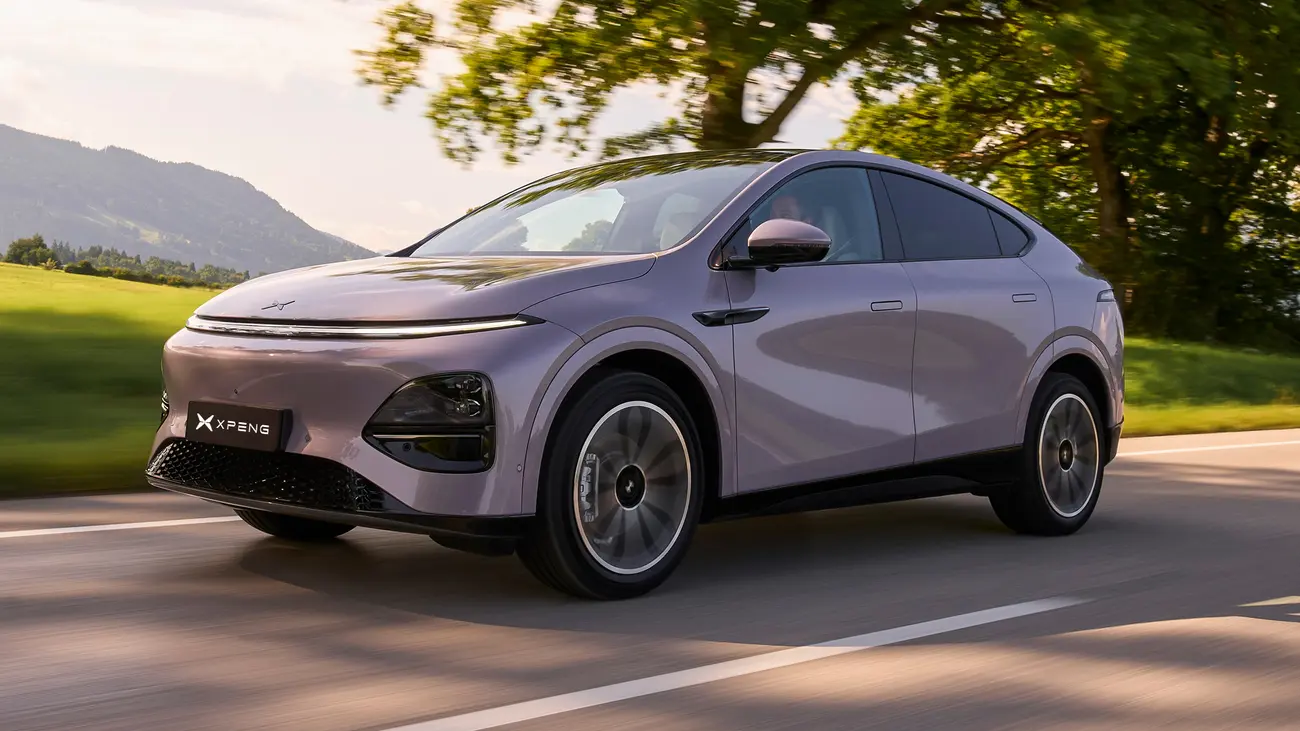
12 minutes to fill up: what the Xpeng G6 800V actually delivers
Twelve minutes from 10 to 80% battery. That is the headline claim that sets the facelifted Xpeng G6 apart from almost every electric SUV on sale in Portugal — and in a real-world test by Caradisiac, the stopwatch landed on 12 minutes and 36 seconds. This is not rounded marketing: it is what the 800V architecture delivers when it meets a charger up to the job. The catch, of course, is that those chargers are still scarce.
This Chinese coupé-SUV reaches Europe with an LFP battery, up to 535 km of WLTP range, and pricing from 46,990€ in France and Belgium. In Portugal, distributed by Caetano, it lines up directly against the Tesla Model Y and the BYD Sealion 7. Worth buying? It depends on what you value most — and especially, where you usually charge.
Xpeng G6 real world range: what survives from 535 km WLTP
The Long Range RWD claims 525-535 km WLTP from its 80.8 kWh LFP pack. In mixed driving, Caradisiac measured around 400 km on the Performance variant, which carries more weight and power. On steady motorway use, the figure drops to roughly 340 km.
The bleaker scenario comes from the UK. Electrifying.com tested the Performance Black Edition through a British winter and recorded only 2.3 mi/kWh — roughly 290 km of real range, with consumption above 22 kWh/100 km. The cause is LFP chemistry, more cold-sensitive than NMC cells. In the Algarve in August, the story is different; in January up in Serra da Estrela, plan for less.
The consumption figures confirm the pattern:
- Mixed (Touring, Belgium): 17.5 kWh/100 km on RWD Long Range
- Mixed (Caradisiac, France): 19.5 kWh/100 km on Performance AWD
- UK winter test: above 22 kWh/100 km
For a Portuguese buyer doing the regular Lisbon-Porto run, that means one charging stop near the halfway point. Not a problem — and exactly where the 800V system starts to earn its keep.
Xpeng G6 800V charging: putting 451 kW to the test
The spec sheet quotes peak DC charging of 451 kW on Long Range and Performance trims, and 382 kW on the Standard Range. In practice, across Portugal and most of Europe, that headline figure is theoretical: very few public stations exceed 350 kW. In France, according to Caradisiac, only around 2% of DC sites cross that threshold; Belgium tops out at 350 kW.
The practical outcome is straightforward. On a 300 kW charger, Caradisiac logged a real peak of 299 kW, an average of 280 kW, and 12 minutes and 36 seconds from 10 to 80%. The charging curve holds firm at whatever the station can deliver — and that is rare in the segment.
In Portugal, MOBI.E (the national charging network) plus operators like Galp, Repsol and Iberdrola already run 300-350 kW sites along the major motorways. The G6 makes full use of them. Plug it into an older 50 kW charger, on the other hand, and it charges like any other EV — the advantage evaporates.
Where 800V genuinely pays off
- A1 Lisbon-Porto: short stops instead of a long lunch
- A22 Algarve in summer: queues at chargers move faster
- Spain-Portugal trips: Ionity and Iberdrola networks now deliver high power
For drivers who charge 90% of the time at home on a 7.4 kW wallbox, this argument fades. The 80 kWh battery refills overnight without trying.
Xpeng G6 specs and trim breakdown
| Spec | Standard Range | Long Range RWD | Performance AWD |
|---|---|---|---|
| Battery (LFP) | 66 kWh | 80.8 kWh | 80.8 kWh |
| WLTP range | 440 km | 525-535 km | 510 km |
| Power | n/a | 295-296 hp | 478-486 hp |
| Torque | n/a | 440 Nm | 660 Nm |
| 0-100 km/h | n/a | 6.7 s | 4.0-4.1 s |
| Top speed | 200 km/h | 200 km/h | 200 km/h |
| Peak DC charging | 382 kW | 451 kW | 451 kW |
| 10-80% (claimed) | 12 min | 12 min | 12 min |
| WLTP consumption | n/a | 17.5 kWh/100 km | 19.5 kWh/100 km |
Length 4,758 mm, width 1,920 mm, wheelbase 2,890 mm and a 571-litre boot (1,374 with the rear seats folded). Heat pump as standard and 3.3 kW V2L output for powering external equipment. Warranty runs to 5 years on the vehicle and 8 years on the battery — class-average rather than class-leading.
Xpeng G6 vs Tesla Model Y vs BYD Sealion 7
A direct look at the two rivals that matter most to Portuguese buyers:
| Xpeng G6 LR RWD | Tesla Model Y LR | BYD Sealion 7 | |
|---|---|---|---|
| Battery | 80.8 kWh LFP | ~78 kWh NMC | 82.5 kWh LFP |
| WLTP | 525-535 km | 600 km | 482 km |
| Peak DC charging | 451 kW | 250 kW | 150 kW |
| 0-100 km/h | 6.7 s | 5.0 s | 6.7 s |
| Base price (FR/BE) | 46,990€ | ~46,000€ | ~47,000€ |
Tesla still wins on driving dynamics, efficiency and the Supercharger network. The BYD Sealion 7 has a more polished cabin, but charges at a third of the G6's speed. The Xpeng delivers the fastest charging in the class and the most generous standard equipment, while European reviewers consistently flag ride comfort as its weak spot — passive damping, comparatively firm, and unsettled on poor surfaces.
How much the Xpeng G6 costs in Portugal
Official prices in France and Belgium:
- Long Range RWD: 46,990€
- Performance AWD: 50,990€
Portuguese pricing is expected to track French levels closely as Caetano XPeng expands its dealer footprint — somewhere between 47,000€ and 51,000€. Two local incentives sweeten the deal: full electric vehicles are exempt from ISV (the Portuguese vehicle registration tax) and benefit from reduced IUC (the annual road tax). For a car with 451 kW peak charging and a long standard-equipment list (head-up display, ventilated seats, premium audio), that is aggressive pricing against a Tesla Model Y that costs similar money with less standard kit.
Two cautions before signing. Three- to five-year residual values for Chinese brands in Europe are still unproven — Xpeng is only now building track record. And the after-sales network, although backed by Caetano, is smaller than Tesla's or that of established European brands.
Frequently Asked Questions
Official prices in France and Belgium are 46,990€ for the Long Range RWD and 50,990€ for the Performance AWD, and Portuguese pricing through the Caetano XPeng network is expected to land between 47,000€ and 51,000€. Two local incentives improve the case: full electric vehicles are exempt from ISV (vehicle registration tax) and benefit from reduced IUC (annual road tax), making the G6 more competitive than equivalently priced combustion rivals.
Xpeng claims 12 minutes for 10-80% and Caradisiac recorded 12 minutes and 36 seconds in a real-world test, but only on a 300 kW charger able to feed the battery's curve. The 451 kW peak requires stations above 350 kW, which account for less than 2% of France's DC network and remain scarce in Portugal — plug into a 50 kW charger and the G6 charges no faster than any other EV.
The Long Range RWD claims 525-535 km WLTP from its 80.8 kWh LFP battery, but steady motorway driving brings real-world range down to around 340 km, and Caradisiac measured roughly 400 km in mixed use on the Performance variant. In a UK winter test, LFP cold-sensitivity hit consumption hard, with Electrifying.com logging over 22 kWh/100 km and close to 290 km of usable range.
The Tesla Model Y still leads on efficiency, driving dynamics and the Supercharger network, with about 600 km WLTP versus 525-535 km on the G6 Long Range. In return the Xpeng peaks at 451 kW DC charging (against 250 kW for the Model Y), bundles more standard kit — head-up display, ventilated seats, premium audio — and costs essentially the same, making it the smarter pick for high-mileage motorway drivers who rely on public fast chargers.
For drivers who regularly run Lisbon-Porto or Lisbon-Algarve and stop at 300-350 kW fast chargers on MOBI.E, Galp, Repsol or Iberdrola, the G6 is one of the most convincing electric SUVs you can buy under 50,000€. Two cautions remain: 3- to 5-year residual values for Chinese brands in Europe are still unproven, and the Caetano XPeng after-sales network is smaller than Tesla's or that of established European brands.
Who this SUV is for
The Xpeng G6 Long Range is the obvious pick for high-mileage motorway drivers who frequently charge at high-power stations and want a well-equipped electric SUV under 50,000€. The Performance AWD tempts with its 4-second 0-100, but punishes real-world range and demands charger power most stations can't deliver — buy it for performance, not practicality.
For mostly urban use with home charging, the 800V argument loses its edge and the Model Y remains the efficiency and network benchmark. Buyers chasing ride comfort will find the Skoda Enyaq more refined. But for the driver who runs Lisbon to the Algarve four times a year and wants a 15-minute stop instead of 40, the G6 is one of the most convincing electric SUVs you can buy today — worth a test drive before you decide.