
VW ID. Up Price in Portugal: The €20,000 Electric Car Built at Autoeuropa
Published: 25/11/2026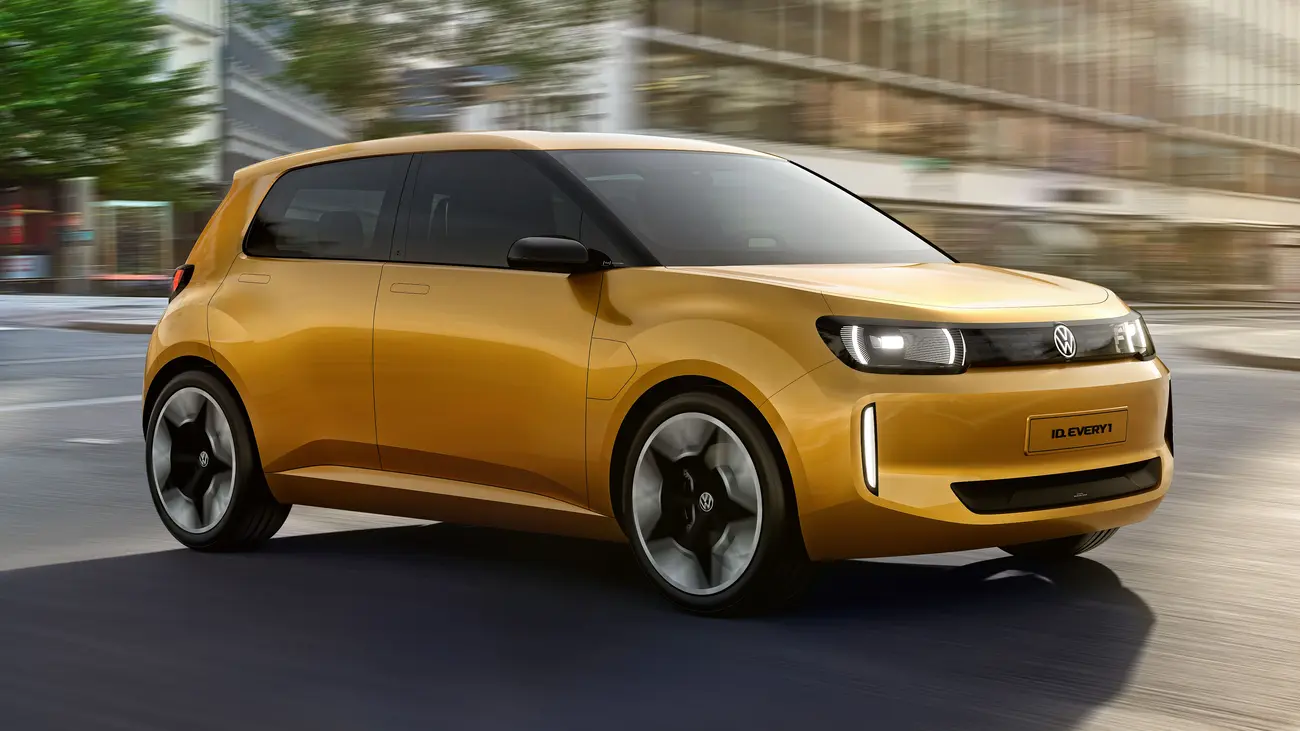
VW ID. Up: the €20,000 EV that will be built in Palmela
Around 20,000 euros, four seats and at least 250 km of range. That's Volkswagen's pitch for its upcoming entry-level EV, and the car now has a likely name: ID. Up. VW filed the name with the EU Intellectual Property Office (EUIPO) on 22 October 2026, according to auto motor und sport, which broke the story. If you're searching for the VW ID. Up price in Portugal, there's a detail that matters more than the badge: this car will be built at the Autoeuropa plant in Palmela, just south of Lisbon.
It's worth separating fact from trademark paperwork. Volkswagen has not officially confirmed that the production model will be called ID. Up. What exists is the EUIPO application (number 019439612, according to press reports) and a clear strategy of reviving familiar names with an "ID." prefix, as already done with the ID. Polo, ID. Cross and ID. Tiguan. Until now, the car was known as the ID. Every1 concept and, in some reports, as the ID.1.
The successor to the VW e-Up, four years on
The up! was sold from 2011 to 2023, and its fully electric version, the e-Up, was one of Europe's most affordable EVs before it went out of production with no direct replacement. Since then, Volkswagen has had nothing below 25,000 euros in its electric line-up.
The ID. Up fills that gap. Comparing it with its predecessor shows how much has changed in a few years:
| VW e-Up (2019) | VW ID. Up (ID. Every1 concept) | |
|---|---|---|
| Length | 3.60 m | 3.88 m |
| Power | 61 kW (83 PS) | 70 kW (95 PS) |
| Battery | 32.3 kWh usable | LFP, unconfirmed (estimates between 32 and 38 kWh) |
| Range | up to 260 km | at least 250 km (WLTP) |
| Base price | €21,975 (Germany, before subsidies) | around €20,000 (target) |
| Production | ended in 2023 | planned for 2027 |
Range stays roughly the same. The gains are everywhere else: 28 cm more length, more power, a new platform and, above all, a target price lower than what the e-Up cost in 2019, despite several years of inflation in between.
VW ID. Up range and specs: what we know so far
Everything official comes from the ID. Every1 concept shown in March 2025. Production figures may shift, but Volkswagen presented these as the reference for the final car:
- Length: 3,880 mm (concept width: 1,816 mm)
- Seats: 4
- Boot: 305 litres
- Motor: newly developed electric motor, 70 kW (95 PS), front-wheel drive
- Top speed: 130 km/h
- Range: at least 250 km (WLTP)
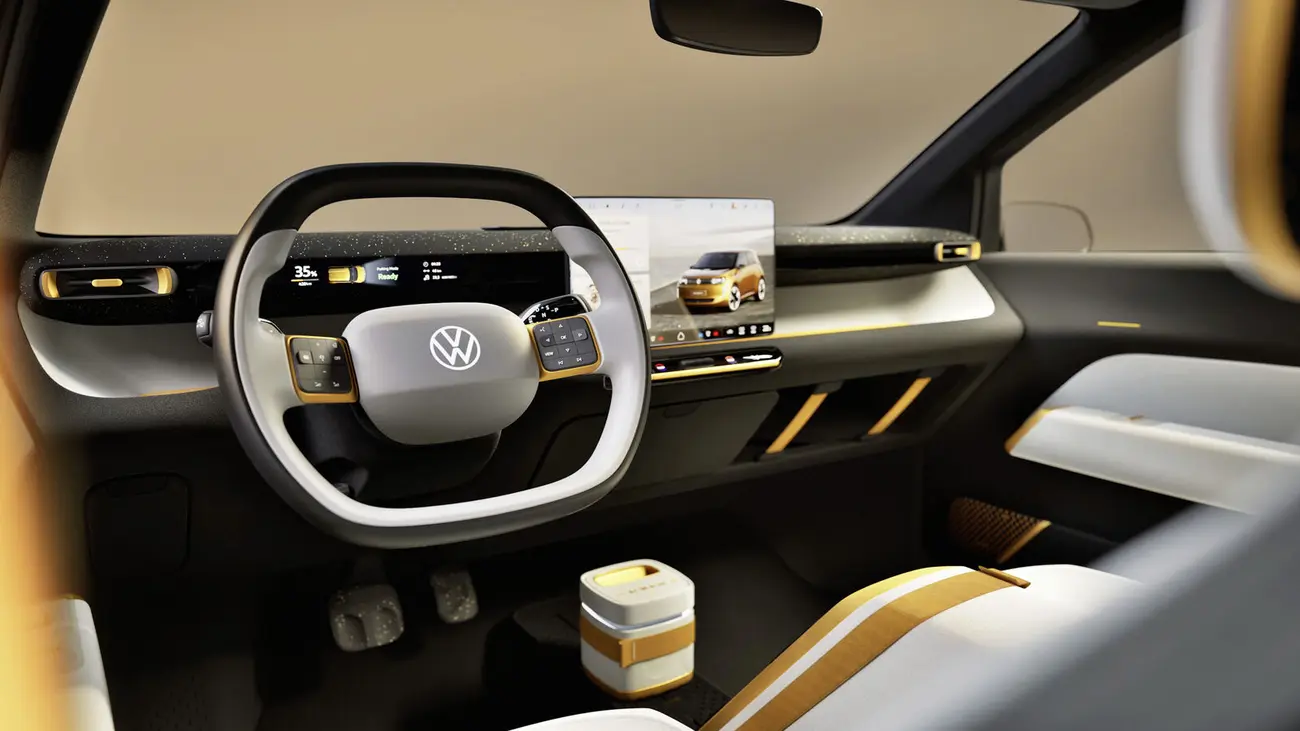
- Screen (concept): 15-inch touchscreen, with physical climate controls
With 250 km WLTP, real-world range on the motorway in winter will be noticeably lower. That's plenty for a week of commuting in Lisbon or Porto, but a Lisbon-Porto run will need a charging stop. This is an A-segment city car, and it should be judged as one.
LFP battery: the big unknown
Battery capacity is the missing piece. Sources agree on LFP (lithium iron phosphate) chemistry, which is cheaper and more tolerant of regular charging to 100%, but disagree on size: Autohled estimates 32 to 38 kWh with cells from Chinese suppliers; auto motor und sport says under 40 kWh; Motor1 and the Paris Motor Show site point to the 37 kWh pack from the entry-level ID. Polo. None of these figures has been confirmed by VW.
MEB Entry platform and Rivian electronics
Underneath sits the front-wheel-drive version of the MEB platform (referred to as MEB Entry or MEB+), shared with the ID. Polo and ID. Cross. The torsion-beam rear axle is carried over from the current Polo.
The most interesting change is one you won't see. The ID. Up will be the first Volkswagen Group car with the zonal electronic architecture developed with Rivian through the RV Tech joint venture. Instead of dozens of separate control units, a few central computers run the car, and it receives over-the-air (OTA) updates throughout its life. Testing took place in Phoenix, USA, and Arjeplog, Sweden, and development was reportedly completed in March 2026.
VW ID. Every1 in Portugal: production at Autoeuropa
On 19 August 2025, the Portuguese government and Volkswagen signed a declaration of intent to build the ID. Every1 at Autoeuropa in Palmela (Setúbal district). Workers and government officials described the decision as historic for the future of a plant that employs more than 4,000 people.
The factory is already being prepared. Production stopped in summer 2026 to modernise the assembly line and paint shop, and resumed on 24 August 2026. A new, less energy-intensive paint shop is due in 2027.
When does production start? The dates don't line up
Sources contradict each other here, so it's best to be upfront:
- In August 2025, Portuguese news agency Lusa reported that Autoeuropa expected ID. Every1 production to begin in mid-2027.
- The Paris Motor Show website (mondial.paris) wrote in October 2026 that staff had reportedly been told in July that production would start toward the end of the year, though the same article is inconsistent between end-2026 and end-2027.
- One Czech outlet (Autohled) says production will happen in Wolfsburg, which contradicts every other source and the agreement signed with the Portuguese government.
The most solid scenario remains Palmela, with a market launch in 2027. Neither the exact start of production nor the world premiere date has been announced.
How much will the VW ID. Up cost in Portugal?
The official target is a starting price of "around 20,000 euros". For Portugal, a few factors are worth weighing before treating that number as a given:
- VAT: European reference prices are usually set with Germany in mind (19% VAT). With Portugal's 23% rate, the local list price could end up slightly higher, although brands often adjust pricing market by market.
- ISV and IUC: as a fully electric car, the ID. Up is exempt from ISV (Portugal's one-off vehicle purchase tax) and IUC (the annual road tax), a clear advantage over a petrol city car.
- Incentives: Fundo Ambiental (the state environmental fund) EV purchase grants could lower the final price, but the rules and amounts for 2027 aren't known yet.
- Price creep: Autohled points out that if Volkswagen repeats the reported price increase on the ID. 2all (now the ID. Polo), the ID. Up could also land above its original target.
The cheapest Volkswagen electric car, below the ID. Polo
The ID. Up will slot in below the ID. Polo, which starts at €24,995 in Germany and France. That roughly €5,000 gap buys you less length (3.88 m versus just over 4 m) and, most likely, a smaller battery and less power. For drivers who mostly do city miles and don't need five seats, the smaller car may make more sense.
Rivals in Portugal: Dacia Spring, Renault Twingo and Leapmotor T03
The sub-€20,000 EV segment is far more crowded than when the e-Up bowed out. Sources name these direct competitors:
- Renault Twingo electric — tipped by Motor1 as the main rival.
- Dacia Spring — the low-price benchmark, more basic and with less power.
- Leapmotor T03 — 265 km of range, with aggressive promotional pricing in several markets.
- Hyundai Inster — 327 km of range in its 42 kWh version, but pricier.
- Citroën ë-C3 and BYD Dolphin Surf — larger or bigger-battery options in a similar price bracket.
- Nissan Pixo — also mentioned by auto motor und sport.
In this group, the ID. Up's trump card probably won't be range, which is in line with the competition. Volkswagen's arguments will be its service network, the resale value of a well-known brand, updatable software and, for many buyers here, the fact that it's made in Palmela.
Frequently Asked Questions
Volkswagen is targeting a starting price of around €20,000, but that figure is a European reference usually set for Germany, where VAT is 19%. With Portugal's 23% VAT, the local list price may end up slightly higher, and official Portuguese pricing has not been announced. As a fully electric car, the ID. Up is exempt from ISV and IUC, while Fundo Ambiental incentive rules for 2027 are not yet known.
Volkswagen says the car will launch in 2027. In August 2025, Lusa reported that Autoeuropa in Palmela expected to start production in mid-2027, but other sources give different dates and the brand has not confirmed an exact start. No date has been announced yet for the world premiere of the production model either.
The Dacia Spring remains the low-price benchmark, but it is more basic and less powerful. The ID. Up promises 70 kW (95 hp), 4 seats, a 305-litre boot, at least 250 km of WLTP range and over-the-air (OTA) updates thanks to the electronics developed with Rivian. The decision will largely come down to the final Portuguese price, which is not yet known.
Volkswagen has not disclosed the battery capacity yet. Sources agree on LFP (lithium iron phosphate) chemistry, which is cheaper and handles charging to 100% better, but estimates range from 32 to 38 kWh (Autohled), under 40 kWh (auto motor und sport) and 37 kWh, the same pack as the entry-level ID. Polo (Motor1 and the Paris Motor Show). For comparison, the e-Up had 32.3 kWh usable.
The ID. Up will sit below the ID. Polo in Volkswagen's electric range, with a target price of around €20,000 versus €24,995 for the ID. Polo in Germany and France. It is 3.88 m long compared with just over 4 m for the ID. Polo, and it has 4 seats instead of 5. Both use the front-wheel-drive MEB platform, but the ID. Up is expected to have a smaller battery and less power.
Is the ID. Up worth waiting for?
If you need an electric city car now, there are alternatives on sale with known prices and specs. If you can wait until 2027, the VW ID. Up promises an entry price close to €20,000, the backing of VW's dealer network and newer tech than many rivals. What we still don't know (battery size, charging speed, final Portuguese price and arrival date) will decide whether it becomes the obvious pick in the segment or just another option. The world premiere, expected in 2027, is the moment to watch.