
Volvo EX60 Price in Portugal and Road Test vs BMW iX3 and Mercedes GLC
Published: 28/09/2026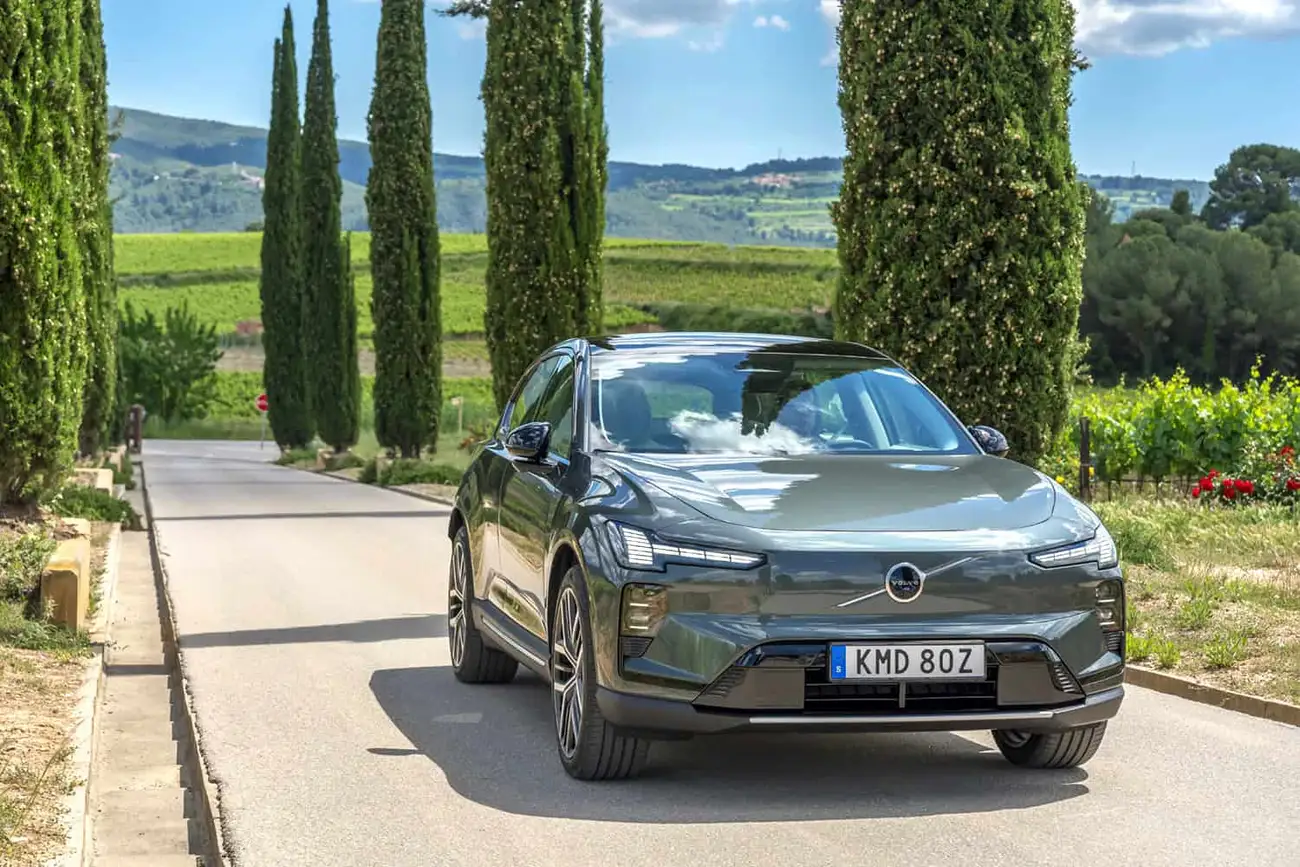
Volvo EX60 vs BMW iX3 and Mercedes GLC: the Swede isn't asking permission
A 380 kW peak at an Ionity charger and 10-80% in 17 minutes 10 seconds. That's what came out of Automobile Propre's test of the Volvo EX60 P10 AWD across the Vosges mountains and the German autobahn — and it goes a long way to explaining why the Volvo EX60 vs BMW iX3 decision has become one of the hardest calls in the premium electric SUV class.
For years, anyone shopping for a premium mid-size electric SUV looked to Munich and Stuttgart first. The EX60 reshuffles that list. It has more power than the iX3 50 xDrive, charges faster than the Mercedes GLC 400 and, when you check the Volvo EX60 price in Portugal, it undercuts both in the equivalent trim. It doesn't win everywhere, though, and there's one weak spot worth knowing about before you sign.
SPA3 platform and 800V architecture
The EX60 is the first Volvo on the new SPA3 platform, which it will share with the upcoming Polestar 7. Three ideas sit underneath it: megacasting (parts like the rear floor made in a single aluminium casting), a battery built directly into the body structure (cell-to-body), and a central computer called HuginCore running Nvidia and Qualcomm chips. Together they save around 130 kg compared with a conventional build.
What you get is an SUV that's 4.80 m long, with a 2.97 m wheelbase and a 0.26 drag coefficient — closer to a raised estate than a boxy SUV. It's built in Torslanda, Sweden, where production started in April 2026.
There are three powertrains:
- P6 RWD — 374 hp, 480 Nm, 0-100 km/h in 5.9 s, 80 kWh usable battery, 620 km WLTP
- P10 AWD — 510 hp, 710 Nm, 0-100 km/h in 4.6 s, 91 kWh usable (95 kWh gross), 660 km WLTP
- P12 AWD — 680 hp, 790 Nm, 0-100 km/h in 3.9 s, 112 kWh usable, 810 km WLTP
All are limited to 180 km/h, and all get 22 kW AC charging as standard — the iX3 and GLC make do with 11 kW in base spec.
Volvo EX60 charging speed 10-80%: the real Ionity test
Volvo quotes 16 minutes for 10% to 80% on the P10. On an Alpitronic HYC400 Ionity charger at Haut-Koenigsbourg, the stopwatch read 17 minutes 10 seconds. A minute slower than promised, but the charging curve is seriously strong:
- 352 kW at just 5% battery
- a 380 kW peak at 42% — above the official 370 kW
- an average of 245 kW across the whole session
For reference, the BMW iX3 50 xDrive claims 21 minutes (with a 400 kW peak) and the Mercedes GLC 400 claims 22 minutes (330 kW). On a Lisbon-Algarve run with a stop on the A2 motorway, the gap between the Volvo and the Mercedes is roughly one fewer coffee.
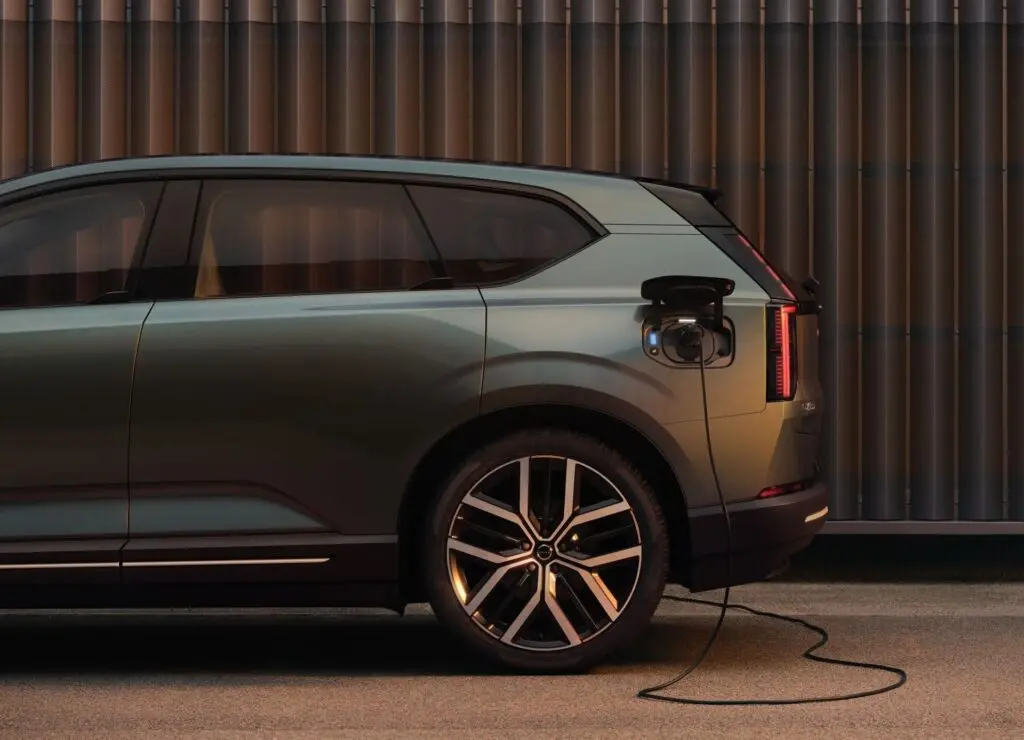
There's a Portuguese catch. Chargers above 300 kW are still rare on MOBI.E, Portugal's national public charging network. The EX60 only shows these numbers on high-power units, like the Ionity sites along the motorways. At a 150 kW charger it will behave like any other recent EV.
Volvo EX60 real-world range and P10 consumption
The P10's 660 km WLTP is the brochure figure. The road tests tell a different story, across three different scenarios.
At high motorway speed
At 180 km/h on an unrestricted autobahn, the EX60 P10 used 36 kWh/100 km. No one in Portugal will reproduce that legally, but it shows the aerodynamics are doing their job: with 91 kWh usable, even at that pace the car covers close to 250 km.
In mixed driving
On the return leg, mixing motorway, back roads and town driving, consumption dropped to 16.2 kWh/100 km — almost exactly the official 15.7 kWh/100 km. L'argus, in a separate test, recorded 16.8 kWh/100 km on a mixed route, which points to roughly 500 km of real-world range.
Auto Express in the UK ran all three cars over the same route. Here's the measured range:
| Model | WLTP range | Test range |
|---|---|---|
| BMW iX3 50 xDrive | 805 km | about 629 km (391 miles) |
| Mercedes GLC 400 4MATIC | 713 km | about 544 km (338 miles) |
| Volvo EX60 P10 AWD | 660 km | about 518 km (322 miles) |
This is where the Volvo comes last. A smaller battery than the BMW's (91 vs 108.7 kWh usable) counts, and its measured efficiency was slightly behind both rivals. Still, 500 real kilometres covers a Lisbon-Porto round trip with room for detours, and the fast charging claws back some of the gap on long journeys.
Head to head: EX60, iX3, GLC and Q6 e-tron by the numbers
| Volvo EX60 P10 AWD | BMW iX3 50 xDrive | Mercedes GLC 400 | Audi Q6 e-tron | |
|---|---|---|---|---|
| Power | 510 hp | 469 hp | 489 hp | 428 hp |
| 0-100 km/h | 4.6 s | 4.9 s | 4.3 s | 5.4 s |
| Battery | 95 kWh | 108.7 kWh | 94 kWh | 100 kWh |
| WLTP range | 660 km | 805 km | 713 km | 652 km |
| WLTP consumption | 15.7 kWh/100 km | 15.1 kWh/100 km | 14.9 kWh/100 km | 16.6 kWh/100 km |
| DC charging | 370 kW | 400 kW | 330 kW | 270 kW |
| 10-80% (official) | 16 min | 21 min | 22 min | 22 min |
| AC charging | 22 kW | 11 kW | 11 kW | 11 kW |
| Boot / frunk | 523 L / 58 L | 520 L / 58 L | 570 L / 128 L | 526 L / 64 L |
| Weight | 2,350 kg | 2,360 kg | 2,535 kg | 2,425 kg |
| Towing | 2,400 kg | 2,000 kg | 2,400 kg | 2,400 kg |
Source: Automobile Propre. Volvo battery shown as gross capacity.
The picture is clear. The BMW wins on range and efficiency, the Mercedes on luggage space (a 128 L frunk makes a real difference), and the Volvo on power, charging speed and 22 kW AC — handy if you rely on public AC posts or have a three-phase wallbox at home.
Volvo EX60 price in Portugal: how it stacks up against the Germans
In Portugal, the EX60 starts at €62,299 for the P6 RWD. The Plus and Ultra trims are priced as follows:
| Version | Plus | Ultra |
|---|---|---|
| P6 RWD | €67,906 | €74,917 |
| P10 AWD | €70,981 | €77,992 |
| P12 AWD | €77,131 | €84,142 |
On the German side, the BMW iX3 starts at around €64,500 for the iX3 40 and rises to roughly €72,900 for the iX3 50 xDrive. The electric Mercedes GLC 400 is expected to land somewhere between €75,000 and €80,000.
Side by side, the EX60 P10 Plus costs about €2,000 less than the iX3 50 xDrive and, against the GLC 400 estimate, the gap could exceed €4,000 — with more power than either. The advantage fades if you measure range per euro: the BMW still gives you more kilometres for the money.
All three benefit from the same tax treatment for EVs in Portugal: exemption from ISV (the one-off vehicle registration tax) and IUC (the annual road tax).
Volvo EX60 company car price in Portugal without VAT
For companies and self-employed buyers — a common setup among expats working in Portugal — the entry P6 comes in at €50,650 + VAT. That figure matters: it sits below the €62,500 threshold the Portuguese tax authority applies to electric company cars, which affects both VAT deduction and autonomous taxation (a flat tax on company vehicle costs). Pricier versions may cross that line, so run the numbers with your accountant before choosing a trim.
Where the Volvo shines — and where it stumbles
Comfort is the most-cited strength. Auto Express placed the EX60 between the BMW's agility and the Mercedes's plush ride, leaning towards the latter. Automobile Propre highlighted the sound insulation, with no wind or road noise at motorway speeds. A 21-speaker Bose sound system comes as standard.
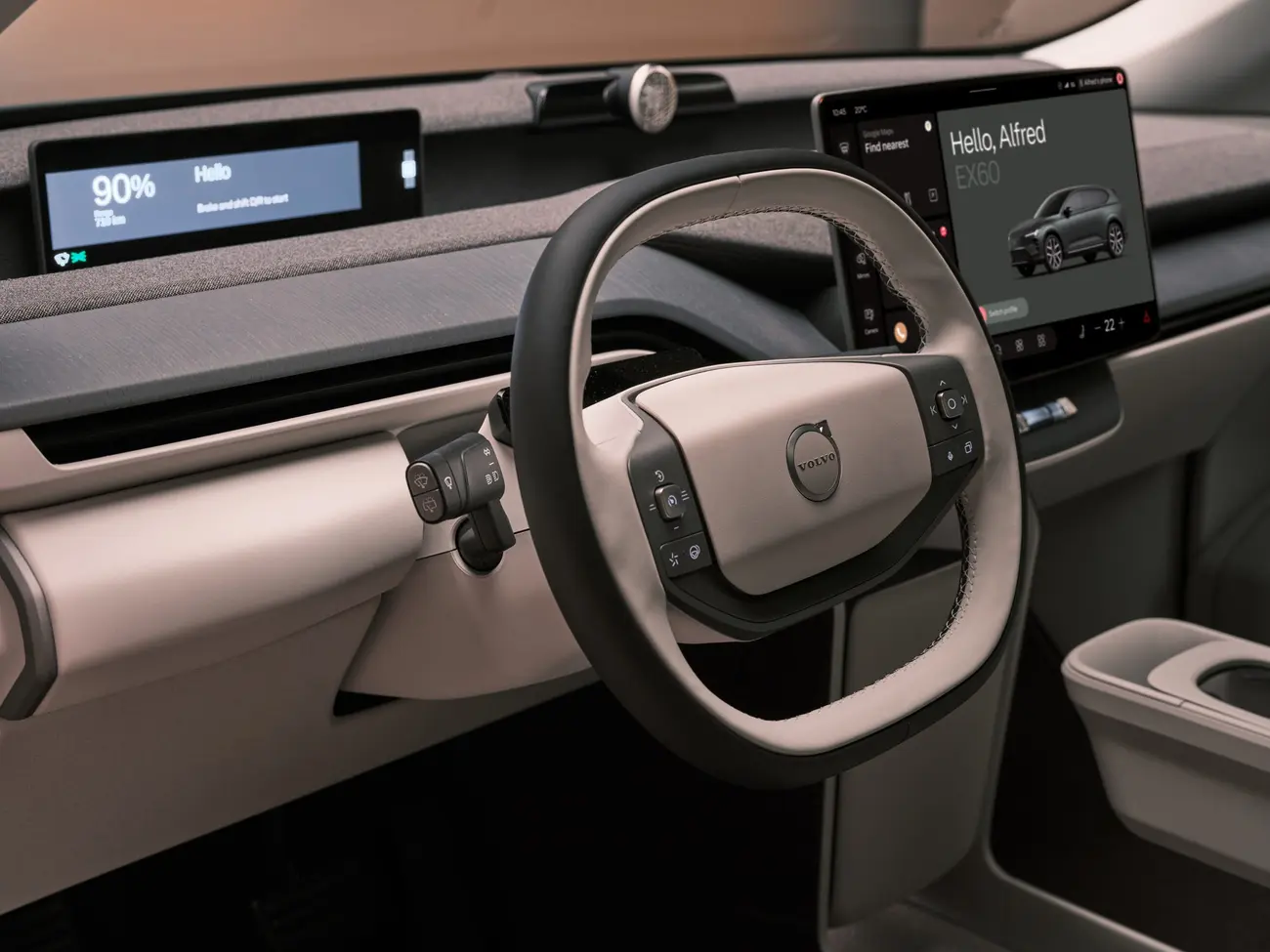
The problem is the all-digital cabin. Mirrors, air vent direction and regen levels are all adjusted through the 15-inch centre screen. There are no paddles for regen and barely any physical buttons. L'argus put it neatly: this digital-first approach, at odds with Volvo's traditional practicality, "won't be to everyone's taste". The Google Gemini voice assistant helps, but it's no substitute for a button while you're driving.
Rear legroom is also a touch tighter than in the iX3, according to Auto Express. In its final verdict, the British magazine ranked the BMW first, the Volvo second and the Mercedes third — calling the EX60 "an appealing package that deserves to do well".
In France the warranty is 3 years or 100,000 km for the car and 8 years or 160,000 km for the battery. Portuguese terms are still to be confirmed with dealers.
Frequently Asked Questions
In most versions, yes. In Portugal the EX60 P6 RWD starts at €62,299, below the roughly €64,500 asked for the BMW iX3 40, and the EX60 P10 AWD Plus (€70,981, 510 hp) costs about €2,000 less than the iX3 50 xDrive (around €72,900, 469 hp). The electric Mercedes GLC 400 is expected to land between €75,000 and €80,000, putting the Volvo more than €4,000 below it. All three are exempt from ISV registration tax and IUC road tax.
On a high-power fast charger, the EX60 P10 went from 10% to 80% in 17 minutes 10 seconds at an Ionity station, peaking at 380 kW and averaging 245 kW. For AC charging, a 22 kW onboard charger is standard, double the 11 kW base spec of the iX3 and GLC: on a three-phase 22 kW wallbox, the 91 kWh usable battery fills from empty in roughly 4 to 5 hours. At the 150 kW DC chargers more common on Portugal's MOBI.E network, times will be noticeably longer than in the test.
It depends heavily on speed. At 180 km/h on a German autobahn, the EX60 P10 used 36 kWh/100 km, which works out to about 250 km from its 91 kWh usable battery. In mixed driving, tests recorded 16.2 to 16.8 kWh/100 km, or roughly 500 to 520 km of real range versus 660 km WLTP. At Portugal's 120 km/h motorway limit, expect something between those extremes, closer to 400 km.
The EX60 P6 RWD costs €50,650 + VAT for companies and self-employed buyers. Excluding VAT, the P6 Plus comes to about €55,200 and the P10 Plus to about €57,700, both still under the €62,500 threshold used in Portugal's tax rules for company EVs. The P10 Ultra (about €63,400 + VAT) and the P12 versions go over that line, which affects VAT deduction and autonomous taxation, so check the numbers with your accountant first.
Orders for the EX60 Cross Country are expected to open around the second quarter of 2027. It is based on the P10 AWD, with 640 km of WLTP range (20 km less than the regular P10) and a raised ride height. Until then, the first Portuguese deliveries are the P6 and P10 versions from summer 2026, with the 680 hp P12 following later.
Volvo EX60 P6 or P10: which to choose in Portugal
For most Portuguese drivers, the P6 makes more sense than it first appears. With 374 hp, 620 km WLTP and the lowest price in the range, it's also the version L'argus praised for its suspension and handling — rear-wheel drive and lower weight make it more agile than the P10.
The P10 earns its place if you need all-wheel drive, tow regularly (up to 2,400 kg) or do plenty of long trips and want to make the most of 370 kW charging. The €3,075 step from P6 Plus to P10 Plus is fair for what you get, but it's not essential.
If you want the more rugged look, you'll have to wait: the EX60 Cross Country, with 640 km WLTP and a raised ride height, is only expected to open for orders around the second quarter of 2027.
If maximum range and efficiency top your list, the iX3 remains the benchmark. But if you value comfort, fast charging and a sharper price, the Volvo EX60 is now a serious alternative to the Germans — with first Portuguese deliveries of the P6 and P10 due this year. Book a test drive, and spend ten minutes just poking around the menus before you decide.