
Volvo EX40 and EC40 2027 Facelift in Portugal: Specs, Range and Price
Published: 10/09/2026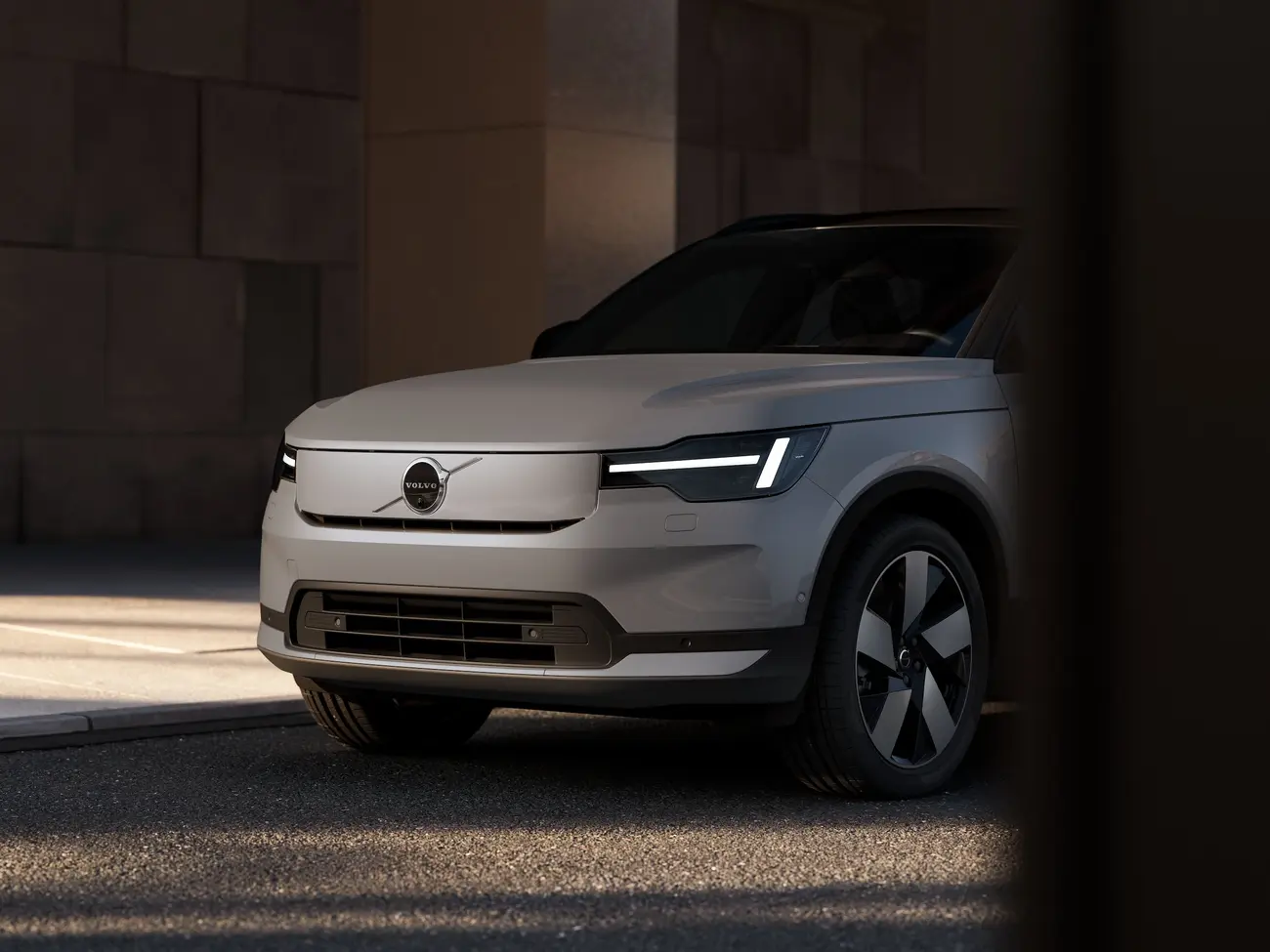
What changes on the 2027 Volvo EX40 and EC40
Nine years after the XC40 introduced the CMA platform, Volvo has decided it still isn't time to replace it. On 10 September 2026 the brand announced a simultaneous update to the XC40, EX40 and EC40 for model year 2027, and the list of changes is clear enough: new face, new screen, new safety electronics. Batteries and motors stay exactly as they were.
That's a defensible call. The electric powertrain in both SUVs already went through a deep overhaul in 2024 — switching to rear-wheel drive, gaining bigger batteries — and remains competitive. What was ageing was the cabin, with a 9-inch screen that already looked small next to the EX30's.
A new face, and a rear end only the EX40 gets
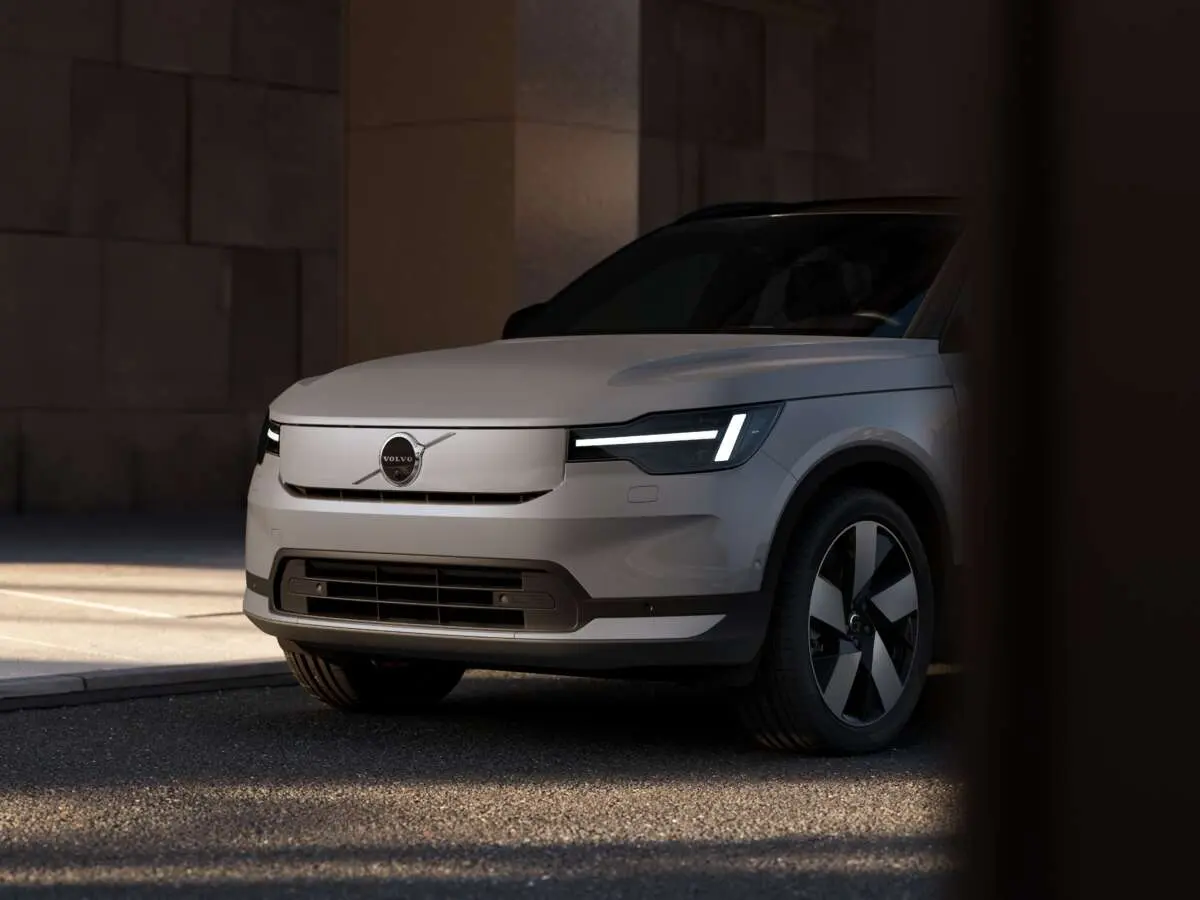
Up front, everything is new: bonnet, front wings, lower bumper and a fully closed grille, more sealed than the combustion XC40's because an EV needs less cooling. The Thor's Hammer Matrix LED headlights have been redesigned with 15 segments, aimed at a broad, long beam.
At the back, the story splits. The EX40 gets new LED tail lights, a reworked tailgate and a redesigned bumper. The EC40 keeps its coupé rear exactly as it was — the most visible difference between the two models after this facelift.
Exterior designer Alain Snoodijk puts the intent plainly: "The silhouette is the same, the proportions are the same. We tried to protect and keep the stance that the car has." Anyone hoping for a radical redesign will be disappointed. Anyone who likes the current shape won't notice it has been under the knife.
An 11.2-inch screen with Google Gemini on board
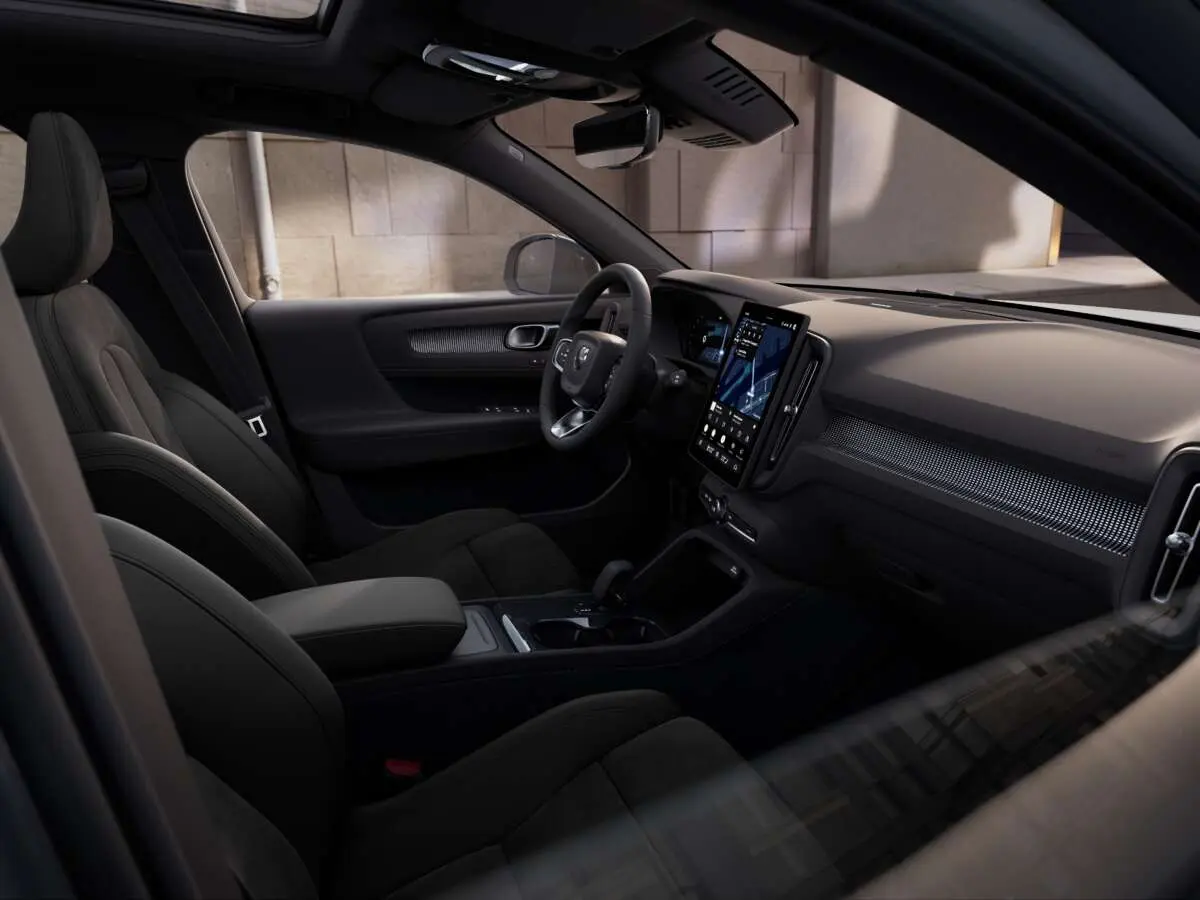
The change you'll notice every day sits in the middle of the dashboard. The centre display grows from 9 to 11.2 inches, in tablet format, running the latest version of Volvo's operating system — the same one used by the brand's newer models, with fewer taps needed to reach key functions.
The headline tech addition is Google Gemini as the voice assistant. Instead of rigid commands, it handles natural conversation: planning a trip, finding a charging stop mid-route, dealing with messages without taking your hands off the wheel. If you regularly drive Lisbon–Porto, an assistant that understands "find me a fast charger before Coimbra" is worth more than any styling tweak.
The rest of the cabin gets detail work: an updated wireless phone charger, refined ambient lighting, new upholstery and decor — Arianne Cardamom leather with Brown Ash wood, or Black Ash and aluminium alternatives. One honest caveat: not everything the XC40 gained carries over to the EX40. Some alloy wheel designs and interior materials stay exclusive to the combustion car, and the EX40's wireless charger isn't relocated the way the XC40's is. Over-the-air updates continue to arrive regularly.
Safety: 12 new sensors and a door opening alert
This is the least glamorous part and probably the most valuable. Volvo has replaced the entire sensor platform: front, corner and rear corner radars, a new front camera, 12 new ultrasonic sensors, new parking cameras, and a safety computer with more processing power.
What that enables:
- Door Opening Alert — warns you before opening a door if a cyclist or passing traffic is approaching. In a city like Lisbon, where bike lanes run right alongside parking spaces, that's a genuinely useful function.
- Pilot Assist with automatic lane change and smoother road following.
- An optional 360-degree camera with 3D view for tight parking and low-speed manoeuvres.
- Automatic emergency braking with steering support and collision mitigation.
Range and charging: 575 km for the EX40, 584 km for the EC40
The announced WLTP figures are up to 575 km for the EX40 and up to 584 km for the EC40 — preliminary numbers, with homologation still to be finalised. The gap between the two comes down to bodywork: the EC40's coupé profile cuts through the air better and consumes slightly less.
The naming has changed too. Where you used to read Single Motor and Twin Motor, you now read P5 and P8, in line with the rest of Volvo's electric range.
| Version | P5 | P5 Long Range | P8 AWD | P8 Performance |
|---|---|---|---|---|
| Drive | Rear-wheel | Rear-wheel | All-wheel | All-wheel |
| Power | 175 kW / 238 hp | 185 kW / 252 hp | 300 kW / 408 hp | 325 kW / 442 hp |
| Torque | 420 Nm | 420 Nm | 670 Nm | 670 Nm |
| Battery nominal / usable | 69 / 66 kWh | 82 / 79 kWh | 82 / 79 kWh | 82 / 79 kWh |
| Peak DC charging | 135 kW | 205 kW | 205 kW | 205 kW |
| 10–80% | 33 min | 28 min | 28 min | 28 min |
| 0–100 km/h | 7.3 s | 7.3 s | 4.7 s | 4.6 s |
| EC40 range (WLTP) | 445–482 km | 540–576 km | 510–547 km | 510–542 km |
| EX40 consumption | 18.3–17.2 kWh/100 km | 18.4–16.7 | 19.4–17.7 | 19.4–18.0 |
| Kerb weight | 1,977 kg | 2,021 kg | 2,110 kg | 2,110 kg |
The practical point: only the 82 kWh versions reach 205 kW on DC, doing 10–80% in 28 minutes on a 200 kW charger with the battery between 20 and 35 °C. The entry version, with 69 kWh, is capped at 135 kW and 33 minutes. On a Lisbon–Algarve run, that's the difference between a coffee stop and a lunch stop. The on-board charger is a three-phase 11 kW unit with a Type 2/CCS port — compatible with the overwhelming majority of Portugal's Mobi.E public charging network. The battery is covered for 8 years or 160,000 km.
Top speed is limited to 180 km/h across the range, as on every Volvo since 2020. Braked towing capacity: 1,500 kg on rear-drive versions, 1,800 kg on all-wheel drive.
Space: 410 litres in the EX40, 404 in the EC40
Dimensions are unchanged. Both measure 4,440 mm long on a 2,702 mm wheelbase, and width is 2,034 mm with mirrors extended (1,938 folded). The EX40's boot holds 410 litres to the glass line and 1,400 litres with the seats folded and loaded to the roof; the EC40, penalised by its sloping roofline, manages 404 and 1,310 litres. Both add a 31-litre frunk up front — enough for charging cables and not much else.
Prices: what's known, and what's still missing
Here we need to be blunt. At the time of writing, Volvo Portugal has not published the model year 2027 price list. Order books are already open in selected markets — Black Edition versions included — and production starts in autumn 2026 in Ghent, Belgium, but the Portuguese list with facelift pricing isn't out yet.
What does exist is the official UK MY27 price list, useful as a positioning reference rather than a conversion: the EX40 opens at £43,860 on the road in Core Single Motor Extended Range trim and climbs to £58,110 for the top Ultra Black Edition Twin Motor Performance; the EC40 starts higher, at £46,860. Don't convert those into euros — British and Portuguese car taxation have nothing in common.
For the Portuguese market, the useful reference point remains the range currently on sale, which sits broadly from around €50,000 and passes €57,000 for the better-equipped Black Edition versions. Treat that as an indicative bracket for the outgoing model, not confirmed MY27 pricing — always check with a Volvo dealer before committing.
Portuguese tax rules work in the buyer's favour here. As fully electric cars, the EX40 and EC40 are exempt from ISV (the one-off vehicle registration tax) and pay a reduced IUC (annual road tax), which brings total cost of ownership closer to combustion rivals that look considerably cheaper on the sticker.
Frequently Asked Questions
Volvo Portugal has not yet published the model year 2027 price list, so there is no confirmed Portuguese price for the facelifted car. The only official reference available is the UK MY27 list, where the EX40 starts at £43.860 OTR and rises to £58.110 for the top version, with the EC40 starting at £46.860 — figures that should not be converted into euros, since the tax regimes are completely different. As a positioning guide, the range currently on sale in Portugal sits broadly from €50.000 upwards. Always confirm with a Volvo dealer before committing.
They share the CMA platform, batteries, motors and the entire updated interior, including the 11.2-inch screen. The difference is the body: the EX40 is the conventional SUV and, in this facelift, gains new LED tail lights, a new tailgate and a redesigned rear bumper, while the EC40 keeps its coupé rear end unchanged. That shows in practicality — 410 litres of boot space in the EX40 against 404 in the EC40, and 1.400 versus 1.310 litres with the seats folded. In exchange, the sleeker profile gives the EC40 up to 584 km WLTP against 575 km for the EX40.
Versions with the 82 kWh battery (79 kWh usable) peak at 205 kW DC and Volvo quotes 28 minutes from 10% to 80%, with the battery between 20 and 35 °C. The entry version, with 69 kWh (66 usable), is capped at 135 kW and needs around 33 minutes for the same window. On AC, the three-phase onboard charger is rated at 11 kW, which suits overnight charging at home or at work. The battery is covered by an 8-year or 160.000 km warranty.
The new naming replaces the old Single Motor and Twin Motor labels. The P5 is rear-wheel drive with 175 kW (238 hp) on the 69 kWh battery or 185 kW (252 hp) on the 82 kWh pack, does 0-100 km/h in 7.3 seconds and is the long-range choice, with the headline 575 km in the EX40. The P8 is all-wheel drive with 300 kW (408 hp), or 325 kW (442 hp) in Performance trim, cutting 0-100 km/h to 4.7 and 4.6 seconds. The trade-off is range and mass: the P8 weighs 2.110 kg against 2.021 kg for the P5 Long Range. For typical Portuguese use, the P5 Long Range is the more rational balance.
The CMA platform is nine years old and the next generation is expected to move to SPA3, the architecture used by the EX60 — but that change is not anticipated before 2028. If you need a car now, the MY27 facelift finally brings the interior and software this model was missing, while keeping over 500 km of homologated range and 205 kW charging. If your budget stretches well beyond €65.000, the EX60 already offers far faster charging; if it is tighter, the smaller EX30 sits below. As fully electric cars, both the EX40 and EC40 remain exempt from ISV and pay reduced IUC in Portugal.
EX40, EC40, EX30, or wait for the EX60?
Volvo's electric range has become crowded, so it's worth placing these two.
Below sits the EX30, smaller, cheaper and on a different platform — the logical pick if you mostly drive in town and don't need 410 litres of boot space.
Above, the EX60 arrived in 2026 on the new SPA3 platform with megacasting, a much faster charging architecture, and prices starting well above €65,000. That's a different product and a different budget.
In between sit the EX40 and EC40, on a nine-year-old platform but with the essentials sorted: 575–584 km of homologated range, 205 kW charging on the 82 kWh versions, and now the updated cabin they were missing. The next generation is expected to move to SPA3 — but that's a 2028-or-later story.
If you want a compact premium electric SUV with a solid service network in Portugal and range figures north of 500 km, there's now a clearly better version of the same car. The open question is what it will cost here — and that answer comes with the Portuguese MY27 price list, worth watching over the coming weeks.