
VW ID. Tiguan Specs Confirmed: Range, Charging and What Changed From the ID.4
Published: 07/10/2026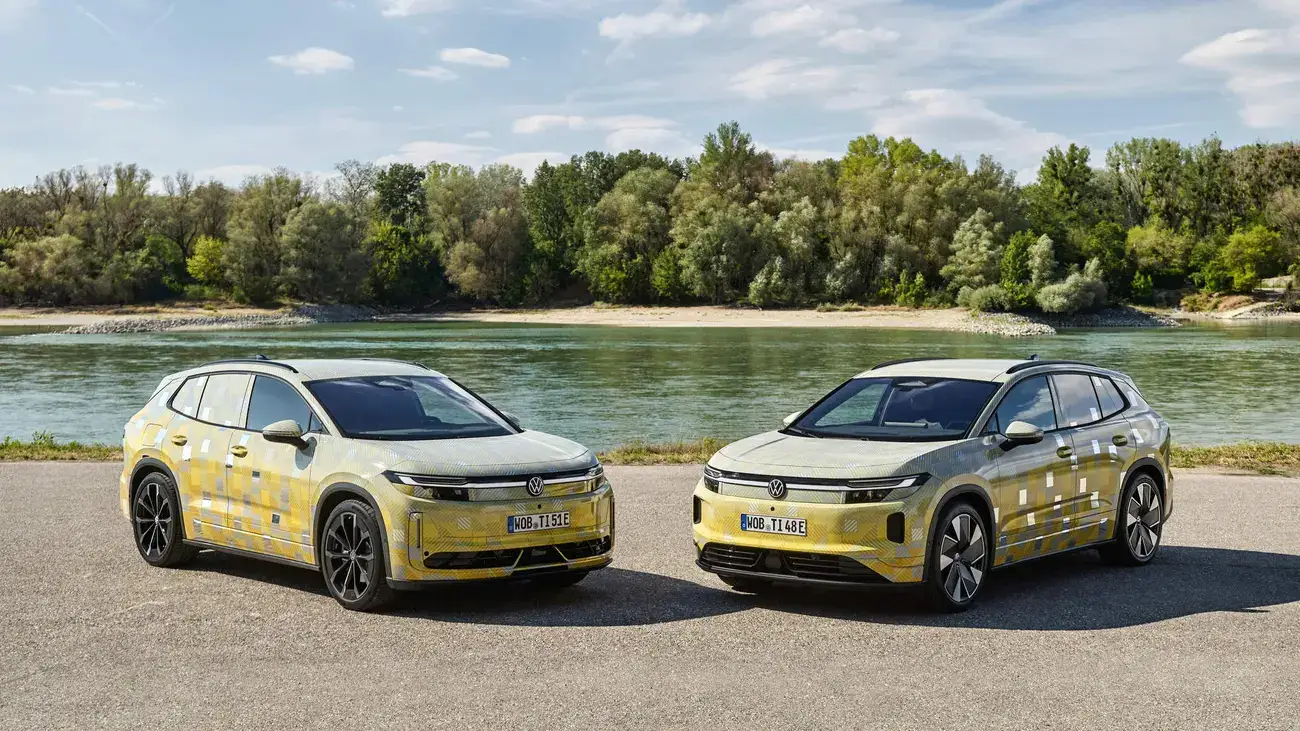
VW ID. Tiguan specs: confirmed at last
165 kW peak DC charging — less than today's ID.4 manages. That's the most surprising line on the VW ID. Tiguan spec sheet, which Volkswagen confirmed on 28 September while letting a group of European journalists drive camouflaged prototypes around Vienna. The name is no longer a rumour: the ID. Tiguan officially replaces both the ID.4 and the ID.5 with a single model. The world premiere is set for October 2026 (AutoScout24 says 9 October), with the car reaching the market in early 2027.
If you're weighing up a family-sized electric SUV in Portugal, there are finally hard numbers to work with. Three versions, two batteries with different chemistries, WLTP range between 450 and 600 km, and a set of practical upgrades that tackle the most common ID.4 owner complaints. Price is the only piece still missing.
Three versions, two batteries
Underneath sits the MEB platform in its evolved MEB+ form. This is not a light facelift, though: according to Volkswagen, every body panel is new except the roof. The car is roughly 4.58 m long, and the styling moves closer to the combustion Tiguan — boxier, with conventional door handles and full-width light strips front and rear.
| Version | Drive | Power | Battery | WLTP range (est.) | 0–100 km/h | Top speed |
|---|---|---|---|---|---|---|
| Entry | Rear | 140 kW / 190 hp | 58 kWh LFP | ~450 km | 8.5 s | 160 km/h |
| Mid | Rear | 210 kW / 286 hp | 77 kWh NMC | ~600 km | 6.6 s | 180 km/h |
| Top | All-wheel (2 motors) | 220 kW / 299 hp | 77 kWh NMC | ~560 km | 6.3 s | 180 km/h |
The mid version uses the APP550 motor with 550 Nm, already familiar from other Volkswagen Group models. Trims will be Trend, Life, Style and R-Line: the 58 kWh battery is offered on Trend, Life and Style, while the 77 kWh pack is standard on R-Line and optional on Life and Style.
VW ID. Tiguan range with the 58 kWh and 77 kWh batteries
The WLTP figures are still Volkswagen estimates — final homologation comes with the premiere. Even so, the picture is clear: around 450 km for the entry car, 600 km for the rear-drive 77 kWh version and 560 km for the all-wheel-drive model.
What about the real world? In ADAC's test of an all-wheel-drive R-Line prototype, consumption came in at 17.7 kWh/100 km. Applied to 77 kWh, that works out at roughly 430 km on a full battery. Enough for Lisbon to Porto (about 310 km) in one go, with room to spare. At 120 km/h on the motorway in winter, expect less.
LFP or NMC battery: which to choose
The 58 kWh LFP pack is new to the range. This chemistry copes better with regular charging to 100% and tends to age well, which makes it a sensible pick if you mostly drive in and around town and charge at home every night. The trade-off is less range and slower fast charging.
The 77 kWh NMC battery makes more sense if you regularly travel around the country. An extra 150 km of WLTP range and a much higher charging peak change how you plan a trip to the Algarve or up to Trás-os-Montes.
ID. Tiguan charging speed: 165 kW, and lower on purpose
This is the point that will spark the most debate. On the 77 kWh battery, peak DC charging drops from 183 kW on the current ID.4 to 165 kW on the ID. Tiguan. The 58 kWh LFP pack tops out at 105 kW.
Volkswagen's reasoning, as reported by Elektroauto-News, is twofold: stricter homologation rules for battery longevity, and a preference for a longer plateau above 100 kW rather than a high peak that tails off quickly. Real charging times hold up reasonably well:
- 58 kWh: 10–80% in around 26 minutes
- 77 kWh: 10–80% in around 29 minutes
- AC charging: 11 kW on both (8 to 12 hours on a home wallbox)
In practice, a half-hour stop at a rapid charger on the MOBI.E network (Portugal's national public charging network) puts about 54 kWh back into the 77 kWh car — close to 300 km at the consumption ADAC measured. AutoScout24 rightly notes that this lags behind 800 V rivals such as the Hyundai IONIQ 5. For a family doing two or three long trips a year, the gap barely matters. If you practically live on the motorway, it matters more.
ID. Tiguan vs ID.4: what changed
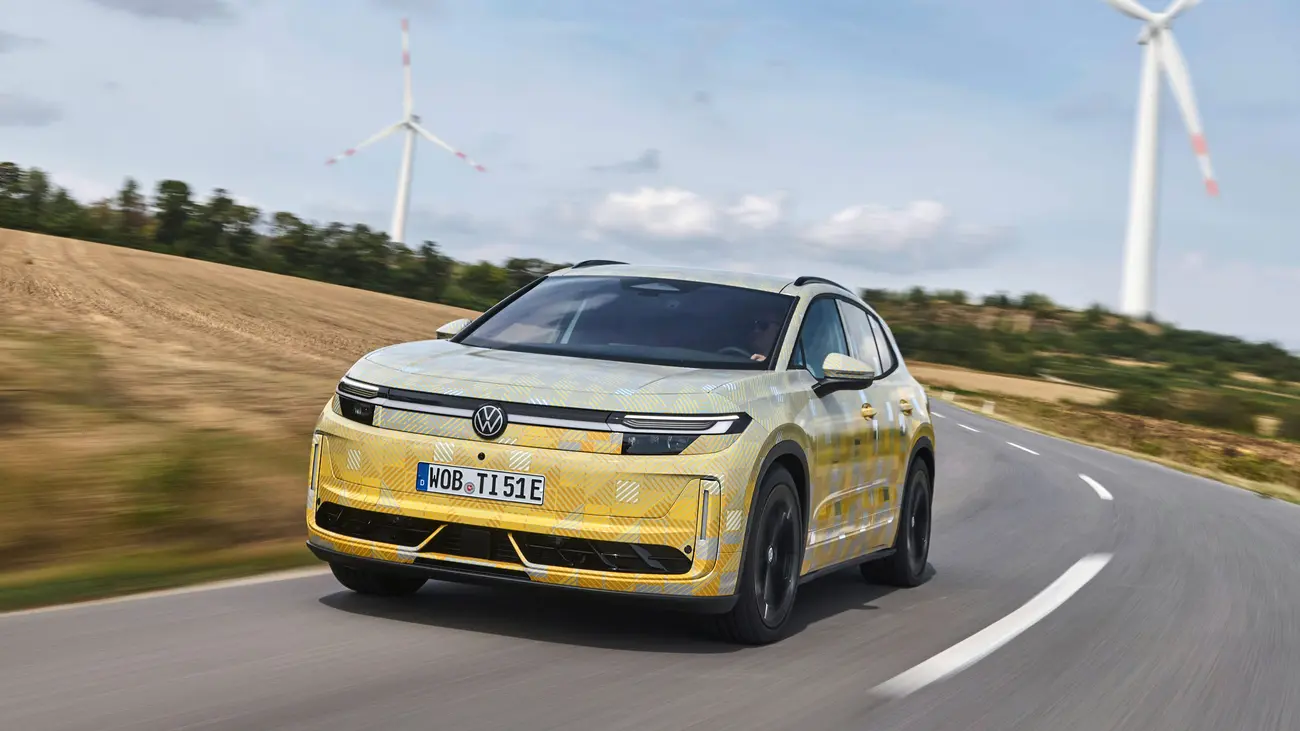
Every journalist who drove the prototypes agrees on one thing: the ID. Tiguan is quieter, more comfortable and better finished than the ID.4. Electrifying called it "more grown up". ADAC went as far as describing the near-silent running as "Rolls-Royce-like".
A cabin with proper physical buttons
The interior gets the ID. Polo steering wheel with revised haptic controls, plus a dedicated climate control button panel above the centre console. After years of complaints about the ID.4's touch-sensitive controls, Volkswagen is going back to buttons and knobs. Material quality also takes a step up, according to every test.
Towing, V2L and one-pedal driving
The practical upgrades are arguably the most relevant for everyday use:
- Towing capacity: 1.8 tonnes (58 kWh) and 2.0 tonnes (77 kWh)
- Nose weight: up from 75 kg to 90 kg — enough for a rack carrying two e-bikes
- V2L: power external devices from the car's battery
- Bidirectional charging (V2G): supported since software 3.5, managed through home energy systems
- One-pedal mode: a first for the family, with precise regeneration and a smooth handover to the mechanical brakes
First drive: comfort over sportiness
The longest drive, by Elektroauto-News, lasted about an hour across city streets, suburbs and motorway in a 210 kW Style with the 77 kWh battery. The suspension soaks up cobbles and expansion joints far better than the ID.4's, and the progressive steering is light when manoeuvring. The APP550 motor pulls eagerly from a standstill, although acceleration above 80 km/h is less pronounced. One downside: on 21-inch wheels, road noise comes through on broken surfaces — worth bearing in mind on Portugal's rougher secondary roads.
AutoScout24 also praised the optional DCC Pro adaptive suspension and long-distance comfort. Volkswagen's message is clear: the ID. Tiguan isn't trying to beat the Tesla Model Y on efficiency or charging speed, but on suspension tuning, perceived quality and service network.
VW ID. Tiguan price in Portugal: still an estimate
Official price? There isn't one yet, in Germany or in Portugal. The figures doing the rounds are estimates from the motoring press and should be read that way:
- AutoScout24 (Germany): estimated base price below €45,000
- Electrifying (UK): between £40,000 and £52,000
Running the numbers for Portugal from the German estimate: €45,000 including 19% German VAT is about €37,800 before tax. Add Portugal's 23% VAT and you land close to €46,500 for the entry version. It's a rough approximation — Volkswagen adjusts pricing and equipment by market — but it gives you a ballpark. The 77 kWh versions should sit well above that.
In the buyer's favour: as an EV, the ID. Tiguan is exempt from ISV (Portugal's vehicle registration tax) and IUC (the annual road tax), and company buyers keep the usual tax advantages for electric cars on autonomous taxation and VAT recovery (within legal limits). Official prices should arrive with the October world premiere.
Frequently Asked Questions
There is no official price yet, so any figure is only an estimate. Starting from AutoScout24's German estimate (base price below €45,000) and adjusting from 19% to Portugal's 23% VAT, the entry-level 58 kWh version could land around €46,500 in Portugal, with the 77 kWh versions well above that. As an EV it is exempt from ISV registration tax and IUC road tax, and official Portuguese pricing is expected after the world premiere in October 2026.
Volkswagen estimates around 450 km WLTP for the 58 kWh LFP version, but real-world range will be lower. At the 17.7 kWh/100 km that ADAC recorded in an all-wheel-drive prototype, 58 kWh works out to roughly 330 km, a conservative reference since the entry model is rear-wheel drive and less powerful. Expect less on the motorway at 120 km/h and in winter.
On a DC fast charger, the 58 kWh version (105 kW peak) goes from 10 to 80% in about 26 minutes, and the 77 kWh version (165 kW peak, down from the ID.4's 183 kW) in about 29 minutes. Both accept 11 kW AC, which means 8 to 12 hours to fully charge the 77 kWh battery on a home wallbox, depending on the installation's power.
It depends on how you drive: the ID. Tiguan adds towing up to 2 tonnes, V2L, one-pedal driving and physical buttons, but it only arrives in early 2027 and has no confirmed price yet. A used 77 kWh ID.4 keeps its 183 kW charging peak, higher than the new model's 165 kW. As the successor arrives, expect more ID.4 and ID.5 trade-ins during 2027, which tends to push used prices down.
The ID. Tiguan can tow up to 1.8 tonnes with the 58 kWh battery and up to 2.0 tonnes with the 77 kWh pack, and the permitted tow-bar nose weight rises from 75 kg on the ID.4 to 90 kg, enough for a rack carrying two e-bikes. It also debuts V2L to power external devices from the battery and supports bidirectional (V2G) charging since software 3.5.
Rivals, and what happens to used ID.4 prices
The ID. Tiguan will compete with the Skoda Enyaq, Audi Q4 e-tron, Tesla Model Y, Hyundai IONIQ 5, Opel Grandland Electric and Volvo EX60. Against the Enyaq, with which it shares its underpinnings, it should stand out on comfort and cabin quality; against the Model Y, it loses on charging but wins on physical controls and dealer coverage.
Its arrival in early 2027 will also ripple through the used market. Expect more ID.4 and ID.5 trade-ins at dealers through 2027, which tends to push prices down. If you don't need a 2-tonne towing limit or one-pedal driving, a used ID.4 with the 77 kWh battery — and its 183 kW charging peak — could be a smart buy over the coming months.
If you want a new ID. Tiguan, wait for the October announcement: that's when the real Portuguese price, the exact line-up for our market and homologated WLTP figures will be confirmed. Until then, the spec sheet already lets you pick the right battery — LFP for town, NMC for the open road.