
Types of Hybrid Cars Explained for Portugal: MHEV, HEV, PHEV & REEV
Published: 16/07/2026
Four hybrids sharing one name — and very different realities
They're all called "hybrid", but under the bonnet there are four technologies that have almost nothing in common. One hybrid saves you a few euros on weekend runs; another drives 100 km without burning a drop of petrol. The difference lives in the acronyms: MHEV, HEV, PHEV and REEV. Getting the types of hybrid cars explained properly — for Portugal, not the UK or US — is what separates a smart buy from a regret, especially since most guides skip the fourth category entirely: the range-extender.
Let's go from the simplest to the most electric.
What a MHEV (mild hybrid) actually is
The MHEV, or mild hybrid, is the lowest rung of electrification. It pairs a normal combustion engine with a small starter-generator fed by a 12 or 48-volt battery. This is not a car that runs on electricity — it's a petrol or diesel car with a helping hand.
You feel that help on pull-away and during acceleration, and the system claws back some energy under braking. The 12V setups can't move the car on their own; some 48V systems allow a few metres of low-speed electric crawl, useful for parking or creeping in traffic. That's the whole difference between a 48V mild hybrid and a 12V one: the former gives a bigger nudge, but neither cuts your fuel bill dramatically.
It's the cheapest option for carmakers, which is why it shows up everywhere — from the VW T-Roc 1.5 eTSI to the Mazda CX-60 diesel MHEV, and even in big pickups like the Ram 1500. If you cover lots of motorway kilometres and want nothing to do with charging cables, it does the job.
The self-charging hybrid (HEV): what it is and who it suits
The HEV is the "classic" hybrid Toyota made famous. It combines the combustion engine with one or more electric motors — more powerful than a MHEV's — and a small battery, typically 1 to 2 kWh. It recharges itself (hence self-charging) through regenerative braking and the engine. It never plugs in.
It can travel a few kilometres on electricity alone at low speed, and that's where it shines: in the city, with constant braking, fuel savings run to around 30% versus a conventional car. On the motorway the advantage fades, because the engine does nearly all the work.
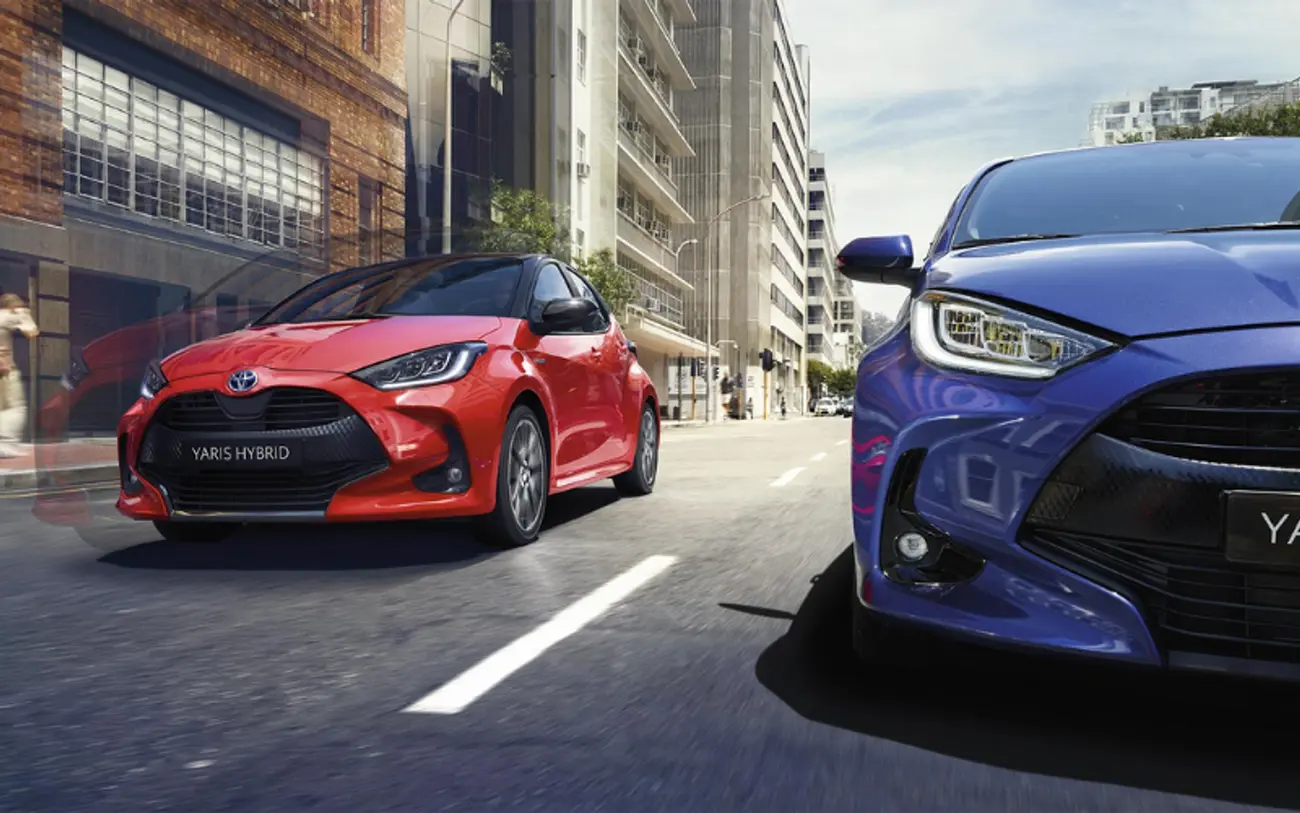
This is the hybrid for people who want lower running costs and emissions without changing their habits or thinking about charging. Toyota Yaris and RAV4, Renault Clio E-Tech, Honda Civic, plus models from Hyundai, Kia and Ford — the choice is huge and mature.
PHEV: the plug-in hybrid that only pays off if you charge it
The PHEV takes the HEV principle and grows the battery dramatically — somewhere between 15 and over 25 kWh — charged from a home socket or a public point. The reward is real electric range: on the WLTP cycle many exceed 100 km, and so-called super hybrids clear that mark on electric power alone while reaching around 1,500 km of total combined range. The Volvo XC70 and BMW 3 Series sit in this bracket.
How many km does a plug-in hybrid do on electric only? It depends on the model, but for most daily journeys it's enough to burn no petrol at all. When the battery runs down, the combustion engine takes over and drives the wheels normally — you always have the conventional fuel network as a safety net for long trips.
There's a catch, and it's a big one: the PHEV only delivers if you charge it regularly. Is a plug-in hybrid worth it if you never plug it in? No. Without a socket, you're hauling a heavy, usually empty battery and burning more than a plain HEV would. It's the natural bridge for buyers not yet ready for a full EV — but it demands charging discipline.
What a REEV (range-extended electric) is
Here's the category almost nobody explains. The REEV — also badged EREV depending on the market — works the opposite way to everything else: the wheels are driven only by an electric motor, and the combustion engine serves purely as a generator to charge the battery. Do the wheels of a REEV run on the petrol engine? No. It never touches them.
In practice it drives like an EV — quiet, smooth, zero emissions day to day — but without the range anxiety, because the petrol generator kicks in when the battery drops. It's the ideal answer for anyone who wants the electric experience but drives long distances or can't count on charging along the way.
It grew mostly in the Chinese market, led by Li Auto, and it's now arriving in Europe. Models like the Nissan Qashqai and X-Trail e-Power already use this logic, and Leapmotor brings the tech with its B10 and C10. In the US, REEV versions of the F-150 Lightning and Ram REV are on the way. This is the category to watch over the next few years.
MHEV vs HEV vs PHEV vs REEV: the quick comparison
| Type | Plugs in? | Battery | Electric range | Engine drives wheels? | Fuel benefit | Examples |
|---|---|---|---|---|---|---|
| MHEV | No | 12V or 48V (small) | None (12V) / a few metres (48V) | Yes | Modest | VW T-Roc eTSI, Mazda CX-60, Ram 1500 |
| HEV | No | around 1-2 kWh | Few km, low speed | Yes | around 30% in the city | Toyota Yaris, Renault Clio E-Tech, Honda Civic |
| PHEV | Yes | 15 to over 25 kWh | over 100 km WLTP | Yes | High, if charged | BMW 3 Series, Volvo XC70 |
| REEV | Yes | Large (BEV-like) | Electric nearly all the time | No (generator only) | Zero emissions day to day | Nissan Qashqai e-Power, Leapmotor C10, Li Auto |
Figures vary by market and model — read them as indicative, not as the exact spec sheet for any one car.
Which type of hybrid is best for you
Forget the acronyms for a moment. The choice comes down to two questions.
Can you charge at home? And how many kilometres do you drive a day?
- No home charging and lots of motorway: MHEV or HEV. They save fuel with no charging dependency at all. For anyone racking up motorway kilometres, this is the sensible answer — no point lugging around a battery you'd rarely use.
- Home charging and under 80 km a day: PHEV or REEV. You spend most of your time in electric mode, with the engine held in reserve for weekends and holidays. If you want the experience closest to an EV without cutting the cord entirely, the REEV is the most interesting of the two.
Plug-in hybrid tax incentives in Portugal
The fiscal angle matters at the till. In Portugal, plug-in hybrids qualify for a reduction in ISV (the vehicle registration tax) provided they meet two conditions: a minimum electric range of 50 km and emissions no higher than 50 gCO₂/km. It's a detail most guides gloss over, but it can mean a meaningful price difference against a PHEV that misses the thresholds.
MHEVs and HEVs get no such break — they pay ISV like any combustion car, though their lower consumption helps with IUC (the annual road tax) over the years. It's always worth checking the specific model's homologation figures before you sign.
Is it worth buying a hybrid instead of an EV in 2026? For anyone without reliable charging, or who regularly covers long distances, yes — and picking the right one of the four categories makes all the difference between genuine savings and hauling dead weight. If you have a socket at home and your routine fits inside 100 km a day, a well-charged PHEV or a REEV puts you almost in the electric world, without the leap of faith.
Frequently Asked Questions
If you never plug it in, a PHEV is a poor choice: it runs mostly on petrol while carrying the extra weight of a 15 to 25+ kWh battery, which pushes fuel consumption above that of a self-charging hybrid (HEV). A PHEV only pays off when charged regularly, using the 100+ km of WLTP electric range that current models offer. Without a charger, an HEV or MHEV is almost always cheaper to run and more efficient.
No. In a REEV (range-extended electric vehicle), the combustion engine works only as an electricity generator and is never connected to the wheels — the car is always driven electrically. This is the key difference from a PHEV, where the petrol engine can drive the wheels directly. Examples available or arriving in Portugal include the Nissan Qashqai e-Power and Leapmotor models (B10/C10).
Without charging access, the smartest choice is a self-charging hybrid (HEV) or a mild hybrid (MHEV). Both recharge themselves through regenerative braking and the combustion engine, and never need a plug. An HEV can cut fuel consumption by around 30% in city driving, whereas PHEVs and REEVs only make sense for drivers who charge at home and cover short daily distances.
Both are mild hybrids (MHEV), where a small motor-generator assists the combustion engine on start-up and acceleration for modest fuel savings. The difference is power: a 12V system can never move the car on electricity alone, while some 48V systems allow a few kilometres of low-speed electric-only crawling. Neither system plugs into the grid.
In Portugal, plug-in hybrids (PHEVs) can qualify for a reduced ISV (vehicle tax) provided they meet two requirements: a minimum WLTP electric range of 50 km and emissions of no more than 50 gCO₂/km. Mild hybrids (MHEVs) and self-charging hybrids (HEVs) do not get this benefit and pay ISV like an equivalent combustion car. Always check the model's homologated specs, as falling just short of either limit forfeits the incentive.