
Subaru E-Outback in Portugal: Price, Real Range and Solterra Comparison
Published: 07/08/2026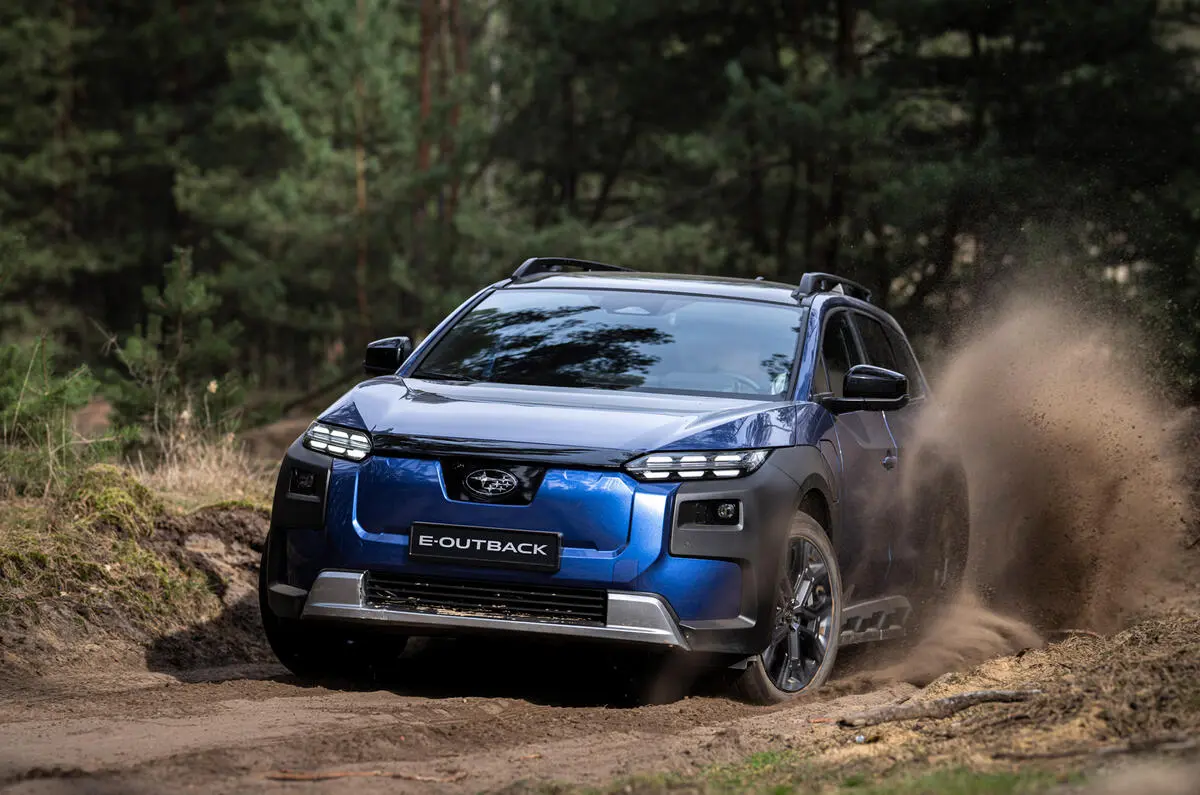
381 hp, 633 litres and 21 cm of ground clearance: the Outback is back, and it's electric
Thirty years after Subaru invented the jacked-up estate — before Audi got round to calling it Allroad — the Outback swaps fuel for electrons. The E-Outback is the first Outback without a combustion engine and, at the same time, the most powerful and quickest Subaru ever built: 280 kW, 381 hp, 0-100 km/h in 4.5 seconds. For context, the quickest factory STI managed 5.2.
There is no confirmed Subaru E-Outback price for Portugal yet, but the European numbers give us a solid anchor: France starts at €52,990 and the Netherlands at €52,900. And because it's fully electric, it pays no ISV here — Portugal's vehicle registration tax — which changes the arithmetic considerably against a comparable diesel.
Subaru E-Outback range: 526 km on paper, 425 km in the real world
The battery is a CATL unit, 74.7 kWh gross and 71.0 kWh usable — just 1.6 kWh more than the Solterra. Subaru claims up to 526 km WLTP; EV Database lists 523 km on the TEL cycle and 477 km on TEH, which is the figure closer to a car sitting on 20-inch wheels with the full kit.
The numbers that matter to a driver are different. In mild weather, estimated real-world combined range is 425 km. In cold weather it drops to 315 km. Motorway running is where it hurts: 340 km in good conditions, 265 km in winter. Put that in Portuguese terms — Lisbon to Porto, roughly 310 km up the A1, is a single-hop trip in summer, but in January with the heating on and 120 km/h on the clock you'll want a stop before Coimbra.
Official consumption sits between 15.4 and 16.6 kWh/100 km. For a two-tonne car with permanent all-wheel drive and 21 cm of ground clearance that's respectable — though it isn't what you'd hope for from a €53,000 EV in 2026.
Charging: 150 kW DC, and an underrated AC trump card
On DC the E-Outback peaks at 150 kW, averages 110 kW, and does 10-80% in roughly 28 to 29 minutes. Adequate rather than impressive. Rivals on 800-volt architectures do the same in half the time, and the Subaru is a 400-volt car (391 V nominal). Plugging into a 350 kW post buys you nothing — it still caps at 150 kW.
The real differentiator is on the other side of the socket. The onboard charger goes up to 22 kW AC, rare in this class where 11 kW is standard. On a three-phase 32 A connection the battery goes from 0 to 100% in about four hours. If you have three-phase at home, or park somewhere with 22 kW AC posts — common on the Mobi.E network in Portuguese city car parks — that's worth more day to day than a few extra DC kilowatts. On a typical 7.4 kW home wallbox, budget eleven and a half hours.
Two omissions worth noting: no Plug and Charge, no V2G or V2H, and battery preconditioning is manual — the driver has to switch it on before arriving at a rapid charger.
Genuine off-road ability, which is rare in an electric estate
This is where the E-Outback stops being a rebadged Solterra. You get 211 mm of ground clearance, a 3 mm battery skid plate, approach, breakover and departure angles of 17.6°, 18.2° and 20.2°, plus a software package most EVs don't even pretend to offer: dual X-Mode (snow/dirt and deep snow/mud), Hill Descent Control, a "transparent bonnet" camera view, and Grip Control — an off-road cruise control that holds 2 to 12 km/h in 2 km/h steps.
It isn't just marketing. At a launch event near Berlin, CompleteCar took the car up and back off a 36-degree incline and through deep sand on summer road tyres, and called the result "comprehensively brilliant".
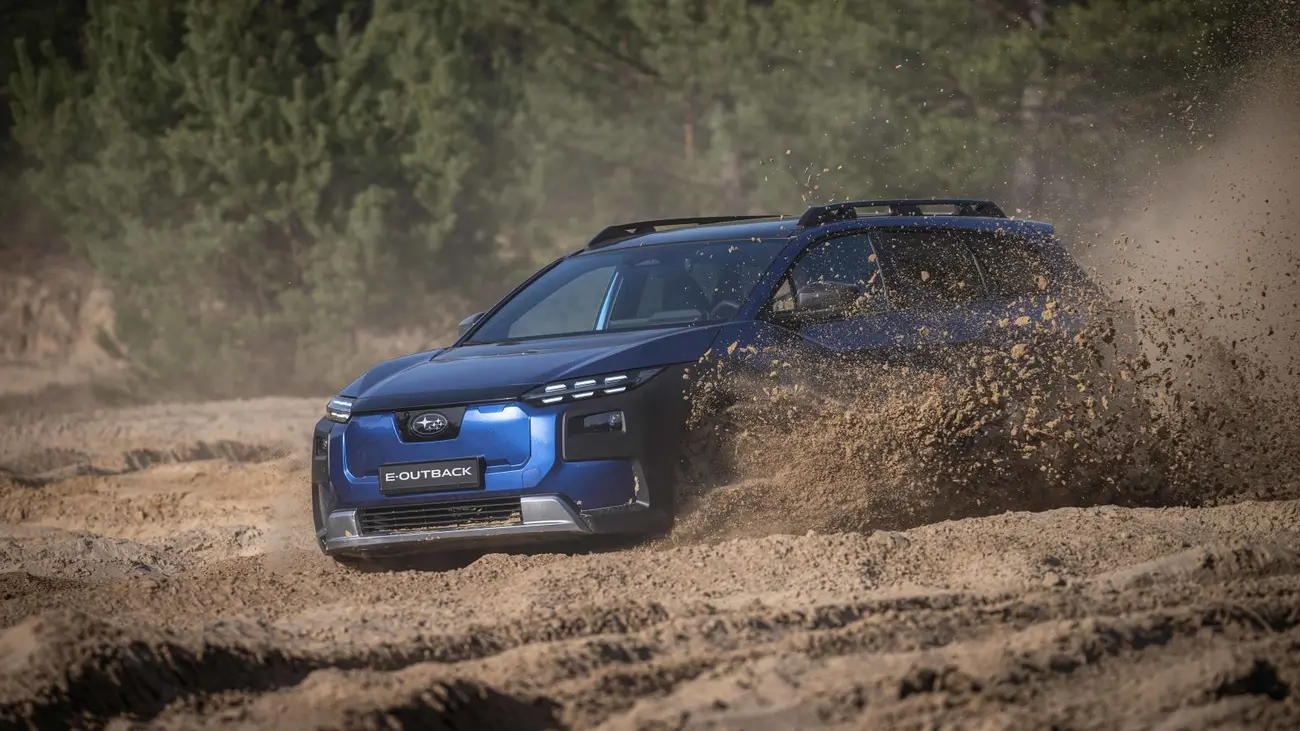
The drivetrain was reworked over the Solterra's: two 2XM motors (one per axle, the rear one stronger than the Solterra's), silicon-carbide inverters and detailed work on the reduction gear teeth that cuts transmission losses by 40%. Regen is smarter too — instead of the Solterra's fixed 70/30 split, braking is distributed according to how much grip each axle has.
For anyone towing: 1,500 kg braked and 750 kg unbraked, with a 75 kg noseweight. The roof bars take 80 kg dynamic and up to 317 kg static, which means they'll hold a roof tent with people inside it.
Subaru E-Outback specifications
| Specification | Value |
|---|---|
| Body | Raised estate, 5-door, 5 seats |
| Platform | e-TNGA (Toyota bZ4X / Subaru Solterra) |
| Motors | 2 electric, one per axle, permanent symmetrical AWD |
| System power | 280 kW / 381 hp |
| Torque | around 536-538 Nm |
| 0-100 km/h | 4.5 s |
| Top speed | 180 km/h |
| Battery | 74.7 kWh gross / 71.0 kWh usable, CATL NMC, 400 V |
| WLTP range | up to 526 km (523 km TEL / 477 km TEH) |
| Estimated real range | 425 km mild / 315 km cold |
| Estimated motorway range | 340 km mild / 265 km cold |
| WLTP consumption | 15.4-16.6 kWh/100 km |
| DC charging | 150 kW peak, 10-80% in 28-29 min |
| AC charging | 11 kW standard, 22 kW available (0-100% in about 4 h) |
| Length / Width / Height | 4,845 / 1,860 / 1,675 mm |
| Wheelbase | 2,850 mm |
| Ground clearance | 211 mm |
| Boot | 633 L / 1,718 L with seats folded |
| Kerb weight | around 2 tonnes |
| Payload | 555 kg |
| Braked towing | 1,500 kg |
| Warranty | 3 years / 100,000 km; battery 8 years / 160,000 km |
Subaru E-Outback vs Solterra: is it worth the extra €4,000?
This is the central question, because the E-Outback is a stretched Solterra underneath. The wheelbase is identical at 2,850 mm, but the car is 155 mm longer and the rear end was redesigned from scratch.
In France the two trims cost €52,990 (4XPerience) and €55,990 (4XPerience +), which is €4,000 and €3,000 more than the equivalent Solterra. What that money buys:
- 181 litres more boot — 633 L against the Solterra's 452 L, with room for items up to 1.07 m long
- 39 more horsepower (381 vs 342 hp in the Solterra 4XPerience), thanks to a stronger rear motor
- 1.6 kWh more battery and roughly 14 to 23 km more official range
- More ground clearance, a battery skid plate and the full off-road package (Grip Control, dual X-Mode, transparent bonnet view)
- Heated rear bench and a 360-degree camera as standard; the Plus trim adds a panoramic roof, Harman Kardon audio and ventilated front seats
If you live in the city and mostly drive motorways, the Solterra does the job and saves you €4,000. If you load bikes, dogs and camping kit, or tow a caravan down a dirt track in the Alentejo, the premium earns itself — and there aren't many electric cars that will do both.
Portuguese pricing, availability, and what's still open
Subaru Portugal hasn't announced local pricing. Working from the French €52,990 and Dutch €52,900, expect something in the €53,000 to €57,000 band depending on trim. Considerably lower figures have been circulating from Spanish sources, but we couldn't verify them against anything official, so we're sticking with the French and Dutch numbers. European sales began in March 2026, and the UK gets the car in summer 2026 with an estimated £60,000 price tag.
The Portuguese tax side helps. As a full EV, the E-Outback is exempt from ISV and qualifies for the reduced IUC annual road tax, with VAT deductible for companies within the legal limits. That's how a €53,000 electric car ends up close to a well-equipped diesel SUV on true cost of ownership here.
Frequently Asked Questions
Subaru Portugal has not confirmed local pricing yet. In France the E-Outback starts at €52,990 (4XPerience) and rises to €55,990 (4XPerience +), while the Netherlands lists it at €52,900, so €53,000 to €57,000 is a reasonable expectation here. European sales opened in March 2026 and the UK gets the car in summer 2026 at an estimated £60,000. As a full EV it is exempt from ISV, Portugal's registration tax, and qualifies for reduced IUC road tax — on a car at this price that saving easily runs into thousands of euros against a comparable diesel.
Subaru claims up to 526 km WLTP (523 km on the TEL cycle, 477 km on TEH, which is closer to a car on 20-inch wheels). Estimated real-world combined range is 425 km in mild weather and 315 km in the cold. On the motorway that falls to roughly 340 km in summer and 265 km in winter, with official consumption of 15.4 to 16.6 kWh/100 km. In practice, Lisbon to Porto up the A1 (about 310 km) is a single-hop trip in summer, but needs a charging stop in January at 120 km/h with the heating on.
It depends on how you use it. The extra €4,000 (€3,000 on the higher trim) buys 181 litres more boot — 633 L against 452 L — plus 39 more horsepower (381 vs 342 hp), 1.6 kWh more battery, greater ground clearance, a battery skid plate and the full off-road package with dual X-Mode and Grip Control. The wheelbase is identical at 2,850 mm; the E-Outback is simply 155 mm longer. For city and motorway use the Solterra does the job and saves the money; for carrying bulky kit, towing, or driving dirt tracks, the premium earns itself.
On DC it peaks at 150 kW (110 kW average) and covers 10-80% in 28 to 29 minutes — it is a 400-volt car, so plugging into a 350 kW post gains you nothing. The real strength is AC: the onboard charger goes up to 22 kW, double the class norm, taking the battery from 0 to 100% in about four hours on a three-phase connection. On a 7.4 kW home wallbox, budget around eleven and a half hours. There is no Plug and Charge and no V2G or V2H, and battery preconditioning has to be triggered manually.
Yes. Towing capacity is 1,500 kg braked and 750 kg unbraked, with a 75 kg maximum noseweight — enough for a light caravan or a small bike or horse trailer. The roof bars are rated at 80 kg dynamic and up to 317 kg static, which means they will hold a roof tent with people sleeping in it. Payload is 555 kg on a kerb weight of around two tonnes. Expect a significant range penalty with a trailer attached, particularly at motorway speeds.
Where it falls short
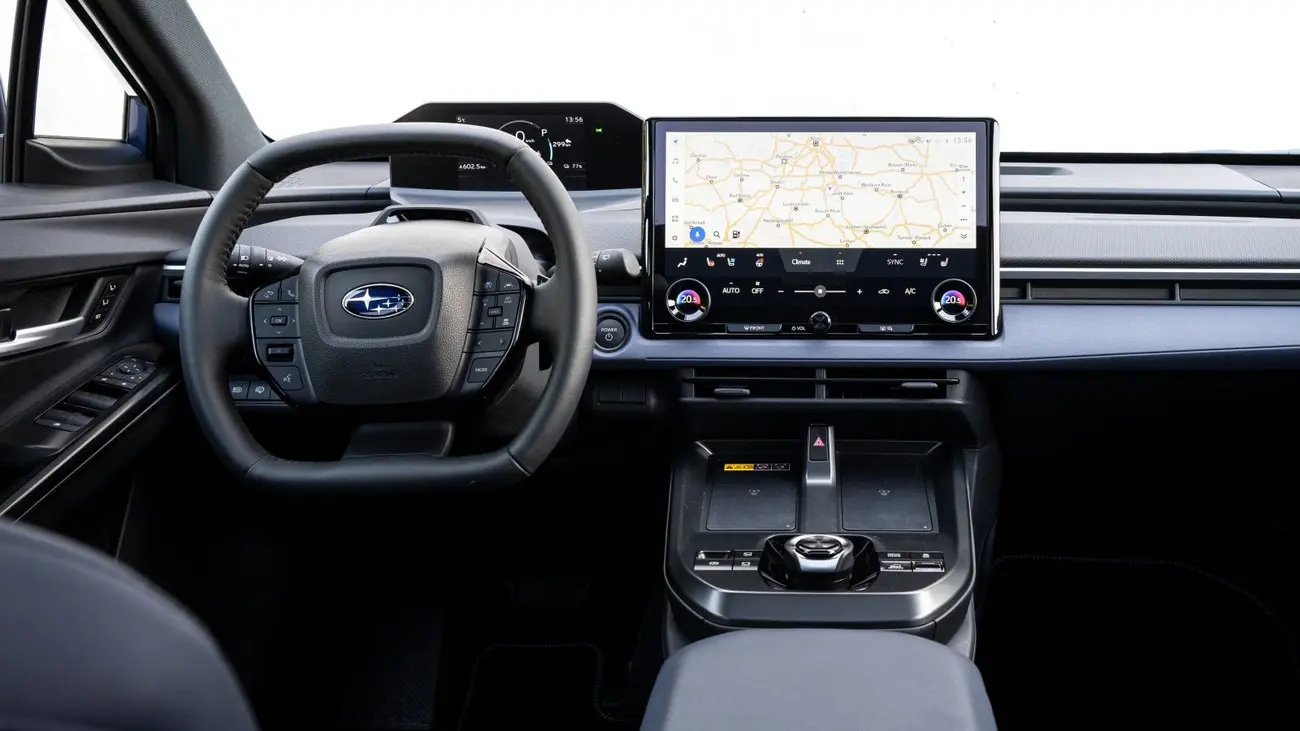
The criticism is consistent across reviews. The cabin is the Solterra's, with material quality below what this price bracket suggests. There is no glovebox at all — not for lack of space, but by Subaru's own decision. The five regen levels barely feel different from one another. And the rear seats split only 60:40, with no 40:20:40 and no ski hatch, which is odd in a car sold to people who carry long items.
Then there's the positioning problem. At €53,000 to €60,000 the E-Outback lines up against the BMW iX3, Volvo EX60 and Audi A6 e-tron Avant, all of which offer more range and much faster DC charging. Caradisiac scored it 14/20, Auto Express 3.5 out of 5. Both landed in the same place: good car, hard price to defend in a straight comparison.
What none of those rivals will do is climb a dirt trail with a tent on the roof and 1,500 kg behind it. If that's your life, the E-Outback is close to unique in the EV market — and it's worth waiting for Subaru Portugal's official pricing before you commit. If it isn't, there are electric cars on the same shelf offering more range per euro.