
Used EV Battery Health Check in Portugal: Can You Trust the SOH Figure?
Published: 03/09/2026
Two cars showing 88% can have completely different batteries
That line comes from Hervé Eloin, CEO of MyBatteryHealth, a company that has run more than 80,000 battery diagnostics. It sums up the problem facing anyone doing a used EV battery health check in Portugal: the percentage on the listing, on the dashboard or in the dealer's report is not a measurement. It's an estimate.
That doesn't make the number worthless. It means it needs context — age, mileage, charging history and, ideally, who ran the test and how.
Why the dashboard SOH figure isn't a measurement
No sensor in the car measures battery state of health. The BMS — the battery management system — collects voltage, current, temperature and energy-flow data, then estimates remaining capacity using proprietary algorithms that manufacturers almost never publish.
Every brand uses different methods, different recalibration intervals and different safety margins. Two practical consequences follow:
- Recalibration can "improve" SOH without improving anything. A full slow charge followed by a deep discharge can push the displayed figure or the estimated range up, while the cells have recovered no physical capacity at all.
- The buffer hides ageing. Every pack keeps a locked reserve to protect against extreme charges and discharges. Manufacturers can progressively unlock that reserve as cells degrade: the driver keeps the range they started with and isn't being cheated, but SOH stops reflecting real electrochemical wear.
A 2026 arXiv paper goes further, arguing that manufacturer SOH reporting fails independent validation, with model-dependent bias that is hard to predict. It's a preprint, not yet peer-reviewed — treat it as a warning flag, not proof.
How big are the discrepancies?
MyBatteryHealth's own figures, comparing an independent recalculation from raw vehicle data against the BMS value, are more reassuring than the alarmism suggests:
| Comparison result | Share of cases |
|---|---|
| Discrepancy of 2 percentage points or less | 94% |
| Recalculated at least 3 points below the BMS | 2% |
| Recalculated at least 3 points above the BMS | 4% |
| Average variance | −0.56 points |
| Largest gap observed | 5.8 points |
So the BMS is close to the truth in the overwhelming majority of cases. The catch is that you can't tell in advance whether the car in front of you belongs to the 94% or to the 6%. The company's own reports carry a ±2 percentage point precision margin and an A-to-E rating, precisely because they treat SOH as an estimate.
There's a real-world translation, too: five SOH points are worth roughly 20 to 25 km on a car with 450 km of range. On a Lisbon–Porto run, that's the difference between stopping and not stopping.
What EV battery degradation per year actually looks like
Geotab analysed telematics from more than 22,700 EVs across 21 models. The average is 2.3% degradation per year, which projects to about 81.6% SOH after 8 years. The 2023 study put it at 1.8%/year — the rise is attributed to the growth of high-power DC fast charging.
What separates a pack that ages well from one that doesn't:
| Factor | Annual degradation |
|---|---|
| Infrequent DC fast charging | 1.5% (≈88% at 8 years) |
| Frequent DC charging above 100 kW | 3.0% (≈76% at 8 years) |
| Hot climate (over 35% of days above 25 °C) | +0.4% on top |
| Over 80% of the time outside the 20–80% charge window | 2.0% (versus 1.4%) |
| Vans and MPVs | 2.7% |
| Light passenger cars | 2.0% |
| Mature models with years on the market | 1.4% |
Two readings matter if you're buying here. First, heat counts. Portuguese summers, especially in the south and the interior, put plenty of cars into that hot-climate bracket — an EV that spent years parked on the street at 100% charge in Beja has not aged like one that slept in a garage in Porto. Second, the famous 20–80% rule matters less than people claim. The penalty only becomes significant once a car spends more than 80% of its life at the extremes.
There's one more useful pattern when you're reading an odometer: according to AVILOO, most capacity is lost in the first 25,000 km, after which the curve flattens. A car with 40,000 km at 93% isn't automatically a better bet than one with 90,000 km at 91%.
What SOH percentage is acceptable on a used EV
As a market benchmark for an EV that's 3 to 6 years old:
- 95–100% — excellent, worth full market price
- 90–95% — very good, the sweet spot for most buyers
- 85–90% — acceptable, but negotiate for the range you've lost
- 80–85% — only with a clear discount
- Below 80% — red flag, check the warranty before anything else
Context, again: 92% on a two-year-old car with 35,000 km is a poor result; 92% on a 2020 Model 3 Performance with roughly 38,000 km — a real case tested by AVILOO — works out at 1.3% loss per year and projects to stay above 70% at 20 years old.
And SOH isn't everything. Ask about cell voltage balance, internal resistance and thermal behaviour as well. A 92% pack with badly imbalanced cells is a worse buy than an 88% pack ageing evenly.
Independent battery testing: what to ask for, and what it costs
CARA-Europe, the European car remarketing association, certifies battery health tests in two classes — and the difference between them is exactly the difference between trusting the BMS and not:
- Basic: reads SOH from the BMS via a diagnostic tool. The battery is never stressed and the car doesn't need to be driven. Fast, but it inherits every limitation above.
- Premium: an external, independent test involving charging, discharging or real driving. The result comes from the provider's own algorithm rather than the manufacturer's BMS estimate.
CARA Approved® providers include names that operate in Portugal and across the EU: AVILOO Flash Test, DEKRA Battery SOH Report, TÜV NORD BatterieCheck, Autel Blitz Test, MAHLE E-SCAN, LAUNCH Battery Index Test, Moba Certify Pro, Power Cruise Control PKC, vsNEW and the Generational Battery Health Check.
Reference prices, so you know what's on the table:
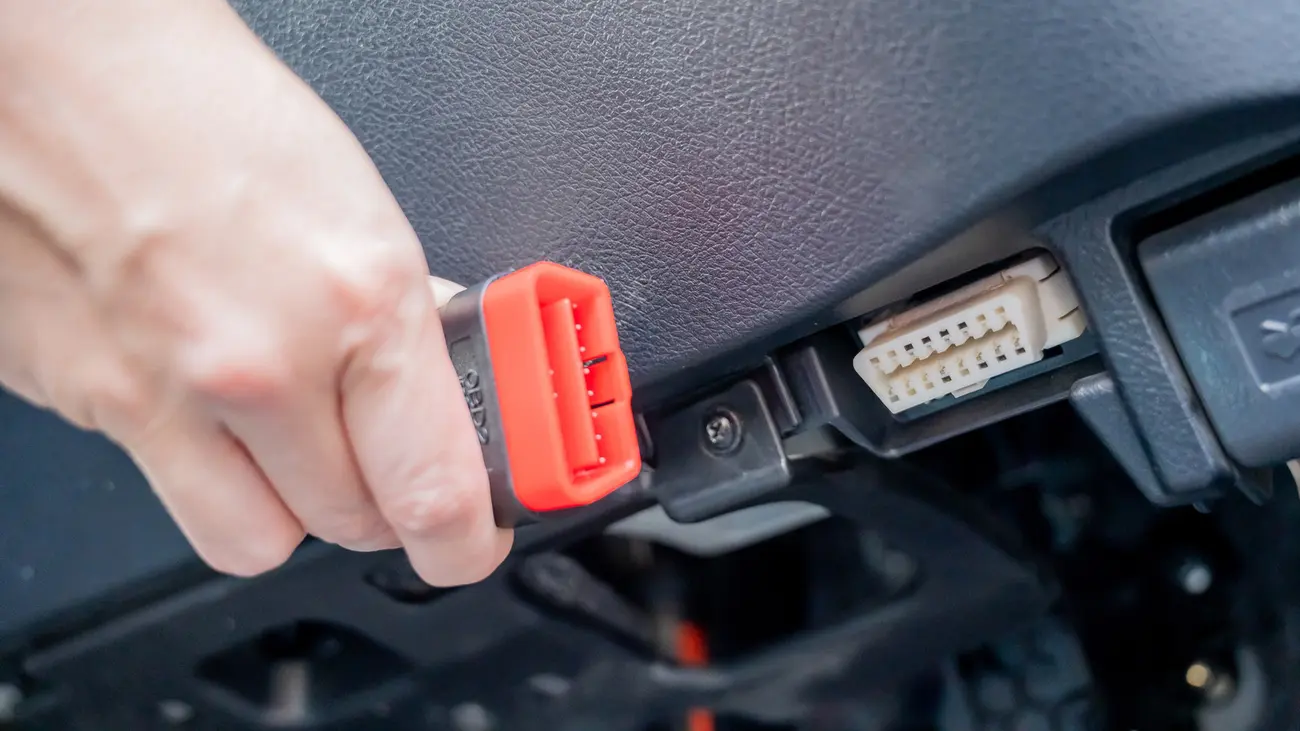
- AVILOO PREMIUM: around €99. A box arrives at your door, you plug it into the OBD-II port, charge the car to 100% and then have a week to run it down to 10%. You get a PDF certificate and ship the device back.
- AVILOO FLASH: €35 per test, run at the dealership in three minutes with the car stationary (€480 a year for the professional licence). This is the kind of certificate that can realistically show up on a listing.
- DIY: a Bluetooth OBD-II adapter for €30–60 plus the app for your model — Leaf Spy for the Nissan Leaf, Scan My Tesla, or Car Scanner ELM OBD2 and EVNotify for Hyundai and Kia. Take the reading between 20% and 80% charge, never at 2% or 100%.
Worth noting: in July 2026 AVILOO launched a used-EV battery warranty built on the FLASH Test — one year of cover, 96% of models, a £2,700 payout plus a refund of the test cost if SOH drops below the guaranteed level. Partners include Mercedes-Benz, Volvo, Porsche Holding, Ayvens, Arval, BCA and Cox Automotive. It's a signal of where the market is heading.
The EU digital battery passport lands in 2027 — and won't fix everything
From 18 February 2027, EV batteries placed on the EU market must carry a digital passport accessible by QR code, covering origin, composition, carbon footprint and usage history. Manufacturers are responsible for the accuracy of the data.
Two caveats take the shine off. It isn't retroactive: the cars on the road today — exactly the ones you'll be shopping for over the next few years — get no passport at all. And nothing stops the passport from simply repeating the BMS-calculated SOH, with no independent recalculation and no standardised method across brands. Better traceability; not guaranteed comparability.
Until then, no EU rule obliges a seller to hand over a battery health certificate with a used EV. Which brings us to the practical part.
What to ask a Portuguese dealer about the battery
One telling detail from an informal survey of seven used-EV professionals — with a Mégane E-Tech, Model 3, Model S, Taycan, iX1, Dacia Spring and e-Soul in stock: nearly all of them pull SOH straight from the BMS, trust it completely, and most do not publish it in their listings even though they have it.
The data exists. You just have to ask for it — and ask for the full version:
- What is the SOH, when was it measured, and with what tool?
- Is it a BMS read (Basic) or an independent charge/discharge test (Premium)?
- Is there a PDF report from a CARA Approved® provider I can take with me?
- What's the cell voltage balance and the internal resistance?
- How much of the car's mileage was covered using DC fast charging?
- How much battery warranty is left — usually 8 years or 160,000 km — and does it transfer to the second owner?
- Where did the car sleep, and at what state of charge?
If the seller has no answers, a €99 AVILOO PREMIUM on a €25,000 car is cheap insurance. And if the SOH comes back lower than expected, that number becomes a negotiating lever — in the UK, used EVs with a battery certificate sell faster and for £450–900 more than equivalents without one.
SOH isn't a lie. It's a useful indicator handed over without an instruction manual. Treat it the way you treat the odometer on a used diesel: a number that tells you a lot, as long as you know who read it and what it leaves out.
Frequently Asked Questions
It depends on age and mileage. On a three to six year old EV, 85 to 95% is the normal band, so 88% is acceptable — but the same figure on a two year old car with 35,000 km is a warning sign. Ask for cell voltage balance too: a pack at 88% ageing evenly is a better buy than one at 92% with badly imbalanced cells. Below 80% treat it as a red flag and check the remaining warranty before going any further.
A full independent test such as AVILOO PREMIUM costs around €99 — an OBD-II box is shipped to you, you charge the car to 100% and discharge to 10% within a one week window, and you get a PDF certificate. The quick dealer test, AVILOO FLASH, costs €35 per test and takes three minutes with the car stationary. The cheapest route is a Bluetooth OBD-II adapter for €30 to €60 plus the app for your model, such as Leaf Spy, Scan My Tesla or Car Scanner.
Less than commonly claimed, but it does matter. Geotab's analysis of 22,700 EVs found that heavy use of DC charging above 100 kW costs 3.0% of capacity per year — roughly 76% SOH at eight years — against 1.5% per year, or about 88% at eight years, for light DC users. The fleet average is 2.3% per year. On a used car, ask what share of the mileage was covered on rapid chargers.
Yes. The same Geotab study shows that climates where more than 35% of days exceed 25 °C add around 0.4 percentage points of degradation per year — a penalty that applies to much of Portugal, particularly the south and the interior. In practice, an EV that spent years parked on the street at 100% charge in Beja has not aged like one that slept in a garage in Porto. It is worth asking the seller where the car was parked and charged.
Usually yes, but only below a minimum capacity threshold set by the manufacturer, not for every point lost. Typical battery warranties run for 8 years or 160,000 km, whichever comes first, so on a used EV you need to confirm how much time and mileage remain and whether the cover transfers to the second owner. Note that no EU rule obliges a dealer to supply a battery health certificate — and the digital battery passport arriving on 18 February 2027 is not retroactive to cars already on the road.