
Rolls-Royce Spectre Series II in Portugal: Up to 628 km Range and 670 hp
Published: 04/06/2026
What's new in the Rolls-Royce Spectre Series II
An extra 160 km of range and the most powerful Rolls-Royce ever built. That's the short version of the Rolls-Royce Spectre Series II, the mid-life update to the British marque's first electric car, revealed on 2 June 2026. The Spectre has been on sale since 2023, and this refresh keeps it competitive in a luxury EV segment that is filling up fast — arriving just a week after Ferrari unveiled its Luce.
For anyone watching the market here in Portugal, the takeaway is simple: the most expensive electric coupé on sale now goes further, charges quicker, and gains a Black Badge variant that rewrites Goodwood's own power figures.
Rolls-Royce Spectre Series II range: up to 628 km WLTP
The headline change is the battery. Capacity stays at around 102 kWh, but the cells have been "re-engineered" — Rolls-Royce's own word — and the result is a range of up to 390 miles WLTP, roughly 628 km. That's an 18% gain over the outgoing car. On the US EPA cycle it's rated at 308 miles (~496 km), a 16% jump from the previous ~265 miles.
In practical terms, this is an electric grand tourer that does Lisbon to Porto with a comfortable buffer left over for the start of the trip back, without charging anxiety. Charging times have dropped 14% too: 10–80% in under 30 minutes, with the pack accepting around 250 kW on DC.
Where do these gains come from? Shared technology inside the BMW group. The BMW i7 facelift landed in April with a battery 20% more energy-dense, keeping the same 102 kWh thanks to Croatian firm Rimac. The Spectre uses the same packs. The range difference versus the i7 comes down to the Spectre being bigger, heavier and less aerodynamic.
The most powerful Rolls-Royce ever: the Black Badge
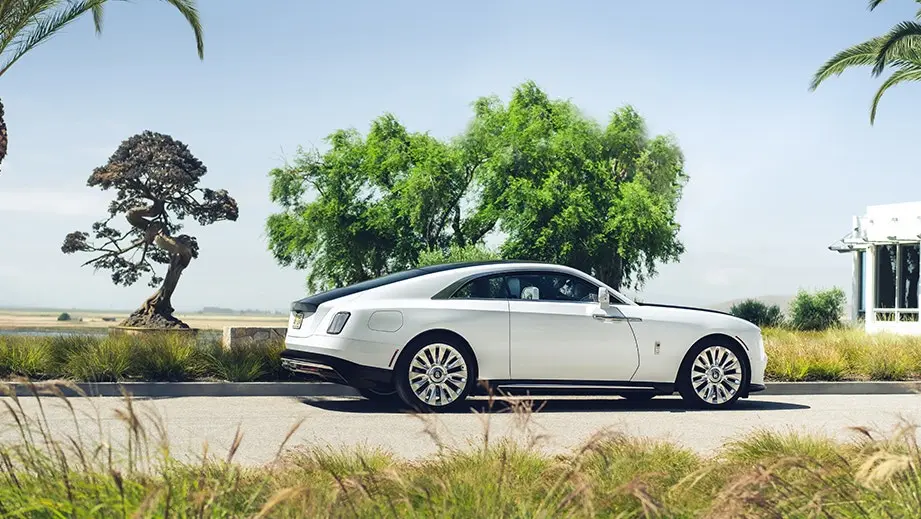
Power is up across both variants. The standard car now produces 593 bhp and 1,015 Nm of torque, against 577 bhp before. But the new Black Badge is the star: 670 hp in "Infinity Mode" and up to 1,100 Nm in "Spirited Mode", when launch control kicks in.
Those 670 hp make it the most powerful production Rolls-Royce in the company's 122-year history. The figure says little about how a car like this drives — nobody buys a Spectre to chase lap times — but it proves that going electric has freed Rolls-Royce from any power compromise.
Both versions use the dual-motor setup from the BMW i7 M70, BMW's flagship electric saloon.
Specs: Series I vs Series II
| Specification | Standard | Black Badge |
|---|---|---|
| Power | 593 bhp | 670 hp |
| Torque | 1,015 Nm | 1,100 Nm |
| Previous power (Series I) | 577 bhp | — |
| WLTP range | up to 628 km | up to 628 km |
| EPA range | 496 km | 496 km |
| Battery | ~102 kWh | ~102 kWh |
| Charge 10–80% | under 30 min | under 30 min |
| Powertrain | Dual-motor (BMW i7 M70 base) | Dual-motor (BMW i7 M70 base) |
Personalisation: where the Spectre earns its price
If the technical numbers are a measured evolution, personalisation is where Rolls-Royce really opened the catalogue. The Spectre is the marque's second most personalised model after the Phantom, and since the original launch clients have requested more than 20 bespoke elements per car.
The Series II additions include:
- Duality Twill fabric, made from bamboo-derived fibres, with 2.6 million stitches, over 16 km of thread and up to 25 hours of work per piece.
- Placed Perforation leather with 78,138 precision-cut perforations in three different sizes, allowing custom artwork.
- Brindled Walnut veneer, in wood from non-fruiting trees combined with eucalyptus fibres and lacquered glass flakes.
- An illuminated fascia with 8,108 light pinpricks in a horizontal wave pattern.
- A new aviation-inspired clock on the dashboard, set above a miniature Spirit of Ecstasy.
- Ethereal Blue paint (standard) and an Iced Black matte finish on almost all of the Black Badge's brightwork, with the Pantheon grille kept polished.
- Forged 23-inch wheels, hand-finished in up to six hours each.
Spectre Series II price and availability in Portugal
Order books opened on the day of the reveal. In the UK, the standard car starts at around £330,000 and the Black Badge at £400,000; in the US, the announced figures are $397,750 and $467,750. North American deliveries begin in late 2026.
There's no official Portugal price yet. But we can frame it: the Series I sat around €350,000 in our market, and everything points to the Series II climbing from there. Worth remembering that, being electric, the Spectre qualifies for ISV exemption (Portugal's vehicle registration tax) and a reduced IUC (annual road tax) — a detail that, even on a car this expensive, still represents a real saving against a combustion equivalent.
A note of context is fair here. The 628 km range, much improved as it is, still trails rivals such as the Mercedes EQS (up to 575 miles WLTP in some versions) or the Lucid Air (over 500 EPA miles, from a fraction of the price). And Spectre sales fell 47% in 2025, to 1,002 units, after nearly 1,900 in 2024. Owners average around 6,400 km a year and charge almost always at home — which makes range, in reality, less critical than the figures suggest.
Frequently Asked Questions
There is no official Portugal price yet. In the UK, the Spectre Series II starts at around £330,000 for the standard car and £400,000 for the Black Badge; in the US, the figures are $397,750 and $467,750. Since the Series I sat around €350,000 in the Portuguese market, the Series II is expected to climb from there. Being electric, it qualifies for ISV exemption and a reduced IUC road tax.
The Spectre Series II claims up to 390 miles WLTP, roughly 628 km, an 18% gain over the outgoing car. On the US EPA cycle it is rated at 308 miles (~496 km). The improvement comes from re-engineered battery cells while keeping the ~102 kWh capacity. In practice it does Lisbon to Porto with a comfortable buffer, though most owners drive around 6,400 km a year and charge almost always at home.
The new Black Badge produces 670 hp in 'Infinity Mode' and up to 1,100 Nm of torque in 'Spirited Mode', making it the most powerful production Rolls-Royce in the company's 122-year history. The standard model also rose, from the previous 577 bhp to 593 bhp and 1,015 Nm. Both versions use the dual-motor setup from the BMW i7 M70.
Despite the jump to 628 km WLTP, the Spectre Series II still trails rivals such as the Mercedes EQS, which claims up to 575 miles WLTP in some versions, or the Lucid Air, with over 500 EPA miles for a fraction of the price. Even so, in the luxury electric coupé segment the Spectre has no direct rival with the same exclusivity and personalisation.
The Series II gains more range (up to 628 km WLTP, +18%), 14% faster charging (10-80% in under 30 minutes) and more power (593 bhp versus the Series I's 577 bhp). It also introduces the 670 hp Black Badge variant and a major personalisation update, with Duality Twill fabric, Placed Perforation leather, Brindled Walnut veneer and 23-inch forged wheels. Exterior visual changes are minimal.
If you're after a luxury electric car, the Spectre Series II is the most extreme proposition on the market right now. For those who can buy one, the range gains and the new Black Badge make it easier to justify than the original. The wait is for an official euro price — and to see how many reach Portuguese roads.