
Used Renault Zoe in Portugal: 65% Depreciation and What It Really Costs
Published: 30/08/2026
A 65% five-year drop: the number that made the Zoe Europe's cheapest used EV
A Renault Zoe that cost €32,445 new in 2020 now sells for an average of €11,477 in France. That is 65% of its value gone in five years — the steepest fall among ten high-volume EVs analysed by Leboncoin. Bad news if you bought one new. Excellent news if you are shopping used, because nothing else gets you into electric motoring for less.
Portugal, though, tells a different story. We pulled what is actually listed in our market, and the answer to "is a used Renault Zoe in Portugal worth buying?" shifts considerably once you swap French prices for Portuguese ones.
Used EV depreciation, model by model
Leboncoin compared the average new price in 2020 with the average used price five years later across ten widely sold electric cars. The group average is a 59% loss. The Zoe is bottom of the table.
| Model | Depreciation | New price (2020) | Used price after 5 years |
|---|---|---|---|
| Dacia Spring | 53% | €17,695 | €8,347 |
| Tesla Model 3 | 56% | €52,136 | €23,180 |
| Fiat 500e | 56% | €31,487 | €13,993 |
| Volkswagen ID.3 | 57% | €41,963 | €17,871 |
| Mini Cooper Electric | 57% | €39,066 | €16,617 |
| Kia e-Niro | 58% | €44,625 | €18,722 |
| Peugeot e-208 | 60% | €35,096 | €13,873 |
| Renault Twingo E-Tech | 62% | €24,423 | €9,392 |
| Peugeot e-2008 | 62% | €40,690 | €15,464 |
| Renault Zoe | 65% | €32,445 | €11,477 |
Two caveats before taking those figures at face value. First, the study measures against full list prices, with no discounts or incentives applied. French buyers in 2020 could claim an eco-bonus of up to €7,000, so the first owner's real loss was materially smaller than 65%. Portugal's Fundo Ambiental grant was far more modest and capped by annual quotas that ran out fast — our advantage came mainly from the ISV purchase-tax exemption and near-zero IUC road tax for EVs, which still applies and benefits second-hand buyers too.
Second, the Zoe went out of production in 2024, replaced by the Renault 5 E-Tech. A discontinued model depreciates faster, and a visibly more modern successor accelerates that. The upside: the used pool is now closed and will not grow.
What a used Renault Zoe costs in Portugal
Here is the part nobody explains: on the Portuguese market the Zoe has not fallen to €11,477. We counted 104 Renault Zoe listings available in Portugal, priced between €10,099 and €22,500, with a median of €15,480.
| Year | Listings | Median price | Cheapest |
|---|---|---|---|
| 2017 | 3 | €11,500 | €10,500 |
| 2019 | 11 | €11,750 | €10,099 |
| 2020 | 30 | €14,500 | €11,500 |
| 2021 | 32 | €15,725 | €13,490 |
| 2022 | 18 | €16,950 | €14,900 |
| 2023 | 8 | €18,444 | €17,850 |
A 2020 Zoe — the exact car in the French study — asks a median €14,500 here. That works out at roughly 55% off the €32,445 reference, not 65%. Supply in Portugal is thin, the used EV fleet is still young, and steady demand for city EVs with a symbolic road-tax bill keeps prices up.
In practice: buying an electric car under €12,000 in Portugal is possible, but at that level there are only 11 Zoes and nearly all are 2019 or older with 80,000 to 130,000 km on them. The real sweet spot sits between €13,000 and €16,000, where 47 cars land with a median 70,000 km.
Supply is also clustered: Porto (24 listings), Braga (20) and Lisboa (18) account for more than half the national stock. Inland and in the Alentejo, you can count them on one hand.
The 52 kWh Zoe dominates Portuguese stock
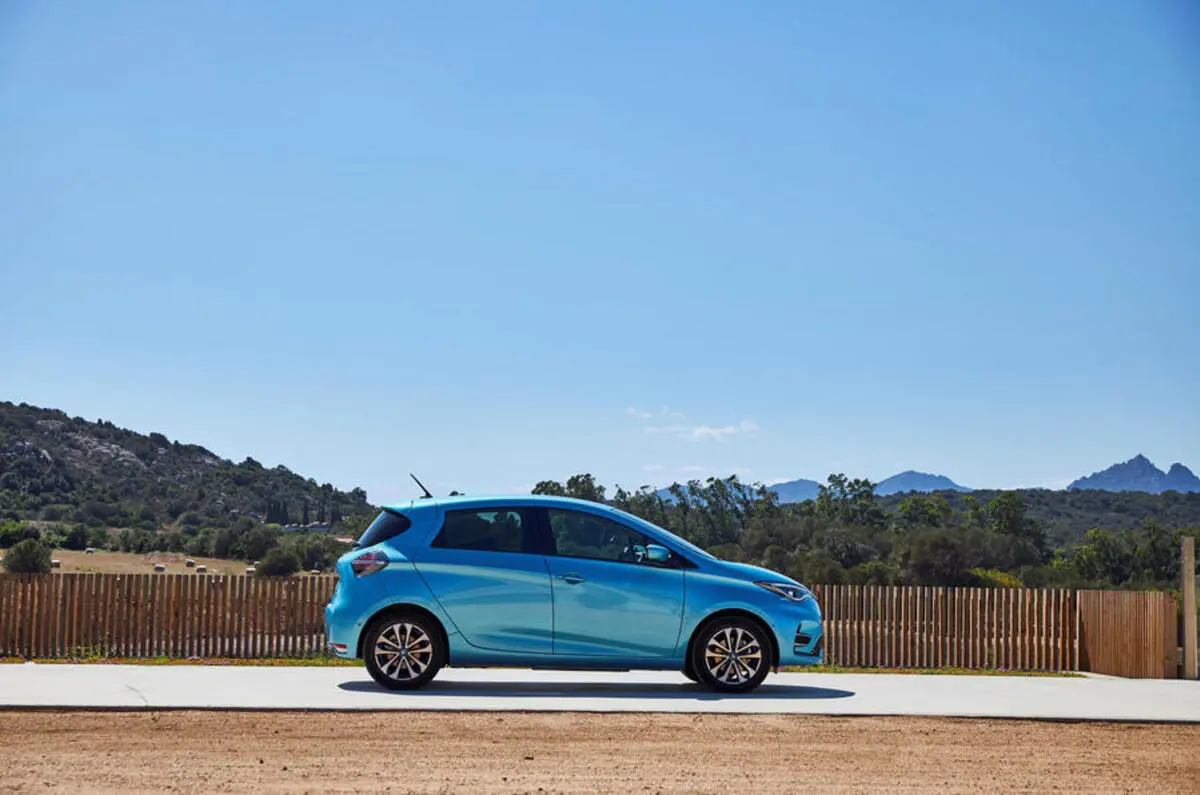
Of the 104 cars for sale, 69 are R110 versions with the 52 kWh battery and 23 are R135s, also 52 kWh. Only 12 carry the older 41 kWh, 44 kWh or 22 kWh packs. Buy a Zoe in Portugal and you are almost certainly buying the Phase 2 launched in 2019 — the version with the best range and the better cabin.
Renault Zoe real-world range: what each battery delivers
The Zoe ran three batteries across twelve years on sale, and the gap between them is huge.
| Battery | Years | Official range | Real-world range |
|---|---|---|---|
| 22 kWh | 2013–2015 | 210 km NEDC | around 100 km |
| 41 kWh (Z.E. 40) | 2017+ | 400 km NEDC | 250–300 km |
| 52 kWh (Z.E. 50) | 2019+ | 395 km WLTP | around 380 km in summer city driving, 250 km in winter |
That winter figure of 250 km for the 52 kWh car is the one that matters. It covers a full working week of commuting around Lisboa or Porto without thinking about charging. It does not cover Lisboa to Faro without a stop.
Motors run from the Q210 and R240 (88 hp) of the early cars to the R110 (108–110 hp) and the R135, with 135 hp and 245 Nm, good for 0–120 km/h in 7.1 seconds. Check too whether the car has the 50 kW DC rapid charging option: a €1,000 extra when new, it recovers around 150 km in 30 minutes and is what separates a Zoe you can travel in from a strictly urban one.
Leased battery or owned battery? A difference worth thousands
Before April 2018, Renault sold the Zoe with a compulsory battery lease. The scheme only ended in January 2021, and on affected cars the monthly payment ran from €74 to €124 depending on the mileage plan.
Buying the pack out from Renault's finance arm costs roughly €8,900 for the 41 kWh and €7,400 for the 22 kWh — more than many of these cars are now worth. That is why an owned-battery example commands a €3,000 to €5,000 premium over an otherwise identical leased-battery car.
This matters especially in Portugal, because a slice of national stock is imported from France, where leasing was the norm. If the advert does not state outright that the battery belongs to the car, ask before you get excited about the price. An unusually cheap Zoe is almost always a leased-battery Zoe, a high-mileage one, or both.
Warranty terms differ too: an owned battery is covered for 8 years or 160,000 km, replaced if capacity falls below 66%. A leased battery is covered for the life of the contract, replaced below 75%.
How to check EV battery health before buying used
State of health (SoH) is the single biggest swing factor in a used EV's value. DAT, the German vehicle valuation body, calculates the expected SoH for a car's age and mileage, then converts every point of deviation straight into euros of price correction.
Practical benchmarks for negotiating:
- Above 90%: excellent, pay the asking price.
- 85–90%: normal for a three to five year old car.
- 80–85%: ask for a discount.
- Below 80%: investigate properly before committing.
How to measure it: the My Renault app shows the SoH percentage; a quick OBD test takes around 15 minutes and needs the pack between 10 and 30 °C; a read during a charging session takes an hour; a full 100% to 10% cycle test can run for days. The most trustworthy document remains Renault's own battery capacity certificate.
What wears a pack down: frequent rapid charging, deep discharges, heat and hard driving, plus plain calendar ageing. To preserve it, charge on AC and keep the state of charge between 20% and 80%.
Known faults and what they cost
The Zoe is Europe's most common used EV, which means parts are cheap and workshops know it well. It also has documented weak points:
- Continental Q210 motor: fragile bearings and a seal that lets coolant into the rotor. Symptoms are a whistle under acceleration and lost range. Repair around €4,000.
- Chameleon charger: failures reported before 100,000 km, replacement also around €4,000.
- TCU (telematics unit): when it fails the car refuses to charge and displays "checks in progress".
- Earth resistance: the Zoe refuses to charge above 150 ohms (200 ohms on ZE50 cars). It is a safety feature, but it can block charging on older domestic wiring.
- R135: multiple owners report bearing wear at around 70,000 km.
- Smaller stuff: R-Link screens going black (reprogramming around €120), fragile paint, a loose tailgate mechanism on cars built before September 2014.
A test drive is non-negotiable — listen to the motor under acceleration and run a full charge cycle. Do that, and a well-kept Zoe reaches 200,000 km without drama.
Zero Euro NCAP stars: what that actually means
In 2021 the facelifted Zoe scored zero stars from Euro NCAP — only the third car in the programme's history to manage it. The cause was specific: Renault swapped the seat-mounted side airbag protecting head and thorax for a thorax-only unit. In the frontal offset crash, chest protection for the driver was rated poor; in the severe side pole test, the dummy's head hit the pole.
Euro NCAP general secretary Michiel van Ratingen did not soften it: "Renault was once synonymous with safety... safety has now become collateral damage in the group's transition to electric cars."
The context matters: the pre-facelift Zoe held five stars under the 2013 protocol, protocols have tightened enormously since, and Renault announced a 2022 update to address side impact. Even so, it is a fact that should weigh on anyone carrying children every day.
Frequently Asked Questions
Well-maintained cars routinely reach 200,000 km, and the battery typically lasts between 8 and 15 years. On owned-battery cars Renault covers the pack for 8 years or 160,000 km and replaces it if capacity falls below 66%; leased packs have a more generous 75% replacement threshold, but only while the contract is running. Most Zoes on sale in Portugal sit between 60,000 and 100,000 km, so mechanical wear is rarely the deciding factor — battery condition is.
Check the vehicle registration document and ask the seller for the Renault finance (DIAC) contract or the battery purchase declaration. Every Zoe built before April 2018 left the factory with a rented battery, a scheme that only ended in January 2021, and many cars sold in Portugal were imported from France, where leasing was the norm. Buying the pack outright afterwards costs around €8,900 for the 41 kWh version and €7,400 for the 22 kWh — more than many of these cars are worth — so an unusually cheap advert almost always means a leased pack at €74–€124 a month.
Only the Phase 2 car (2019 onwards) offers 50 kW DC charging, and it was roughly a €1,000 option when new, so plenty of cars simply do not have it. With it you recover about 150 km in 30 minutes; without it you are limited to the Chameleon AC charger at up to 22 kW. Check the listing details or look for the CCS socket before buying, especially if you drive long distances — it is one of the biggest differentiators in resale value.
For urban use with home charging, yes: a 2020 Zoe averages €14,500 in Portugal against €32,445 new, and a full 52 kWh home charge costs around €7.50 versus up to €0.90/kWh on public networks. Insist on a battery state of health above 85% and written confirmation that the pack belongs to the car. Bear in mind that the 2021 facelift scored zero Euro NCAP stars, which makes it a poor choice for heavy motorway use or for carrying children.
The 52 kWh Zoe delivers roughly 380 km of real city range in summer and 250 km in winter, against little more than 200 km WLTP for the Spring, and its cabin and road manners are clearly better. On the other hand the Spring held its value best in the Leboncoin study (53% depreciation over five years against the Zoe's 65%) and starts at about €12,990 here. If you need range and comfort, the Zoe justifies the extra €2,000–€4,000; if the car is only for short trips, the Spring is cheaper to buy and retains value better.
Who the Zoe suits — and who it does not
At roughly €7.50 for a full 52 kWh home charge (against up to €0.90/kWh on public networks), with ISV exemption and a token IUC bill, a 52 kWh Zoe between €13,000 and €16,000 delivers some of the lowest per-kilometre running costs available in Portugal. It works for anyone who can charge at home, drives up to 200 km a day, and wants a second car for town.
It does not work if you charge exclusively on public chargers, travel long distances regularly, or cannot get written confirmation that the battery belongs to the vehicle. In those cases look at a Nissan Leaf instead (median €15,250 here) or, with lower range ambitions, a Dacia Spring at €12,990.
And if you are weighing buying now against waiting: with production over and the Renault 5 E-Tech taking its place in showrooms, the Portuguese pool of used Zoes only shrinks from here. Today's 104 cars will not be 200 next year.