
Renault 5 vs Clio in Portugal: Electric or Hybrid City Car
Published: 19/06/2026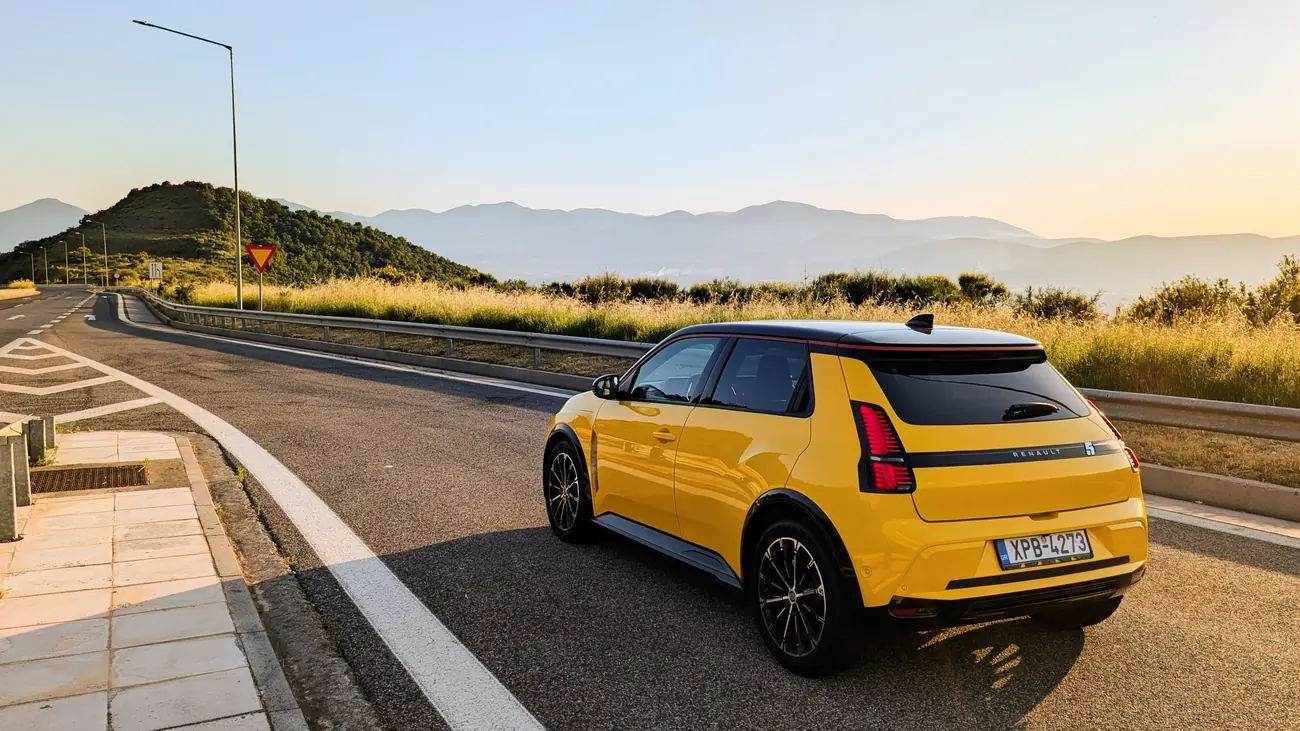
Renault 5 vs Clio in Portugal: which one to buy?
Renault now sells two city cars that chase the same buyer: the fully electric Renault 5 E-Tech and the Clio, France's best-selling supermini for years, offered in petrol and self-charging hybrid form. Same B-segment, same badge — yet they answer very different needs. If you're weighing the Renault 5 electric vs Clio hybrid, the choice comes down to one question: do you have somewhere to charge?
Let's put them side by side, with the real numbers and what they mean for daily driving here in Portugal.
Renault 5 electric: a city car with 405 km of range
The 52 kWh version of the Renault 5 E-Tech claims a WLTP range of around 405 km. In the real world you'll see roughly 300 to 335 km in mixed use, and in the city — where these cars live — consumption sits at 15 to 17 kWh/100 km. For a daily Lisbon or Porto commute, that means charging once a week, maybe less.
Under the floor sits a 110 kW motor, that's 150 hp, with 245 Nm of torque. It does 0–100 km/h in 8.0 seconds and tops out at 150 km/h. It isn't built for long motorway hauls, but around town it's quick, agile and silent.
Charging is where the R5 shows its maturity. On AC it takes 11 kW, enough to fill the battery overnight at home. On DC fast charging it reaches 100 kW, enough to go from 10 to 80% in about 31 minutes at a motorway stop. It also comes with a heat pump as standard — a detail that protects range in cold weather and that many rivals charge extra for.
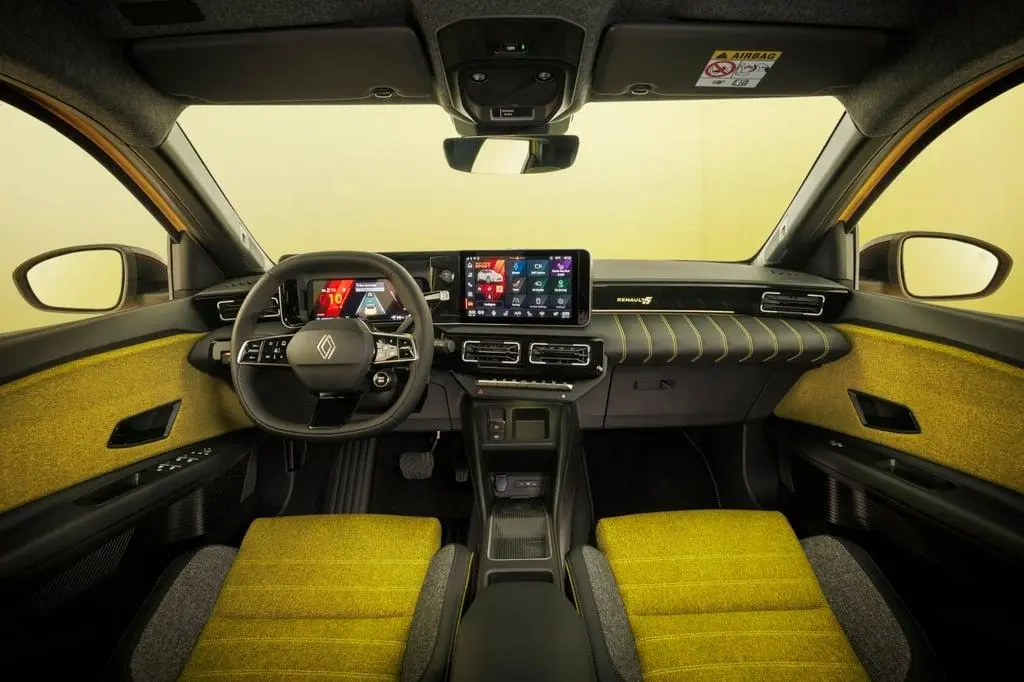
There's also an entry-level 40 kWh battery with 120 hp for buyers who want the cheapest R5 and cover fewer kilometres. On space, the boot holds 326 litres — competitive for the class — but the rear seat is tight. At 3,922 mm long, it's one of the shortest cars in the segment.
Renault Clio E-Tech: the hybrid that never plugs in
The Clio hybrid's main argument is simple: it never needs a plug. The E-Tech system is self-charging — it recovers energy under braking and coasting and uses it to drive on electric power for much of an urban journey.
There are two generations in play, and the distinction matters. The new sixth-generation Clio arrives in 2026 with a 160 hp full hybrid, pairing a 1.8-litre Atkinson-cycle engine with two electric motors. It claims 3.9 L/100 km and 89 g/km of CO2, does 0–100 km/h in 8.3 seconds, and has a 391-litre boot in a 4,116 mm body.
The previous fifth generation — 145 hp, 1.6-litre engine — is still the most common one on the Portuguese used market, and the one many buyers will actually find. It returns 67.3 mpg, around 4.2 L/100 km, emits 96 g/km and does 0–100 km/h in 9.3 seconds. The hybrid's boot drops to 301 litres because of the battery, against 391 in the petrol version.
In both cases the logic is the same: it runs in electric mode up to about 80% of the time in the city, but only for a few kilometres at a stretch and up to 40 km/h. It isn't an EV — it's petrol with electric help. The upside is you can do Lisbon–Porto–Algarve without thinking about where to refuel, with ranges that easily pass 1,000 km per tank.
Renault 5 or Clio: the matchup number by number
| Specification | Renault 5 E-Tech (52 kWh) | Renault Clio E-Tech Hybrid |
|---|---|---|
| Powertrain | Fully electric, 52 kWh battery | Self-charging hybrid (petrol + 2 motors) |
| Power | 110 kW / 150 hp | 160 hp (new gen) / 145 hp (previous) |
| 0–100 km/h | 8.0 s | 8.3 s (new) / 9.3 s (previous) |
| Range / economy | WLTP around 405 km; 15–17 kWh/100 km | 3.9 L/100 km (new) / 4.2 L (previous) |
| CO2 | 0 g/km tailpipe | 89 g/km (new) / 96 g/km (previous) |
| Charging | AC 11 kW; DC 100 kW (10–80% in 31 min) | Never plugs in |
| Length | 3,922 mm | 4,116 mm (new) / 4,053 mm (previous) |
| Boot | 326 L | 391 L (new) / 301 L hybrid (previous) |
| Euro NCAP | 4 stars | 5 stars (2019) |
The Clio is the more practical everyday family car: longer, with more rear room and a bigger boot in petrol form. The R5 wins on agility, quietness and that new-car feel, but pays for it in rear space and crash rating (4 stars against the Clio's 5).
Running costs and taxes in Portugal
This is where the scales tip towards electric — provided you can charge. The Renault 5, being fully electric, qualifies in Portugal for ISV (the vehicle purchase tax) exemption and pays a much-reduced IUC (the annual road tax). Charging at home on a night tariff costs a fraction of fuelling the Clio, even at the hybrid's 3.9 L/100 km. For high-mileage urban drivers with home charging, the R5 is clearly cheaper to run.
The Clio hybrid doesn't get the EV's tax breaks, but it also doesn't depend on charging infrastructure. And that's where the real decision lies: around 44% of homes can't fit a charger. If you live in a flat with no private garage, relying on the public MOBI.E network (Portugal's national charging network) for daily use can be frustrating — and the Clio sidesteps that entirely.
Frequently Asked Questions
The petrol Clio starts around €19,900 and the Clio E-Tech hybrid from roughly €24,600, while the 52 kWh Renault 5 electric sits at €30,990 to €32,900 in markets like Germany and the Netherlands, before incentives. In practice the R5 starts roughly level with a mid-spec hybrid Clio, but the long-range version costs more. In Portugal the EV's ISV exemption narrows the gap, so it's worth checking Renault Portugal's official pricing and the incentives in force.
The 52 kWh Renault 5 E-Tech claims around 405 km WLTP, but in the real world expect 300 to 335 km in mixed use. In the city, where consumption drops to 15 to 17 kWh/100 km, range is even better, meaning a daily Lisbon or Porto commute only needs charging about once a week. It comes with a heat pump as standard, which helps preserve range in winter.
Charging the Renault 5 at home on a night tariff costs a fraction of fuelling the Clio, even at the new hybrid's 3.9 L/100 km. For high-mileage urban drivers with home charging, the R5 is clearly cheaper to run, and it also qualifies for ISV exemption and a much-reduced IUC in Portugal. That advantage shrinks if you rely on the public network for daily use, where fast-charging prices approach the cost of fuel.
Generally not. Around 44% of homes in Portugal can't fit a charger, and relying on the public MOBI.E network for daily use can be frustrating and more expensive. In that case the self-charging Clio hybrid is the smarter choice: it never plugs in, runs in electric mode up to 80% of the time in the city, and easily covers over 1,000 km per tank with no range anxiety.
Choose the Renault 5 electric if you have charging at home or work, drive mostly in the city, and want low running costs with zero local emissions and tax breaks. Pick the Clio hybrid if you have nowhere to charge, do more motorway or long-distance driving, or want a more affordable used fifth-generation car. The Clio is also more practical for families, with more rear room and a bigger boot, and holds a 5-star Euro NCAP rating against the R5's 4.
Renault 5 or Clio: who each one is for
The Renault 5 electric makes sense if you have charging at home or work, drive mostly in the city and region, and want low running costs with zero local emissions. The tax incentives and the price of electricity do the rest.
The Clio hybrid is the right call if you have nowhere to charge, do more motorway or long-distance driving, and want low fuel use without ever thinking about charging points. In used fifth-generation form, it's also cheaper to get into.
On price, the petrol Clio starts around €19,900, the hybrid from roughly €24,600, and the 52 kWh R5 sits at €30,990 to €32,900 in markets like Germany and the Netherlands — before incentives. So the R5 starts roughly level with a mid-spec hybrid Clio, but the long-range version costs more. It's worth checking Renault Portugal's official pricing and the incentives in force before deciding — that's where the final sum is settled.