
Why Used Electric Car Mileage in Portugal Barely Affects the Price
Published: 03/06/2026
Why used electric car mileage barely moves the price anymore
For decades, the first question about any used car was simple: how many kilometres has it done? With electric cars, that rule has stopped working. A recent German study analysed around 50,000 batteries and found that degradation is far slower than most people assume — and that the odometer has lost much of its power at the negotiating table. What matters now is battery health, not the number on the dashboard.
For anyone weighing up a second-hand EV in Portugal, this shift is worth real money. You could be overpaying for a low-mileage car — or walking away from a great buy simply because the odometer reading looks intimidating.
The German study that rewrote the maths
The joint analysis by TÜV Nord and Carly, published in March 2026, measured the State of Health (SoH) of roughly 50,000 electric and plug-in hybrid batteries. SoH is a 0-to-100 scale showing how much capacity a battery retains compared with its factory condition.
The headline figure: a median of 96 points. In other words, half the cars analysed still held 96% or more of their original capacity. Only 9.9% dropped below 85 points. In practice, batteries hold up far better than the collective anxiety suggests.
When does an EV battery actually start to degrade
Here's the number that changes how you should buy. Degradation isn't linear — it has a clear tipping point at 90,000 km:
- Up to 90,000 km: the battery loses about 0.7 SoH points per 10,000 km. Almost nothing.
- Beyond 90,000 km: the loss accelerates to roughly 2.3 points per 10,000 km — more than three times faster.
This is exactly why used electric car mileage stopped being a reliable price signal: the vast majority of EVs on the second-hand market are still under that threshold and have barely felt any wear. Between an EV with 30,000 km and one with 70,000 km, the real difference in battery health may be just two or three SoH points. That doesn't justify the thousands of euros that often separate the two listings.
Similar mileage, different batteries
Brand matters too — but less than you'd expect on recent cars. In the study, current models from nearly every brand cluster between 97 and 100 SoH points. The variation shows up in older cars: Hyundai, Kia and Mercedes-Benz hold at 90–95+, while earlier-generation Volkswagen, Renault and Citroën drop to 70–80. That's a spread of up to 10 points.
A second study, this one British and independent, confirms the idea from another angle. Generational's 2025 Battery Performance Index analysed over 8,000 EVs across 36 brands and found an average SoH of 95.15%. The most revealing detail: cars with more than 160,000 km (100,000 miles) often still showed 88% to 95% health. High-mileage fleet cars that were charged well sometimes beat older, low-mileage cars.
The takeaway is blunt: mileage on its own tells you almost nothing about battery condition. A three-year-old EV with 90,000 well-treated kilometres can have a healthier battery than a six-year-old with 30,000 km of careless charging.
What to check before buying a used EV
If mileage is no longer the number that counts, what is? Four things, in order of importance.
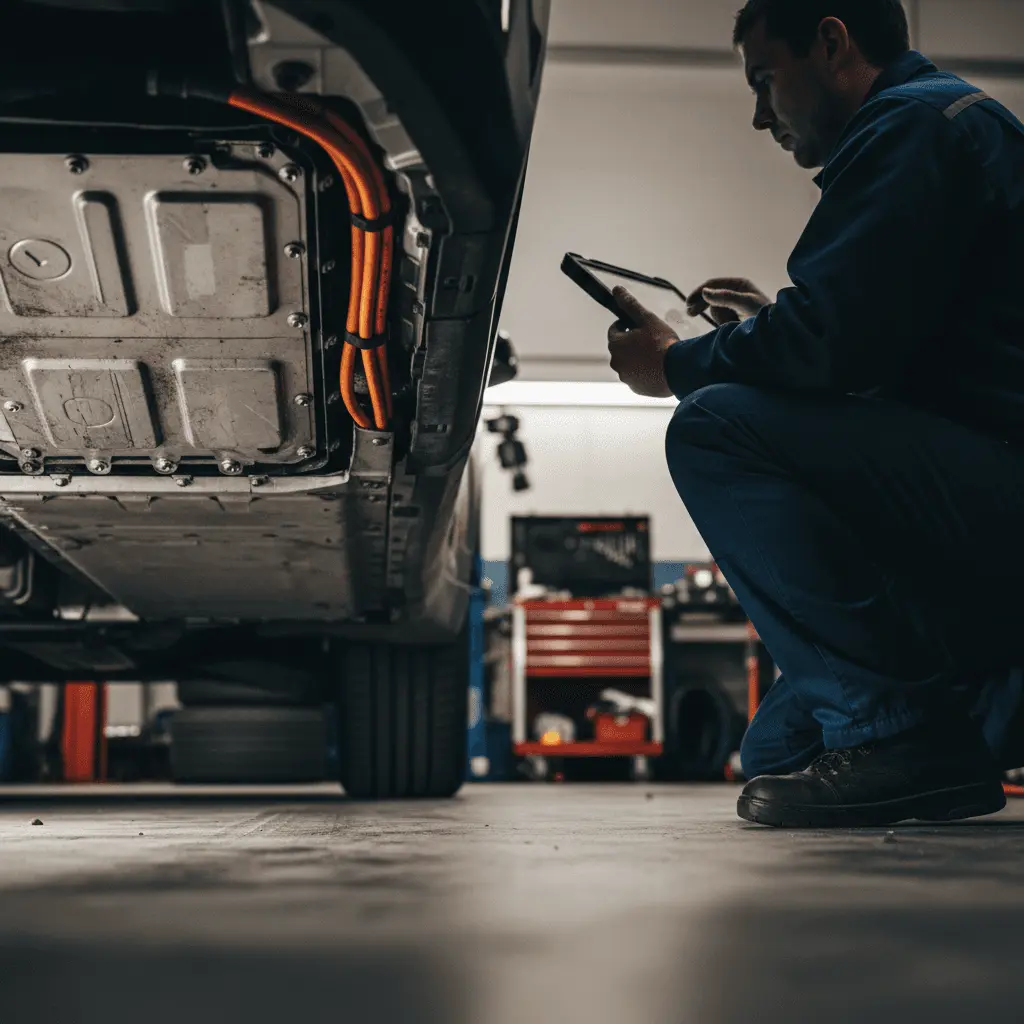
1. Battery health (SoH). This is the new odometer. Ask for an SoH certificate or report. In Portugal, Dekra already carries out independent battery tests. A car with documented SoH above 90% is a strong candidate, even with high mileage.
2. Charging history. This is where the invisible wear hides. Cars charged mostly at home, on an AC wallbox, and kept between 20% and 80%, age gently. Frequent DC fast charging plus charges to 100% in heat speed up degradation. Always ask: how was this car charged?
3. Battery warranty. Most manufacturers guarantee at least 70% capacity for 8 years or around 160,000 km. Check how much of that warranty is left and — crucial when buying second-hand — whether it transfers to the new owner.
4. Real-world range. WLTP range is a catalogue figure. What matters is the real range the car delivers today, with the battery in its current state. Make sure it covers your daily use with margin to spare.
On top of that come the basics of any used car: tyre condition (EVs wear them faster thanks to instant torque), brakes, and software and recall status.
The ideal mileage for a used electric car
There's a sweet spot. The data points to the 65,000–130,000 km band (40,000–80,000 miles) as the best balance: the steep early depreciation is behind it, but it's still comfortably below the 90,000 km accelerated-wear tipping point — and within the battery warranty window.
This table, adapted from a used-EV valuation guide, helps you read the listings (figures converted to kilometres):
| Mileage | How the market reads it | Typical price impact | What to check |
|---|---|---|---|
| 0–32,000 km | Nearly new | Baseline price | Warranty start, recalls |
| 32,000–65,000 km | Lightly used | -5% to -10% | Battery almost new |
| 65,000–113,000 km | Average use | -10% to -20% | Value zone; focus on SoH |
| 113,000–160,000 km | High but reasonable | -20% to -30% | Some range loss |
| 160,000–240,000 km | High mileage | -30% to -45% | Needs a strong battery test |
| Over 240,000 km | Very high | Case by case | Only if price, SoH and use align |
The golden rule: think in kilometres of useful range, not kilometres driven. An EV with 95,000 km at 92% SoH can be worth more than one with 55,000 km already down to 82%.
Frequently Asked Questions
Far less than on a combustion car. The TÜV Nord and Carly study (2026, around 50,000 batteries) found that up to 90,000 km a battery loses only about 0.7 SoH points per 10,000 km. Between an EV with 30,000 km and one with 70,000 km, the real difference in battery health is usually just two or three points. What counts today is battery state of health (SoH), not the odometer.
The data points to the 65,000–130,000 km band as the best balance: the steep early depreciation is already behind it, the car stays comfortably below the 90,000 km accelerated-wear tipping point, and it remains within the battery warranty window. More important than the mileage is a documented battery health figure.
Ask for a State of Health (SoH) certificate or report — a 0-to-100 scale showing how much capacity the battery retains versus factory condition. In Portugal, Dekra carries out independent battery tests in about 15 minutes. A documented SoH above 90% signals a healthy battery, even on a high-mileage car.
Most manufacturers guarantee at least 70% capacity for 8 years or around 160,000 km. When buying second-hand, check how much of that warranty is left and — crucially — whether it transfers to the new owner, since that directly protects your investment.
It can be well worth it. The UK Battery Performance Index 2025 (over 8,000 EVs across 36 brands) recorded an average SoH of 95.15%, with cars above 160,000 km often still holding 88% to 95% health. Because an electric motor has very few moving parts, a well-kept, well-charged EV with 130,000 km can be a smart buy. Think in kilometres of useful range, not kilometres driven.
Why the logic is different with EVs
In a combustion car, high mileage means a worn engine and gearbox — expensive parts, with failure risk climbing past 100,000–120,000 km. The EV doesn't carry that worry. It has very few moving parts, and the electric motor shrugs off hundreds of thousands of kilometres.
That's why a well-kept EV with 130,000 km can be a smart buy, while the petrol equivalent would already be penalised. The question is no longer "how worn is the engine?" but "what state is the battery in?".
The Portuguese market is still adjusting to this new reality — and that's precisely the opportunity. Buyers who learn to read SoH instead of the odometer will find used EVs that everyone else, still stuck in petrol-car thinking, is undervaluing for no good reason. It's worth asking for the battery report before you ask for the price.