
How Many Solar Panels to Charge an Electric Car in Portugal
Published: 15/09/2026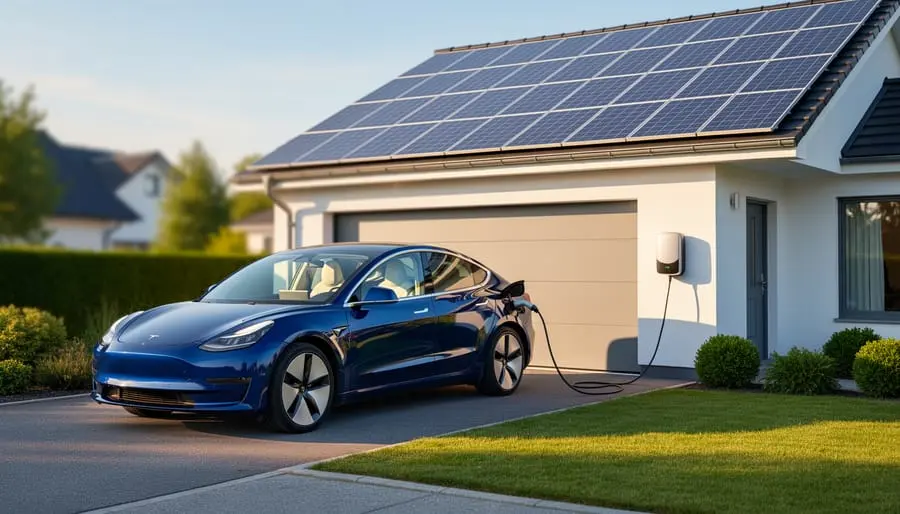
How many solar panels to charge an electric car in Portugal
Four panels. That is what it takes to cover a year of charging for a compact EV in Lisbon — not the six, eight or ten you will find in nearly every guide on the subject. The arithmetic is not in dispute; the sunshine is. Almost everything written about charging an electric car with solar panels comes from France or the United States, where a panel produces considerably less than it does here.
Portugal yields between 1,450 and 1,800 kWh per kWp installed per year, depending on the region. An Algarve roof returns roughly 25% more than the same roof in the Minho, and nearly 40% more than a roof in Toulouse. Transplanting French panel counts into a Portuguese quote gives you an oversized system and an inflated invoice.
Working out the number
Three variables, nothing more: how far you drive, what the car consumes, and what a panel yields where you live.
The average Portuguese driver covers around 15,000 km a year. A compact EV uses about 17 kWh/100 km in real conditions — heating, motorway speeds and charging losses included. That is 2,550 kWh a year that has to come from somewhere.
With 450 Wc panels, the standard size in new domestic installations, annual output per panel works out like this:
| Region | Yield (kWh/kWp/year) | Output per 450 Wc panel | Panels for 2,550 kWh/yr | Panels for 4,000 kWh/yr |
|---|---|---|---|---|
| Porto, Braga, Viana | 1,450 | 653 kWh | 4 | 7 |
| Lisbon, Coimbra, Leiria | 1,650 | 743 kWh | 4 | 6 |
| Faro, Évora, Beja | 1,800 | 810 kWh | 4 | 5 |
The 4,000 kWh column is a heavier profile: an electric SUV at 20 kWh/100 km covering 20,000 km a year. Even then, an Alentejo roof handles it with five panels — half what American guides prescribe for the same vehicle.
Now the honest part. Those figures assume every kWh produced ends up in the car, which only happens if the car sits at home during daylight or you have a home battery. Leave at 8am, return at 19h, and you will capture perhaps 40 to 50% of production directly. In that case you either double the panel count, add storage, or accept that some of the car's energy comes off the grid at night.
How much roof you need
A 450 Wc panel takes up about 2.1 m². Four panels is 9 m² of roof. Seven panels, 15 m². Any detached house with a south-facing pitch has that to spare.
But installing panels purely for the car rarely stacks up. The system that pays is the one covering the whole house plus the car: 4 to 5 kWp in Portugal, meaning 9 to 11 panels across 20 to 23 m². French guides recommend 9 kWp and 57 m² for the same job. With this much sun, that is money thrown at the roof.
Charge the car, or sell the surplus to the grid?
This is the decision with the most money attached, and most people get it wrong.
A kWh exported to the grid is worth between €0.034 (Goldenergy's fixed rate) and €0.04–0.07 at other retailers. Indexed to OMIE, the Iberian wholesale market, it can average €0.10–0.12/kWh — with one cruel detail: OMIE prices bottom out at exactly midday, when your panels are at full output.
A kWh put into the car saves you €0.17 to €0.24/kWh of electricity you no longer buy.
The comparison settles itself. Across 2,550 kWh a year:
| Where the energy goes | Annual value |
|---|---|
| Exported at €0.034 | €87 |
| Exported at €0.12 (OMIE-indexed) | €306 |
| Used in the car, avoiding €0.20/kWh | €510 |
Self-consumption is worth five to seven times more than fixed-price export, and it still wins against the best indexed scenario. This is not a Portuguese quirk: in France the surplus buy-back collapsed to €0.011/kWh from 5 June 2026, and the self-consumption premium was abolished outright. The "install panels to sell to the grid" business case is finished across Europe.
What it takes to sell surplus legally
If you still want to export and be paid for it, the Portuguese process is formal and none of the steps can be skipped:
- Deliberately disable Zero Export mode — leaving it on means exporting zero kWh and earning zero euros.
- Register the UPAC (self-consumption production unit) with DGEG, the energy directorate, through the MCP/SERUP procedure with full technical data.
- Ask E-REDES, the grid operator, to install and parameterise a bidirectional meter.
- Contract an eligible retailer to buy the surplus.
- Check on the first invoice or two that exported kWh actually appear at the agreed price.
Decreto-Lei 15/2022, article 11, exempts systems up to 700 W from prior authorisation — raised to 800 W on 28 August 2026 by DL 130/2026 — but only where they do not inject into the grid. Declare injection and you fall into the full procedure regardless of system size.
On tax: surplus income is exempt from IRS (income tax) while it stays under €1,000/year, and from IVA (VAT) under €13,500/year. The solar kit itself carries 23% VAT here, against the 5.5% France applies to installations up to 9 kWc.
What you save against the night tariff and public charging
Solar does not compete with the flat tariff. It competes with the off-peak window of the bi-horária, Portugal's two-rate domestic tariff — and that is where retail simulators quietly overstate the case.
For the same 2,550 kWh a year:
| Charging method | Annual cost |
|---|---|
| Solar panels (energy already produced) | €0 |
| Grid, flat tariff at €0.20/kWh | €510 |
| Grid, bi-horária off-peak at €0.14/kWh | €357 |
| Public charging at €0.35/kWh average | €893 |
So a driver already charging religiously at night saves around €357 a year by switching to solar, not the €510 the flat-tariff comparison suggests. Real, but half of what most quotes promise. The big win belongs to people who charge away from home: the gap between the public network and your own roof clears €800 a year.
The wallbox is the real bottleneck, not the panels
Here is the mistake that ruins otherwise well-sized installations: too many panels, too little charger.
Most EVs need at least 6 A before they will begin charging at all. On three-phase that means 4.2 kW of available surplus — a level a domestic system only reaches on clear summer days around noon. On single-phase the threshold drops to 1.4 kW, which your panels clear on almost every day of the year.
That works in Portugal's favour, since the overwhelming majority of homes here are single-phase. The automatic phase-switching problem that dominates German and Austrian buying guides barely applies to Portuguese houses — the local constraint is different: contracted power. On a 6.9 kVA supply, a 3.7 kW wallbox leaves little headroom for the washing machine and the oven at the same time.
Two requirements hold regardless of phase count:
- An EMS (energy management system) with a meter in the consumer unit. Without knowing what the house is drawing and what is left over, the wallbox is guessing. A "PV-compatible" label on the box is not enough.
- Fast response to fluctuation. A cloud cuts production in seconds; the wallbox has to drop its current on the same timescale, or it is buying grid power without telling you.
What a solar-surplus wallbox costs
These prices include the energy-management module, which is the part the marketing tends to leave out:
| Solution | Charger | Module required | Approximate total |
|---|---|---|---|
| go-e Charger Gemini flex 2.0 | €829 | Controller €249 | €1,078 |
| KEBA PV Edition | €849 | Meter €209 + phase switch €279 | €1,337 |
| myenergi Zappi | €1,397 | harvi sensor €69 | €1,466 |
Wallbox's Pulsar Plus handles surplus through Eco-Smart mode with a CT clamp or a Power Boost module; Easee uses the Equalizer. A plain wallbox with no solar management runs €500 to €2,000 depending on model, so the solar capability adds roughly €300 to €600. It pays back in three to five years of charging — and never pays back at all if the car spends its days elsewhere.
Standby draw is worth checking too: 2 to 5 W is the acceptable band for a device that stays powered 8,760 hours a year.
Cars that manage solar surplus on their own
Tesla is the only brand with a closed factory solution: Charge on Solar charges only from excess PV output, but it requires Tesla panels and a Powerwall. For everything else, the intelligence sits in the wallbox or in third-party platforms such as ChargeHQ, Clever-PV or Monta, which tie inverter, meter and charger together.
Going the other way — using the car's battery to power the house — the picture has improved. The Kia EV9 and Hyundai IONIQ 9, both on the E-GMP platform, ship with V2G and V2H as standard. The Renault 5 supports V2H with a bidirectional charger. At Tesla, only the Cybertruck is bidirectional, and it is not sold here.
Frequently Asked Questions
With 450 Wc panels and Portuguese yields of 1,450 to 1,800 kWh per kWp per year, four panels cover the 2,550 kWh a compact EV needs for 15,000 km at 17 kWh/100 km. A larger electric SUV driving 20,000 km a year needs five panels in the Algarve and seven in the north. The seven to twelve panels quoted in most guides come from French or US calculations, where the same panel produces considerably less.
On 2,550 kWh a year, the saving depends on your current habit: around €510 against a flat tariff at €0.20/kWh, but only about €357 against the €0.14/kWh off-peak slot of the bi-hourly tariff. If you mostly use public chargers at an average €0.35/kWh, the saving climbs to roughly €893 a year. The common mistake is benchmarking solar against the flat rate when you already charge overnight.
Charging the car is worth five to seven times more. A kWh exported to the grid earns €0.034 on Goldenergy's fixed tariff and €0.04 to €0.07 with other retailers; OMIE-indexed contracts can reach €0.10–0.12/kWh, but OMIE prices bottom out at midday, exactly when your panels peak. The same kWh put into the car avoids €0.17 to €0.24 of electricity you would otherwise buy.
Only with home battery storage, and even then the battery normally serves the house before the car. Without storage, a household that leaves at 8am and returns at 7pm directly uses only 40 to 50% of its solar output, so the rest of the charge has to come from the grid — ideally during the bi-hourly off-peak window. A system with storage typically costs €6,000 to €10,000, against €3,500 to €5,000 without a battery.
If the system never injects into the grid, Decree-Law 15/2022 waives prior authorisation up to 800 W (raised from 700 W by DL 130/2026 on 28 August 2026). Once you declare surplus injection, you must register the UPAC with DGEG through MCP/SERUP, ask E-REDES for a bidirectional meter and sign with an eligible retailer. Surplus income is exempt from IRS below €1,000/year and from VAT below €13,500/year, but the PV kit itself carries 23% VAT.
Is it worth installing panels just for the car?
No, and it is worth being blunt about it. A system bought purely to fuel a car has a poor usage profile: it produces at midday, when the car is usually elsewhere, and it needs storage to work at night — and the home battery normally serves the house first and the car second.
The reverse works. Size the system for the whole house, then add the car to it. An EV is the best load a solar installation can have: large, flexible, and happy to take energy precisely in the hours when there is spare. The car accelerates the payback on the panels, not the other way round.
Before signing any quote, ask the installer for a PVGIS simulation using your actual postcode and roof orientation. If the numbers they hand you match the ones in French guides, you are paying for panels you do not need.