
Porsche Cayenne Coupe Electric in Portugal: 1,156 hp, 669 km Range and Price
Published: 27/04/2026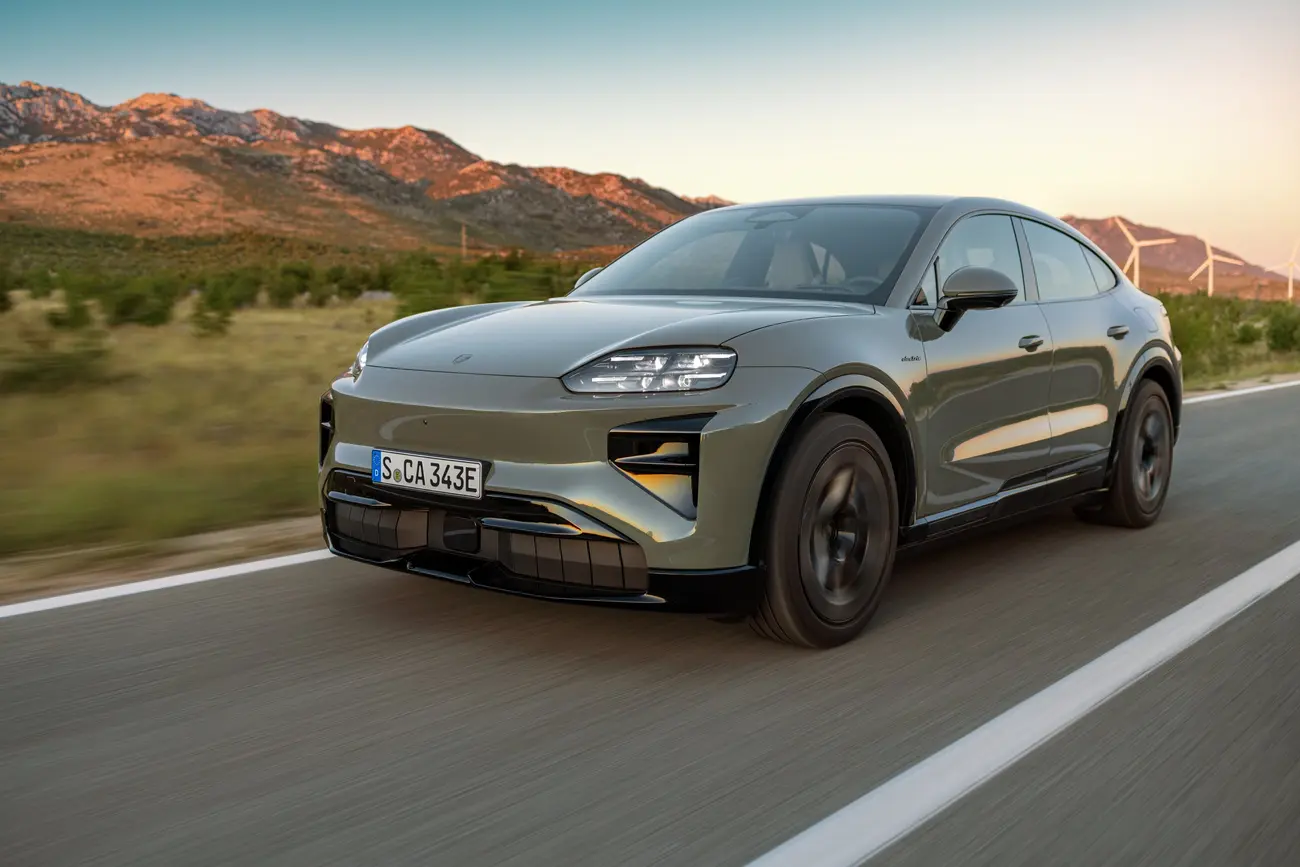
1,156 hp in the most powerful Porsche ever — and it's an electric SUV coupe
Porsche has just unveiled the new Porsche Cayenne Coupe Electric, and the Turbo flagship's numbers sit in a different league. 850 kW in overboost with Launch Control — 1,156 PS (1,139 hp) — which makes this the most powerful road-going Porsche ever built. Better still: the coupe body has less drag than its SUV sibling and travels up to 18 km more on WLTP range. The world premiere is at Auto China 2026 in Beijing, with first deliveries at the end of summer 2026.
For anyone already familiar with our coverage of the Cayenne S Electric, this is a clear evolution: same E4 platform, same 113 kWh battery, same 800-volt architecture — but now with a 911-inspired coupe silhouette and three variants launched simultaneously. Here's what it means for buyers looking at a Porsche Cayenne Coupe Electric in Portugal.
What changes versus the Cayenne Electric SUV
The recipe is familiar: take the Cayenne Electric, drop the roof by 24 mm, and draw a 911-inspired "flyline" roof. The result isn't just cosmetic. The drag coefficient falls from 0.25 to 0.23 — the same figure as a Tesla Model 3. Applied to a five-metre SUV weighing nearly two tonnes, that delta translates into lower consumption and more real kilometres per charge.
In practice, the Cayenne Coupe Electric travels up to 669 km on the combined WLTP cycle, against roughly 651 km on the equivalent SUV. That's an 18 km gain — small on a Lisbon-Porto trip, but enough to skip a recharge stop on a day when traffic and air conditioning eat into range.
The Turbo Coupe variant also gets so-called aeroblades — small active surfaces that extend from the rear fenders at speed to balance aerodynamics and brake cooling. The rear wing is also adaptive, hidden away when not needed.
Dimensions and practical space
| Measurement | Value |
|---|---|
| Length | 4,985 mm |
| Width (excluding mirrors) | 1,980 mm |
| Height | 1,650 mm |
| Rear cargo volume | 534–1,347 L |
| Front frunk | 90 L |
| Towing capacity | up to 3,500 kg |
The panoramic glass roof is standard on every Coupe variant — on the SUV it remains an extra of around 1,470 dollars in the US. Rear seats are electrically adjustable, with the option of a two-seat or 2+1 layout.
Porsche Cayenne Coupe Electric specs: three variants
Porsche launched all three powertrains simultaneously, which is unusual. All use dual-motor all-wheel drive, a 113 kWh battery, and the Porsche E4 platform on 800 volts.
| Specification | Cayenne Coupe Electric | Cayenne S Coupe Electric | Cayenne Turbo Coupe Electric |
|---|---|---|---|
| Nominal power | 300 kW / 408 PS | 400 kW / 544 PS | 630 kW / 857 PS |
| Overboost power (Launch Control) | 325 kW / 442 PS | 490 kW / 666 PS | 850 kW / 1,156 PS |
| Torque | about 833 Nm (615 lb-ft) | about 1,079 Nm (796 lb-ft) | about 1,500 Nm (1,106 lb-ft) |
| 0–100 km/h | 4.8 s | 3.8 s | 2.5 s |
| 0–60 mph | 4.5 s | 3.6 s | 2.4 s |
| Top speed | 230 km/h | 250 km/h | 260 km/h (162 mph) |
| WLTP consumption | 21.3–19.2 kWh/100 km | 21.1–18.9 kWh/100 km | 22.0–20.0 kWh/100 km |
| CO₂ | 0 g/km (Class A) | 0 g/km (Class A) | 0 g/km (Class A) |
The Turbo Coupe's 2.5-second 0–100 km/h sprint puts it in Taycan Turbo GT territory. It's the most powerful road Porsche ever built — above the most extreme 911 models, above the Taycan itself. For a family SUV rated to tow 3.5 tonnes, that's a quietly absurd figure.
113 kWh battery and 400 kW DC charging
The 113 kWh (gross) battery pairs with the 800-volt architecture to accept DC charging up to 400 kW — typically 390 kW in real conditions. Under those conditions, a 10-80% charge takes under 16 minutes. On AC, the on-board charger handles 11 kW as standard, with an optional 22 kW unit for owners with three-phase domestic supply.
In Portugal, where the MOBI.E network is steadily adding ultra-fast chargers above 150 kW and several Ionity stations already deliver 350 kW, these figures translate into real stops of 15 to 20 minutes to recover 400 km of range — about the time of a relaxed coffee at an A1 service area.
Porsche Cayenne Coupe Electric price in Portugal
Official European prices aren't out yet. What's confirmed is the US list:
- Cayenne Coupe Electric: 113,800 USD (116,150 with destination)
- Cayenne S Coupe Electric: 131,200 USD (133,550 with destination)
- Cayenne Turbo Coupe Electric: 168,000 USD (170,350 with destination)
The Coupe body costs between 4,800 and 5,000 USD more than the equivalent SUV. Applying the same pattern to the already-known Portuguese prices of the Cayenne Electric SUV, a realistic estimate is a starting price near 114,000 euros for the Cayenne Coupe Electric and above 175,000 euros for the Turbo Coupe Electric — figures to be confirmed by Porsche Portugal once order books open.
There's a positive footnote for buyers here: as a fully electric vehicle, the Cayenne Coupe qualifies in Portugal for exemption from ISV (the one-off vehicle import tax) and reduced IUC (the annual road tax). On cars with a list price above 100,000 euros, this saves tens of thousands of euros compared with a V8 Cayenne — and it's what keeps the electric option competitive against the E-Hybrid at the top of the lineup.
Porsche Cayenne Coupe Electric vs SUV: which makes more sense?
For 90% of Portuguese buyers, Coupe versus SUV is an aesthetic call before it's a rational one. But there are concrete differences worth weighing:
- Range: +18 km in the Coupe's favour (669 vs 651 km WLTP combined).
- Interior space: essentially identical up front; in the back, the lower roof slightly compromises headroom for taller passengers.
- Boot space: 534 L in the Coupe against near-identical figures in the SUV — the gap only shows with the rear seats folded.
- Standard equipment: the Coupe includes the panoramic roof and Sport Chrono package, both extras on the SUV.
- Price: the Coupe costs between 4,800 and 5,000 dollars more on matching powertrains.
Put another way: if you were already going to tick panoramic roof and Sport Chrono on the SUV, the Coupe ends up at roughly the same money — and throws in the 911-derived silhouette and a bit more range. That's why 40% of Cayenne buyers in the US already pick the Coupe, and that figure climbs to 90% in some Asian markets.
Frequently Asked Questions
Official Portuguese prices haven't been announced yet, but estimates point to around 114,000 euros for the entry-level Cayenne Coupe Electric and above 175,000 euros for the 1,156 hp Turbo Coupe Electric. These figures are extrapolated from the US list (113,800 to 168,000 USD) and from the confirmed 4,800 to 5,000 dollar premium over the equivalent SUV body. Porsche Portugal's final price list is expected in summer 2026, when order books open.
The world premiere is at Auto China 2026 in Beijing in April 2026, with first European deliveries starting at the end of that summer. For Portugal, units should be available at official Porsche dealerships in Lisbon, Porto, and the Algarve between October and November 2026, following the brand's typical logistics for the local market.
On the combined WLTP cycle, the Cayenne Coupe Electric is rated at up to 669 km with its 113 kWh battery — 18 km more than the SUV sibling thanks to a 0.23 drag coefficient (vs 0.25). In real-world Portuguese mixed use across motorway and urban driving, WLTP consumption of 19.2 to 22 kWh/100 km translates into a practical range of roughly 480 to 550 km depending on variant, speed, and air conditioning load.
Thanks to the 800-volt architecture, the 113 kWh battery accepts DC charging up to 400 kW (390 kW typically), enabling a 10-80% top-up in under 16 minutes at a compatible charger. In Portugal, 350 kW Ionity stations and several MOBI.E chargers above 150 kW come close to full speed. For home charging, the standard AC onboard charger handles 11 kW, with an optional 22 kW unit for three-phase installations.
As a fully electric vehicle, the Cayenne Coupe qualifies in Portugal for full ISV exemption and only pays the minimum IUC (category E), saving tens of thousands of euros versus a V8 Cayenne. BEVs priced above 62,500 euros don't qualify for the private-buyer Environmental Fund incentive, but companies can still deduct VAT and use accelerated depreciation — worth confirming with an accountant before placing an order.
Auto China 2026 premiere and deliveries in Portugal
The world premiere is at the Beijing Auto Show in April 2026. European deliveries start at the end of summer that same year. For the Portuguese market, that means seeing units at Porsche dealerships in Lisbon, Porto, and the Algarve from October or November 2026, assuming the brand's usual logistics.
Unlike the Macan — which has gone fully electric — Porsche has confirmed that the Cayenne will keep combustion and plug-in hybrid variants alongside the electric versions beyond 2030. Buyers who aren't ready to commit to electric still have alternatives within the same range.
For anyone in the premium market weighing a luxury electric SUV, it's worth waiting for Porsche Portugal's official price list before placing an order. With three variants, two body styles (SUV and Coupe), and generous options packs, the gap between two well-specced electric Cayennes can easily exceed 30,000 euros — and at that point, the Coupe stops being the automatic answer.