
Small Chinese Electric Cars for Portugal: 4 Auto China 2026 Debuts
Published: 06/05/2026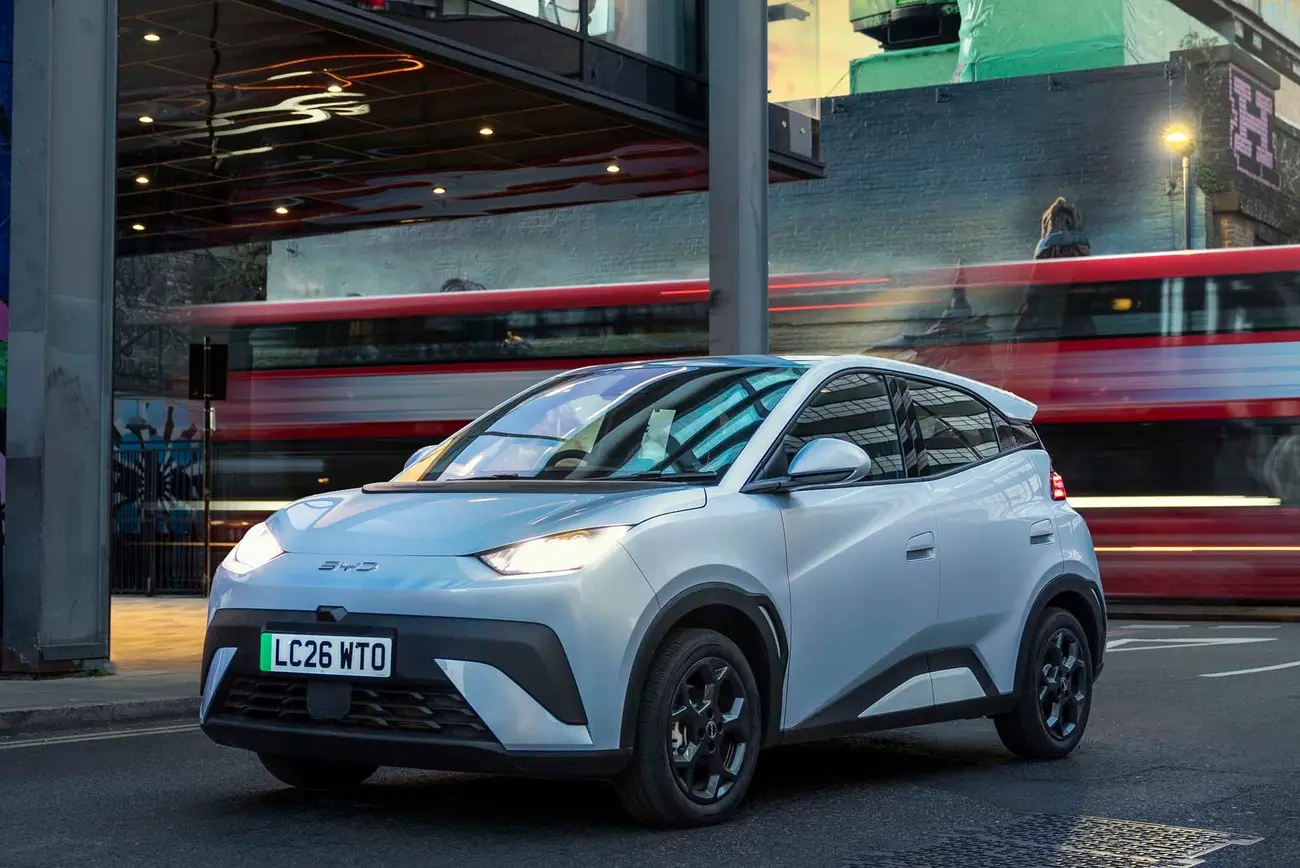
The small Chinese electric cars heading to Portugal in 2026 — Beijing made the message clear
Auto China 2026, held in Beijing across 380,000 m² with more than 1,450 vehicles on show and 181 world premieres, was anything but a routine motor show. But the story that matters most to a Portuguese buyer is not the giant SUVs or luxury sedans. It is the small electric hatchbacks Chinese brands brought to the show with Europe specifically in mind — cheap, urban-friendly, and increasingly well-equipped.
The threat is no longer theoretical. Small Chinese electric cars Portugal 2026 buyers should know about now hold close to 14% of the European BEV market, with forecasts pointing to 15-25% within four or five years. In Italy, the UK and Norway, market share has already crossed 10%. Portugal is earlier on that curve — which is exactly why it pays to know what is coming before signing the next lease.
Auto China 2026 small EVs Europe — what changed in the pitch
For years, Chinese brands tried to enter Europe through the front door of large SUVs with big batteries and matching prices. It did not really work. In 2026 the strategy is different: small hatchbacks, LFP batteries to keep the price down, and local European manufacturing to dodge the tariffs Brussels imposed on EVs built in China.
The practical outcome? Four small models left Beijing with a European tag — and three of them are real alternatives for anyone currently considering a VW ID.3, a Renault Megane E-Tech or a Peugeot E-308.
BYD Dolphin Surf 2026: the cheapest city EV coming to Europe
The BYD Seagull, sold in Europe as the Dolphin Surf, received its first major update at the Beijing show. The headline change: CLTC range climbs from 405 km to 505 km on the top trim. WLTP figures will be more modest, but the small BYD remains very competitive for urban and suburban use.
The motor stays modest — 60 kW, or 80 hp. This is not a car built for the A1 motorway; it is a car for Lisbon, Porto, Coimbra or Braga. The real surprise is the optional roof-mounted LiDAR paired with BYD's "God's Eye B" driver-assistance system. It is the first time we see that hardware on an EV in the 18,000 euro bracket.
Other 2026 upgrades:
- 16-inch wheels running 175/55 R16 tyres
- 50 W wireless phone charging with a cooling vent
- Twin wipers replacing the previous single-wiper setup
- Simplified steering wheel and new flip-top armrest
European entry pricing for the Dolphin Surf sits around 18,000 euros — well under any top-spec Dacia Spring and competing directly with petrol superminis. For anyone shopping for a second household EV, it is one of the most serious city-car propositions on the market today.
Leapmotor B05: the Chinese hatchback built in Spain
If the Dolphin Surf is the urban end of the spectrum, the Leapmotor B05 is the direct answer to the Volkswagen ID.3 — at a price that is hard to ignore. Launched in Italy from 26,900 euros, the B05 is 9,600 euros cheaper than the pre-facelift ID.3 and 13,080 euros below the Peugeot E-308, which sits inside the same Stellantis group.
The detail that changes everything: this Leapmotor is assembled at Stellantis' Figueruelas plant in Zaragoza, Spain. Because it is built inside the EU, it sidesteps the additional tariffs Brussels applies to EVs imported from China. That is why the sticker lands where it does.
Leapmotor B05 specifications
| Trim | Battery | WLTP range | DC charging |
|---|---|---|---|
| Pro | 56.2 kWh LFP | 401 km | 174 kW (30-80% in 17 min) |
| Pro Max | 67.1 kWh LFP | 482 km | 174 kW (30-80% in 17 min) |
| Ultra | 67.1 kWh LFP | 482 km | 174 kW (30-80% in 17 min) |
Drivetrain across the range: a rear-mounted 215 hp (160 kW) motor, with the Ultra version stepping up to 241 hp to take on the next generation of electric hot hatches. Length of 4,430 mm puts it squarely in the European compact-hatch segment.
The LEAP 3.0 platform brings Cell-to-Chassis integration, meaning the battery cells form part of the car's structure. That delivers rigidity, lowers the centre of gravity and enables a 50:50 weight distribution. Inside, you get a 14.6-inch central screen, an 8.8-inch digital cluster, dual-zone climate, 360-degree camera, panoramic glass roof and a full ADAS suite even on the entry trim.
For a Portuguese buyer, the maths is simple: under 27,000 euros before incentives buys an electric hatchback with 401 km WLTP and 174 kW DC fast charging. That equipment level cost 35,000 euros only two years ago.
Leapmotor A05: smaller still and even cheaper
Leapmotor was not content with a single contender. The A05, revealed through filings with China's MIIT, will sit one rung below the B05 — aimed straight at the BYD Dolphin, MG4 and Cupra Born. Length of 4,200 mm, wheelbase of 2,605 mm, single front motor in 70 kW or 90 kW flavours, and an LFP battery whose final capacity is not yet confirmed.
The plan is a UK launch later in 2026, with the rest of Europe to follow. Final pricing has not been announced, but the logic is clear: if the B05 starts at 26,900 euros, the A05 will need to come in below 23,000 euros to make sense in the line-up.
Smart #2: the truly small city EV returns
The Smart #2 concept, spiritual successor to the iconic Fortwo, was another Beijing debut. Smart — now a joint venture between Mercedes and Geely — promises a fully electric city car with 300 km WLTP range, 10-80% charging in 20 minutes, V2L capability for powering devices off the car, and a 6.95-metre turning circle — tighter than a London taxi.
The production version will only be revealed later in 2026 and pricing has not been confirmed. But the signal matters: Smart has stepped away from family SUVs and is heading back to the territory where it always made sense — the minimum-footprint car for the European city.
Frequently Asked Questions
The four most relevant Auto China 2026 launches are the BYD Dolphin Surf (city EV from around 18,000 euros), the Leapmotor B05 (compact hatchback from 26,900 euros in Italy), the upcoming Leapmotor A05 (estimated under 23,000 euros) and the Smart #2 concept (city EV with 300 km WLTP). The B05 is the only one already in European dealerships in 2026; the others will arrive in phases through 2027.
Italian list pricing starts at 26,900 euros (Pro trim) and climbs to about 30,900 euros (Pro Max and Ultra). For Portugal, expect a realistic drive-away price between 28,000 and 31,000 euros once transport and importer margin are factored in, before any incentives. Because it is built in Zaragoza, Spain, the B05 escapes the EU's additional tariffs on EVs imported from China.
The updated version shown in Beijing climbs from 405 km to 505 km on China's CLTC cycle. Under European WLTP testing, the figure typically lands 25-30% lower, meaning around 350-380 km in the larger-battery trim. For urban use in Lisbon, Porto or Coimbra that translates into several days of driving between charges.
The A05 was revealed through filings with China's MIIT and is scheduled to launch first in the UK during 2026, with the rest of Europe — including Portugal — following most likely in 2027. Final pricing has not been confirmed, but the line-up logic points to positioning below 23,000 euros, competing head-on with the BYD Dolphin, MG4 and Cupra Born.
Pure electric vehicles (BEVs) are exempt from ISV (vehicle import tax) and pay only a symbolic IUC (annual road tax), regardless of where the manufacturer is based — Chinese, European or otherwise. Companies can also deduct VAT on the purchase (up to set limits) and benefit from reduced autonomous taxation. These benefits remain in place in 2026, making models like the Leapmotor B05 or Dolphin Surf highly competitive on total cost of ownership versus petrol or diesel equivalents.
What this means for the Portuguese buyer
Portugal is not the most aggressive market for Chinese EV sales, but the infrastructure is in place: the MOBI.E network covers the country, fast chargers line every motorway, and tax incentives still move the needle. Pure electric cars are exempt from ISV (the Portuguese vehicle import tax) and IUC (annual road tax) is symbolic — for both private and company buyers, that changes the total cost-of-ownership maths against a combustion equivalent.
Three practical points to keep in mind:
- Availability: the Leapmotor B05 is the only one of these four models already in European dealerships in 2026. The Dolphin Surf depends on BYD's expanding Portuguese dealer network. The A05 and Smart #2 are unlikely to land before 2027.
- Drive-away pricing: on top of the 26,900 euro Italian base price for the B05, expect transport and the Portuguese importer margin. A realistic Portugal sticker will sit between 28,000 and 31,000 euros once the car is officially launched here.
- After-sales: the Stellantis-Leapmotor partnership is a clear advantage — workshop network, parts and warranty are handled by the same group that distributes Peugeot, Citroen, Opel and Fiat. BYD's network is newer but expanding.
The big shift of 2026 is this: we are no longer comparing Chinese EVs with European EVs purely on price. The comparison is now on specifications, range, charging speed and equipment — and in several cases the Chinese side wins. Worth tracking the next few months, especially the official price announcements for the Portuguese market.