
Nissan Micra Electric in Portugal: Prices, Range and Renault 5 Comparison
Published: 23/03/2026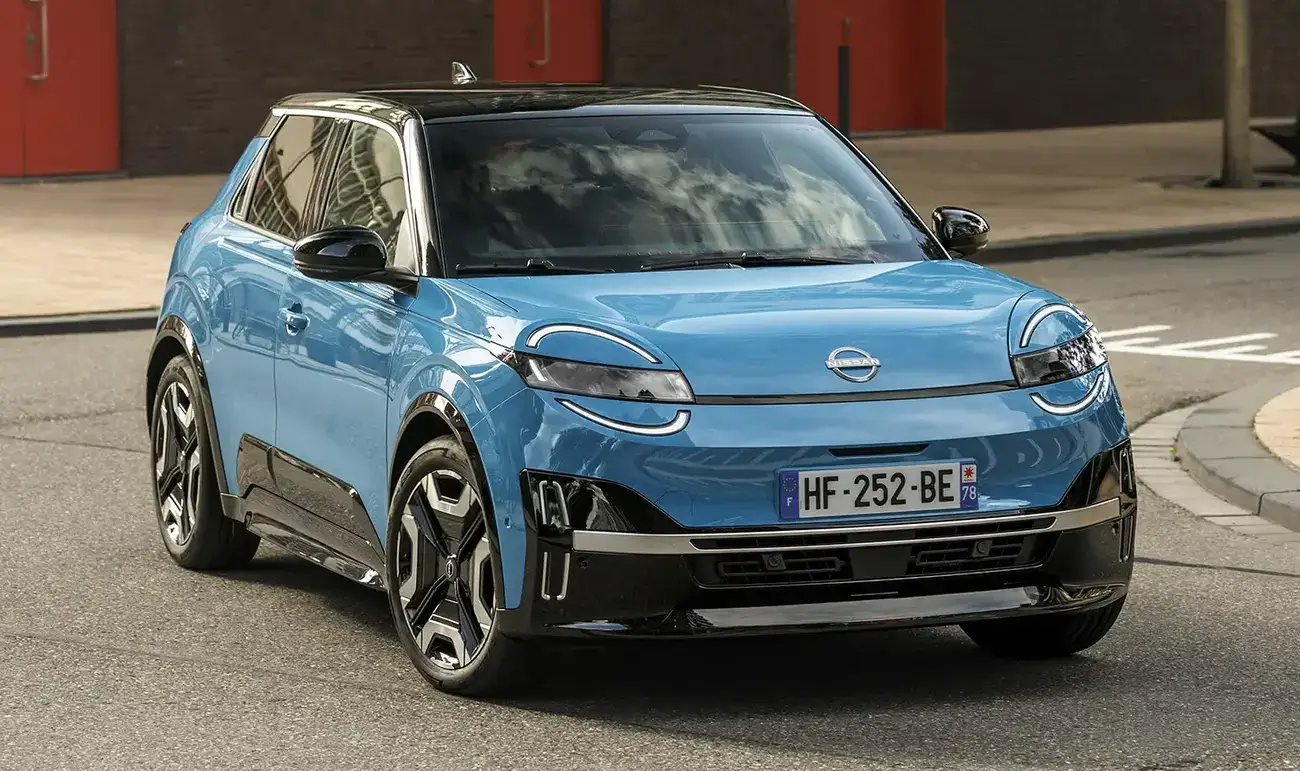
The new Nissan Micra goes electric on the Renault 5 platform
Starting at EUR 27,990, the Nissan Micra is back in Europe after a two-year hiatus — and it looks nothing like the car it replaces. This sixth-generation Micra is fully electric, built on the same AmpR Small platform as the Renault 5 E-Tech, and manufactured at Renault's Douai plant in northern France. For buyers in Portugal, it adds another compelling option to the growing list of affordable electric hatchbacks.
Same platform, different character
Under the skin, the Micra and Renault 5 are mechanical twins: shared AmpR Small platform, multi-link rear suspension, front-mounted electric motor. The interior is virtually identical too — twin 10.1-inch screens, 48-colour ambient lighting, same cockpit layout and storage compartments.
Where they part ways is design. The Renault 5 leans into angular, retro-inspired styling. The Micra goes the opposite direction: rounded lines inspired by the beloved K12 generation (2003-2009), with circular LED headlights, a higher bonnet line, and what designer Yongwook Cho calls a "gelato scoop" silhouette. At 3.97 metres long and under 1.8 metres wide, it is compact but only comes as a five-door — no three-door option this time.
Nissan Micra 40 kWh vs 52 kWh: which battery to pick?
Two battery options are available, each with different chemistry — a detail worth understanding before you buy.
| 40 kWh (LFP) | 52 kWh (NMC) | |
|---|---|---|
| Power | 90 kW (121 hp) | 110 kW (148 hp) |
| Torque | 225 Nm | 245 Nm |
| 0-100 km/h | 9.0 s | 8.0 s |
| Top speed | 150 km/h | 150 km/h |
| WLTP range | 317 km | 416 km |
| Kerb weight | 1,400 kg | 1,524 kg |
| DC charging (15-80%) | 30 min at 100 kW | 30 min at 100 kW |
| AC charging | 11 kW | 11 kW |
The 40 kWh version uses LFP (Lithium Iron Phosphate) battery chemistry — more durable and tolerant of frequent charging cycles. The 52 kWh goes with NMC (Nickel Manganese Cobalt), which packs more energy density and delivers 416 km of WLTP range. Both versions come with a heat pump as standard, helping preserve range in colder weather.
In a real-world test with the 52 kWh model at 12°C, consumption came in at 16.4 kWh/100 km, translating to roughly 320 km of usable range. Portugal's milder climate should push that figure slightly higher for most of the year.
Real-world range and fast charging
Charging from 15% to 80% takes 30 minutes at 100 kW DC — competitive for this segment. On an 11 kW AC wallbox at home, a full charge takes 7 to 10 hours depending on battery size. For overnight home charging, that is more than adequate.
Portugal's MOBI.E network (the national EV charging infrastructure) already has fast chargers along all major motorways, making a Lisbon-to-Porto trip perfectly doable with the 52 kWh version — and manageable with one short stop in the 40 kWh.
Two features stand out as unusual for this price bracket: V2L (Vehicle-to-Load), which lets you power external devices from the car's battery, and V2H (Vehicle-to-Home), planned for a later update, which will allow the car to feed energy back to your house.
Trim levels and European pricing
| Trim | Battery | Price (EUR) |
|---|---|---|
| Engage | 40 kWh | EUR 27,990 |
| Advance | 40 kWh | EUR 29,990 |
| Advance | 52 kWh | EUR 32,990 |
| Evolve | 52 kWh | EUR 34,990 |
Even the base Engage trim comes well equipped: 18-inch alloy wheels, 10-inch touchscreen, heat pump, and Nissan ProPilot with autonomous emergency braking. Step up to Advance for integrated Google Maps, parking sensors, and wireless phone charging. The range-topping Evolve adds a Harman Kardon sound system, two-tone paint, heated seats and heated steering wheel.
What about pricing in Portugal?
These are European prices before local taxes. In Portugal, fully electric cars are exempt from both ISV (the vehicle registration tax, which can add thousands to combustion cars) and IUC (the annual road tax). This makes the real cost gap between electric and petrol/diesel significantly smaller than the sticker price suggests.
Final Portuguese pricing has not been confirmed yet, but based on European figures, expect the entry-level Micra to land around EUR 28,000-30,000 — directly competing with the Renault 5 E-Tech.
Nissan Micra vs Renault 5: what actually differs?
They share a platform, factory, interior, and powertrain. So what justifies choosing one over the other?
- Design: the Micra is rounded and forward-looking; the Renault 5 is angular and retro
- Range: the Micra has a slight edge — 317 vs 310 km (40 kWh) and 416 vs 410 km (52 kWh)
- Regenerative braking: the Micra offers three levels via steering wheel paddles; the Renault 5 does not match this setup
- Boot space: both offer 326 litres, expanding to 1,106 litres with seats folded
- Towing: the Micra can tow up to 500 kg (braked trailer)
In practice, the choice comes down to design preference and whichever brand offers better commercial terms in Portugal.
Competition in the Portuguese market
The affordable electric hatchback segment is heating up fast. Beyond the Renault 5, the Micra faces the Hyundai INSTER, Citroen e-C3, BYD Dolphin Surf, and Fiat Grande Panda. Later in 2026, the VW ID. Polo and Cupra Raval will join the fight.
The Micra's EUR 28,000-35,000 range places it above the cheapest options (e-C3, Grande Panda) but in line with the Renault 5 and INSTER in better-equipped trims. With Portugal's ISV and IUC exemptions for electric vehicles, this is a segment where switching from combustion starts to make genuine financial sense for many households.
Frequently Asked Questions
The Nissan Micra electric starts at EUR 27,750 in Portugal for the Engage 40 kWh version. The full range includes: Engage 40 kWh (EUR 27,750), Advance 40 kWh (EUR 29,750), Advance 52 kWh (EUR 33,250), and Evolve 52 kWh (EUR 35,250). Electric vehicles in Portugal are exempt from ISV (vehicle registration tax) and IUC (annual road tax), making them significantly more affordable compared to combustion alternatives.
The Nissan Micra electric is available with two battery options: 40 kWh (LFP) with 317 km WLTP range and 121 hp, or 52 kWh (NMC) with up to 416 km WLTP range and 148 hp. Both versions include a heat pump as standard. In real-world testing, the 52 kWh version achieved 16.4 kWh/100 km consumption at 12°C, translating to roughly 320 km of usable range.
The Nissan Micra and Renault 5 E-Tech share the AmpR Small platform, the Douai factory (France), the front-mounted electric motor, multi-link rear suspension, the interior with twin 10.1-inch screens, and boot capacity (326 litres). They differ in exterior design (rounded Micra vs retro Renault 5), regenerative braking with steering wheel paddles (Micra exclusive), and a slightly higher range on the Micra.
DC fast charging from 15% to 80% takes about 30 minutes at 100 kW for the 52 kWh version (80 kW for the 40 kWh version). On an 11 kW AC wallbox at home, a full charge takes 7 to 10 hours. The Micra also features V2L (Vehicle-to-Load) capability to power external devices from the car's battery.
The Nissan Micra electric is already available for pre-order in Portugal through the Nissan dealer network and the official website nissan.pt. Deliveries are expected in 2026. The launch offer includes five years of warranty and scheduled maintenance. You can also search for Nissan Micra listings on automar.pt.
What comes next
The electric Nissan Micra marks the Japanese brand's return to Europe's B-segment with a credible proposition. Sharing the AmpR Small platform with the Renault 5 is not a weakness — it is pragmatism that delivers competitive pricing and proven technology.
If you are shopping for a compact EV in Portugal, keep an eye on local pricing once Nissan confirms it. The brand also has three more European EVs in the pipeline for 2027: a new Leaf in crossover form, an electric Juke, and a city car priced below EUR 20,000 based on the Renault Twingo platform.