
New Nissan Leaf in Portugal: Price, 622 km Range and Full Specs
Published: 20/06/2026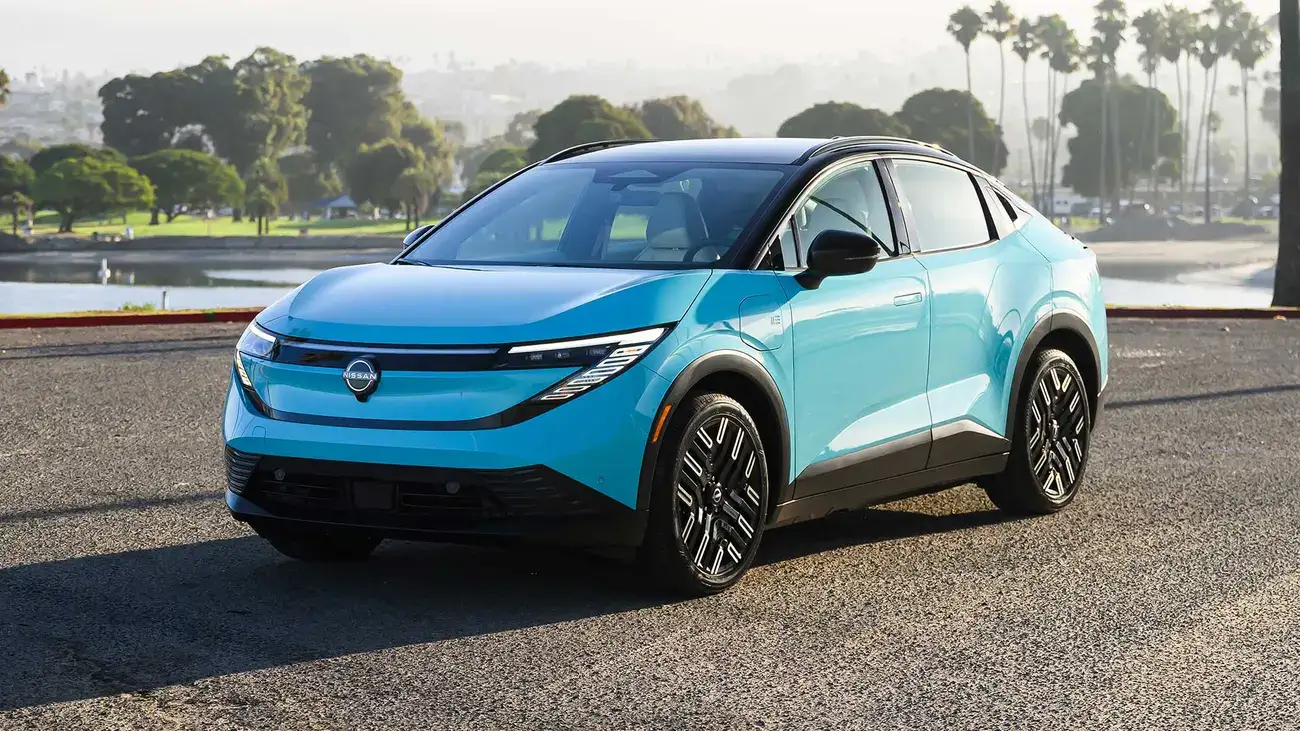
The EV pioneer returns, now as a crossover
The car that opened the door to mainstream electric motoring is back — and you'd barely recognise it. The third-generation Nissan Leaf drops the hatchback body it carried since 2010 and reinvents itself as a coupé-styled crossover, with a sloping roofline and a teardrop silhouette. More to the point for buyers: the new Nissan Leaf now has an official Portugal price, starting at €29,990 + VAT, with a homologated range of up to 622 km WLTP. Pre-orders are already open at leaf.nissan.pt and through the Caetano network.
This isn't a refresh. It's a full reinvention of a model that spent the last decade falling behind its rivals. It returns on the CMF-EV platform — shared with the Nissan Ariya and Renault Mégane E-Tech — with a package that actually makes sense for the Portuguese market.
New Nissan Leaf: range up to 622 km and two batteries
There are two battery configurations, and the gap between them defines which driver each version suits.
The 52 kWh version claims around 440 km WLTP. That covers most days: the commute around Lisbon or Porto, errands, weekends away. The 75 kWh raises the bar to 622 km WLTP — the headline number, and one that puts the Leaf among the longest-range electric SUVs at this price.
| Specification | 52 kWh | 75 kWh |
|---|---|---|
| WLTP range | ~440 km | up to 622 km |
| Power | 174 hp (130 kW) | 215 hp (160 kW) |
| Torque | 345 Nm | 355 Nm |
| 0-100 km/h | — | 7.6 s (Sport mode) |
| DC charging | up to 105 kW | up to 150 kW |
| AC charging | 11 kW | 11 kW |
| Boot | 437 L (up to 1,052 L) | 437 L (up to 1,052 L) |
Real-world range: what to expect off the brochure
The 622 km figure is WLTP, and WLTP is rarely what shows up on the dash. International reviewers who have driven the 75 kWh version report around 430 km of real range at 120 km/h on the motorway — the toughest scenario. Drive more gently on national roads and in town, and you can clear 480 km, with consumption around 13.8 kWh/100km.
In Portuguese terms: a Lisbon-Porto run (about 310 km) is a no-stop trip in the big-battery car, even at motorway pace and with the safety margin nobody wants to lose. The 52 kWh version asks for more planning on a long journey, but stays comfortable for daily use.
Fast charging: 150 kW and half an hour to 80%
The 75 kWh battery accepts DC charging up to 150 kW, which means going from 10 to 80% in about 30 minutes — the time it takes for a coffee and a stretch at a service station. In that half hour you recover over 430 km of range, according to Nissan.
The 52 kWh version tops out at 105 kW DC, still enough for a quick stop. At home or at work, both charge at 11 kW AC as standard. On the MOBI.E network (Portugal's public charging system) and the fast chargers along Portuguese motorways, 150 kW puts the Leaf among the more practical cars in its class — though rivals like the Kia EV3 and Skoda Elroq already match or beat those numbers.

Technology: built-in Google and twin 14.3-inch screens
The interior is where the generational leap is most obvious. Two 14.3-inch screens dominate the dashboard, and the big news is NissanConnect with Google built-in: Google Maps with route and charging planner, Google Assistant by voice, and Play Store access, all native, no phone needed. If you use your car as a work tool, that changes the daily routine.
There's also wireless Apple CarPlay and Android Auto, ProPILOT Assist with adaptive cruise, one-pedal driving via e-Pedal, and a heat pump as standard — the last of which makes a real difference to winter range. The V2L (Vehicle-to-Load) system delivers up to 3.1 kW to power external devices, handy for camping or tools.
It's not all good news. There's no frunk — the space under the bonnet isn't available for storage. And the glass panoramic roof, lovely on the top trims, steals a few centimetres of headroom from rear passengers thanks to that sloping roofline. The 437-litre boot is honest, but rivals like the Skoda Elroq offer more.
New Nissan Leaf vs Kia EV3: the segment duel
The Kia EV3 is the most direct rival, and the comparison is telling. The 75 kWh Leaf delivers 622 km WLTP; the EV3, at its best, manages around 600 km — and needs a bigger 78 kWh battery to get there. In other words, the Leaf is more efficient: it squeezes more kilometres from each kWh.
Where the EV3 wins is boot practicality and a trim range already well established in Portugal. The Leaf answers with efficiency, built-in Google, and the fact that it's built in Sunderland, UK — a point that, for now, brings no direct tax benefit in Portugal the way it does in the British market.
| New Nissan Leaf 75 kWh | Kia EV3 Long Range | |
|---|---|---|
| Battery | 75 kWh | 78 kWh |
| Max WLTP range | up to 622 km | ~600 km |
| DC charging | up to 150 kW | ~128 kW |
Price in Portugal and tax incentives
The new Nissan Leaf starts at €29,990 + VAT for the 52 kWh version (Engage trim), rising to around €42,560 + VAT for the fully-equipped 75 kWh Evolve. The range splits into four levels: Engage, Engage+, Advance and Evolve.
As a pure EV, the Leaf benefits from ISV exemption (ISV is Portugal's vehicle registration tax) and reduced IUC (the annual road tax), plus the tax advantages for company cars — factors that bring the real cost closer to a petrol or diesel equivalent than the sticker price suggests. For anyone counting cost per kilometre, the claimed efficiency (13.8 kWh/100km at best) also adds up to monthly savings.
First European deliveries began in France in spring 2026. In Portugal, with pre-orders already open, it's worth confirming timelines and the availability of each version through the Caetano network before committing — the 75 kWh version, the most sought-after for its range, tends to have longer waiting lists at launch.
After years of losing ground, the Leaf is back with a solid case: competitive range, technology that rivals premium brands, and an entry price that puts it in the conversation for any EV buyer in Portugal. The open questions are how the 52 kWh version performs on Portuguese roads and whether delivery times keep pace with demand.
Frequently Asked Questions
The new Nissan Leaf starts at €29,990 + VAT for the 52 kWh version (Engage trim) and rises to around €42,560 + VAT for the fully-equipped 75 kWh Evolve. The range splits into four levels: Engage, Engage+, Advance and Evolve. As a pure EV it benefits from ISV exemption and reduced IUC, which brings the real cost closer to a petrol equivalent than the sticker price suggests.
Pre-orders are already open in Portugal at leaf.nissan.pt and through the Caetano network. First European deliveries began in France in spring 2026, with Portugal following on. It is worth confirming timelines by version, as the 75 kWh, the most sought-after for its range, tends to have longer waiting lists at launch.
The 75 kWh version is homologated at up to 622 km WLTP, but in practice international reviewers report around 430 km of real range at 120 km/h on the motorway, the toughest scenario. Drive more gently on national roads and in town and you can clear 480 km, with consumption around 13.8 kWh/100km. The 52 kWh version claims about 440 km WLTP.
The 52 kWh battery (~440 km WLTP, 174 hp, DC charging up to 105 kW) covers daily commuting around Lisbon or Porto and weekends away. The 75 kWh (up to 622 km WLTP, 215 hp, 150 kW DC) does a Lisbon-Porto run without stopping and is the right pick for regular long-distance drivers. The price gap between them comes mainly from range and charging speed.
The 75 kWh Leaf delivers up to 622 km WLTP from a 75 kWh battery, while the Kia EV3 needs a bigger 78 kWh battery to reach around 600 km, meaning the Leaf is more efficient. The Leaf also charges faster (150 kW DC versus ~128 kW) and brings built-in Google. The EV3 wins on boot practicality and a trim range already well established in Portugal.