
Nissan Juke EV 2027 in Portugal: Range, Specs and Price Projection
Published: 19/04/2026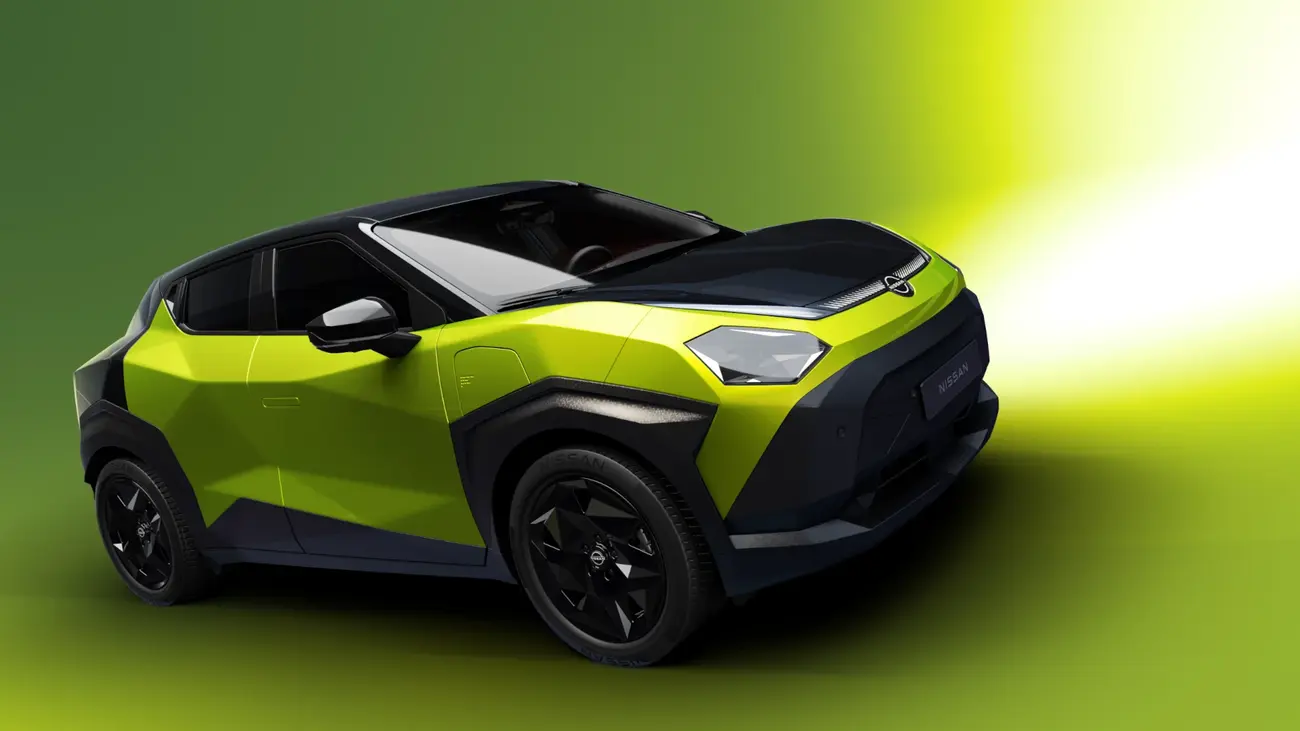
The 2027 Nissan Juke EV is real — and it's not a concept
Nissan pulled the covers off the third-generation Juke in Yokohama and the first reaction is disbelief: those origami creases, the blanked-out front panel, the aggressive light signatures — surely this is a show car? It isn't. The Nissan Juke EV heading to Portuguese showrooms in spring 2027 is the production version, built in Sunderland, UK, and it kills off combustion engines in the Juke line for good.
For buyers in Portugal, three things matter right now: the car is confirmed, the technical numbers stack up against the rivals, and Nissan has decided to keep the current hybrid Juke alive alongside it — at least for a while. Here's what we know.
CMF-EV platform: sibling of the Leaf, not the Renault 4
One piece of misinformation worth clearing up. The new Juke shares its platform with the Nissan Leaf III and the Ariya — the Alliance's CMF-EV architecture. It is not a cousin of the Renault 4 or Renault 5, which ride on Renault's own AmpR Small platform. They are segment rivals, not platform siblings.
That distinction has practical consequences. The Juke EV inherits the new Leaf's battery packs (52 kWh and 75 kWh liquid-cooled NMC chemistry) and its motor, just detuned. Drive is front-wheel only — no all-wheel-drive option like the Ariya. For a 4.2-metre B-SUV aimed at city driving and family trips, that's the right call.
Specs: 218 hp and up to 622 km of range
The top-spec configuration lines up neatly with what most Portuguese drivers expect from a compact electric SUV: enough range to cover Lisbon-Porto without stopping, and enough power to stay comfortable on the A1.
| Spec | 52 kWh | 75 kWh |
|---|---|---|
| Power | 177 hp | 218 hp |
| Torque | 345 Nm | 355 Nm |
| WLTP range | up to 436 km | up to 604–622 km |
| DC charging | 150 kW | 150 kW |
| 10–80% DC | around 35 min | around 35 min |
| Drive | FWD | FWD |
| V2G | Yes | Yes |
A 150 kW DC peak isn't class-leading — the Kia EV3 hits similar figures, the Hyundai Kona Electric falls short — but it recovers close to 400 km of range during a 35-minute coffee stop. On a Lisbon-Algarve run, one stop does the job.
The Vehicle-to-Grid (V2G) capability is where the Juke gets ahead of most direct rivals. The car can send power back to the grid or keep the house running during an outage — a real advantage in Portugal once dynamic tariffs and self-consumption rules mature over the next few years.
Design and cabin: origami outside, Google inside
The styling traces back to the 2023 Hyper Punk concept, and Jordi Vila, Nissan Europe's vice president, admitted the Sunderland stamping team struggled with the sharp angles. The result splits opinion — Autocar called it a "Marmite car" — you either love it or you don't. There's no middle ground.
Inside, the focus is screens and connectivity. Twin 14.3-inch displays, Google built-in as standard (with Maps tuned for EV charging stops) and over-the-air updates to keep the software fresh for years. Cabin space improves over the current Mk2 Juke, which needed it — the rear bench in today's car is tight.
Nissan Juke EV in Portugal: how much will it cost?
No official price yet. UK press estimates put the entry version at roughly £30,000 — around 35,000 € before local taxes.
For Portugal, the realistic projection looks like this: the 52 kWh entry trim should land between 37,000 € and 40,000 €, with the 75 kWh flagship likely above 45,000 €. Two Portuguese incentives help the bottom line:
- ISV exemption (Portugal's one-off vehicle registration tax) — a major saving over a combustion equivalent.
- Reduced IUC (annual road tax) and favourable company-car rules that continue to tilt towards EVs.
That positioning puts the Juke EV head-to-head with the Jeep Avenger EV (from ~35,000 € in Portugal), the Peugeot e-2008 (~37,000 €) and the Kia EV3 (~38,000 €). The smaller Renault 4 E-Tech undercuts it. The Ford Puma Gen-E plays in the same bracket.
When does the Nissan Juke EV arrive in Portugal?
Nissan's timeline is straightforward:
- April 2026: pilot production starts in Sunderland.
- Early 2027: full series production.
- Spring 2027: European sales launch.
Portugal follows the general European rollout. Expect the first units at Nissan Portugal dealerships between April and June 2027, with pre-orders likely opening in the final quarter of 2026, once prices are announced locally.
Frequently Asked Questions
There is no official price yet, but estimates point to a starting range of 37,000 € to 40,000 € for the 52 kWh version, and above 45,000 € for the 75 kWh flagship. The UK entry price sits around £30,000 (roughly 35,000 € before local taxes). Portugal's ISV exemption for EVs and reduced IUC road tax significantly cut the total cost of ownership versus a combustion equivalent.
Pilot production starts at the Sunderland plant in April 2026 and full series production begins in early 2027. European sales launch in spring 2027, with the first units expected at Portuguese dealers between April and June 2027. Pre-orders in Portugal are likely to open in the final quarter of 2026, as soon as Nissan Portugal announces official pricing.
On the WLTP cycle, the 52 kWh version achieves up to 436 km while the 75 kWh version reaches 604-622 km. In mixed real-world driving (highway plus city), expect around 350 km from the 52 kWh and roughly 480-520 km from the 75 kWh. The top-spec configuration is enough to cover Lisbon-Porto without a single charging stop.
Despite both brands belonging to the Alliance, the Juke uses the CMF-EV platform (shared with the Leaf III and Ariya), while the Renault 4 sits on the AmpR Small — they are segment rivals, not technical siblings. The Renault 4 is smaller and cheaper, the Kia EV3 matches the 150 kW charging and starts around 38,000 € in Portugal. The Juke's standout feature is standard Vehicle-to-Grid (V2G), which none of its direct rivals currently offer at this price point.
Fully electric vehicles qualify for total ISV exemption (Portugal's vehicle registration tax), a saving of several thousand euros compared with a combustion equivalent. Annual IUC road tax is also reduced, and company cars continue to enjoy favourable tax deductions for EVs. Private buyers should track the Fundo Ambiental, which has historically offered grants between 3,000 € and 4,000 € depending on the yearly budget allocation.
Dual strategy: the hybrid stays
Nissan was going to axe the second-generation hybrid Juke. It changed its mind. Massimiliano Messina, head of Nissan Europe, confirmed the brand is still "firmly committed to a fully electric future" but chose to offer "greater choice" in response to slower-than-expected EV uptake in some markets.
For the undecided Portuguese buyer that translates into a genuine choice: the hybrid Juke continues in parallel, built in the same factory, for anyone not ready to go electric. The EV is the future of the range; the hybrid is the bridge.
With close to 1.5 million units sold in Europe since 2010, the Juke is Nissan's second-best-seller on the continent after the Qashqai. The pressure on this third generation is significant — and the technical numbers, the polarising design and the shared tech base with the new Leaf give it a solid case to keep dominating the segment.
Worth watching over the coming months: official Portuguese pricing should land by late 2026, and that's when we'll know whether the Juke EV becomes an obvious pick or ends up chasing the Kia EV3 and the Renault 4.