
Nio ES9 in Portugal: China's Biggest Electric SUV, 697 hp, 620 km
Published: 07/04/2026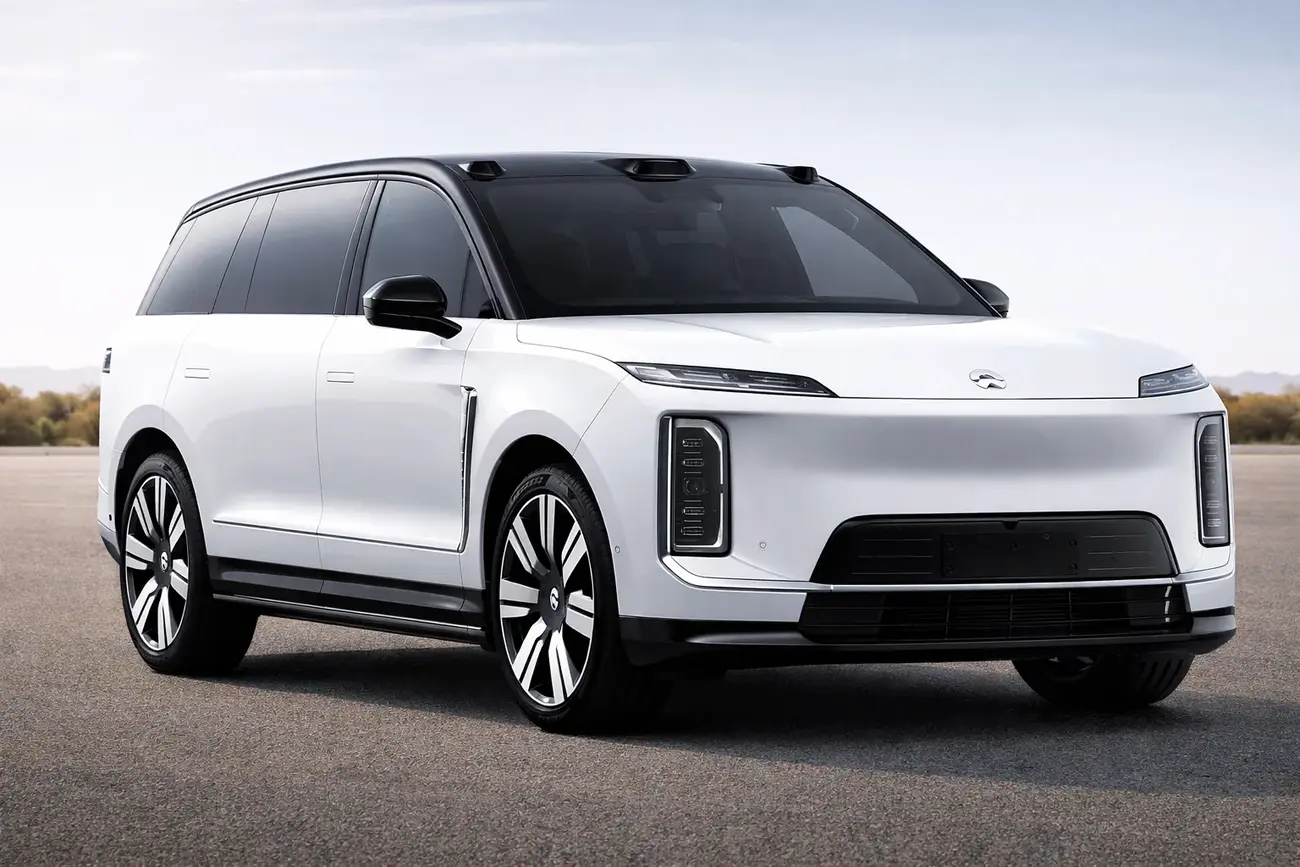
China's biggest electric SUV wants to be Europe's next flagship
5,365 mm long, 697 hp, six seats and a 900-volt architecture. The Nio ES9 is the brand's new top-of-the-range model — and it's officially the largest mass-produced electric SUV in China. Pre-orders open on April 9, 2026, deliveries start in June, and plenty of people are already asking whether the Nio ES9 Portugal launch is actually going to happen.
Short answer: not confirmed yet. The longer answer is more interesting, because Nio arrived in our market only a few months ago and its European strategy is clearly shifting shape.
A flagship built to make a statement
The ES9 doesn't aim for subtle. It measures 5,365 mm long, 2,029 mm wide and 1,870 mm tall, with a 3,250 mm wheelbase. Curb weight ranges from 2,845 to 2,915 kg depending on variant — numbers that put it squarely in BMW iX and Mercedes EQS SUV territory.
Inside, the layout is 2+2+2 with six individual seats. The second row features zero-gravity seats with ventilation, heating and massage. Behind them, Nio has designed what it calls "Sky Island" and "Executive Bridge" — two 14.5-inch screens plus an 8-inch rear controller for the passenger who'd rather be chauffeured. There's an onboard fridge, Nappa leather, real wood trim, and electrochromic windows with three privacy modes.
Power and range: the numbers that matter
Two electric motors deliver 180 kW at the front and 340 kW at the rear, for a combined 520 kW (697 hp) and 700 Nm of torque. Top speed is 220 km/h. All of this sits on Nio's 900 V architecture — the same platform used by the ET9 flagship sedan — which unlocks very fast DC charging wherever the infrastructure allows.
The battery holds 102 kWh, weighs 545 kg and hits an energy density of 187 Wh/kg. CLTC range varies between 580, 600 and 620 km depending on trim. One caveat worth knowing: the CLTC cycle is notoriously optimistic. On the European WLTP standard, expect 480 to 520 km of real-world range — enough for Lisbon to Porto without stopping, even with the air conditioning running.
| Spec | Value |
|---|---|
| Length / width / height | 5,365 / 2,029 / 1,870 mm |
| Wheelbase | 3,250 mm |
| Curb weight | 2,845–2,915 kg |
| Combined power | 520 kW (697 hp) |
| Torque | 700 Nm |
| Top speed | 220 km/h |
| Battery | 102 kWh (187 Wh/kg) |
| CLTC range | 580 / 600 / 620 km |
| Electrical architecture | 900 V |
| Seats | 6 (2+2+2) |
Technology that hasn't reached Europe yet
This is where the ES9 pulls ahead of its European rivals. It runs a full active SkyRide suspension, steer-by-wire (no mechanical link between the wheel and the road wheels), and two dedicated Shenji NX9031 self-driving chips. The Aquila sensor pack combines LiDAR with 4D imaging radar — the same hardware Nio uses for its most advanced autonomous driving mode in China.
The dashboard runs a 15.6-inch AMOLED central display on the SkyOS system, the Nomi Mate 3.0 voice assistant, and HDPL headlights that can project 20 to 30-second videos onto the road ahead. Is it excess? Probably. But it's also a technical statement no European maker is matching today.
What it costs — and what that means in euros
In China, Nio is expected to price the ES9 between 500,000 and 600,000 yuan. At current exchange rates, that works out to roughly 67,000 to 80,000 euros before European import duties and VAT. For context: the Nio ET5 sedan starts at €59,900 in Portugal, and the EL6 (currently Nio's largest SUV available here) starts at €66,900. A Portugal-spec ES9, if it ever arrives, would likely land between €90,000 and €110,000.
Nio usually also offers its BaaS (Battery as a Service) model, where you buy the car without the battery and subscribe to it monthly. That drops the upfront price by around €15,000 in China, but it depends on the availability of battery swap stations — and that's where things get complicated in Europe.
Nio in Portugal: what's actually on sale today
Nio officially arrived in Portugal in December 2025 through Grupo JAP, its exclusive distributor. Two showrooms opened, in Lisbon and Porto, and the Portuguese line-up launched with four models:
- Firefly, the brand's city car, from €29,900
- ET5 sedan, from €59,900
- ET5 Touring (the estate), from €62,500
- EL6, the five-seat SUV, from €66,900
Neither the ES9, nor the larger EL8, nor the flagship ET9 has been confirmed for Portugal. The current range is complete enough to launch a brand, but there's a clear gap at the seven-seat SUV end — a segment where the ES9 would be a strong commercial argument.
The missing piece: battery swap
Here's the part Nio fans don't want to hear. The brand built its European reputation in the Nordics and Germany on battery swap stations — you drive in, the battery is replaced in about five minutes, and you drive out with 100% charge. It's a clever and genuinely unique system.
In the seven new European markets (Austria, Belgium, Czech Republic, Hungary, Luxembourg, Poland, Romania) announced for 2025-2026, Nio will not be installing battery swap stations. Not in Portugal either. The official line is that distributors decide case by case; the real answer is economic — each station costs millions and Portugal doesn't yet have the buyer volume to justify the infrastructure.
That changes the value proposition entirely. Without battery swap, the BaaS subscription model loses most of its appeal, and the Nio ES9 would depend purely on DC fast charging. The 900 V architecture helps — in theory it can add 200-300 km in 15 minutes — but few public chargers in Portugal currently deliver the power needed to take real advantage of it.
(Quick context for readers new to Portugal: ISV is the one-off import tax applied to new cars, IUC is the annual road tax, and MOBI.E runs the interoperable charging network. EVs currently benefit from significant ISV and IUC reductions, which is part of why Chinese brands are arriving here in force.)
Frequently Asked Questions
Pre-orders for the Nio ES9 open in China on April 9, 2026, with deliveries starting June 1, 2026. A Portuguese launch has not been confirmed by exclusive distributor Grupo JAP — in the best-case scenario, and assuming European WLTP homologation lands by the end of 2026, the first units would only reach Portugal sometime in 2027.
In China, the ES9 is expected to be priced between 500,000 and 600,000 yuan, which equates to roughly 67,000 to 80,000 euros before European import duties and VAT. If it reaches Portugal, the sticker price would likely land between 90,000 and 110,000 euros — above the Nio EL6 (from 66,900 euros) and in line with rivals like the BMW iX and Mercedes EQS SUV.
The ES9 is rated at 580, 600 or 620 km on China's CLTC cycle depending on trim, using a 102 kWh battery. CLTC figures are notoriously optimistic, so on Europe's WLTP standard expect 480 to 520 km of real-world range — more than enough for a Lisbon-Porto run without stopping, even with the air conditioning on.
They share the same 900 V architecture, steer-by-wire system and SkyRide active suspension, but serve different purposes: the ET9 is Nio's flagship sedan, while the ES9 is a six-seat SUV measuring 5,365 mm long — officially the largest mass-produced electric SUV in China. The ES9 prioritises space, a 2+2+2 layout and premium rear-passenger tech; the ET9 focuses on driving dynamics and electric limousine status.
Fully electric vehicles in Portugal benefit from ISV (vehicle tax) exemption or significant reduction and a much lower IUC (annual road tax) compared to combustion models. There is currently no direct purchase incentive for private buyers, but for companies the deductible VAT and favourable depreciation rules make cars like the ES9 substantially more attractive — part of the reason Chinese brands are arriving in Portugal in force.
What a Portuguese buyer should actually take away
The ES9 is probably the most technically ambitious electric SUV coming out of China in 2026. It's also a car that, in the best case, wouldn't reach Portugal until sometime in 2027 and at six-figure prices. If you're shopping for a premium electric SUV right now, the realistic Nio option is the EL6 — a more restrained proposition but already priced right up against the BMW iX3 and Audi Q6 e-tron.
Worth watching what Nio announces after the Beijing Auto Show (April 24 to May 3). If the ES9 gets European WLTP homologation by the end of 2026, and if Grupo JAP decides to play at the top of the segment, we could end up with a serious EQS SUV rival for €20,000 less. Plenty of ifs — and Nio's European strategy without battery swap is still very much an experiment in progress.