
Mercedes GLC Electric in Portugal: Real Range, Specs and Price
Published: 18/06/2026
The first fully electric GLC arrives with 715 km of WLTP range
Mercedes claims up to 715 km of WLTP range for the new electric GLC. It's a big number — the kind that looks great on a spec sheet. But the real-world range of the Mercedes GLC electric sits closer to 500 km in daily use, and that gap is exactly what matters if you're weighing up trading your diesel GLC for a premium electric SUV in Portugal.
This is the first GLC built from the ground up as an EV. It isn't the old platform adapted: it debuts the new MB.EA-M base ("M" for midsize) with 800V architecture, the same one that will underpin the future electric C-Class. So it's worth looking at the numbers carefully before assuming those 715 km are what you'll see on the road.
Real-world range of the Mercedes GLC electric: what to expect
The catalogue figure for the GLC 400 4MATIC EQ reaches around 715 km WLTP (TEL cycle, with the most favourable wheels). Depending on the wheels and the source, that drops into the 568-673 km bracket — WLTP variability is real and worth knowing about.
In practice, EV Database estimates 500 km of real combined range. UK testing by Electrifying and What Car? returned roughly 3.7-3.8 miles per kWh, which works out to about 580 km in mild conditions and closer to 480 km in winter. Mercedes itself quotes an average consumption of around 188 Wh/km.
Put into a Portuguese context: a Lisbon-Porto trip (about 310 km) is done comfortably with charge to spare for part of the return. Lisbon-Algarve, the same. The weak point shows up on long motorway runs at a steady speed, where EV Database calculates around 365 km in the cold — still enough for most journeys with a single stop.
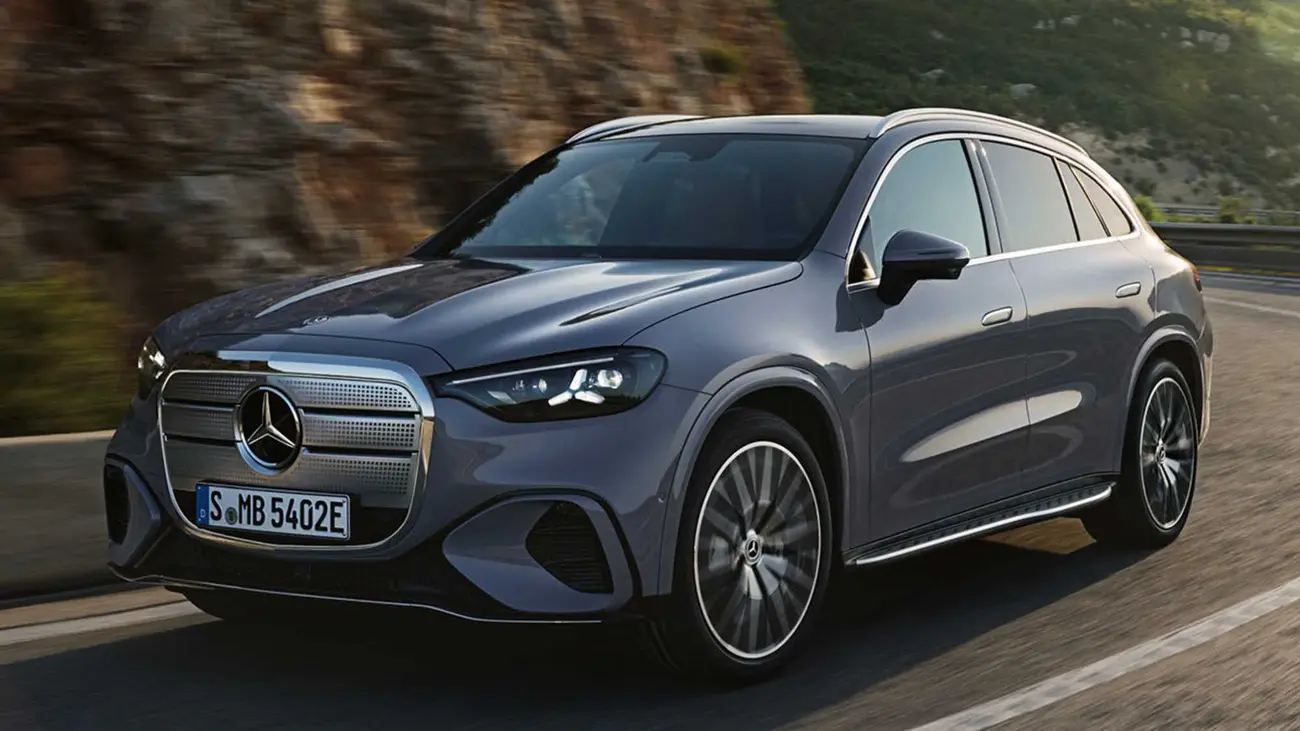
Mercedes GLC 400 4MATIC EQ specs
For now, the version arriving is the range-topping GLC 400 4MATIC EQ. Two motors, all-wheel drive, and numbers that leave no doubt about its pedigree.
| Specification | Value |
|---|---|
| Platform | MB.EA-M (dedicated EV), 800V |
| Drivetrain | All-wheel drive, dual motor |
| Power | 360 kW / 489 PS |
| Torque | 800 Nm |
| 0-100 km/h | 4.3 s |
| Top speed | 210 km/h |
| Usable battery | ~94 kWh (100 kWh nominal), NMC |
| WLTP range | up to ~715 km |
| Real-world range (est.) | ~500 km |
| Consumption | ~188 Wh/km |
| Length | 4,845 mm |
| Wheelbase | 2,972 mm |
| Boot / frunk | 570 L / 128 L (~690 L) |
| Towing capacity | 2,400 kg |
| Weight | ~2,535 kg |
The 489 PS and 800 Nm fire the GLC 400 from 0 to 100 km/h in 4.3 seconds — sports-car pace from a family SUV weighing more than 2.5 tonnes. More relevant day to day: the heat pump is standard, which helps preserve range in winter rather than burning it to heat the cabin.
Charging: 800V architecture and a 330 kW peak
Here's one of the electric GLC's trump cards. The 800V architecture allows up to 330 kW on DC, and that changes the logistics of long trips.
- DC rapid: 10-80% in around 22 minutes on a 350 kW charger
- Lightning top-up: roughly 300 km of range in 10 minutes, in ideal conditions
- Home AC: 11 kW standard, 22 kW optional — a full charge in a little over 10 hours
- Heat pump: standard across all versions
In practice, a coffee stop at a service area with a rapid charger restores range for another few hundred kilometres. Portugal's MOBI.E network (the national public charging system) and the ultra-rapid chargers on the motorways already have 150 kW posts and above — the GLC makes good use of them, though the 330 kW peak only appears on the most powerful units.
Space and everyday practicality
Building the car as an EV from scratch freed up space. At 4,845 mm long with a 2,972 mm wheelbase, the electric GLC offers around 50 mm more rear legroom than the combustion GLC.
The boot holds 570 litres, with 128 litres in the frunk (the front trunk) on top, for a total near 690 litres. The frunk is handy for charging cables or an extra bag. Braked towing capacity reaches 2,400 kg — a rare figure for an electric SUV and useful if you tow a trailer or caravan.
Inside, the highlights are the optional 39.1-inch Hyperscreen and the new MB.OS system with AI-assisted voice control. All very high-tech — perhaps too much, according to some reviews, which flag the lack of physical climate controls.
Mercedes GLC electric vs BMW iX3: the comparison that counts
The most direct rival is the new BMW iX3, itself a next-generation premium electric SUV. And it's an honest comparison: the iX3 leads on range, with versions claiming close to 800 km WLTP and charging up to 400 kW.
The GLC answers with comfort, a refined interior, and very good efficiency. What Car? places it between the iX3 and the upcoming Volvo EX60, praising the material quality and the balance of comfort and performance. Other rivals to keep on the radar: the Audi Q6 e-tron and the Tesla Model Y. The GLC isn't the cheapest or the longest-range, but it plays a strong all-round game.
Mercedes GLC electric price in Portugal
Official Portuguese prices aren't finalised yet, but the European figures give a solid reference. In Germany, the range starts at €64,736 for the GLC 250, rises to €68,306 for the GLC 300 4MATIC and reaches €71,281 for the GLC 400 4MATIC EQ. In the Netherlands, the GLC 400 sits at €72,651.
In Portugal, factoring in import margins and equipment, it's realistic to expect the GLC 400 EQ to land somewhere between €75,000 and €80,000. Working in the buyer's favour is the tax treatment of EVs: exemption from ISV (the vehicle registration tax) and benefits on IUC (annual road tax), plus tax advantages for company cars — all of which make the final bill on a premium EV easier to swallow than the combustion equivalent.
The GLC 250 (rear-wheel drive) and GLC 300 4MATIC versions, with a smaller battery of around 85 kWh, open for orders from June 2026 and should bring the entry price down.
Frequently Asked Questions
Official Portuguese prices aren't finalised yet, but the European figures give a solid reference: in Germany the range starts at €64,736 (GLC 250), rises to €68,306 (GLC 300 4MATIC) and reaches €71,281 for the GLC 400 4MATIC EQ. In Portugal, factoring in import margins and equipment, it's realistic to expect the GLC 400 EQ between €75,000 and €80,000. The ISV exemption and IUC benefits for EVs make the final bill easier to swallow than the combustion equivalent.
Mercedes claims up to 715 km WLTP (TEL cycle, most favourable wheels), but real-world range sits closer to 500 km combined according to EV Database. In mild conditions it's around 580 km, dropping to about 480 km in winter, with average consumption near 188 Wh/km. On steady motorway runs in the cold, EV Database calculates around 365 km — enough for a Lisbon-Porto trip (310 km) with a single stop.
Thanks to the 800V architecture, the GLC accepts up to 330 kW on DC and does 10-80% in around 22 minutes on a powerful charger. In ideal conditions it recovers roughly 300 km of range in just 10 minutes. At home, the standard 11 kW AC charger (22 kW optional) completes a full charge in a little over 10 hours. The 330 kW peak only appears on the most powerful units in Portugal's public network.
The BMW iX3 is the most direct rival and leads on range (versions claiming close to 800 km WLTP) and charging speed (up to 400 kW). The GLC answers with comfort, a refined interior and very good efficiency, sitting between the iX3 and the upcoming Volvo EX60 according to What Car?. The GLC isn't the cheapest or longest-range, but it plays a strong all-round game and offers a 2,400 kg braked towing capacity.
For anyone already buying a GLC who wants to switch to electric without giving up space, comfort or towing, the GLC 400 EQ makes sense: the real-world range of around 500 km and 800V charging solve trip anxiety, and the standard heat pump shows Mercedes thought about winter. What's left to confirm are the final Portuguese prices and the arrival of the GLC 250 and 300 versions, with a ~85 kWh battery, which open for orders from June 2026 and should bring the entry price down.
Is the Mercedes GLC electric worth it?
For anyone already buying a GLC who wants to make the jump to electric without giving up space, comfort or towing capacity, the GLC 400 EQ makes sense. The real-world range of around 500 km and the 800V charging solve trip anxiety, and the standard heat pump shows Mercedes thought about winter.
What's left to confirm are the final Portuguese prices and the arrival of the more affordable versions. It's worth watching for the official Portugal price announcements before deciding — and, above all, comparing closely with the BMW iX3, which remains the range benchmark in this segment.