
Mercedes EQS 2026 in Portugal: 926 km Range, 800V and Steer-by-Wire
Published: 15/04/2026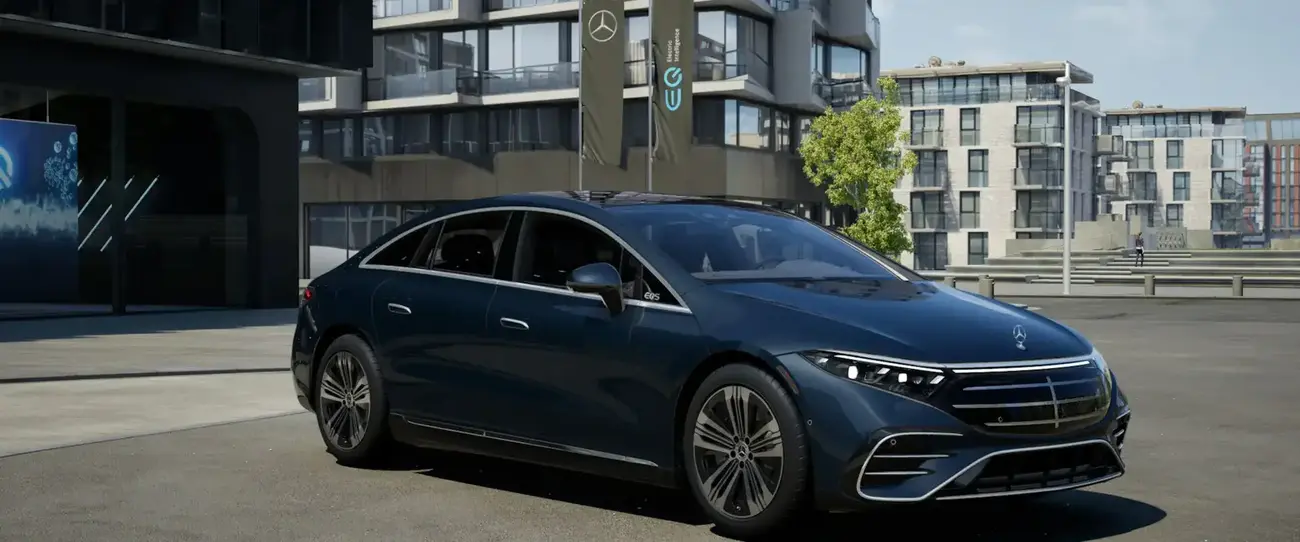
926 km WLTP on a single charge
Mercedes-Benz has revealed the second facelift of the EQS, and this one goes well beyond a cosmetic refresh. The Stuttgart brand's electric flagship gains 800V architecture, a 122 kWh battery with new silicon oxide-graphite anodes, and a range that reaches 926 km WLTP in the EQS 450+. For anyone tracking the Mercedes-Benz EQS 2026 as a Portugal-market option, this is the moment Mercedes finally joins Lucid Air and Porsche Taycan in the technical conversation — and it does so just months before retirement, since the next S-Class (both combustion and electric) is set to replace the current EQS.
Over 25% of the car's components are either new or reworked. This is the deepest update the model will ever receive.
What changes in the Mercedes EQS facelift 2026
Four versions, German prices already published, and a near-new electrical architecture. The essentials, for anyone considering an order:
| Version | Power | Torque | 0-100 km/h | WLTP range | Price (DE) |
|---|---|---|---|---|---|
| EQS 400 RWD | 367 hp (270 kW) | 505 Nm | 6.2 s | 817 km | €94,403 |
| EQS 450+ RWD | 408 hp (300 kW) | 505 Nm | 5.9 s | 926 km | €108,635 |
| EQS 500 4Matic | 476 hp (350 kW) | 750 Nm | 4.5 s | 876 km | €123,285 |
| EQS 580 4Matic | 585 hp (430 kW) | 800 Nm | 4.1 s | 876 km | €134,732 |
Top speed is capped at 210 km/h across the range. The rear gearbox remains a two-speed unit — uncommon among EVs, and a clever way to combine strong launches with highway efficiency.
800V architecture: the missing piece
Three of the four variants move to an 800V architecture. Only the EQS 400 keeps a lower-voltage system paired with a 112 kWh NMC pack. On the rest, usable battery capacity goes from 118 to 122 kWh without changing pack dimensions — the gain comes from chemistry, with composite silicon oxide-graphite anodes and reduced cobalt content.
What that means on the ground: the EQS 450+ now peaks at 350 kW DC (the EQS 400 tops out at 330 kW). Ten minutes of charging adds up to 320 km of WLTP range. And when you plug into one of the many European fast chargers still limited to 400V — roughly half the fast network in Portugal — the pack splits virtually into two halves charging at 175 kW each. No compatibility penalty.
Regen braking and V2G
Peak regenerative braking power climbs from 290 kW to 385 kW. More engine braking on long descents, more recovered energy, less wear on the discs. The battery also supports bidirectional charging (V2G and V2H), enabled via OTA update after launch — relevant for anyone pairing the EQS with rooftop solar and an indexed tariff.
Mercedes EQS steer-by-wire: a German first in series production
Optional, but this is the detail that will get people talking. It arrives a few months after the commercial launch and is the first series-production steer-by-wire system from a German brand. With no mechanical column between wheel and tyres, it runs a 170° lock-to-lock range — less than half a turn each way — with fully redundant sensors and actuators. A yoke (U-shaped) steering wheel is also available as an option.
Rear-wheel steering, previously limited to 4.5°, now stretches to 10° when combined with steer-by-wire. Turning radius drops to under 11 metres — city-car numbers in a 5.2-metre sedan. For drivers tackling Lisbon or Porto's narrow streets, that's a bigger deal than the spec sheet suggests.
Real-world range and consumption
The EQS 450+ claims 15.4 to 19.3 kWh/100 km on the WLTP cycle. Portuguese reality — the A1 at 120 km/h, A/C running, some mixed city traffic — tends to land between 18 and 22 kWh/100 km. That puts actual range somewhere between 600 and 700 km in the 450+, depending on driving style. Lisbon-Porto without a stop becomes routine rather than a planning exercise.
Drag coefficient stays at 0.20, a benchmark for the industry. Towing capacity: 1,600 kg for RWD, 1,700 kg for 4Matic variants.
When does the new Mercedes EQS arrive in Portugal
Orders are already open in Germany. European deliveries, Portugal included, are expected in the second half of 2026. Portuguese prices haven't been confirmed by Mercedes-Benz Portugal yet, but a reasonable estimate is possible:
- The EQS 400 starts at €94,403 in Germany. In Portugal, pure EVs are exempt from ISV (the country's vehicle registration tax), which keeps the local price close to the German list plus local VAT adjustments. Expect an entry point around €95,000 to €100,000.
- The EQS 580 4Matic should land near €138,000 to €145,000 once importer margin and Portugal-specific standard equipment are factored in.
Portuguese tax incentives remain attractive: full ISV exemption, minimal IUC (annual road tax) for EVs, and generous corporate tax deductions (IRC) for businesses registering the EQS as a company car. None of these fix the sticker price — but they meaningfully change the five-year total cost of ownership.
How it stacks up against what's already here
The BMW i7 xDrive60 starts around €140,000 in Portugal and peaks at 611 km WLTP. The Lucid Air still lacks an established retail network in the country. The Porsche Taycan, positioned more as a sports sedan, plays in the same price range without matching EQS 450+ range. In the luxury electric sedan segment with 900 km of range, the facelifted EQS is currently the benchmark — and it should hold that position until the next electric S-Class lands.
On-board technology
The Hyperscreen carries over, with a 12.3" driver display, 17.7" central screen, and a 12.3" passenger display. In the back, two 13.1" touchscreens. The operating system is the new MB.OS, with OTA updates and deeper integration of smart assistants.
Micro-LED Digital Light headlamps offer +40% illuminated field and -50% energy consumption, with a high-beam reach of 600 m. ADAS runs on 10 cameras, up to 5 radars, and 12 ultrasonic sensors. The HEPA filter captures 99.65% of airborne particles — noticeable for drivers in urban pollution zones. Heated seatbelts reach 44 °C, a feature Mercedes pioneered in this line and is now generalising.
Frequently Asked Questions
Orders for the 2026 Mercedes EQS opened in Germany in April 2026, with European deliveries — Portugal included — expected in the second half of 2026. Mercedes-Benz Portugal has not yet confirmed exact dates or local pricing, but the Portuguese launch should follow the German rollout within a few weeks.
In Germany, the EQS 400 starts at €94,403 and the flagship EQS 580 4Matic reaches €134,732. In Portugal, because pure EVs are exempt from ISV (vehicle registration tax), we estimate an entry price of €95,000 to €100,000 for the EQS 400 and €138,000 to €145,000 for the EQS 580 4Matic, factoring in importer margin and market-specific standard equipment.
The EQS 450+ claims 926 km WLTP and official consumption of 15.4 to 19.3 kWh/100 km. On Portuguese roads — A1 motorway at 120 km/h with A/C running — expect 18 to 22 kWh/100 km, which puts actual range between 600 and 700 km. That makes the Lisbon-Porto run feasible in a single charge, without stops.
The EQS 450+ leads clearly on range with 926 km WLTP, versus 611 km for the BMW i7 xDrive60 (which starts around €140,000 in Portugal). The Lucid Air matches the EQS on range but has no established retail network in the country. With DC charging up to 350 kW and new 800V architecture, the facelifted EQS becomes the luxury electric sedan benchmark until the next electric S-Class launches.
Being fully electric, the EQS is exempt from ISV registration tax, pays the minimum IUC (annual road tax), and qualifies for corporate tax (IRC) deductions when registered as a company car. These incentives don't change the sticker price but can meaningfully lower the five-year total cost of ownership, especially for business use.
Is it worth waiting for?
If you already drive a pre-facelift EQS, the answer depends on how you use it: if long distances are part of your routine, jumping from 200 kW to 350 kW DC charging is transformative. If your pattern is mostly urban and suburban, the facelift matters less — and trade-in values on the current EQS will drop as soon as the new one lands.
For buyers entering the segment now, it makes sense to wait for the second half of 2026. The base price will likely edge up from the outgoing model, but the gains in range, charging speed, and technology justify it. Worth keeping an eye on Mercedes-Benz Portugal's official price announcements before placing an order.