
Mercedes-AMG GT SUV: Price in Portugal, Specs and 700 km Range
Published: 26/10/2026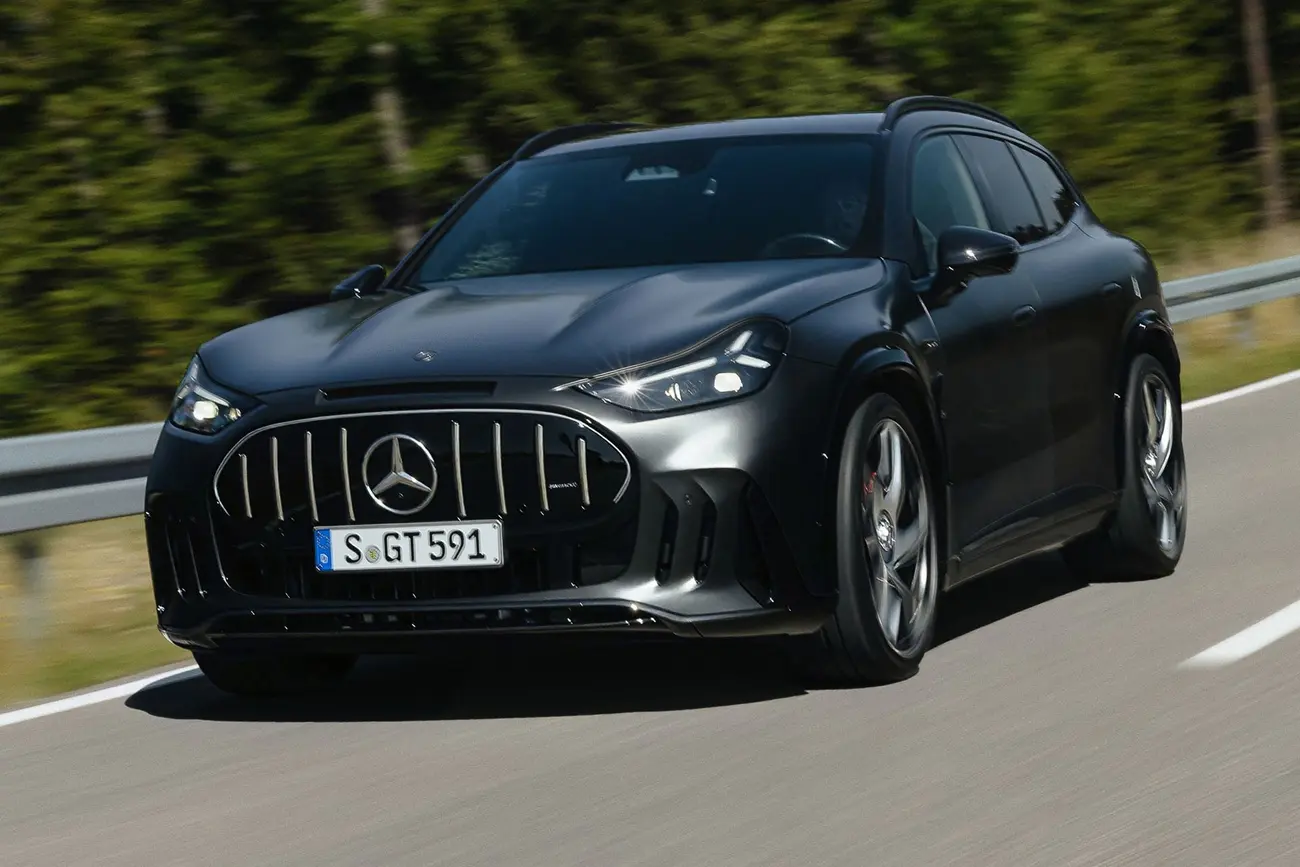
Mercedes-AMG GT SUV: up to 1,153 hp and 710 kW charging
1,153 hp, 2,000 Nm and 0-100 km/h in 2.7 seconds — from an SUV that's over five metres long and weighs close to 2.7 tonnes. That's how Mercedes-AMG introduced the new all-electric Mercedes-AMG GT SUV in Affalterbach on 17 October, the first full-size SUV the brand has developed entirely in-house. Orders for the entry-level GT 53 open across Europe on 20 October 2026, and the big question for buyers here is the Mercedes-AMG GT SUV price in Portugal.
One thing to clear up first: this is the SUV, not the electric Mercedes-AMG GT 4-Door Coupé that arrived in May 2026. Both sit on the AMG.EA platform and share much of their hardware, but the GT SUV is a new, taller and more practical body.
And a note on numbers: the "1,153 hp" in US coverage and the 1,169 PS (or "cv", as Portuguese brochures say) you'll see in European material are exactly the same output — 860 kW. Only the unit changes, imperial horsepower versus metric.
Three versions: AMG GT 53 SUV, GT 55 SUV and GT 63 SUV
The range launches with three variants, all with fully variable 4MATIC+ all-wheel drive and rear-axle steering (up to 6°). The real dividing line is the motors.
GT 53 SUV: two motors and the way in
The GT 53 uses two conventional synchronous motors, producing 400 kW (544 PS) peak and 800 Nm. It does 0-100 km/h in 4.2 seconds and tops out at 250 km/h. It only comes with the 106 kWh battery and steel brakes. Lightest, most efficient — and, for now, the only one with a price.
GT 55 and GT 63 SUV: three axial-flux motors
The 55 and 63 get three axial-flux motors from YASA, the British company Mercedes owns. The GT 55 delivers 600 kW (816 PS) and 1,860 Nm; the GT 63 steps up to 860 kW (1,169 PS) and 2,000 Nm. Both hold 530 kW of continuous output — what the car can sustain, say, over a full track lap, rather than a short peak burst.
The front motor acts as a booster when extra power or traction is needed, and can be decoupled to save energy. At the rear there's a two-speed gearbox, an approach Mercedes already uses in the electric C-Class.
Mercedes-AMG GT SUV specs at a glance
| Spec | GT 53 SUV | GT 55 SUV | GT 63 SUV |
|---|---|---|---|
| Motors | 2 synchronous | 3 axial flux | 3 axial flux |
| Peak power | 400 kW / 544 PS | 600 kW / 816 PS | 860 kW / 1,169 PS |
| Continuous power | 270 kW | 530 kW | 530 kW |
| Max torque | 800 Nm | 1,860 Nm | 2,000 Nm |
| 0-100 km/h | 4.2 s | 3.1 s | 2.7 s |
| 0-200 km/h | 14.6 s | 9.9 s | 7.2 s |
| Top speed | 250 km/h | 250 / 270 km/h | 250 / 270 km/h |
| Battery (net) | 106 kWh | 106 or 128 kWh | 106 or 128 kWh |
| Max DC charging | 600 kW | 600 / 710 kW* | 600 / 710 kW* |
| 10-80% | 11 min | 11 / 12 min | 11 / 12 min |
| WLTP range | 597-668 km | 585-700 km | 585-700 km |
| WLTP consumption | 18.8-21.1 kWh/100 km | 21.2-23.8 kWh/100 km | 21.2-23.8 kWh/100 km |
| Kerb weight (DIN) | 2,525-2,635 kg | 2,605-2,715 kg | 2,585-2,695 kg |
| Brakes | Steel | Steel (carbon-ceramic opt.) | Carbon-ceramic |
| Price Germany | from €113,050 | TBA | TBA |
*Preliminary figure according to Mercedes, not yet certified. The 270 km/h top speed requires the AMG Driver's Package.
With a 1-foot rollout (the measuring method common in the US), the GT 63 drops to 2.5 s for 0-100 km/h and 6.8 s for 0-200 km/h — which is why you'll see both sets of numbers out there.
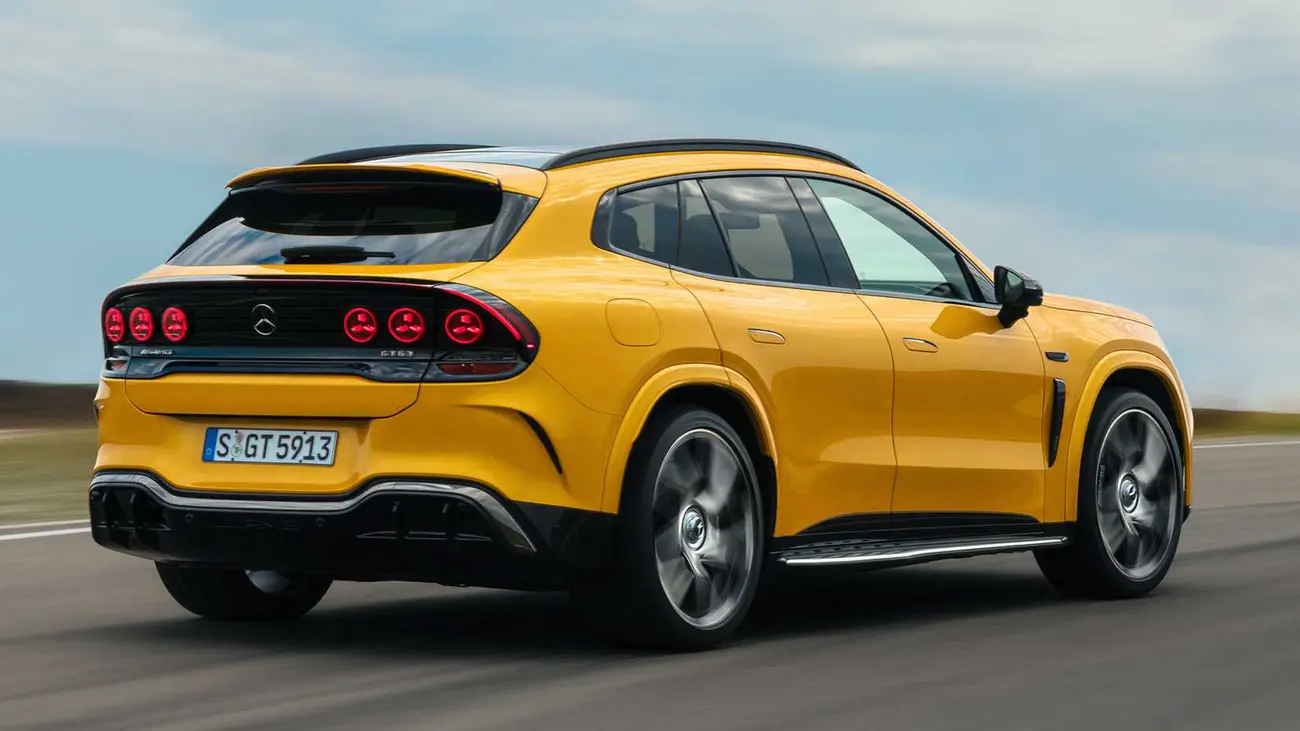
Dimensions are firmly flagship-SUV: 5,084 mm long, 2,001 mm wide, 1,656 mm tall, with a 3,040 mm wheelbase. The boot takes 607 litres (1,740 with the seats folded), plus a 78-litre frunk up front. The drag coefficient is 0.27, helped by an active roof spoiler.
Mercedes-AMG GT 63 SUV range and charging
This is probably the GT SUV's strongest card. The 800-volt architecture and directly cooled cylindrical cells allow charging at up to 600 kW with the 106 kWh pack and up to 710 kW with the 128 kWh pack — the latter still a preliminary figure, by Mercedes' own account.
In practice, Mercedes quotes 10-80% in 11 minutes (106 kWh) or 12 minutes (128 kWh). In 10 minutes the GT 63 adds roughly 454 km of range; the GT 53, about 440 km. The bigger battery takes on 83 kWh in just 10 minutes.
WLTP range reaches 700 km on the 55 and 63, and 668 km on the GT 53. On paper, that's Lisbon to Porto and back without plugging in. On the motorway at 120 km/h, with 1,169 PS on tap, expect considerably less.
Is there a 700 kW charger in Portugal?
No. That's the honest caveat for anyone living here: the fastest chargers on MOBI.E, Portugal's national public charging network, sit well below the 600-710 kW the GT SUV can accept. On a 400 kW charger, electrive reports around 16 minutes for 10-80% — still quick, but the headline 11-12 minutes depends on infrastructure that barely exists in the country yet.
On the plus side, the car supports five charging standards (CCS2, GB/T, CHAdeMO, CCS1 and NACS), and at 800 V it will make the most of any ultra-fast charger you do find.
Interior, chassis and the sound that isn't there
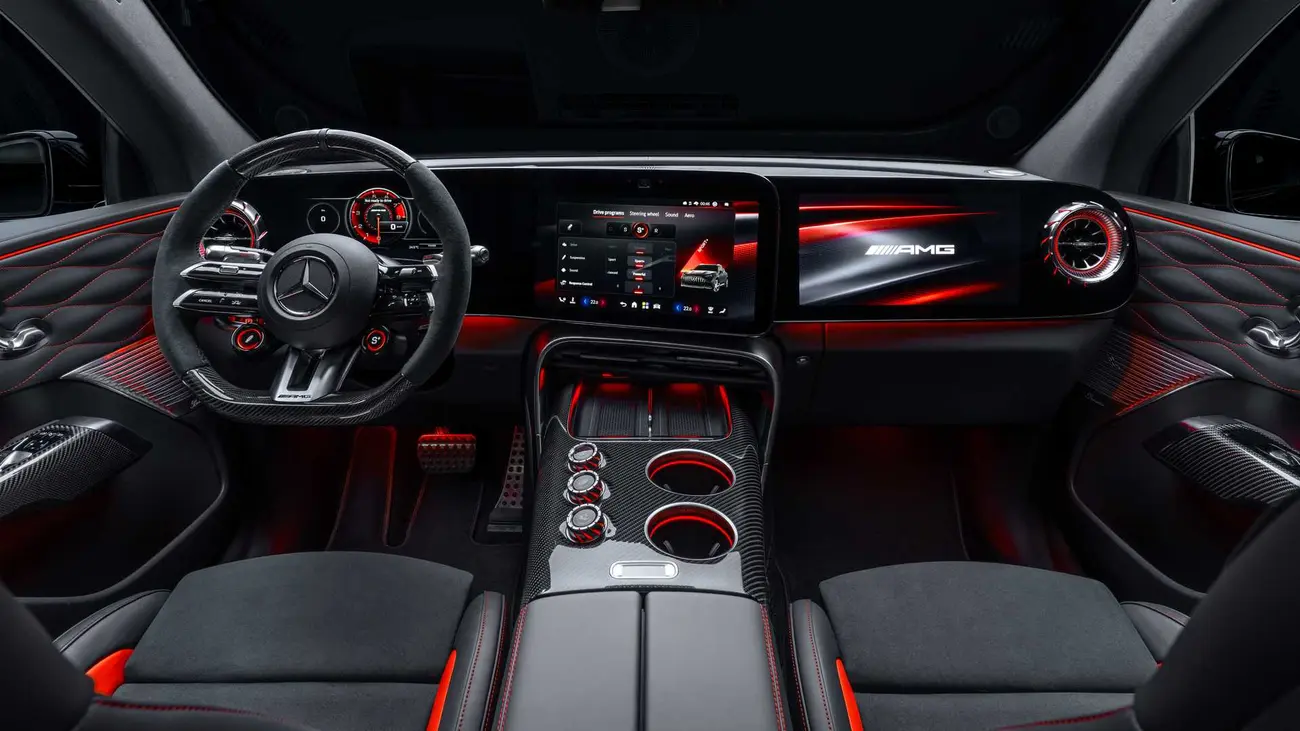
The cabin follows the GT 4-Door: a 10.2-inch driver display, a 14-inch central screen and an optional third 14-inch screen for the passenger. Sky Control panoramic roof, Burmester 4D sound and MBUX with built-in AI assistants round things off.
For enthusiasts, AMG Race Engineer puts three rotary controls on the centre console (response, agility, traction control) in the 55 and 63. AMG Active Ride Control+, which swaps conventional anti-roll bars for a hydraulic system, is standard on the GT 63 and optional on the GT 55.
And the sound? AMGFORCE Sport+ simulates an inline-six (GT 53) or a V8 (GT 55 and 63), complete with fake gear shifts and seat shakers. It's a matter of taste — some people love it, others switch it off after two days.
Mercedes-AMG GT SUV vs Porsche Cayenne Electric and BMW iX M70
Mercedes-AMG openly benchmarked the Porsche Cayenne. Here's how the GT 63 SUV stacks up against the Cayenne Turbo Electric and the BMW iX M70:
| AMG GT 63 SUV | Porsche Cayenne Turbo Electric | BMW iX M70 | |
|---|---|---|---|
| Peak power | 860 kW / 1,169 PS | 850 kW / 1,156 PS | 485 kW / 659 PS |
| Torque | 2,000 Nm | 1,500 Nm | 1,015 Nm |
| 0-100 km/h | 2.7 s (2.5 s rollout) | 2.5 s | 3.8 s |
| Battery | 106 / 128 kWh net | 113 kWh gross | 108.9 kWh |
| Max DC charging | 710 kW* | 400 kW | 195 kW |
| WLTP range | up to 700 km | 623 km | 521-600 km |
| Price Germany | TBA | €165,500 | €124,900 |
*Preliminary.
On raw power, the Porsche duel is effectively a tie — a 13 PS gap won't be felt on the road. Where the AMG pulls ahead is charging: 710 kW against 400 kW for the Cayenne and 195 kW for the BMW. The iX M70 plays in a different league for performance, but it's also the most restrained of the three.
The more interesting comparison may be a different one: at €113,050 in Germany, the GT 53 SUV undercuts the iX M70 (€124,900) and lands in base Cayenne Electric territory (€105,200). It has more power than the base Cayenne (544 vs 436 PS) and less than the iX M70 (659 PS), but charges far faster than either: 600 kW versus 400 and 195 kW.
How much does the Mercedes-AMG GT SUV cost in Portugal?
There's no official Portuguese price yet. The only confirmed figure is the German one: from €113,050 for the GT 53 SUV, including 19% VAT.
A simple estimate: strip out German VAT and you're left with roughly €95,000; add Portugal's 23% VAT and you land at about €117,000. Electric cars are exempt from ISV (Portugal's vehicle purchase tax), so there's no registration tax to add on top. Even so, Mercedes' Portuguese price lists usually carry their own equipment and pricing adjustments, so we estimate the Mercedes-AMG GT SUV price in Portugal at €117,000 to €130,000 for the GT 53. Treat that as our estimate, not a list price.
The GT 55 and GT 63 SUV haven't been priced in any market. Given the power and standard kit (carbon-ceramic brakes, Active Ride Control+), expect the GT 63 to land well above the €150,000 mark.
Taxes: what it means for private and company buyers
For private buyers the picture is simple: no ISV and no IUC (the annual road tax), as with any EV. Company buyers should run the numbers — at a price well above €62,500, the GT SUV falls outside the ceiling that lets businesses deduct VAT on electric cars.
Frequently Asked Questions
There is no official Portuguese price yet. The only confirmed figure is German: from €113,050 for the GT 53 SUV, including 19% VAT. Adjusting for Portugal's 23% VAT, with no ISV to add because electric cars are exempt, we estimate the GT 53 SUV at €117,000 to €130,000 in Portugal, close to the €129,500 asked locally for the GT 53 4-door. The GT 55 and GT 63 SUV have no price in any market yet, but the GT 63 is expected to land well above €150,000.
GT 53 SUV orders open in Europe on 20 October 2026, with the GT 55 and GT 63 SUV following in spring 2027. The car is built in Hall 32 at Mercedes' Sindelfingen plant in Germany. Mercedes has not yet confirmed Portuguese pricing or first delivery dates, but the local market is expected to follow the European schedule; US deliveries only start in summer 2027.
The GT 53 SUV uses two synchronous motors with 544 PS and 800 Nm, does 0-100 km/h in 4.2 s and always comes with the 106 kWh battery and steel brakes. The GT 55 and GT 63 get three YASA axial-flux motors: 816 PS and 1,860 Nm in the 55, 1,169 PS (1,153 hp) and 2,000 Nm in the 63, with 0-100 km/h in 3.1 s and 2.7 s respectively. Only these two offer the 128 kWh battery (up to 700 km WLTP) and 270 km/h with the AMG Driver's Package; the GT 63 also adds standard carbon-ceramic brakes and Active Ride Control+ suspension.
No. The fastest stations on Portugal's MOBI.E network are well below the 600 kW (106 kWh battery) and 710 kW (128 kWh battery, still a preliminary figure according to Mercedes) the GT SUV can accept. On a 400 kW charger, 10-80% takes around 16 minutes instead of the advertised 11-12 minutes at full power. Even so, its 800-volt architecture gets the most out of any ultra-fast charger, and under ideal conditions the GT 63 can add about 454 km of range in 10 minutes.
Both share the 800-volt AMG.EA platform, the same motors and outputs of up to 1,169 PS, so the choice is mainly about body style and use. The GT SUV stands 1,656 mm tall, has a 607-litre boot (1,740 litres with the seats folded) plus a 78-litre frunk, making it the more practical family and touring choice. The GT 4-door is lower and more efficient, with the GT 53 claiming up to 809 km WLTP versus 668 km for the GT 53 SUV, and it already has a Portuguese price (€129,500), while the SUV's is still an estimate.
When will the Mercedes-AMG GT SUV arrive in Portugal?
- GT 53 SUV: orders open in Europe from 20 October 2026
- GT 55 SUV and GT 63 SUV: spring 2027
- Production: Hall 32 at the Sindelfingen plant in Germany
Portuguese dealers should open GT 53 orders in line with the rest of Europe, but first deliveries and the local price list haven't been confirmed yet.
If you're shopping for a sporty luxury electric SUV, the GT 53 looks like the sweet spot of the range: it charges three times faster than the BMW iX M70 and costs less, at least in Germany. The GT 63 is a different story — an exercise in excess that only makes sense if you want Mercedes-AMG's most powerful electric SUV. Worth waiting for the Portuguese price list before deciding.