
Mercedes-AMG GT electric V8 sound in Portugal: how the silent supercar roars
Published: 17/05/2026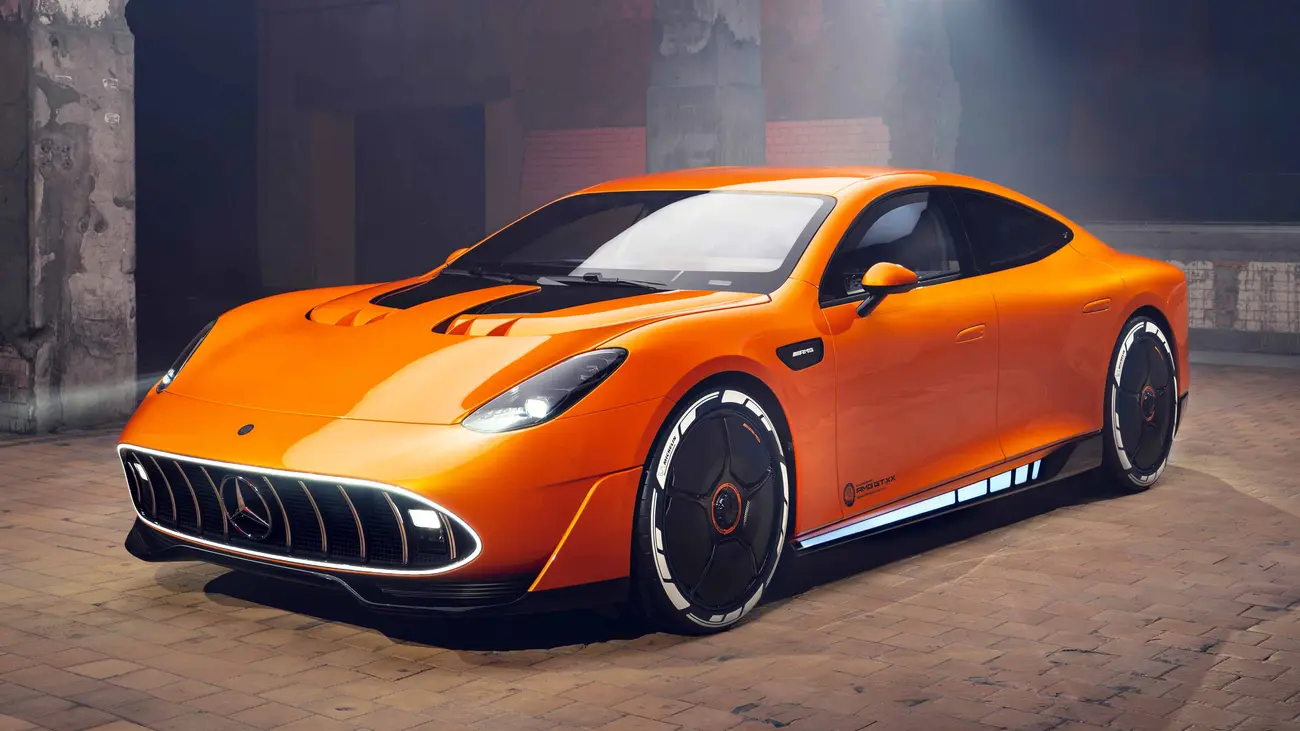
Mercedes-AMG GT electric V8 sound in Portugal: how the silent supercar roars
Three axial-flux motors, 1,341 horsepower, zero combustion. And yet, push the throttle in Sport+ and the new Mercedes-AMG GT electric roars like a V8 — complete with simulated gear shifts, paddle-controlled "upshifts", and a fake redline you hit before the next "gear" engages. AMG has decided electric performance does not have to be silent. And the brand is betting heavily on the idea.
The car will be revealed on May 20 in Los Angeles, with its full debut in summer 2026 and production starting later this year at Marienfelde, Berlin. It is the first series-production model on the new AMG.EA platform, and Mercedes is clearly trying to redefine what a sporting GT means in the battery era.
The AMG.EA platform and YASA axial-flux motors
The Mercedes-AMG GT XX (the concept name that previews the production car) sits on a brand-new architecture, designed from scratch for electric performance. It is not a reworked EQS. It is a dedicated platform with an above-800V base.
The big technical story is in the motors. AMG uses three axial-flux units built by YASA — a wholly-owned Mercedes subsidiary since 2021. Two motors live on the rear axle; a third, on the front axle, acts as a booster with a disconnect unit. When it is not needed, it simply switches off, cutting drag losses.
YASA's axial-flux motor offers around three times the power density of a conventional radial motor, weighs roughly two-thirds less, and takes up about a third of the space. The main rear assembly measures just 9 cm wide. The kind of breakthrough usually reserved for hypercars — now reaching a series-production model.
Mercedes-AMG GT XX specs
| Specification | Value |
|---|---|
| Platform | AMG.EA (above-800V architecture) |
| Motors | 3 YASA axial-flux units (2 rear + 1 front) |
| Peak power (concept) | 1,000 kW / 1,341 hp / 1,360 PS |
| Estimated production power | around 1,100 bhp |
| Estimated torque | 1,220 Nm (900 lb-ft) |
| 0-100 km/h | 2.2 s (estimated) |
| Top speed | over 360 km/h (concept) / around 305 km/h (production est.) |
| Battery | 114 kWh (concept) / around 100 kWh (production) |
| Chemistry | NMCA cylindrical cells with direct cooling |
| DC charging | 900 kW (concept) / over 500 kW (production est.) |
| WLTP range | around 400 km |
| Length | 5,200 mm |
| Estimated kerb weight | 2,200 kg |
| Drag coefficient | 0.198 |
| Estimated UK price | 200,000 pounds |
How the AMG GT XX synthetic V8 sound works
This is the bit that will split opinions. In Comfort mode the GT is almost silent. Switch to Sport+ and Mercedes activates a synthesized soundtrack that mimics an AMG V8 — including fake gear shifts.
The car has a single-speed reduction gear. Mechanically, it does not change gears. But the system fakes a sequential gearbox: as you accelerate, the "engine" climbs to a redline with a characteristic "barrp" cut, and only then does acceleration continue, as if you had engaged the next gear. You can "shift" manually with paddles behind the steering wheel.
The immersion runs deeper. The driver's seat vibrates in sync with a central rev counter, giving haptic feedback of an engine spinning up. Carscoops testers who drove prototypes call the system technically superior to the electric Dodge Charger Daytona — the other major experiment in synthetic EV sound.
Does it make sense? For an enthusiast raised on AMG V8s, it may make the transition more palatable. For a pure EV buyer, it is probably a novelty that gets switched off after a week. AMG is betting that, in a performance GT, acoustic theatre is still part of the experience.
AMG GT 4-door electric range and charging
This is the weak spot. WLTP range comes in around 400 km — modest for a car carrying roughly 100 kWh. The pack is clearly tuned for maximum track discharge, not road efficiency.
Charging makes up for some of it. At 900 kW (on the concept), the GT XX adds about 400 km in 5 minutes. Even the production car, at roughly 500 kW, will be among the fastest-charging cars on sale. The catch: no public station in Portugal delivers 500 kW today. The fastest MOBI.E (Portugal's national charging network) and Ionity stations cap out around 350 kW. The car's full charging potential is reserved for a handful of European hubs.
In August 2025, a prototype set a 24-hour distance world record: 5,480 km at an average of 228.3 km/h. That is more than the all-time Le Mans 24 Hours distance record. It proves the battery can sustain high power for hours — the opposite of most performance EVs, which derate after two track laps.
Chassis: 4Matic+ AWD and drift mode
AMG is not just throwing power numbers at the problem. The chassis is probably the most serious piece of engineering here.
- 4Matic+ all-wheel drive with fully variable torque vectoring
- Rear-wheel steering
- Active Ride Control suspension with air springs and hydraulically-linked dampers
- Active anti-roll stabilization
- Nine response modes, 729 setup combinations via rotary dials on the steering wheel
- Pure rear-wheel-drive mode for controlled drifting
That last point is classic AMG: even in a car weighing over 2,200 kg, there is a mode that decouples the front axle and turns the GT into a rear-driver. Seriously.
AMG GT electric price Portugal: what to expect
Autocar estimates a UK list price of 200,000 pounds (around 235,000 euros). In Portugal, being a fully electric car, the GT is exempt from ISV (the vehicle import tax) — usually worth 15,000 to 25,000 euros on premium models. IUC (annual circulation tax) for EVs is also minimal.
Even so, expect a Portuguese sticker between 240,000 and 280,000 euros. Direct rivals are the Porsche Taycan Turbo GT (1,034 hp), Lotus Emeya 900, and Polestar 5 Performance. For reference, the Xiaomi SU7 Ultra delivers 1,526 hp for a fraction of the price — but it is not sold in Europe.
Frequently Asked Questions
In Sport+ mode, the electric GT activates a synthesized soundtrack that mimics an AMG V8, synced with driver-seat haptic vibration and a central rev counter. Even though the car has a single-speed transmission, the system simulates sequential gear shifts: revs climb to a redline cut with a characteristic 'barrp' before acceleration resumes, as if a higher gear had been engaged. The driver can control these virtual shifts manually using paddles behind the steering wheel.
The official reveal is scheduled for May 20, 2026 in Los Angeles, with the European debut in summer 2026 and series production starting later that year at Mercedes-Benz Marienfelde in Berlin. First Portuguese deliveries via Mercedes-Benz dealers are expected in late 2026 or early 2027, with very limited initial volumes given the flagship positioning.
WLTP range is estimated at around 400 km with the 114 kWh battery (about 100 kWh in the production version) — modest for the capacity because the pack is optimized for maximum discharge on track rather than efficiency. DC charging peaks at 900 kW on the concept (around 500 kW in production), enough to recover 400 km in just 5 minutes. In Portugal, however, the fastest MOBI.E and Ionity stations top out at 350 kW, so the full potential will only be unlocked at specific European charging hubs.
In the UK, the estimated price is around 200,000 pounds (about 235,000 euros before taxes). In Portugal, with 23% VAT and the partial ISV exemption for electric vehicles, the final price is expected to land between 230,000 and 270,000 euros depending on equipment. IUC remains low for pure EVs, but at this price point the positive fiscal impact of incentives is marginal relative to the total cost.
The AMG GT XX delivers 1,341 hp (concept) or about 1,100 bhp (estimated production), versus 1,034 hp for the Porsche Taycan Turbo GT, with an estimated 0-100 km/h of 2.2 seconds. Technically, AMG uses three YASA axial-flux motors and an 800V+ architecture, while Porsche relies on radial motors and a conventional 800V setup. The AMG further differentiates itself with the synthetic V8 sound and simulated shifts, whereas the Taycan keeps a more discreet acoustic profile focused on EV purity.
Mercedes AMG electric availability Portugal
Production starts in 2026 at Marienfelde. First European deliveries should land in late summer or autumn 2026. The Mercedes-Benz dealer network in Portugal — Sucena, Caetano Auto, Santogal — should get the model in the first allocation wave, though volumes will be small. Bespoke configurations, as usual on flagship AMGs, can push delivery into 2027.
The May 20 LA reveal is worth watching. That is when Mercedes is expected to confirm the final production name, the official base price, and the launch markets. The 1,341 hp are locked in. The synthetic V8 soundtrack too. What is still open is whether Mercedes can convince two decades of AMG buyers that this is the natural next step — rather than the electrified version of something that no longer exists.