
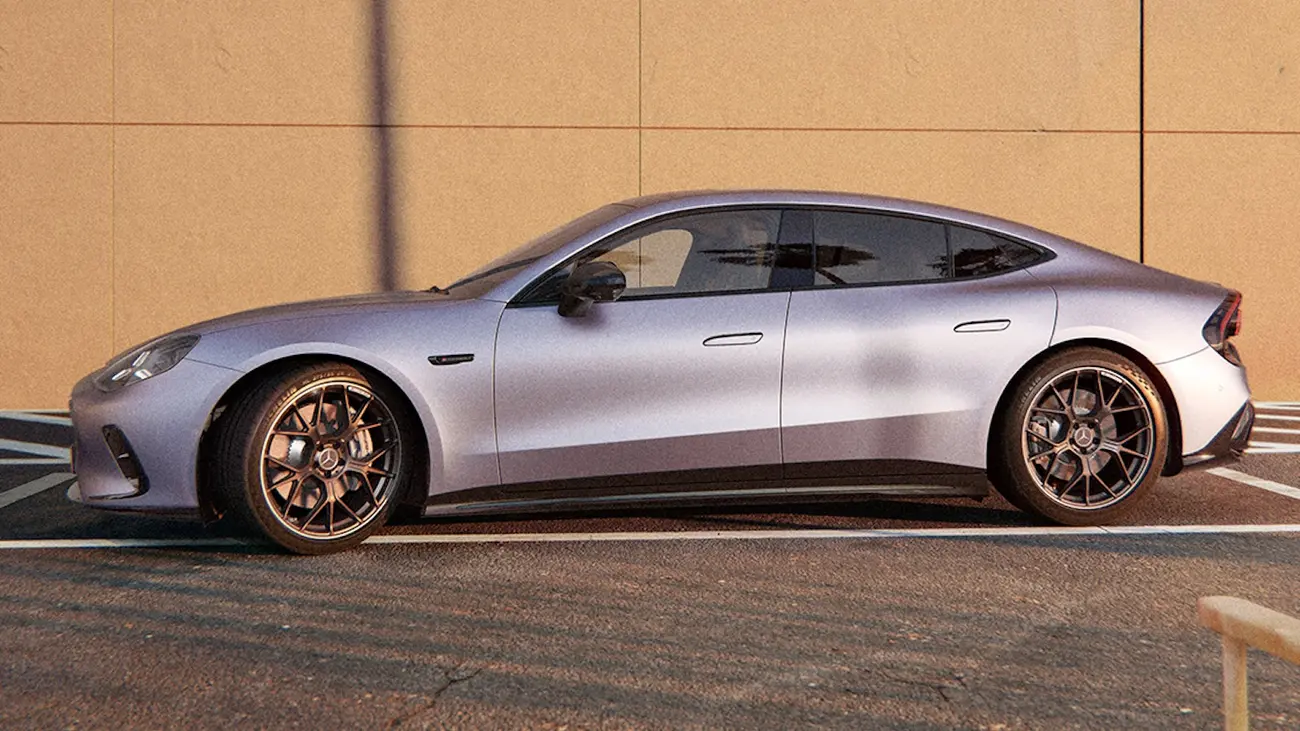
Mercedes-AMG GT 53 in Portugal: Price, 809 km Range and Full Specs
Published: 17/08/2026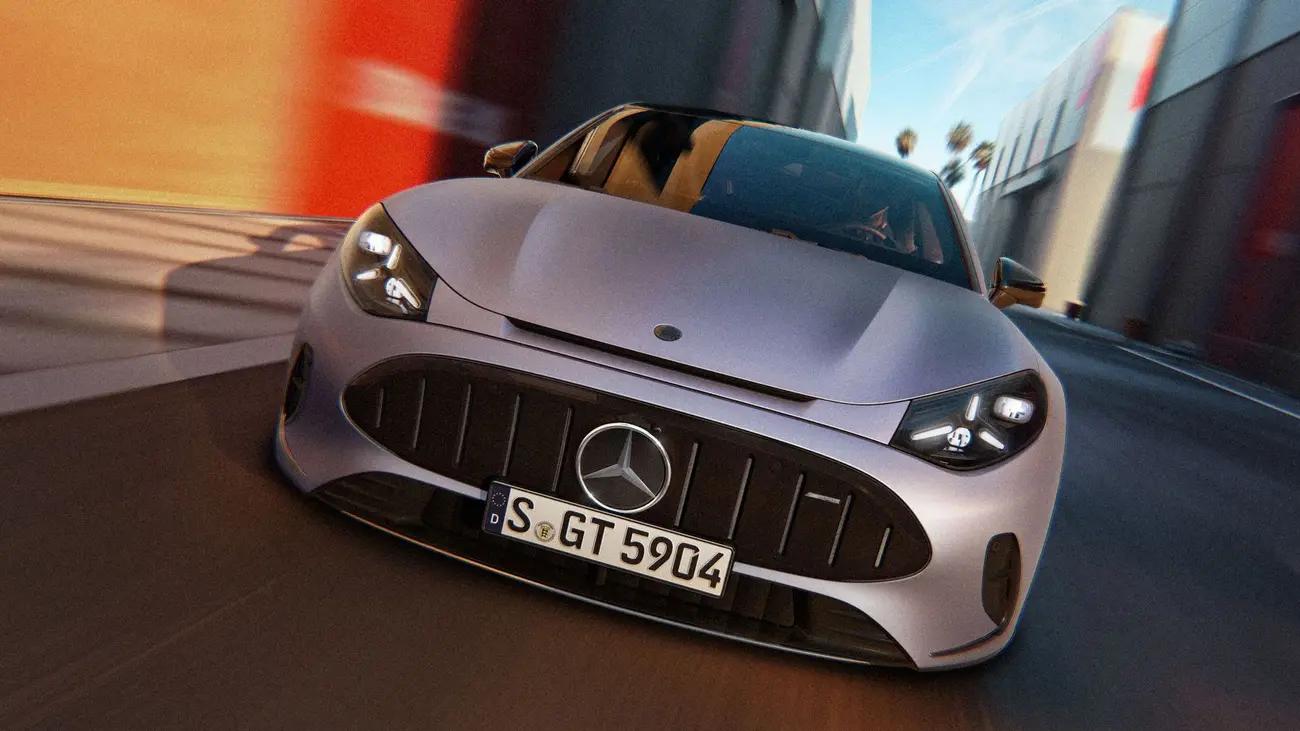
€129,500 in Portugal — the cheapest AMG is also the one that goes furthest
The Mercedes-AMG GT 53 price Portugal question now has an answer: €129,500, with order books opening on 13 August 2026. In Germany the same car starts at €115,430, and the gap comes down to the usual things — import margins, standard equipment and how Mercedes-Benz Portugal structures its list prices.
Here's the twist. This is the entry rung of the electric four-door GT family — fewer motors, less power, less money — and it still covers more ground on a charge than either of its siblings. 809 km on the WLTP cycle, against 595 to 695 km for the more expensive cars. Paying less to travel further is not a trade you get offered often.
Mercedes-AMG GT 53 specs: two motors instead of three
Everything that separates the GT 53 from the GT 55 and GT 63 unveiled in May sits in the drivetrain. The flagships use three Yasa axial-flux motors — compact, extraordinarily power-dense, good for 860 kW in the GT 63. The GT 53 swaps them for two permanent magnet synchronous motors (PSM), more conventional and considerably more efficient in everyday driving.
The main unit sits on the rear axle. Up front there's a second PSM acting as a boost motor, linked through a Disconnect Unit (DCU) that decouples it under light load to cut drag. Cruise on the motorway and the GT 53 behaves essentially as a rear-wheel-drive car. Ask for everything and the front axle joins in, with AMG Performance 4MATIC+ shuffling torque according to grip.
The numbers: 400 kW (536 hp) and 800 Nm, 0-100 km/h in 3.5 seconds with a one-foot rollout, 3.9 seconds from a standstill. The GT 63, with 860 kW and around 2,000 Nm, does it in 2.1 and 2.4 seconds. On a Portuguese road that difference is close to theoretical. In consumption and range, it is anything but.
Why the AMG GT 53 has more range than the GT 63
The battery is identical across all three cars: 106 kWh usable, 800-volt architecture, cylindrical NCMA cells with silicon-enhanced anodes and energy density above 298 Wh/kg. Each cell is cooled directly by oil, which keeps temperatures steady during hard driving and rapid charging alike.
Same energy on board, so whoever uses less of it travels further. The GT 53's 400 kW and its disconnecting front motor add up to 809 km WLTP, more than 100 km beyond what the GT 55 and GT 63 manage. In real Portuguese conditions — air conditioning on, motorway speeds — expect meaningfully less than the homologated figure. Even with a generous margin, though, Lisbon to Faro or a Lisbon-Porto round trip fits comfortably inside one charge.
Active aerodynamics help: there's a rear spoiler that adjusts itself automatically and an optional active rear diffuser, both aimed at trimming consumption at cruising speed.
600 kW charging: 10 to 80 percent in 11 minutes
This is where the GT 53 concedes nothing to its siblings. It accepts up to 600 kW DC on 800-volt infrastructure, which means 10 to 80% in 11 minutes and 534 km recovered in a 10-minute stop.
The Portuguese caveat is obvious: chargers capable of 600 kW barely exist on our network. On 400-volt units — which is almost everything you'll find on MOBI.E, Portugal's national charging network, and at motorway service areas — the car switches voltage automatically and charges without fuss, just more slowly. At home or at the office, AC charging runs at 11 kW, enough to fill the battery overnight if your supply can take it.
Worth being straight about it: the 600 kW architecture is an investment in where the network is going, not an advantage you can use in Portugal today.
AMG GT 53 vs GT 63 electric: the spec table
| Specification | GT 53 | GT 55 | GT 63 |
|---|---|---|---|
| Motors | 2 PSM (rear main + front boost, DCU) | 3 Yasa axial-flux | 3 Yasa axial-flux |
| System output | 400 kW (536 hp) | around 800 hp | 860 kW (1,170 PS) |
| Torque | 800 Nm | n/a | around 2,000 Nm |
| 0-100 km/h (rollout) | 3.5 s | n/a | 2.1 s |
| 0-100 km/h (standstill) | 3.9 s | n/a | 2.4 s |
| Top speed | n/a | n/a | 300 km/h |
| Usable battery | 106 kWh, 800 V | 106 kWh | 106 kWh |
| WLTP range | 809 km | 595-695 km | 595-695 km |
| Peak DC charging | 600 kW | 600 kW | 600 kW |
| 10-80% DC | 11 min | 11 min | 11 min |
| Range added in 10 min | 534 km | around 430 km | around 430 km |
| AC charging | 11 kW | 11 kW | 11 kW |
| Boot / frunk | 415 l / 41 l | 415 l / 41 l | 415 l / 41 l |
| Price (Germany) | €115,430 | €154,700 | €196,350 |
That's €39,270 between the GT 53 and the GT 55 on the German list. A lot of money for 1.4 seconds to 100 km/h and over 100 km less range.
Inside, and how it sounds
The cabin is shared with the rest of the range: a 14-inch central screen set into a seamless glass dashboard, an optional passenger display, wireless phone charging and an optional SKY CONTROL panoramic roof with electronically variable transparency. AMG RIDE CONTROL air suspension with adaptive damping offers Comfort, Sport and Sport+ settings, and there are six AMG DYNAMIC SELECT modes including Eco and Slippery.
The real point of difference is the soundtrack. Where the GT 55 and GT 63 fake a V8, the GT 53 recreates a turbocharged 3.0-litre inline-six, complete with simulated gearshifts, through AMGFORCE Sport+ mode. A Sound Slider lets you pick the profile and how loud it gets — or switch it off entirely. Underneath sits a two-speed transmission, part of the reason this car is so efficient at speed.
ISV and IUC exemption: the sum that only works in Portugal
Being fully electric, the GT 53 is exempt from ISV (Portugal's vehicle registration tax, calculated on engine capacity and emissions) and exempt from IUC (the annual circulation tax). On a car in this class that matters a great deal: a 536 hp four-door with a combustion engine would face tens of thousands of euros in ISV alone, then keep paying IUC every year.
What doesn't apply is the state purchase incentive for EVs or full VAT deduction on company vehicles — both capped well below this AMG's €129,500. For business use the saving sits mainly in the reduced autonomous taxation rate applied to electric cars, a calculation worth running with an accountant before choosing between outright purchase and a rental agreement.
Frequently Asked Questions
The GT 53 4-Door Coupé starts at €129,500 in Portugal, with order books opening on 13 August 2026. The same car costs €115,430 in Germany — a gap of roughly €14,000 driven by standard equipment, import margins and Mercedes-Benz Portugal's pricing structure. It is still the entry point to the range: the GT 55 costs €154,700 and the GT 63 €196,350 in Germany.
Yes. As a fully electric car, the GT 53 pays no ISV (vehicle tax) and no IUC (annual road tax) in Portugal, which on a 544 hp four-door saves tens of thousands of euros compared with a combustion equivalent. What does not apply are the state EV purchase incentive and full VAT deduction for company cars, both capped well below this AMG's €129,500 price; for business use the main benefit is the reduced autonomous taxation rate applied to EVs.
All three versions share the same 106 kWh usable battery with 800-volt architecture and NCMA cells with a silicon-enhanced anode (over 298 Wh/kg). The difference is the drivetrain: the GT 53 uses two permanent-magnet synchronous motors with a disconnect unit that decouples the front motor under light load, while the GT 55 and GT 63 use three Yasa axial-flux motors producing up to 860 kW. The result is 809 km WLTP for the GT 53 against 595–695 km for the more powerful cars — over 100 km in favour of the cheapest model.
On paper, 11 minutes: the GT 53 accepts up to 600 kW DC on 800-volt infrastructure, which adds 534 km of range in 10 minutes. In Portugal that figure is out of reach today because the national network has no 600 kW chargers; on the far more common 400-volt units the car switches voltage automatically and charges without issue, just more slowly. At home, AC charging runs at 11 kW, enough for a full battery overnight.
The Taycan is the direct rival and the benchmark for high-performance electric four-doors, and it is exactly what Mercedes-AMG benchmarks the GT four-door family against. The GT 53's case rests on range (809 km WLTP) and charging speed (600 kW, 10–80% in 11 minutes), with 400 kW (544 hp), 800 Nm and 0–100 km/h in 3.5 seconds with rollout. Both are ISV- and IUC-exempt in Portugal, so the decision comes down to the final optioned price, real-world range and residual values — it is worth comparing used examples on the Portuguese market too.
Is the AMG GT 53 worth it?
It depends what you want from a €130,000 four-door. If the goal is the biggest number in the brochure and acceleration that pins you to the seat, the GT 63 exists at nearly €200,000 in Germany and nothing else will do. If the goal is to drive an electric AMG every day, run Lisbon to Porto without planning stops, and still have 536 hp on tap when you want it, the GT 53 is the sensible one of the three — and the cheapest.
Orders open on 13 August 2026, first GT 55 and GT 63 deliveries land at the end of the year, and the US gets the GT 53 in early 2027. What's still unknown is exactly what Mercedes-Benz Portugal puts in the €129,500 car as standard, and how quickly the options list moves that figure. On cars like this, that's usually where the real money goes.