
Jeep Compass e in Portugal: Real-World Range, Specs and Estimated Price
Published: 14/04/2026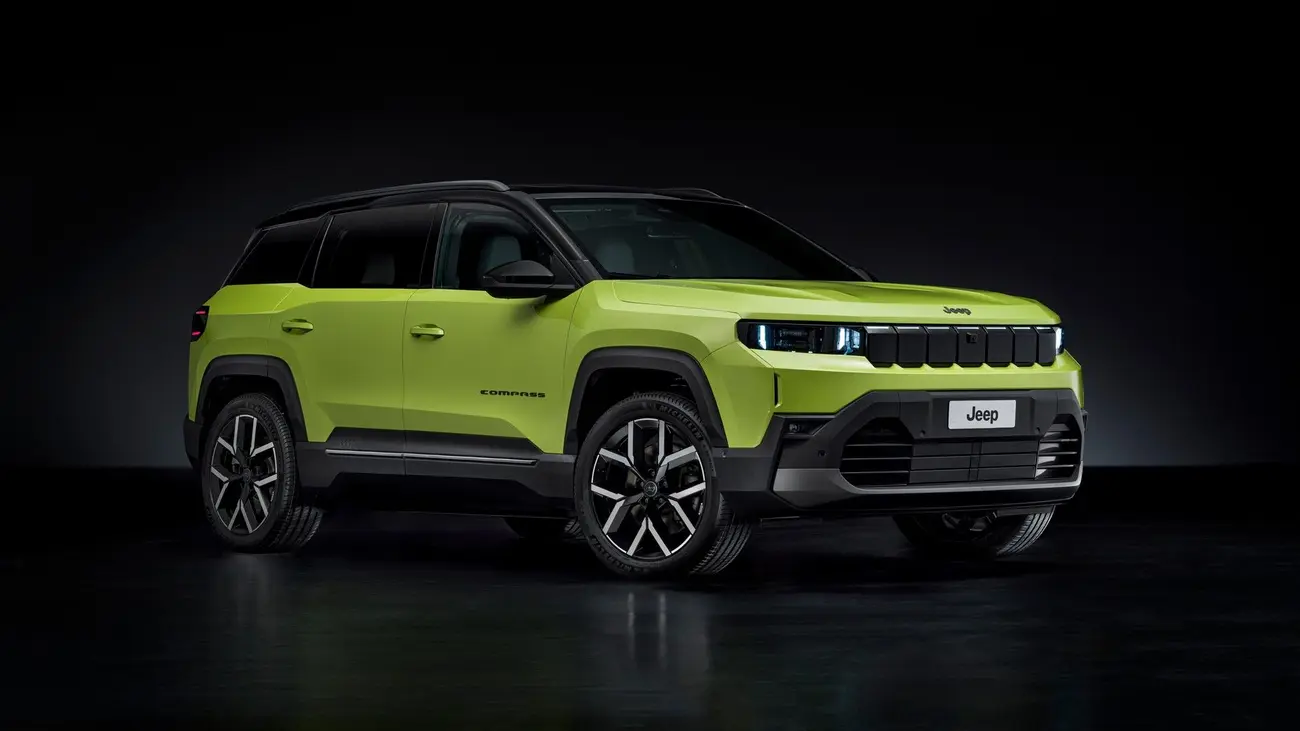
Jeep Compass e: real-world range vs WLTP — the numbers that matter
500 km of WLTP range. That is what Jeep promises for the new Compass e with its 73.7 kWh battery. But the first real-world range test, conducted by ArenaEV at 7°C, tells a different story — and anyone planning long trips in Portugal needs to see these figures.
Around town and on secondary roads, the Compass e impresses. At 60 km/h, the test recorded 676 km of range with a consumption of just 10.9 kWh/100 km. At 90 km/h, it still managed 434 km — above the WLTP claim. The trouble starts at motorway speeds.
Jeep Compass e real consumption: what happens at 130 km/h
At 130 km/h, range drops to 286 km. Consumption climbs to 25.8 kWh/100 km — more than double what it achieved at 60 km/h. That is 43% less than the 500 km WLTP figure. For someone driving Lisbon to the Algarve (roughly 280 km), this means arriving with the battery nearly empty and no margin for detours.
This deficit is not unique to the Compass e — most EVs lose range at high speed. But in a 2,185 kg SUV built on a shared platform (STLA Medium, not an EV-dedicated architecture), aerodynamics work against it. The drag coefficient below 0.30 is a 10% improvement over its predecessor, but it is not enough to match more efficient rivals like the Skoda Enyaq or Tesla Model Y.
What day-to-day range estimates actually look like
EV Database, which calculates real-world range across multiple scenarios, estimates 420 km in mixed driving with mild weather and 315 km in cold conditions. On the motorway in cold weather, the estimate drops to 265 km. These are more realistic numbers for planning trips in Portugal, especially during winter.
| Scenario | Estimated range | Consumption |
|---|---|---|
| City, mild weather | 540 km | 13.6 kWh/100 km |
| Combined, mild weather | 420 km | 17.5 kWh/100 km |
| Motorway, mild weather | 335 km | 22.0 kWh/100 km |
| Combined, cold weather | 315 km | 23.4 kWh/100 km |
| Motorway, cold weather | 265 km | 27.8 kWh/100 km |
For urban and suburban use, the Compass e is more than adequate. Lisbon to Porto (310 km) is doable in mild weather at moderate speeds, but requires a charging stop if you cruise at 120-130 km/h.
Fast charging: 160 kW on paper, 90 kW in practice
The maximum DC charging rate is 160 kW, but the real average between 10% and 80% sits at 90 kW. In practical terms: 36 minutes to recover that battery range. During a 15-minute stop at a fast charger on Portugal's MOBI.E network, you gain enough range for another 136 km in mild weather — or 108 km in the cold.
AC charging comes at 11 kW standard, with an optional 22 kW onboard charger. At home on a 7.4 kW wallbox, expect roughly 10-12 hours for a full charge. Nothing exceptional, but it works for overnight charging.
EV Database gives the Compass e just 2 out of 5 stars for long-distance suitability. The combination of modest real-world motorway range and average fast charging speed limits its open-road credentials.
Jeep Compass electric specs: the essentials
| Specification | Value |
|---|---|
| Battery (useable) | 73.7 kWh (NMC, prismatic, 400V) |
| Power | 157 kW / 213 hp |
| Torque | 345 Nm |
| Drive | Front-wheel drive |
| 0-100 km/h | 8.5 s |
| Top speed | 180 km/h |
| WLTP range | 500 km (TEL) / 467 km (TEH) |
| Max DC charging | 160 kW |
| DC charging 10-80% | 36 min (avg. 90 kW) |
| Length | 4,552 mm |
| Weight | 2,185 kg |
| Boot | 550 litres |
| Ground clearance | 200 mm |
| Wading depth | 470 mm |
With 213 hp and 345 Nm, the Compass e is not sporty, but it has enough punch for daily driving. The 0-100 km/h time of 8.5 seconds is perfectly adequate for a family SUV of this size.
Interior and equipment: practical without pretending to be premium
CAR Magazine describes the interior as "tough and functional," with rubberised surfaces and wipeable materials — designed for families with children, dogs, and outdoor gear. It is not luxurious, but the proposition is honest.
The 16-inch infotainment screen is large, though occasionally sluggish according to reviewers. A configurable 10-inch digital instrument cluster and wireless Apple CarPlay/Android Auto complete the tech package. The 550-litre boot, with an underfloor compartment for cables, is among the most generous in the segment.
Rear passengers get proper legroom — adults can sit behind adults, which not every rival manages. Selec-Terrain comes standard, though the off-road modes are limited on the front-wheel-drive version.
One notable gap: no V2L, V2H, or V2G support. In a market where competitors like the Hyundai Ioniq 5 and even the Cupra Raval offer bidirectional charging, this is a miss.
Jeep Compass e vs Peugeot e-3008: the Stellantis SUV duel
Both share Stellantis DNA but take different approaches. The Peugeot e-3008 bets on a futuristic interior and higher efficiency, while the Compass e plays the ruggedness and off-road capability card.
In real-world range terms, the e-3008 with its 73 kWh battery claims around 527 km WLTP and is reputed to be more efficient at motorway speeds. The Compass e, with similar WLTP numbers, loses ground at higher velocities. For drivers who stick mostly to city and secondary roads, the gap narrows considerably.
Price will be the deciding factor. In Europe, the Compass e starts from €44,995 (Netherlands) to €50,400 (Germany). The e-3008 sits in a similar bracket, but carries stronger brand recognition in the Portuguese market.
How much will the Jeep Compass electric cost in Portugal
There is no official Portuguese price yet. In the Netherlands it starts at €44,995; in Germany at €50,400; in the UK at £36,999 (roughly €43,500). Extrapolating to Portugal, expect a starting price around €45,000-48,000.
As a fully electric vehicle, it benefits from full ISV (vehicle registration tax) and IUC (annual road tax) exemptions in Portugal. For businesses, there is reduced autonomous taxation and potential VAT deduction on leasing. These tax benefits can represent significant savings compared to an equivalent combustion-engine SUV.
Deliveries began in late 2025 in some European markets. In Portugal, availability should align with the first half of 2026.
Future variants worth waiting for
Those who can wait have interesting options ahead: a 98 kWh battery version with roughly 650 km WLTP range, and an all-wheel-drive variant with 375 hp. If real-world motorway range is a concern, the larger battery could solve much of the problem.
Frequently Asked Questions
In the ArenaEV test at 7°C, the Jeep Compass e achieved 286 km of range at 130 km/h, consuming 25.8 kWh/100 km. That is 43% less than the 500 km WLTP figure. At 90 km/h, range rises to 434 km. For long motorway trips in Portugal, such as Lisbon to the Algarve (280 km), planning a charging stop is advisable.
There is no official Portuguese price yet. Based on European pricing — €44,995 in the Netherlands and €50,400 in Germany — expect a starting price around €45,000-48,000. As a fully electric vehicle, it qualifies for full ISV and IUC tax exemptions, and businesses can deduct VAT on leasing, making it significantly cheaper than equivalent combustion-engine SUVs on a total cost basis.
On DC fast charging, the Compass e takes 36 minutes from 10% to 80%, with an average power of 90 kW (160 kW peak). A 15-minute stop at a fast charger on Portugal's MOBI.E network adds roughly 136 km of range in mild weather. At home on a 7.4 kW wallbox with the standard 11 kW AC charger, a full charge takes 10-12 hours.
Both share Stellantis underpinnings and 73 kWh batteries, but the e-3008 claims 527 km WLTP and is reputed to be more efficient at motorway speeds. The Compass e stands out with its off-road capability (200 mm ground clearance, 470 mm wading depth) and a 550-litre boot. Pricing across Europe falls in the €45,000-50,000 range for both. The choice comes down to motorway efficiency (e-3008) versus versatility and ruggedness (Compass e).
In cold conditions, EV Database estimates 315 km of combined range and just 265 km on the motorway. The ArenaEV test, conducted at 7°C, recorded 286 km at 130 km/h. For predominantly urban driving, cold-weather range stays above 400 km. A future 98 kWh battery version with roughly 650 km WLTP range could address this limitation.
Who the Jeep Compass e actually suits
The Compass e is an honest electric SUV with clear strengths in urban and suburban driving. The real-world range of 420 km in mixed mild-weather use is competitive, the 550-litre boot is among the largest in its class, and its off-road capability — even limited on the FWD version — sets it apart from tarmac-only rivals.
But the steep motorway range drop and the average 90 kW fast charging rate make it less suited for frequent long-distance driving. If your daily routine is urban and long trips are occasional, it deserves a closer look. If the motorway is your natural habitat, consider more efficient alternatives — or wait for the 98 kWh version.