
Jeep Avenger Facelift in Portugal: Prices, Range and What Changed
Published: 17/09/2026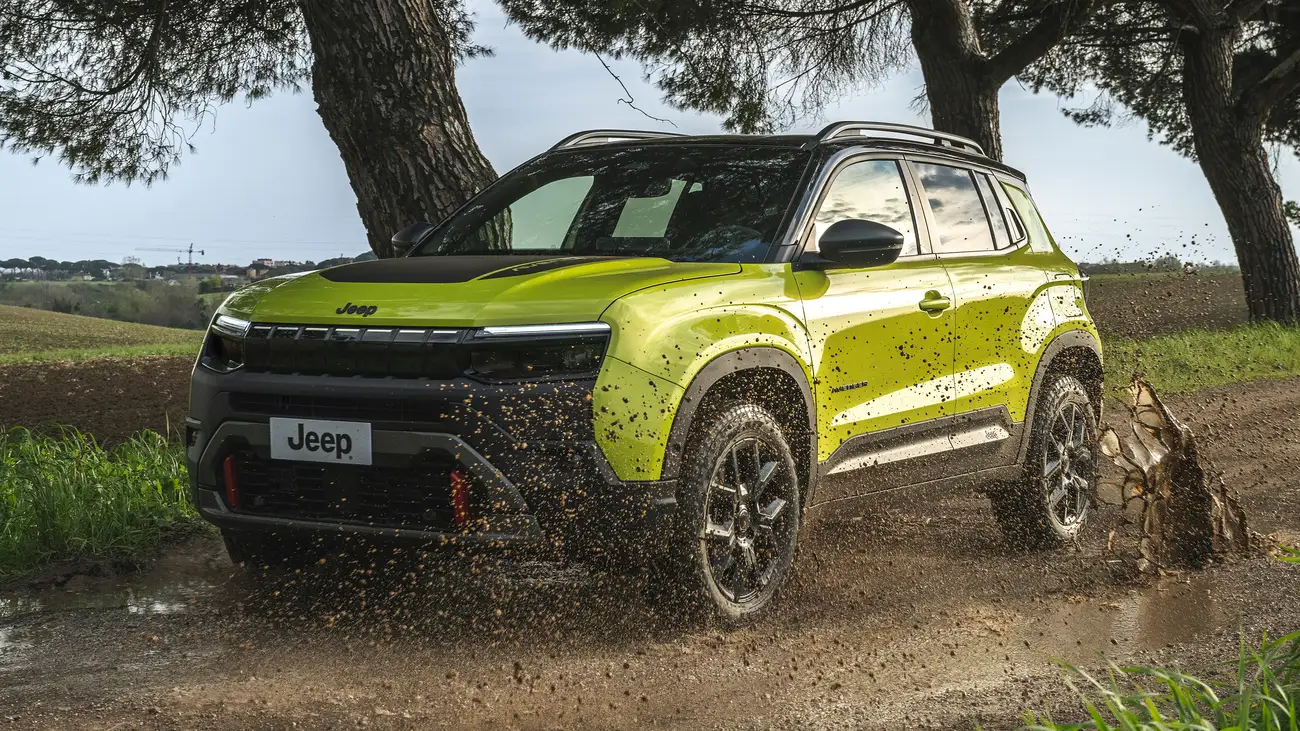
What changed on the facelifted Jeep Avenger
More than 290,000 orders in, Jeep chose not to rewrite the recipe — just tighten it. The refreshed Avenger is now on sale across Europe, first deliveries began in September 2026, and it keeps everything that made it Italy's best-selling SUV: 4.08 metres of length, genuine Jeep attitude and four powertrains to pick from. The changes sit in the details that annoyed owners most.
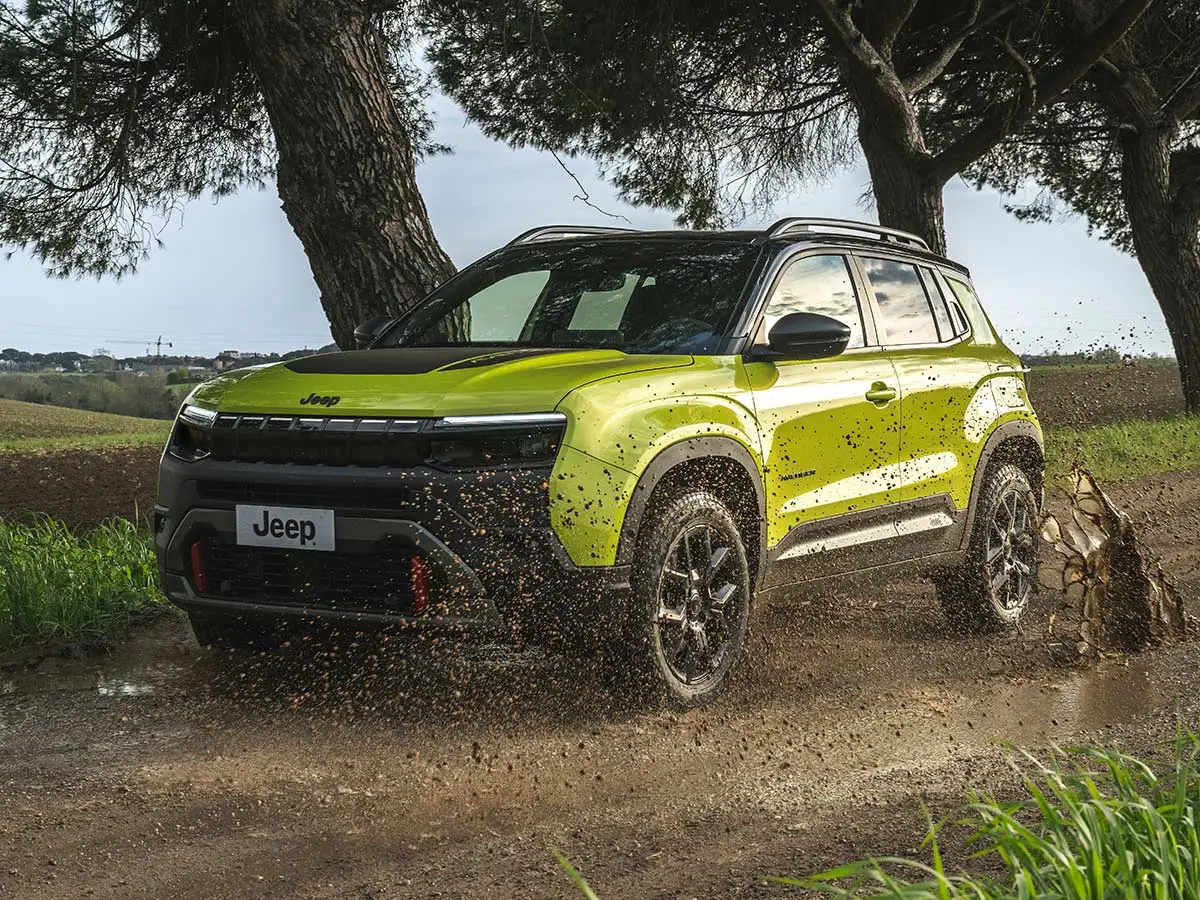
The seven-slot grille now carries LED backlighting, Compass-style, standard on higher trims. There are new bumpers, optional LED Matrix headlights, 17- and 18-inch wheels with Willys MB-inspired centre caps, and two new colours — Forest and Bamboo. Jeep also sharpened the approach, departure and breakover angles to 22°, 35° and 21°, with 200 mm of ground clearance (210 mm on the 4xe).
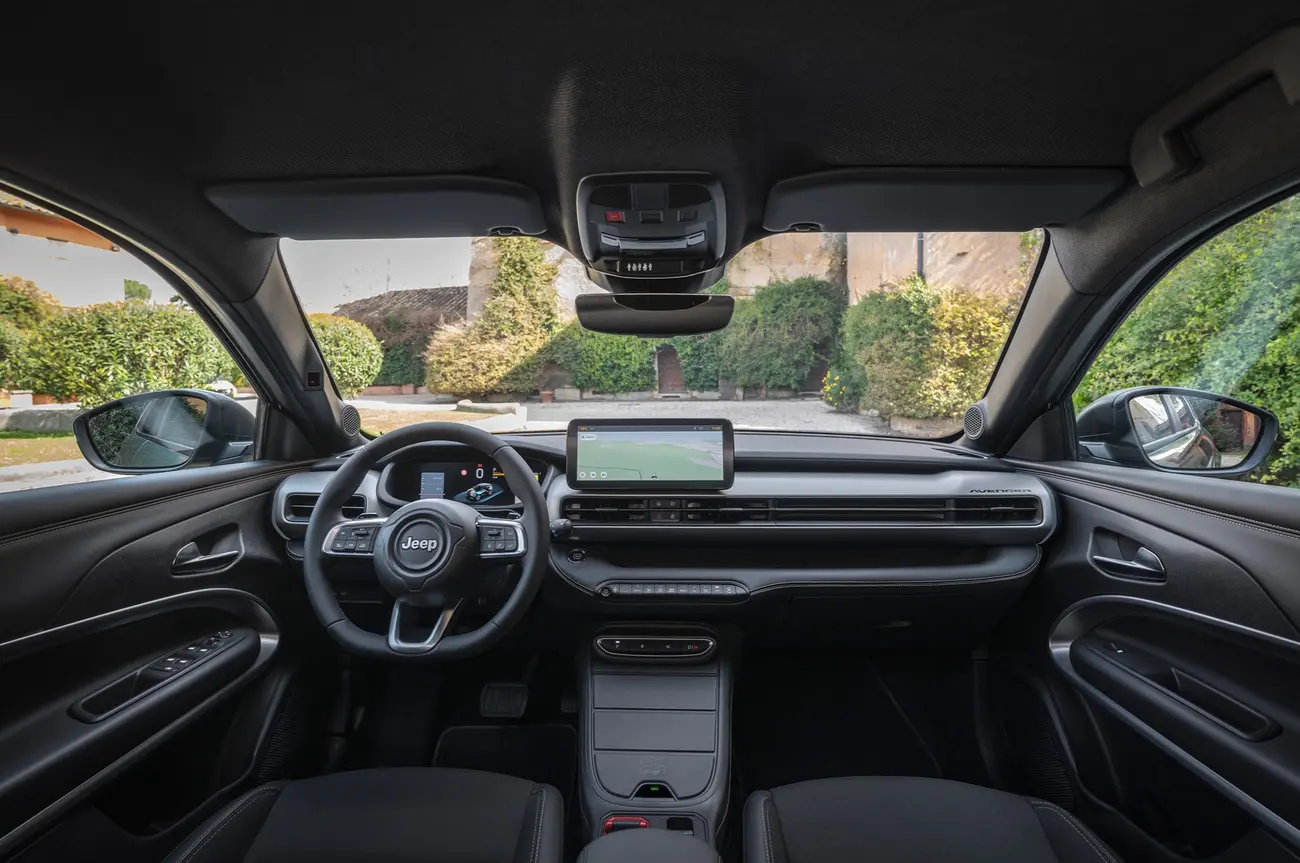
Inside, the most repeated complaint about the old Avenger was hard plastic everywhere. That's been answered with a padded lower dashboard insert, soft-touch door panels and upgraded cloth and vinyl trim on Altitude and Summit. The Selec-Terrain controller gets a red base and rubberised coating, and while the 10.25-inch touchscreen carries over, it now adds a 360-degree camera, ChatGPT integration and — on the electric version — navigation with charging-stop planning.
Jeep Avenger 2026: trims and prices across the range
The range splits into four powertrains, with a trim structure that shifts depending on the mechanicals: Longitude, Altitude, 85th Anniversary and Summit on petrol and hybrid; Upland, 85th Anniversary and Overland on the 4xe; Summit, Skyview and 85th Anniversary on the electric.
| Version | Power | Torque | Gearbox | Starting price (Italy) |
|---|---|---|---|---|
| Turbo 100 (1.2, 3-cylinder) | 101 hp / 74 kW | 205 Nm | 6-speed manual | €25,700 |
| e-Hybrid 48 V | 110 hp / 81 kW | 205 Nm | 6-speed DCT | €27,700 |
| 4xe (all-wheel drive) | 145 hp / 107 kW | up to 1,900 Nm at the wheels | Electrified automatic | €32,700 |
| Electric | 156 hp / 115 kW | 260 Nm | Single-speed | €39,400 |
Within the e-Hybrid line-up, Italian prices climb predictably: €27,700 for Longitude, €29,700 for Altitude and €31,700 for both the 85th Anniversary and the Summit. That anniversary edition — marking 85 years of the brand — builds on Altitude (or Upland on the 4xe) and adds gold accents on the bumpers and 18-inch wheels, an illuminated grille as standard, tartan decals, and upholstery with gold stitching and "85" logos on the seat backs.
What the facelifted Jeep Avenger should cost in Portugal
Time for some honesty: Jeep has not yet published Portuguese pricing for the facelifted Avenger. The figures above are the Italian list, and they work as a reference point — not as a Portuguese sticker price.
The clearest evidence of how much that price can move is Europe itself. The electric version sells for £28,499 in the UK, €34,995 in the Netherlands and €38,500 in Germany. Same car, same factory, thousands of euros apart — and the explanation is entirely national taxation.
For Portugal, two factors work in favour of the electrified versions. Pure EVs remain exempt from ISV (the one-off Portuguese vehicle tax charged on engine capacity and CO2) and pay a reduced IUC road tax. That pulls the electric Avenger closer to the combustion versions than it would be in most other markets. The Turbo 100 and e-Hybrid, meanwhile, pay ISV in full, so the gap between the Italian list and the eventual Portuguese price is likely to be wider on those. In practice: expect the electric Avenger to land here in a relatively stronger position against the 1.2 petrol than the €25,700-versus-€39,400 Italian spread suggests.
Jeep Avenger Electric: real-world range and charging
The 115 kW (156 hp) motor and its 260 Nm draw on a 54 kWh gross battery, of which 50.8 kWh are usable. WLTP homologation stands at up to 400 km — EV Database breaks that down as 404 km in TEL form and 385 km in TEH.
The number that matters is a different one. In real use, EV Database estimates 310 km, at 164 Wh/km. And that average hides an enormous spread depending on how you drive:
- City, mild weather: 465 km
- City, cold weather: 305 km
- Combined, mild weather: 355 km
- Motorway, cold weather: 215 km
If you mostly drive around Lisbon or Porto, in a climate that's mild for most of the year, this is a charge-once-a-week car. If you run Lisbon-Porto regularly, it's a different conversation: 215 to 280 km at motorway speeds means one mandatory stop each way.
Fast charging is where the Avenger's technical base shows its age. The e-CMP platform is a 400 V architecture that wasn't designed exclusively for EVs, and the 100 kW DC peak (107 kW measured, 79 kW average) handles 10-80% in roughly 28 minutes. Not quick by 2026 standards, but enough for a coffee stop at a service area. On AC, the three-phase 11 kW onboard charger completes a full charge in 5h30 — well suited to a home wallbox or to Portugal's MOBI.E public network. There's no V2L, no battery preconditioning, and the heat pump is an option worth ticking for what it does to consumption in January.
Battery warranty runs to 8 years or 160,000 km. In its 2024 Euro NCAP assessment, the Avenger scored 79% for adult occupant protection, 70% for children, 59% for vulnerable road users and 53% for safety assist.
Turbo 100: the new 1.2 fixes the belt problem
The most significant mechanical change in this facelift is one you never see. The new 1.2 three-cylinder — 1,199 cc, 101 hp at 5,500 rpm and 205 Nm from 1,750 rpm — drops the old PureTech's wet timing belt in favour of a timing chain.
Anyone who has followed that engine's reputation knows exactly why this matters. Beyond the chain, the unit gets a new block, new pistons and rings, high-pressure direct injection, a variable-geometry turbo and optimised valve timing. Service intervals stretch to 2 years or 25,000 km, up from 1 year or 20,000 km, though an annual interim check remains.
The e-Hybrid takes the same 1.2, adds a 48 V system with a 0.9 kWh battery and an electric motor built into the six-speed dual-clutch gearbox. That's 110 hp, with about 1 km of electric-only running below 30 km/h — genuinely useful in stop-start traffic and car parks, not much beyond that.
The 4xe is the version that earns the Jeep badge
At 145 hp combined, the 4xe is the only one in the line-up that lives up to the logo. The formula: the 1.2 turbo up front, a 21 kW motor integrated into the DCT, and a second, independent 21 kW motor on the rear axle. That yields up to 1,900 Nm at the wheels, all-wheel drive with no mechanical link between axles, and the Selec-Terrain dial to match the mode to the surface.
The off-road figures are credible for a B-segment SUV: 40% climbs on loose gravel and maintained traction on 20% muddy slopes, with 210 mm of ground clearance. It's no Wrangler, but the dirt track up to the family house in Trás-os-Montes holds no drama.
Jeep Avenger vs Peugeot e-2008 and Opel Mokka Electric
The electric Avenger shares its platform, 54 kWh battery and 156 hp motor with half a dozen Stellantis cousins. WLTP range is effectively identical across all of them, so the decision comes down to other things.
| Model | Battery | Power | WLTP range | Boot |
|---|---|---|---|---|
| Jeep Avenger Electric | 54 kWh | 156 hp | up to 400 km | 355–380 L |
| Peugeot e-2008 | 54 kWh | 156 hp | ~400 km | 434 L |
| Opel Mokka Electric | 54 kWh | 156 hp | ~400 km | 310 L |
If load space decides it, the e-2008 wins comfortably. If attitude and genuine off-road ability decide it — and the Avenger is the only one in the family offered with all-wheel drive — the answer flips. The Mokka trails on both counts. Outside Stellantis, the direct rivals are the Ford Puma Gen-E and the Renault 4 E-Tech, the latter with a notably roomier cabin.
Two practical notes worth keeping. At 4,084 mm long, 1,776 mm wide and with a 10.5 m turning circle, the Avenger is one of the few electric SUVs that fits into central Lisbon underground car parks without a fight. And it weighs 1,595 kg unladen — light for an EV, which you feel in how it changes direction.
Frequently Asked Questions
Jeep has not yet confirmed Portuguese list prices for the facelifted Avenger, so figures can only be estimated from the Italian price list: 25,700 euros for the Turbo 100, 27,700 euros for the e-Hybrid, 32,700 euros for the 4xe and 39,400 euros for the full-electric version. Portuguese prices usually land above those numbers because ISV and local taxation apply differently. The European spread proves how much tax moves the sticker: the electric version costs 28,499 pounds in the UK, 34,995 euros in the Netherlands and 38,500 euros in Germany for exactly the same car.
Official figures quote up to 400 km WLTP (404 km for the most efficient version, 385 km for the best-equipped one) from a 54 kWh gross, 50.8 kWh usable battery. In practice, EV Database estimates around 310 km in mixed use, ranging from roughly 465 km in mild-weather city driving down to just 215 km on the motorway in cold conditions. For typical Portuguese use, mixing city trips with the occasional motorway run, expect a realistic 300 to 330 km between charges.
On DC fast charging the Avenger accepts up to an official 100 kW (EV Database measured a 107 kW peak and a 79 kW average) and goes from 10% to 80% in about 28 minutes on a CCS connector. On AC, the 11 kW three-phase onboard charger fills the battery in roughly 5 hours 30 minutes, which suits overnight wallbox charging at home. There is no V2L function, and the heat pump that helps protect winter range remains an option rather than standard equipment.
Yes. The new 1.2-litre three-cylinder, 1,199 cc unit with 101 hp at 5,500 rpm and 205 Nm from 1,750 rpm switches to a timing chain instead of the wet belt that caused so many complaints on earlier PureTech engines. Stellantis has also stretched service intervals to 2 years or 25,000 km, up from 1 year or 20,000 km. For high-mileage drivers who prefer petrol, it is the most meaningful mechanical change in the whole facelift.
European orders opened in May 2026 and first deliveries are scheduled for September 2026, with production at the Stellantis plant in Tychy, Poland. The Avenger has now passed 290,000 cumulative European orders, with around 60% of sales going to electrified versions. One common source of confusion is worth clearing up: the Avenger sold in Brazil is a different car, with a 1.0 T200 engine and local production, and has nothing to do with this European line-up.
When it arrives in Portugal
European deliveries started in September 2026, and production stays at Tychy in Poland. What's missing is the Portuguese price list, and that's the piece that decides whether the facelifted Avenger is a good buy here or simply a competent update to a car that was already selling well.
If you want a small electric SUV for mostly urban use, with the occasional trip off the tarmac, this remains one of very few with real credentials. If you cover serious motorway mileage, the 215 km winter figure and the 28-minute charge deserve a second look before you sign.