
Hyundai Ioniq 6 N in Portugal: Price, 650 hp Specs and Charging Times
Published: 05/09/2026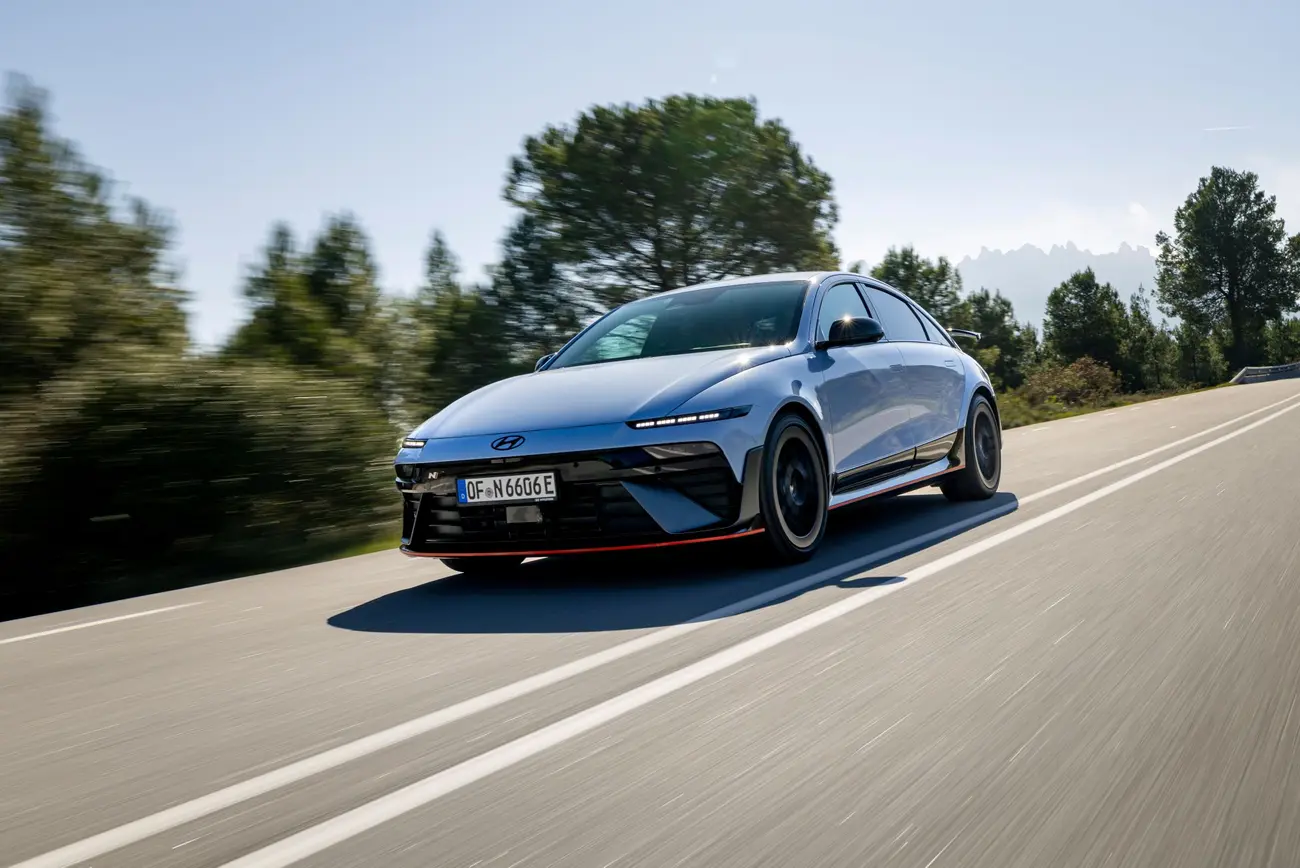
650 hp for €79,000: the Ioniq 6 N is the fastest saloon Hyundai has ever sold
France had given up on the Ioniq 6. Fewer than 1,600 units sold in four years, an eco-score too low to qualify for French purchase incentives and styling that split opinion pushed Hyundai to pull it from the catalogue in summer 2025. In August 2026 the saloon came back — in one version only: the N, with 650 hp and a €79,000 price tag.
This is not a cautious return. It is Hyundai accepting that if the Ioniq 6 will not sell as a long-range family saloon, it can sell as a sports car instead. The numbers back the decision: 3.4 seconds from 0 to 100 km/h, a 257 km/h top speed and 487 km of WLTP range, in a car costing less than half a Porsche Taycan GTS.
Hyundai Ioniq 6 N price: confirmed in France, Germany and the UK
Three European markets have published official figures, and together they give a fairly tight band:
| Market | Price | Launch |
|---|---|---|
| Germany | €75,900 | March 2026 |
| France | €79,000 | August 2026 |
| United Kingdom | £65,800 OTR | order books open since January 2026 |
It is the same car in all three: a single trim, no equipment grades, with customisation limited to paint and the tilt-and-slide roof. In France the Ioniq 6 N costs exactly the same as the Ioniq 5 N — €79,000 — which turns the choice between the two into a question of body style rather than budget.
Ioniq 6 N price in Portugal: still unconfirmed
None of the official sources gives a Portuguese price. A figure of €81,500 has appeared in the national press, but the brand has not confirmed it, and Hyundai Portugal usually positions itself inside the Iberian and central-European band. A realistic range is €76,000 to €82,000.
One thing works firmly in the Portuguese buyer's favour. As a fully electric car, the Ioniq 6 N is exempt from ISV — the one-off vehicle tax charged on registration, calculated from engine capacity and CO2 emissions — and pays a reduced IUC, the annual road tax. On a 650 hp car, that exemption is worth many thousands of euros. A combustion equivalent with this output would be effectively unsellable here once ISV was applied.
Specs: 609 hp as standard, 650 hp for ten seconds
Two permanent-magnet synchronous motors, all-wheel drive and an 800-volt architecture — the same E-GMP hardware that underpins the Ioniq 5 N.
| Specification | Value |
|---|---|
| Battery | 84 kWh, 800 V |
| Power (standard) | 448 kW / 609 hp |
| Power (N Grin Boost) | 478 kW / 650 hp (10 seconds) |
| Torque | 740 Nm / 770 Nm with NGB |
| 0-100 km/h | 3.4 s (3.2 s with N Launch Control) |
| Top speed | 257 km/h |
| WLTP range | 487 km |
| Consumption | 18.7 kWh/100 km |
| Kerb weight | 2,201 kg (UK) / 2,241 kg (FR) |
| Boot | 371 litres |
| Length | 4,935 mm |
| Wheelbase | 2,965 mm |
The gap between 609 hp and 650 hp matters. The higher figure only exists with N Grin Boost engaged and lasts ten seconds — enough for an overtake or a straight on track, not for everyday driving. The rest of the time you have 609 hp and 740 Nm, which is still more than almost any driver will ever deploy on a public road.
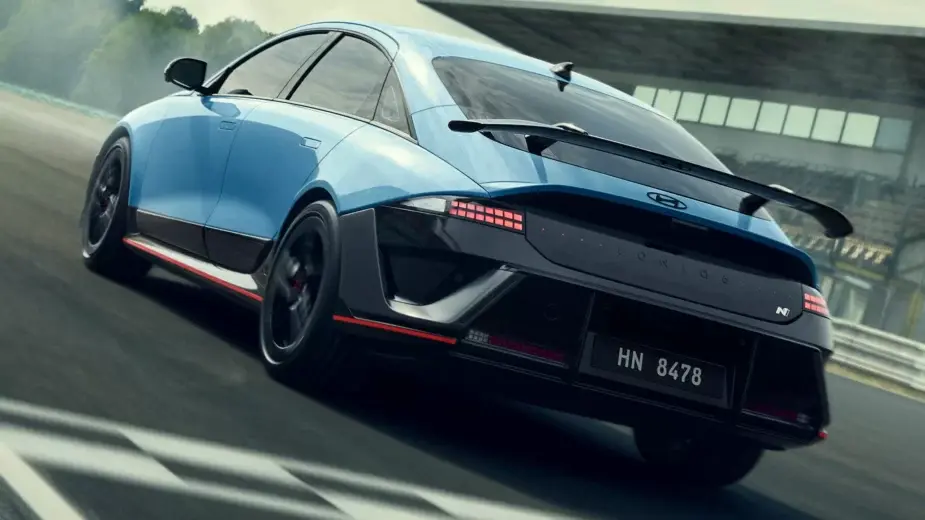
The hardware is not window dressing either: wider tracks than the standard Ioniq 6, stroke-sensing ECS adaptive dampers, an electronic limited-slip differential, ventilated 400 mm front discs with four-piston monobloc calipers in orange, 360 mm discs at the rear, and Pirelli P Zero 275/35 R20 tyres at all four corners.
Range and charging: 487 km WLTP, 18 minutes to 80%
487 km of WLTP range from a 650 hp car is an honest figure. On the motorway at legal speeds, expect a real 350 to 400 km — enough for Lisbon to Porto without a mandatory stop, provided you leave home with a full battery. Drive it enthusiastically and that number falls fast, as it does with any performance car, electric or otherwise.
Charging is where the Ioniq 6 N pulls clear of its rivals. The 800 V architecture allows 10-80% in 18 minutes on a 350 kW charger. On a 50 kW unit — still common across the MOBI.E public network away from the main motorway corridors — 0-80% takes 1h10. At home, the 10.5 kW three-phase on-board charger covers 0-100% in 7h35.
Battery pre-conditioning is standard (essential if you plan on track days), as is V2L, which lets you draw mains power from the car for tools or camping gear, inside and out.
Ioniq 6 N vs Tesla Model 3 Performance: a €21,510 gap
This is the inevitable comparison, and the uncomfortable one for Hyundai. In France the Model 3 Performance costs €57,490 — €21,510 less.
| Hyundai Ioniq 6 N | Tesla Model 3 Performance | |
|---|---|---|
| Power | 650 hp (with NGB) | 510 hp |
| Battery | 84 kWh | 78 kWh |
| Price (France) | €79,000 | €57,490 |
| 10-80% charge | 18 minutes | just under 30 minutes |
| Tyres | 275/35 R20 all round | 20 inch, narrower at the rear |
The Tesla is cheaper, quicker to 100 km/h and comes with its own charging network. The Hyundai answers with bigger brakes, wider rubber at every corner, a limited-slip differential, adaptive dampers and a software package — N e-Shift with a simulated eight-speed gearbox, N Drift Optimizer, N Torque Distribution across 11 levels, N Track Manager telemetry — that Tesla does not attempt to match.
Put bluntly: if you want the fastest EV per euro spent, the Tesla wins. If you want a car that will survive an afternoon at Estoril or Portimão without dropping into thermal protection, the Ioniq 6 N is the easier one to justify.
Ioniq 6 N vs Ioniq 5 N: same price, different characters
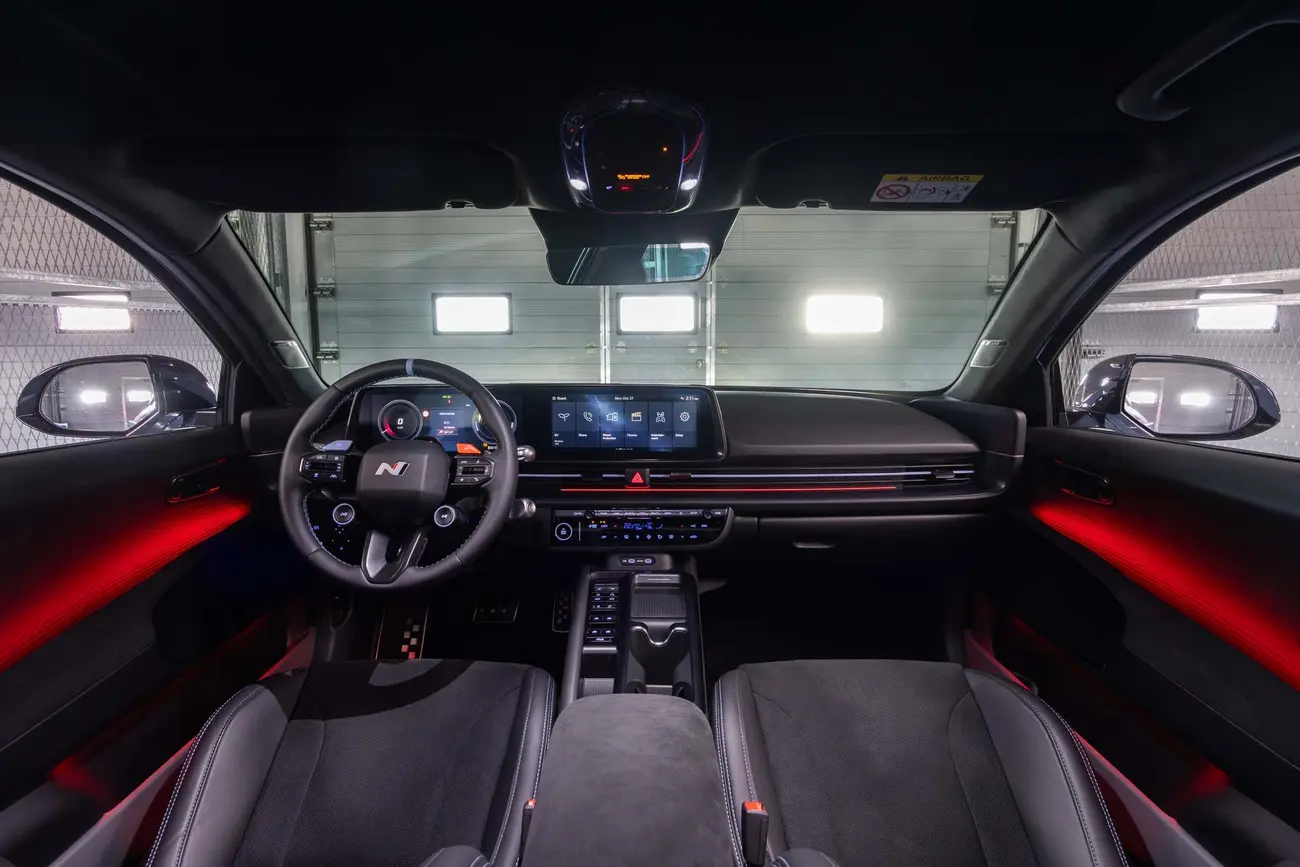
They share motors, battery and virtually all of the N software, and in France they cost exactly the same. What separates them is suspension geometry, aerodynamics and body: the 5 N is a tall, playful crossover, the 6 N a low saloon (1,495 mm high) stretching 4.94 metres with a more favourable centre of gravity.
In practice the 6 N should be the more effective car at high speed and the more comfortable one on a long run, while the 5 N is more versatile for space and easier to park. The saloon's 371-litre boot is not generous for its exterior size — that is the cost of the tapering roofline.
Frequently Asked Questions
Hyundai has not yet announced an official Portuguese price for the Ioniq 6 N, so the useful reference is what neighbouring markets have already confirmed: 79,000 euros in France, 75,900 euros in Germany and 65,800 pounds in the UK. Because it is sold as a single trim with the same equipment across Europe, a Portuguese price within that band is the reasonable expectation. As a fully electric car it is exempt from ISV registration tax, which helps keep it close to the French and German figures.
European WLTP homologation gives 487 km from the 84 kWh battery, at an average 18.7 kWh/100 km. On a motorway at legal speeds you should plan for meaningfully less than 487 km, especially with enthusiastic driving and the 275/35 R20 Pirelli P Zero tyres. The 800 V architecture takes it from 10 to 80% in 18 minutes on a 350 kW charger; on a 50 kW unit that becomes roughly 1h10 to 80%, and a full charge on a three-phase 10.5 kW AC supply takes 7h35.
Both, depending on the mode. In normal use the two synchronous motors deliver 448 kW, or 609 hp, and 740 Nm; engage N Grin Boost and output rises to 478 kW (650 hp) and 770 Nm for ten seconds. Be careful with US coverage: the American market quotes 641 hp and 291 miles of EPA range, figures that do not match the European homologation.
It depends what you want from the car. In France the Ioniq 6 N costs 79,000 euros against 57,490 euros for the Tesla Model 3 Performance, a gap of 21,510 euros, and the Tesla already offers 510 hp from a 78 kWh battery. What the extra buys is track hardware the Tesla does not have: ECS adaptive dampers, an e-LSD limited-slip differential, 400 mm front discs with four-piston monobloc calipers, and 350 kW charging that covers 10-80% in 18 minutes versus just under 30 minutes for the Model 3 Performance.
Fully electric cars are exempt from ISV registration tax and from the annual IUC road tax, unlike an equivalent petrol performance saloon where ISV alone can run to several thousand euros. The 23% VAT is already included in the announced European prices. For company use, check the autonomous taxation treatment with your dealer, since vehicles above 60,000 euros fall under their own rules.
What still needs confirming before you order
Standard equipment leaves little to add: heat pump, 360-degree camera, augmented-reality head-up display, seven-speaker BOSE audio with subwoofer, heated and ventilated front seats, panoramic roof, Level 2 assisted driving, and a five-year unlimited-mileage warranty with eight years or 160,000 km on the battery. Beyond paint, there is almost nothing left to pay extra for.
What remains open is the Portuguese price and the exact date the car reaches national dealers. With Germany served in March and France in August 2026, Portugal should follow shortly. If you are shopping for a performance EV at this level, it is worth asking for a quote before signing for anything else — the difference between €75,900 and €81,500 is far too wide to assume.