
Honda Super-N Electric: Under 23,000€ Price, 206 km Range and Full Specs
Published: 13/04/2026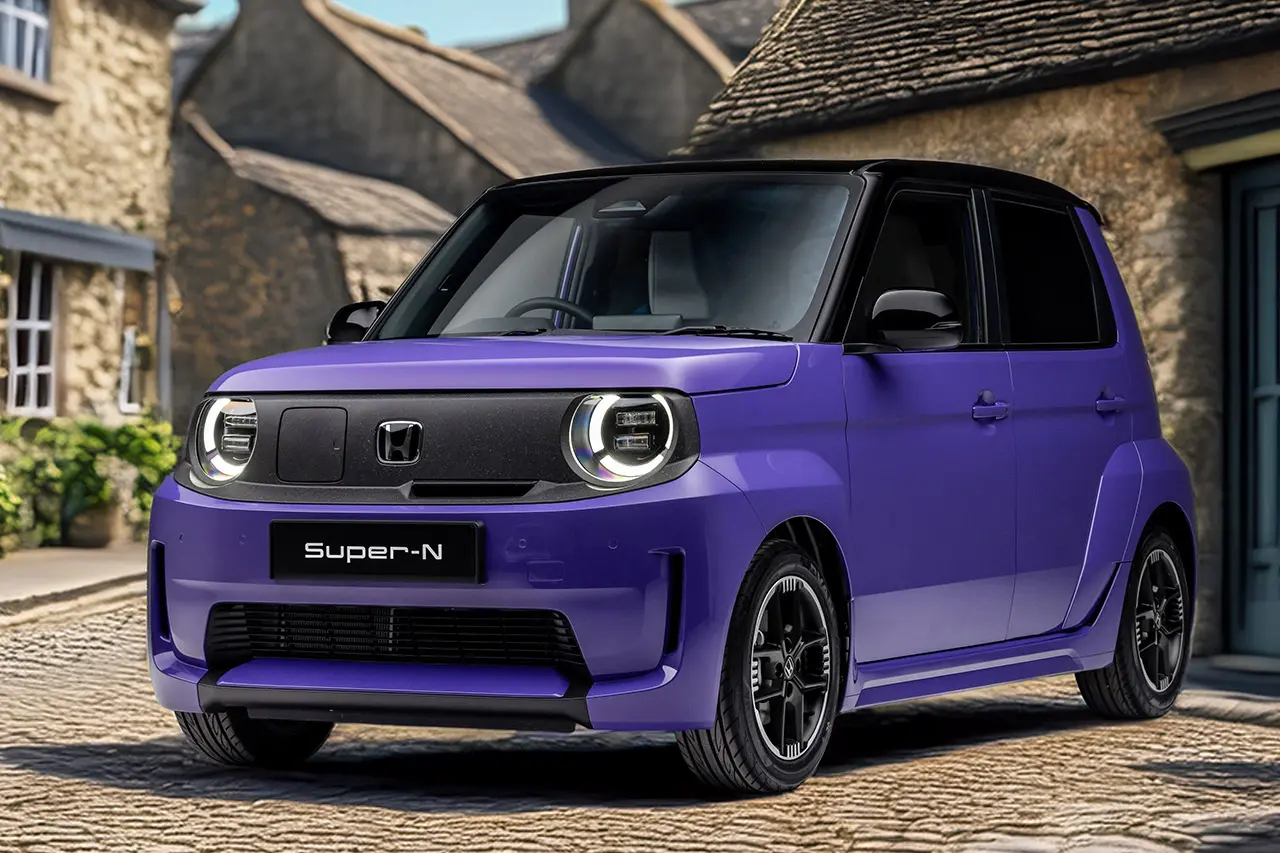
Honda Super-N: the pocket-sized EV hot hatch coming to Europe for under €23,000
63 horsepower in normal mode, 93 in Boost Mode, styling inspired by the legendary Honda City Turbo II, and a price tag under €23,000. The Honda Super-N is Honda's answer to the affordable EV segment — a Japanese kei car reimagined for European roads, launching in July 2026.
After the commercial failure of the Honda E (discontinued at around £37,000), Honda needed a radically different approach. Rebecca Adamson, Honda's UK head, put it plainly: "the affordability of this car" is what matters. The numbers suggest she's right.
Honda Super-N specs and range: what we know so far
The Super-N is built on the Japanese N-One E platform (renamed in the UK due to trademark issues with the SuperOne Kart Racing Championship). It's genuinely small — between 3,395 mm and 3,590 mm long depending on the version and European-spec bumpers. For reference, that's shorter than a Dacia Spring.
| Specification | Value |
|---|---|
| Length | 3,395–3,590 mm |
| Wheelbase | 2,500 mm |
| Weight | ~1,100–1,300 kg |
| Seats / Doors | 4 / 5 |
| Drivetrain | Front-wheel drive |
| Power (standard) | 63 hp (47 kW) |
| Power (Boost Mode) | 93–95 hp (70 kW) |
| Battery | ~30 kWh |
| Max DC charging | 50 kW |
| Combined WLTP range | 206 km (128 miles) |
| Urban range | 320 km (199 miles) |
| Simulated gearbox | 7-speed |
| Touchscreen | 9 inches |
| Estimated price | < €23,000 |
| UK launch | July 2026 |
Boost Mode: simulated gearbox and artificial engine sound
Boost Mode is the Super-N's emotional trump card. Press the button and power climbs from 63 to 93 hp. The Active Sound Control system kicks in — simulating gear shifts through a 7-speed gearbox and pumping engine sounds through the speakers. The ambient lighting shifts from blue to purple. Think Hyundai Ioniq 5 N philosophy, but in pocket format.
It won't pin you to your seat, but in a car weighing around 1,100–1,300 kg, 93 hp is enough to put a smile on your face at roundabouts and traffic lights.
Honda Super-N real-world range: fine for the city, short for road trips
206 km of combined WLTP range. Let's be honest: that won't get you from Lisbon to Porto without stopping. But the Super-N wasn't designed for that.
In the city, it's a different story. Up to 320 km of urban range covers a full week of commuting for most Portuguese drivers. The estimated mixed efficiency sits at roughly 14.5 kWh/100 km — less efficient than the Renault Twingo E-Tech, which achieves a tighter consumption figure. That's the trade-off for the boxy design and less aerodynamic shape.
DC charging tops out at 50 kW. At a fast charger on Portugal's MOBI.E network (the national EV charging infrastructure), a 10% to 80% charge should take around 30 minutes. Not spectacular, but for a city car with a 30 kWh battery, it gets the job done.
Retro design and practical interior: kei car charm meets European roads
The Super-N is a love-it-or-ignore-it car — there's no middle ground. Muscular wheel arches, aggressive bumpers, and a face full of character that echoes the 1980s Honda City Turbo II. In a sea of generic SUVs, it stands out by being unapologetically different.
Inside, the "Magic Seats" let you fold the rear bench with one hand, freeing up cargo space in a car where every centimetre matters. The 9-inch central touchscreen handles infotainment, with physical buttons for heated seats and air conditioning — a sensible choice that too many brands have abandoned.
The suspension has been retuned for European roads: stiffer and more responsive than the Japanese version. Honda took this seriously — the European setup is noticeably sportier than the N-One E sold in Japan.
Honda Super-N vs competitors: where it fits in the European market
The affordable compact EV segment is getting crowded in 2026. Here's how the Super-N stacks up:
| Model | Estimated price | WLTP range | Power |
|---|---|---|---|
| Honda Super-N | < €23,000 | 206 km | 63–93 hp |
| Renault Twingo E-Tech | ~€20,000–25,000 | ~200–300 km | ~95 hp |
| Dacia Spring | ~€17,000–22,000 | ~225 km | 65 hp |
| Hyundai Inster | ~€23,000–25,000 | ~300 km | 97–115 hp |
| BYD Dolphin Surf | ~€23,000–26,000 | ~300 km | 130 hp |
The Super-N's price is competitive, but its 206 km range trails nearly every rival. The argument in its favour? Character. No competitor offers the same combination of retro design, Boost Mode with simulated engine sounds, and Honda's reliability reputation.
The Dacia Spring is cheaper but less engaging. The Hyundai Inster offers more range and space. The Renault Twingo is more efficient. But none has the Super-N's personality.
Honda Super-N price Portugal: when it arrives and what it might cost
Here's the tricky part. The July 2026 launch is confirmed for the UK only. Some sources mention "mainland Europe" as a target market, but without concrete dates. Carscoops references "UK and mainland Europe," while other publications are more cautious.
If the Super-N reaches Portugal, the estimated price should sit around €23,000 or less. Portuguese buyers benefit from ISV exemption (the vehicle registration tax doesn't apply to fully electric cars) and IUC exemption (no annual road tax). For businesses, reduced autonomous taxation on electric company cars adds further savings.
Is it worth waiting for? If 206 km of range covers your daily needs and the retro design wins you over, yes. If you need more kilometres between charges, models like the Cupra Raval or Hyundai Inster are a better fit.
Frequently Asked Questions
The Honda Super-N is expected to cost under 23,000 euros in Europe, based on its UK reference price of under 20,000 pounds. In Portugal, buyers benefit from ISV exemption (no vehicle registration tax) and IUC exemption (no annual road tax) for fully electric cars, which could make the total cost even more competitive against rivals like the Dacia Spring or Hyundai Inster. Official Portuguese pricing has not yet been confirmed.
The launch is confirmed for the UK in July 2026. Some sources, including Carscoops, mention mainland Europe as a target market, but no concrete dates exist for Portugal yet. If Honda follows its usual rollout pattern, availability in continental Europe could come between late 2026 and early 2027.
The Honda Super-N offers up to 320 km of urban range under the WLTP cycle, enough to cover a full week of daily commuting for most Portuguese drivers. In combined driving (city and highway), range drops to 206 km. The approximately 30 kWh battery supports DC charging from 10% to 80% in around 30 minutes at a 50 kW fast charger on Portugal's MOBI.E network.
The Dacia Spring is cheaper (starting from around 17,000 euros) but offers less character and a more basic interior. The Renault Twingo E-Tech is more efficient and may offer greater range, but its final pricing is not yet confirmed. The Super-N stands out with its retro design inspired by the Honda City Turbo II, a Boost Mode delivering 93 hp with simulated engine sounds, and Honda's reliability reputation — advantages none of the rivals directly match.
Boost Mode is activated by a button and increases motor output from 63 to 93 hp (47 to 70 kW). Simultaneously, the Active Sound Control system simulates gear shifts through a 7-speed gearbox and plays engine sounds through the speakers. The interior ambient lighting shifts from blue to purple. It follows a similar philosophy to the Hyundai Ioniq 5 N, but adapted to a compact, lightweight city car.
A Honda that makes sense — if it gets here
The Super-N proves Honda learned from the Honda E's mistakes. Instead of a pretty EV priced out of reach, this is an affordable, charismatic car sized for European city life. The 30 kWh battery is honest — it doesn't overpromise, and it keeps the price down.
For the Portuguese market, the next step is confirmation of availability and official pricing. With competition intensifying in this segment throughout 2026, anyone shopping for a cheap electric city car has more options than ever — and the Honda Super-N deserves a spot on the shortlist.