
Honda e:Ny1 in Portugal: Is a Discontinued EV With €12,800 Off Worth It?
Published: 20/08/2026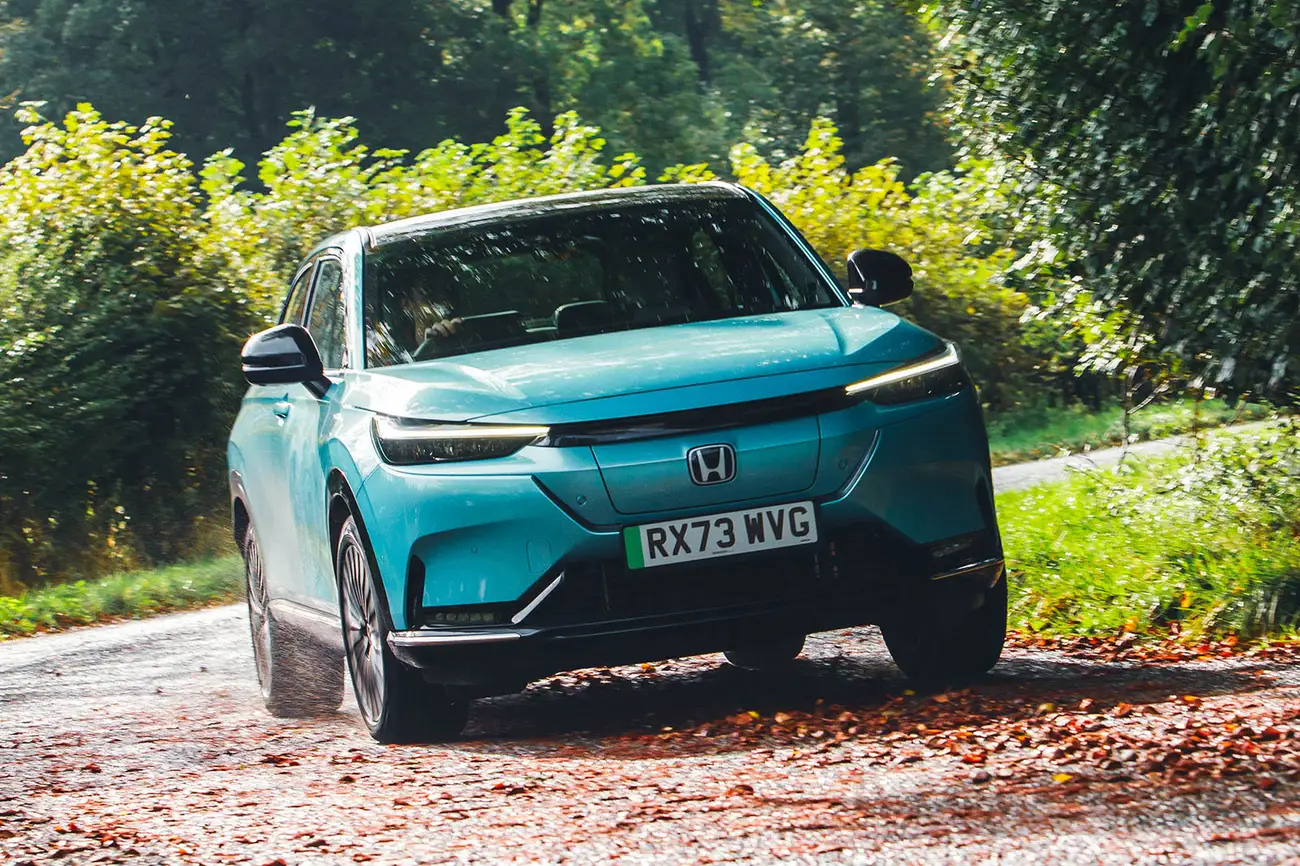
An electric SUV with 28% off — and an expiry date
Knocking €12,800 off a brand-new car is not an ordinary promotion. That is what Honda is doing in France with the e:Ny1: the electric SUV drops from €45,700 to €32,900, valid until 30 September 2026. Twenty-eight per cent, in one move.
Generosity has nothing to do with it. The e:Ny1 is being withdrawn from Europe roughly three years after it arrived. And that is where things get interesting for anyone shopping in Portugal — because the Honda e:Ny1 discount is a French campaign, while the model's end of life is Europe-wide, and that changes the maths for every buyer.
What the campaign actually is, and where it applies
Honda France announced an immediate customer advantage of €12,800, deductible from the purchase price of new vehicles, open to private buyers and businesses, within available stock limits and at participating dealers. It runs until 30 September 2026.
Two things matter here. First, this is a French campaign. None of the sources documents an equivalent offer in Portugal, so anyone interested has to ask a Portuguese dealer directly what the local price is and what stock remains. Second, an almost identical campaign — same €12,800 headline figure — ran between March and June 2024. Honda has been cutting this car's price throughout its commercial life. In Germany the list price fell from €47,590 to €38,990; in the UK there were discounts of £8,750 and £5,000 alongside 0% APR finance.
Why Honda is clearing out the e:Ny1
The car simply did not sell. The German registration figures tell the whole story:
| Year | German registrations |
|---|---|
| 2023 | 266 |
| 2024 | 795 |
| 2025 | 105 |
One hundred and five units in a full year, in Europe's largest car market. By April 2026 the e:Ny1 had vanished from Honda's websites and configurators in the UK, Germany, Italy, Spain and Switzerland, remaining listed only in France and Austria. A Honda UK spokesperson confirmed to EV Powered that the brand would take no new orders once remaining stock was sold, describing in-stock supply as "very limited". What inventory is left is being redirected to the UK and the Nordics, where demand held up better.
Production ended in April 2026. The replacement is the Super-N, a small, cheap hatchback based on the Japanese N-One e, arriving in Europe in July 2026 for under £20,000 (about €23,000), with a 64 bhp motor that boosts to 95 bhp. It is a hard strategic pivot: Honda has abandoned the segment the e:Ny1 competed in and gone downmarket. All of this sits inside a $15.7 billion writedown of the brand's EV business, which also killed the Series 0 project and the Sony-partnered Afeela programme.
Honda e:Ny1 specs, no varnish
It is worth looking at the car for what it is, not for the discount.
| Specification | Value |
|---|---|
| Body | Compact SUV, 5 seats |
| Platform | e:N Architecture F (EV-dedicated) |
| Motor | Vitesco EMR3, front-mounted, front-wheel drive |
| Power / torque | 150 kW (204 hp) / 310 Nm |
| Battery | 68.8 kWh gross / 61.9 kWh usable |
| Architecture | 400 V |
| WLTP range | 412 km |
| Real-world range (EV Database) | around 330 km |
| Max DC charging | 78 kW (10-80% in about 46 min) |
| AC charging | 11 kW three-phase (0-100% in 6h45) |
| Ports | Type 2 / CCS Combo 2 |
| 0-100 km/h | 7.6 s |
| Top speed | 160 km/h |
| Length | 4,387 mm |
| Kerb weight | 1,730 kg |
| Boot | 361 L (Executive) / 344 L (Advance); 1,176 L max |
| Heat pump | No |
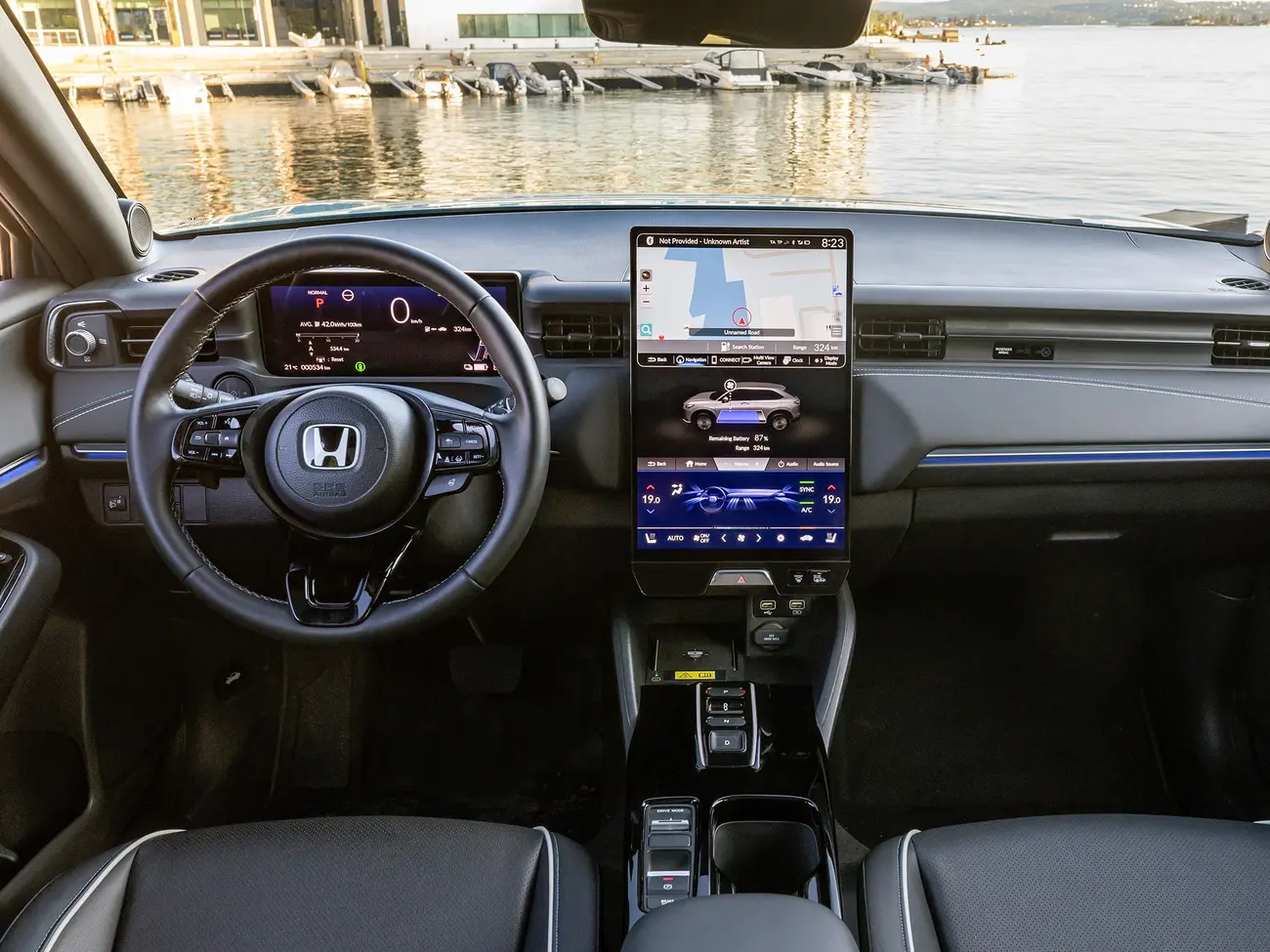
On real-world range: EV Database puts it at around 330 km in mixed use, with 378 km in mild weather and 282 km in cold. Portuguese winters are far gentler than central Europe's, so a realistic combined figure here should sit closer to 350 km than to 282 km. Even so, the missing heat pump bites on cold mornings inland and up north — resistive heating drains the battery fast.
The Achilles heel: 78 kW
The 78 kW DC charging cap is this car's real weakness. On a 150 kW or faster charger, the e:Ny1 goes from 10 to 80% in about 46 minutes, averaging 60 kW. On a 50 kW post, that stretches to 68 minutes. Many current rivals cover the same window in 25 to 30 minutes.
In practice: for daily use around Lisbon, Porto or Braga it hardly matters — you charge at home at 11 kW and wake up full. On a Lisbon-Algarve run it means a stop that is a lunch, not a coffee. Frequent motorway drivers should think twice.
There are other gaps. No V2L, V2H or V2G, no Plug and Charge, no frunk, and no homologated towing capacity at all (0 kg braked and unbraked). The 361-litre boot is also modest for a 4.4-metre SUV.
Buying a discontinued electric car: the trade-off
This is the question that matters. An end-of-line model carries a different calculation from any other new car.
In its favour:
- The factory discount front-loads depreciation. On a car bought at list price, the first 25-30% of value loss happens in the first two years and comes out of the owner's pocket. Here, the manufacturer has absorbed that slice before delivery.
- The warranty does not disappear with the model. Honda's official European terms are 3 years or 100,000 km general warranty, an 8-year battery warranty, and up to 10 years on the electric motor, the last conditional on servicing within the official network. There is also an optional 24-month extension with unlimited mileage, plus 24/7 roadside assistance.
- Honda remains present in Portugal with its combustion and hybrid range. The dealer and workshop network is not going anywhere, and it is that same network that handles servicing and warranty claims.
- It is a known quantity. Three years on sale means the faults have surfaced, been documented and been fixed — unlike a model launched two months ago.
Against it:
- Residual value will be weak. A discontinued, low-volume model with no direct successor attracts less used-market demand. Buy with a factory discount and sell in four years, and the gap between what you paid and what you get back can still sting — the used market prices a car off published valuations, not off what you paid.
- Long-term parts availability is an open question. None of the sources found any Honda statement on this specific point. European type-approval rules generally oblige manufacturers to supply parts for years after production ends, but that is not the same as a public commitment from the brand for this model. Worth asking the dealer in writing.
- No updates. An end-of-line car will not get new software versions or hardware improvements.
What depreciation looks like in numbers
Picture two buyers. One pays list price, €45,700, and sells four years later for, say, €20,000: a €25,700 loss. The other pays €32,900 for the same car and sells at the same market value: a €12,900 loss. Same car, same used-market valuation — only the starting point differs. That is exactly why an aggressive discount on a doomed model can make financial sense, provided you go in with the right expectation: this is a car to keep, not to trade in after three years.
How it stacks up against rivals
At the French campaign price, the comparison flatters it:
| Model | Price (FR) | Power | WLTP range |
|---|---|---|---|
| Honda e:Ny1 | €32,900 | 204 hp | 412 km |
| Kia EV3 | €36,490 | 204 hp | 410 km |
| Peugeot E-2008 | €40,300 | 156 hp | 400 km |
The e:Ny1 is the cheapest, matches the EV3 on power and beats both on rated range. What the table does not show is that the Kia charges far faster on DC and has a commercial future ahead of it — which feeds straight into resale value. The choice comes down to this: save a few thousand today, or protect your valuation four years from now?
In Portugal the tax incentives apply regardless. A pure EV remains exempt from ISV (the vehicle registration tax), pays reduced IUC (the annual road tax) and enjoys favourable treatment as a company car — and none of that changes because the model has been discontinued.
Frequently Asked Questions
There is no confirmation that it does. The €12,800 campaign (from €45,700 down to €32,900, running until 30 September 2026) was announced by Honda France, and no source documents an equivalent offer in the Portuguese market. In Portugal, pricing and remaining stock depend on the importer and each individual dealer, so the only way to know is to request a written on-the-road quote. Note that the e:Ny1 has already been pulled from Honda's configurators in the UK, Germany, Italy, Spain and Switzerland.
The official figure is 412 km WLTP, but EV Database estimates around 330 km in mixed real-world use — 378 km in mild weather and 282 km in cold conditions. Because Portuguese winters are far milder than central Europe's, a realistic combined figure sits closer to 350 km. The missing heat pump is the main penalty on cold mornings inland and in the north, since resistive heating draws directly from the battery.
About 46 minutes, even on a 150 kW rapid charger, because the e:Ny1 peaks at just 78 kW on DC (a real-world average of roughly 60 kW). On a 50 kW unit it takes around 68 minutes. At home or at work, 11 kW three-phase AC charging covers 0-100% in 6h45, which is more than enough for daily urban use; the 78 kW ceiling only really hurts on long motorway trips.
Yes — warranty obligations do not end when a model leaves the price list. Honda's official European terms are 3 years or 100,000 km general warranty, 8 years on the battery and up to 10 years on the electric motor, the latter conditional on servicing within the official network, plus an optional 24-month extension and 24/7 roadside assistance. Honda remains active in Portugal with its petrol and hybrid range, so the dealer and workshop network stays in place. Very long-term parts availability is the open question — no source found a specific statement from Honda about this model, so it is worth getting that commitment in writing.
The replacement is the Honda Super-N, a city hatchback derived from the Japanese N-One, due in Europe in July 2026 for under £20,000 (roughly €23,000), with 64 bhp and a 95 bhp boost. It is not a direct successor: Honda has exited the compact electric SUV segment the e:Ny1 competed in and moved down to a much smaller, cheaper car. The shift is part of a wholesale reset of the brand's EV strategy, which included a $15.7 billion writedown and the cancellation of both the Series 0 and Afeela projects.
What to do if you are genuinely interested
Start by calling a Honda dealer in Portugal and confirming three things: whether any national campaign is running, how many units are still in stock, and the final on-the-road price. Then ask in writing for confirmation of the warranty terms applying to that specific car, and of parts and service availability. If the answers hold up and the discount is real, the e:Ny1 is a comfortable, well-equipped electric SUV with 330 km of real range at a price no direct rival can match.
If there is no Portuguese campaign and the price sits near list, the answer is straightforward: no. At that money the Kia EV3 and the Chinese competition do everything better, and they will still exist in five years.