
Google Maps Brings EV Route Planning to Android Auto — 350+ Models Supported
Published: 31/03/2026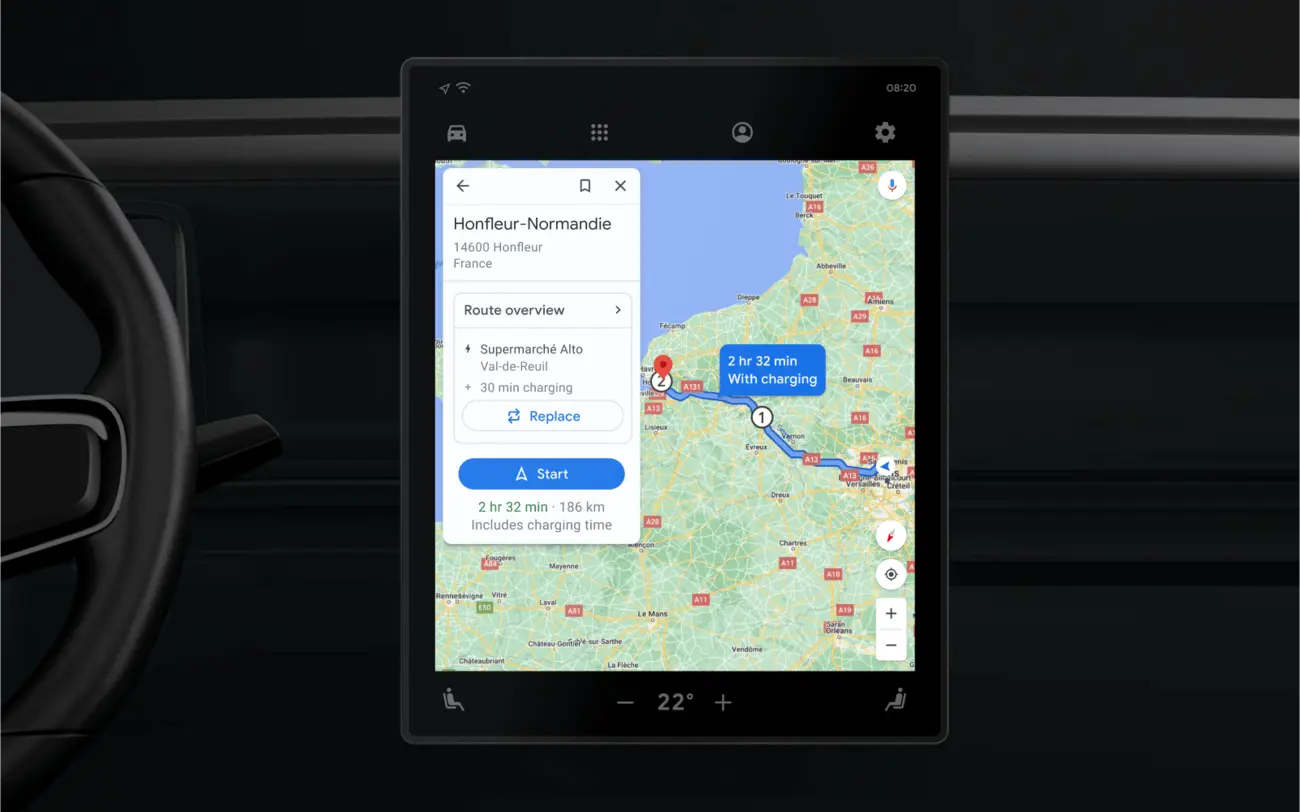
Google Maps brings EV route planning to Android Auto — with 350+ supported models
Planning a long trip in an electric car in Portugal still means juggling two or three apps before leaving home. Google Maps wants to change that. As of March 30, 2026, the app now offers AI-powered route planning with battery predictions and charging stop recommendations for over 350 EV models via Android Auto. Until now, this feature was limited to cars with built-in Android Automotive — a fairly small group.
The big question for EV drivers in Portugal: when does this arrive here?
How Google Maps EV route planning works on Android Auto
The system uses artificial intelligence and advanced energy models to calculate real-world battery consumption for a specific route. Rather than relying on WLTP range figures (which rarely match reality), Google Maps factors in:
- Vehicle weight and battery size
- Real-time traffic conditions
- Road elevation (uphill and downhill stretches)
- Weather conditions
In practice, when you set a destination, the app shows how much battery the trip will use, suggests automatic charging stops, and estimates your battery level at arrival. You can also set a desired charge level at your destination — handy if you don't want to scramble for a charger the moment you arrive.
Step-by-step setup
Configuration is straightforward, done entirely on your phone before connecting to the car:
- Open Google Maps on your phone
- Tap your profile picture, then go to Settings
- Select "Your vehicles"
- Choose "Electric" as the engine type
- Add your car's make, model, year, and trim
- Check the charging plug types listed
- Save
After that, connect Android Auto and set a destination. Battery predictions and charging suggestions appear automatically.
One notable limitation: manual state of charge
There's an important detail. Via Android Auto, Google Maps doesn't read your battery's state of charge automatically — you need to enter it manually. This differs from vehicles with built-in Android Automotive, where the car communicates directly with the app. It's an extra step, but not a dealbreaker for anyone used to checking their charge before heading out.
Which brands are compatible with Google Maps EV routing on Android Auto
At launch, 16 brands are supported, covering over 350 models:
- Audi, BMW, Chevrolet, FIAT, Genesis, Hyundai, Jaguar, Kia, Lexus, Lucid, Mercedes-Benz, Nissan, Porsche, Subaru, Toyota, Volkswagen
For the Portuguese market, brands like BMW, Hyundai, Kia, Mercedes-Benz, Nissan, Volkswagen, and Porsche are particularly relevant — they represent a significant share of EVs on our roads. Audi, FIAT (with the 500e), Jaguar, and Lexus round out solid coverage.
Notable absences: Ford and Tesla are missing from the launch list. For Tesla, this makes sense — the brand has its own integrated navigation with route planning built in. Ford's absence is more noticeable, given its presence in Portugal.
Google Maps vs ABRP: which is the best app for EV trip planning in Portugal
If you already drive an EV in Portugal, ABRP (A Better Route Planner) is probably already on your phone. How does Google Maps compare?
| Feature | Google Maps (Android Auto) | ABRP | Electromaps |
|---|---|---|---|
| Cost | Free | Free / EUR 5/mo Premium | Free |
| Battery prediction | Yes (AI + energy models) | Yes (highly accurate) | Basic |
| Elevation & weather | Yes | Yes | No |
| Automatic state of charge | No (manual input) | Yes (Premium, select brands) | No |
| Driving habits learned | No | Yes (Premium) | No |
| Charger availability | Yes (28 EU countries, built-in only) | Via integrations | Yes (Iberia focus) |
| Community reviews | No | Limited | Strong (photos, votes, comments) |
| Platforms | Android Auto, Android Automotive | iOS, Android, Web, CarPlay/AA | iOS, Android, Web |
ABRP remains the gold standard for long-distance EV trip planning in Europe. The Premium tier (EUR 5/month) reads state of charge directly from brands like Tesla, VW, Hyundai, Volvo, and Ford, and learns from your driving habits — two factors that significantly improve prediction accuracy. For the most precise estimates, ABRP still has the edge.
Google Maps, on the other hand, is free and already on everyone's phone. No extra app to install, no subscription, and it integrates naturally with the navigation you already use daily. For occasional trips or for someone just getting started with an EV, it may be enough.
Electromaps deserves special mention for driving in the Iberian Peninsula. The community reviews — complete with photos, reliability comments, and voting on charger stations — are a resource that neither Google Maps nor ABRP match in this region. For anyone driving in Portugal and Spain, it's a valuable complement.
When does Google Maps EV route planning arrive in Portugal
Here's the less exciting part. The launch is US-only. Google hasn't announced any timeline for Europe via Android Auto.
There are encouraging signs, though. Google Maps already shows live plug counts in 28 European countries — but only on vehicles with built-in Android Automotive (certain Volvo, Polestar, and Renault models). The European data infrastructure exists. And the upcoming AFIR regulation (Alternative Fuels Infrastructure Regulation) will require charging station operators along European motorways to publish live availability data, which should make expanding these features easier.
For the Portuguese market, with the MOBI.E charging network (Portugal's national EV charging network) growing steadily and more EVs on the road every month, demand for this type of tool is real. Until it arrives, the combination of ABRP for detailed planning and Electromaps for community-driven charger information remains the best strategy for long trips in Portugal.
Frequently Asked Questions
Not yet. The EV route planning feature for Android Auto launched on March 30, 2026, exclusively in the United States. Google has not announced a timeline for Europe. However, Google Maps already displays live charger availability data in 28 European countries on built-in Android Automotive systems, suggesting European expansion is a matter of when, not if.
ABRP (A Better Route Planner) remains more accurate for long trips: the Premium tier (EUR 5/month) reads state of charge directly from brands like Tesla, VW, and Hyundai, and learns from your driving habits over time. Google Maps is free and requires no extra apps, but needs manual state of charge input and doesn't personalize predictions. For occasional trips, Google Maps may suffice; for frequent long-distance driving and detailed planning, ABRP offers greater reliability.
At launch, 16 brands and over 350 models are supported: Audi, BMW, Chevrolet, FIAT, Genesis, Hyundai, Jaguar, Kia, Lexus, Lucid, Mercedes-Benz, Nissan, Porsche, Subaru, Toyota, and Volkswagen. Ford and Tesla are not included — Tesla uses its own integrated navigation system.
Setup is done on your phone: open Google Maps, tap your profile picture, go to Settings, and select 'Your vehicles'. Choose 'Electric' as the engine type and add your car's make, model, year, and trim. Confirm the charging plug types and save. Once you connect Android Auto and set a destination, battery predictions and charging stop suggestions appear automatically.
The best combination for the Portuguese market is ABRP for detailed route planning and battery predictions, complemented by Electromaps for community-driven charger information across the Iberian Peninsula — including photos, reliability comments, and user ratings. Google Maps will become a convenient free alternative once EV route planning reaches Europe via Android Auto.
What this means for EV drivers in Portugal
Google Maps entering this space matters — not so much for what it offers today, but for what it signals. When the world's largest navigation platform makes EV route planning a native, free feature, range anxiety loses another argument. For anyone considering buying an electric car and worrying about long trips, knowing that Google Maps already handles this — or will soon — removes a barrier.
Keep an eye on Google's upcoming announcements for Europe. And in the meantime, EV drivers in Portugal have excellent alternatives for planning any trip without stress.