
Genesis Electric Cars in Portugal: GV60, GV70 and G80 Prices from €54,200
Published: 28/04/2026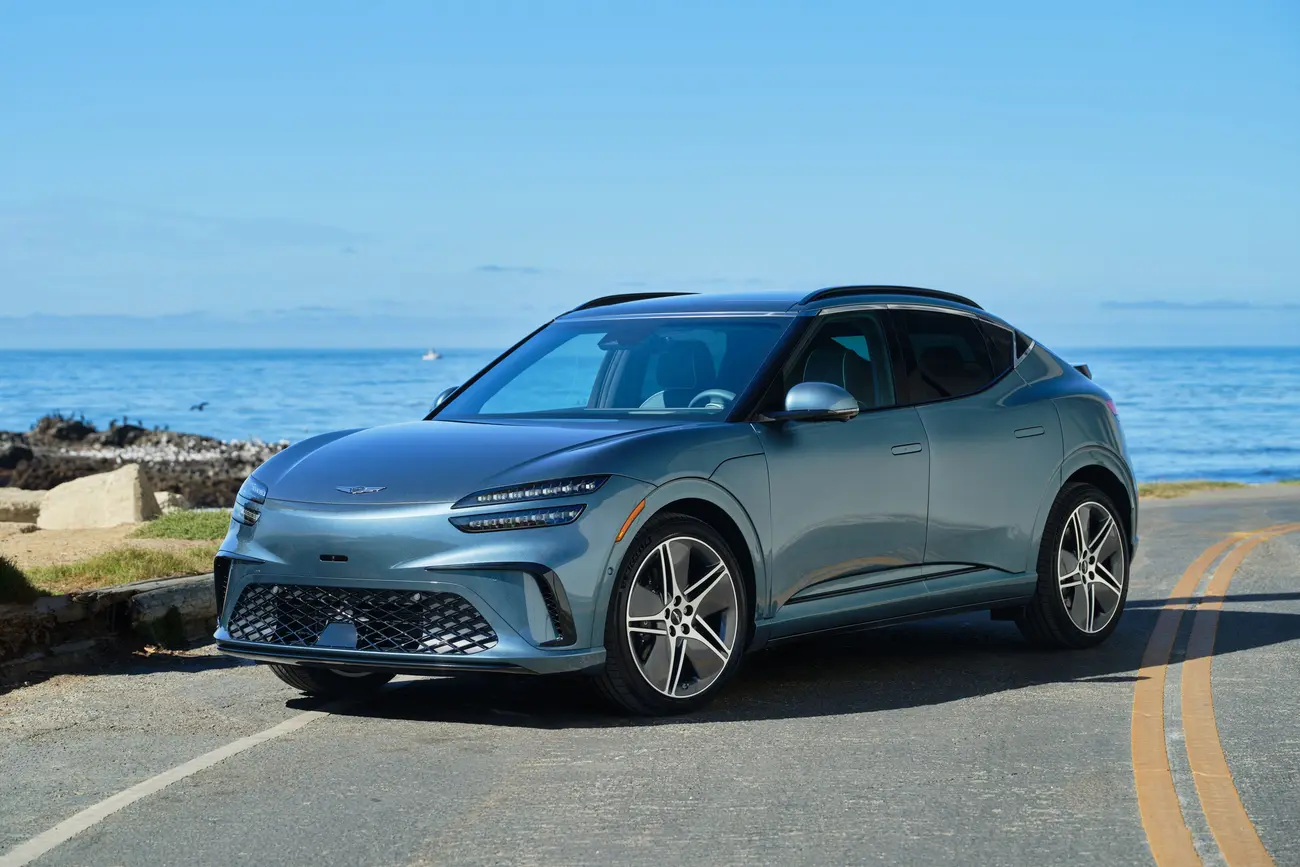
Genesis opens shop in Western Europe — and we now have prices
Hyundai's premium brand has just opened orders in France for three electric models: the GV60, the Electrified GV70, and the Electrified G80 sedan. The official sticker runs from 54,200 EUR at the entry point to 82,000 EUR at the top. France is Genesis's fifth European market, following its 2021 arrival in Germany, the UK, Switzerland, and Italy — and the move matters for anyone in Portugal tracking the premium electric segment.
Portugal isn't on the official map yet. But Spain and the Netherlands are coming in 2026, which brings Genesis considerably closer to Portuguese buyers — even if only through parallel imports at first. Worth understanding what this brand actually is, what the three models cost, and how they stack up against a BMW iX3, a Mercedes EQE or an Audi A6 e-tron.
What Genesis is and why it should matter to you
Launched in 2015 as the luxury division of Hyundai Motor Group, Genesis has already sold 1.5 million vehicles globally. The obvious parallel is DS to Citroën — with the difference that the Korean brand arrives in Europe with real sales numbers and a technical platform DS never had.
The customer experience philosophy is called "Son-nim" (honored guest, in Korean), and it translates into an agency-style direct retail model — no multi-brand showrooms. In France, distribution starts with two temporary showrooms in Issy-les-Moulineaux and Villeneuve-d'Ascq, run by the GGP group. Permanent locations in Paris and Lille open in June 2026, scaling to 25 retail points by end of 2028.
A key detail for the French market — and potentially the Portuguese one: the French line-up is all electric. "Unlike other markets, all will be electric," the brand confirmed. Hybrids might come in 2027, if at all.
Genesis GV60: the compact SUV leading the charge
The GV60 is the most accessible model in the range and probably the one with the most commercial upside. It measures 4.54 metres, shares the E-GMP platform with the Kia EV6 and Hyundai Ioniq 5, but adopts a fastback silhouette with clean lines that clearly set it apart from its Korean cousins.
The 800-volt architecture (technically 697 V in actual operation) enables DC fast charging up to 240 kW. In a stop of about 18 minutes at an ultra-fast charger, the GV60 goes from 10% to 80% — the time it takes to grab a coffee at a motorway service station. The 84 kWh battery is shared across all three trims.
| Trim | Power | Drivetrain | WLTP Range | Price |
|---|---|---|---|---|
| Pure | 229 hp | RWD | 561 km | 54,200 EUR |
| Premium | 318 hp | AWD | 512 km | 64,100 EUR |
| Luxury | 490 hp | AWD | 501 km | 74,100 EUR |
The Pure trim, at 561 km WLTP, offers the best range-to-price ratio in the whole line-up. Translated to Portuguese reality: Lisbon to Porto without a charging stop, even at motorway cruising speeds with the usual real-world range hit.
All trims come standard with the 27-inch OLED panoramic display that runs the width of the dashboard, vegan-leather upholstery, and connected navigation. Premium adds ventilated seats. Luxury brings Nappa leather, semi-autonomous driving, and V2L (vehicle-to-load) — the ability to power external devices from the battery, handy for camping or for powering the lights at a birthday party when the house is off-grid.
Electrified GV70: the family SUV with 490 hp standard
The GV70 is the mid-size SUV, at 4.72 metres, aimed squarely at the BMW iX3, the upper-trim Tesla Model Y, the Mercedes EQB, and the new Volvo EX60. Where the GV60 offers three power steps, the GV70 always comes with all-wheel drive and 490 hp — the difference between trims is equipment, not the powertrain.
| Trim | Price | Power | WLTP Range |
|---|---|---|---|
| Pure | 68,400 EUR | 490 hp | 479 km |
| Premium | 72,300 EUR | 490 hp | 479 km |
| Luxury | 77,300 EUR | 490 hp | 479 km |
The 479 km WLTP figure is the weakest note on the spec sheet — less than the new-generation BMW iX3 promises. In exchange, it hits 0 to 100 km/h in 5.0 seconds and still manages 10-80% charging in about 19 minutes. For anyone running Lisbon-Algarve or Porto-Braga regularly, that means one short stop at a fast charger.
The GV70's platform is architecturally hybrid — compatible with both 400 V and 800 V — because the model is an adaptation of the combustion variant, not a ground-up EV like the GV60.
Electrified G80: the flagship sedan at 82,000 EUR
If the GV60 is the commercial spearhead, the G80 is the tech showcase. A 5.13-metre sedan, dimensionally close to a Mercedes EQE or an Audi A6 e-tron. It comes in a single trim — Luxury — at 82,000 EUR, fully loaded.
| Spec | Value |
|---|---|
| Battery | 94.5 kWh |
| Power | 370 hp |
| WLTP Range | 570 km |
| DC Charging | up to 187 kW |
| 10-80% Charge | 25 minutes |
| Drivetrain | AWD |
The larger battery justifies the 570 km WLTP — the highest number in the current Genesis line-up. What really sets the G80 apart are two engineering details normally found on German sedans well above 100,000 EUR: rear-wheel steering and active suspension. The first improves cornering agility and the turning circle in tight urban manoeuvres; the second adjusts damping in real time to road imperfections.
This isn't an EV for anyone chasing violent acceleration — 370 hp in a car this size won't impress anyone coming out of a Tesla Model S. It is, instead, an EV for someone who wants to do Lisbon to Madrid in silence, without vibration, and with a spine that still works at the other end.
Prices: slightly under the Germans, but not cheap
The pricing strategy is transparent: sit just under the direct German competitors. According to Caradisiac's and Rouleur Électrique's analyses, the French prices come in "slightly below their direct rivals" — the classic emerging-premium playbook.
Key numbers worth remembering:
- GV60 against Audi Q4 e-tron and Mercedes EQA — starts at 54,200 EUR
- Electrified GV70 against BMW iX3, top-spec Tesla Model Y, and Volvo EX60 — starts at 68,400 EUR
- Electrified G80 against Audi A6 e-tron and Mercedes EQE — flat 82,000 EUR
All three come with an unlimited-mileage five-year warranty — a serious argument against the three years that's standard with the German rivals.
So what about Portugal?
Short answer: officially, nothing yet. Genesis hasn't announced Portugal. The confirmed 2026 markets are the Netherlands and Spain, which means Portuguese buyers will have nearer options soon.
There are three realistic paths for anyone who wants a Genesis in Portugal:
- Parallel import from France or Germany — through a professional importer or privately, subject to ISV (Portugal's vehicle registration tax, which is zero on pure EVs — that simplifies the maths considerably), Portuguese plates, and the reduced IUC (annual road tax) for EVs.
- Cross-border purchase from Spain — once the Spanish network opens (likely late 2026), the route becomes trivial: 600 km from Madrid to Lisbon, warranty handled within the EU.
- Wait for an official announcement — given the progressive expansion strategy, Portugal could plausibly land on the Genesis roadmap in the medium term, but nothing is guaranteed.
On tax, Portugal is friendly to these cars: pure EVs are ISV-exempt, get a heavily reduced IUC, and hold corporate-tax advantages (full VAT deduction for company cars up to certain thresholds). For an 82,000 EUR G80 at zero ISV, the final cost doesn't suffer the punishing tax step you'd see on an equivalent V6 combustion sedan.
The Magma card: Genesis wants to go sporty too
A detail that goes beyond the launch: Genesis has created a performance division called Magma — equivalent to Mercedes AMG or BMW M. The GV60 Magma is the first one announced, with rumours pointing to 650 hp, a Drift mode, and a simulated gearbox that mimics shifts like a combustion engine would.
In parallel, Genesis Magma Racing is entering the 2026 FIA World Endurance Championship with the GMR-001 Hypercar, with a team based in Le Castellet. It will race at the 24 Hours of Le Mans. For a brand that plenty of people still confuse with the Old Testament, this is an aggressive visibility play.
Frequently Asked Questions
The Genesis GV60 has no official Portuguese price because the brand does not sell directly in Portugal yet. In France, the 2026 reference prices are 54,200 EUR for the Pure trim (229 hp, 561 km WLTP), 64,100 EUR for the Premium (318 hp), and 74,100 EUR for the Luxury (490 hp). Since pure EVs are exempt from ISV and benefit from a reduced IUC, a parallel import with Portuguese plates stays close to these figures, without the tax penalty a combustion equivalent would face.
There is no official announcement for Portugal. Genesis's next confirmed markets are the Netherlands and Spain, both in 2026 — and that is the most relevant development for Portuguese buyers. The brand entered Europe in 2021 (UK, Germany, Switzerland, and Italy), added France in April 2026 as its fifth market, and expansion has been gradual. Portugal could plausibly join the roadmap in the medium term, but nothing has been confirmed.
WLTP range varies by model: the GV60 Pure reaches 561 km on the 84 kWh battery with rear-wheel drive, the most efficient figure in the compact range; the Electrified GV70 claims 479 km, penalised by its standard 490 hp and mandatory all-wheel drive; and the Electrified G80, with its larger 94.5 kWh battery, hits 570 km. In Portuguese real-world driving — motorway cruising at 120 km/h with air conditioning — expect a typical 15-25% reduction from the WLTP figure.
Yes, and it is currently the only viable path. Parallel import — through a professional importer or privately — means Portuguese plates, but since pure EVs have zero ISV and a reduced IUC, the final cost stays close to the European price. Once the Spanish network opens in late 2026, the process becomes even simpler: the five-year unlimited-mileage warranty works at any Genesis dealer in the EU, and the Madrid-Lisbon drive is just 600 km of motorway.
The Electrified G80 sits slightly below its German rivals on price — a flat 82,000 EUR versus typically higher figures for a comparably equipped EQE. Genesis offsets a more modest power output (370 hp) with two engineering details rarely found in this segment: rear-wheel steering and active suspension, normally reserved for sedans above 100,000 EUR. The 570 km WLTP range is competitive against the EQE, and the five-year unlimited-mileage warranty is a strong argument against Mercedes's standard three-year cover.
What to watch from here
What the French launch tells us about the near future: Genesis wants a seat at the European premium table within a few years, with an all-electric line-up, prices slightly below the Germans, and a parallel bet on motorsport. For the Portuguese buyer, the real milestone isn't this one — it's the Spanish announcement. Once the first GV60s start landing on Spanish roads, the distance to Lisbon becomes a motorway question. Worth keeping an eye on over the next few months.