
Freelander EV in Portugal: Chery and JLR's Electric SUV Arrives in 2027
Published: 21/04/2026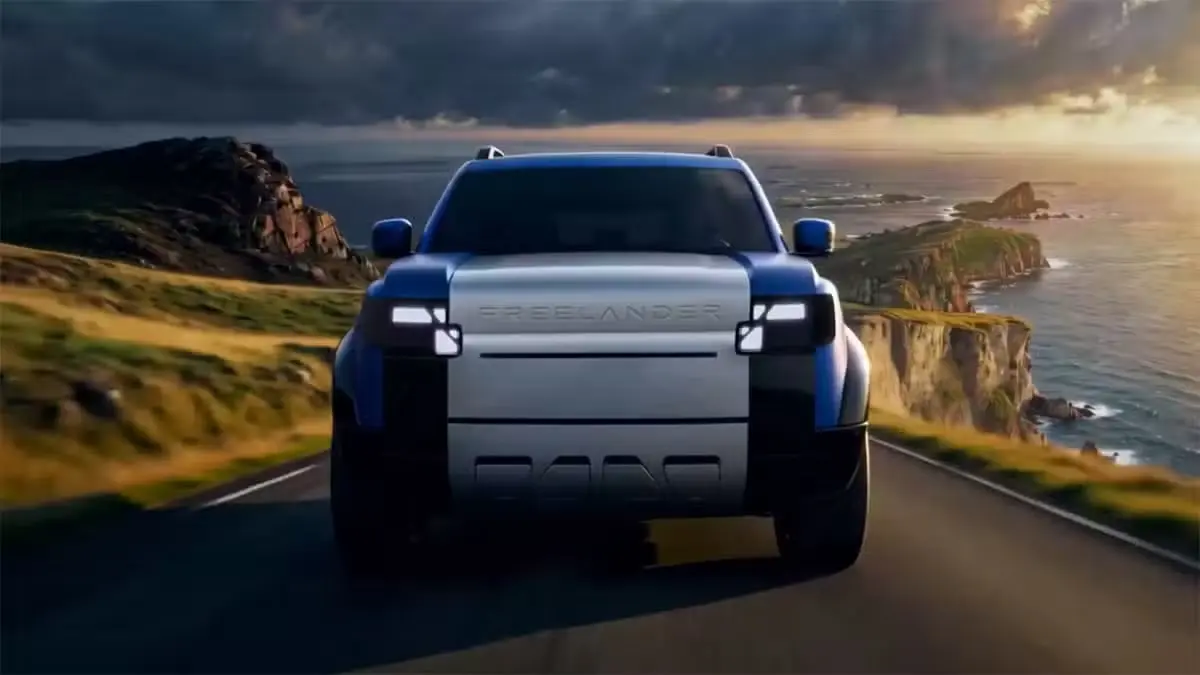
The Freelander is back — but now it is electric and Chinese
Nearly two decades after Land Rover quietly retired the original model, the Freelander name returns. With a twist no one saw coming: it is no longer British. Freelander is now an independent brand jointly developed by Chery and Jaguar Land Rover, headquartered in Shanghai, built in Changshu, and entirely focused on electric propulsion. The first production SUV launches at home in the second half of 2026, and a European rollout is confirmed shortly after — which makes the Freelander EV Portugal story worth tracking now rather than later.
This is not a symbolic operation. The Chery JLR partnership has poured roughly 3 billion yuan (around €375 million, or $439 million) into the Changshu plant, the same site that built the Range Rover Evoque for the Chinese market for years. The stated plan is six models in five years — roughly one new car every six months.
Who does what in this joint venture
The split of responsibilities explains the end product. Chery leads product definition, new-energy vehicle technology and the supply chain. It picks the battery, the software, the chips. JLR handles design direction, brand positioning, and the dynamic tuning — the steering, suspension and on-road feel that has historically defined the parent brand.
The closest parallel is Lynk & Co, the Geely/Volvo brand built on the same logic: Chinese engineering, European polish, cars sold on both sides. The new venture's CEO, Wen Fei (with Wei Lan cited as the Freelander-specific lead), has said openly that the ambition is to reach Western markets without carrying the stigma of being "just another generic Chinese SUV."
The 2026 Freelander: a full-size six-seat SUV
The production model comes straight from the Concept 97, unveiled on 31 March 2026. The name nods to the original Mk1 from 1997, and the design cues are visible: upright proportions, a distinctive diagonal C-pillar — the same shape that now forms the brand's new logo — and overlapping twin headlights that echo the first generation.
The dimensions place it firmly in the larger end of the SUV segment:
- Length: over 5,100 mm
- Wheelbase: over 3,000 mm
- Seating: six seats in a 2+2+2 layout
- Second-row right seat: zero-gravity recliner
This is not a direct successor to the compact original. In footprint it sits closer to a full-size Defender or a Kia EV9 — a roomy family SUV designed for current Chinese tastes, with dimensions that also work well in markets like Germany or Scandinavia.
Specs: 800V, 350 kW charging and a stack of software
This is where the project stands apart. The Freelander launches on the new iMax platform, an 800V architecture that can accommodate full EV, range-extender, or plug-in hybrid drivetrains. The battery is co-developed with CATL, with a 6C charging rate and peak power officially quoted up to 350 kW (one source cited 360 kW).
In practice, a 6C pack charging at 350 kW means you can pull back a meaningful slice of range during a coffee-length stop at a service area. Official WLTP range and exact battery capacity have not yet been released — the full spec sheet is promised for June 2026.
| Specification | Value |
|---|---|
| Electrical architecture | 800V (iMax platform) |
| Powertrains | Full EV, range-extender, PHEV |
| Battery | CATL (co-developed) |
| Charging rate | 6C |
| Peak charging power | Up to 350 kW |
| ADAS | Huawei Qiankun ADS 4.1 (standard) |
| LiDAR | 896-channel (first on an all-terrain SUV) |
| Main SoC | Qualcomm Snapdragon 8397 |
| All-terrain system | i-ATS (co-developed with Huawei Yinwang) |
| Length | over 5,100 mm |
| Wheelbase | over 3,000 mm |
The Snapdragon 8397 is Qualcomm's current flagship automotive chip. According to the figures released, it delivers roughly three times the CPU and GPU power of the 8295 that sits in most current Chinese flagship SUVs, and up to twelve times the AI throughput. Translated to the driver: slicker UI, a sharper voice assistant, and enough headroom for meaningful software updates over the car's lifetime.
Sweden cold-weather testing at -30°C
Before launch, the Freelander completed its extreme-cold validation programme in Sweden, with temperatures dropping to -30°C. That is a meaningful milestone for two reasons. First, Chinese EVs have repeatedly been criticised for heavy winter range loss in Europe. Second, publicly signing off a Nordic validation round is a clear statement of intent — this car is being built with Europe in mind, not purely the home market.
What this means for buyers in Portugal
Europe is confirmed. Executives have said so in press briefings, and Autocar reports that European-bound cars will be re-tuned using JLR's dynamics expertise to suit local roads and buyer preferences. What has not been confirmed is the sales channel. Credible speculation points to parts of the Jaguar Land Rover dealer network being used, but the company has not committed, and the CEO acknowledged that European distribution is still being designed.
For a Portugal-based buyer, three things remain open:
- Exact arrival date. The brand says "shortly after" the China launch in H2 2026. Realistically, first Portugal deliveries are more likely in 2027.
- Price. There is no official figure for China, let alone Europe. Given the size, equipment level and investment in technology, a premium price is likely — roughly €60,000 to €80,000, putting it alongside a Kia EV9 (around €76,000 in Portugal) or a Volvo EX90.
- ISV exemption. As a full battery-electric model, it would benefit from Portugal's full ISV car-tax exemption and reduced IUC road tax. Range-extender or PHEV variants would pay less than a pure combustion car but more than a BEV.
How it fits the Chinese wave already in Portugal
Over the past two years, Chinese brands have moved from curiosity to credible option in Portugal. BYD has dozens of dealers, MG has been established for longer, Xpeng and Leapmotor are opening stores, and Zeekr is preparing to enter. Freelander arrives with a different proposition: it does not need to introduce a new name, it revives one already associated with an off-road identity. That kind of familiarity is unusually helpful in European marketing.
The honest question is whether Portuguese buyers accept a "Freelander" without British DNA underneath. Early adopters are likely to be tech enthusiasts, fans of the original model curious about the revival, or families shopping for a six-seat electric SUV who do not want to spend €90,000 on a well-equipped Volvo EX90.
Frequently Asked Questions
The new Freelander launches in China in the second half of 2026, with Europe confirmed shortly after. In practice, given typical homologation and distribution lead times, first deliveries in Portugal are more realistically expected in 2027. The full spec sheet is due in June 2026.
There is no official price for China yet, let alone Europe. Given the size (over 5.1 metres), six-seat layout, and tech level (800V platform, LiDAR, Snapdragon 8397), a premium position is likely — roughly €60,000 to €80,000 in Portugal. That puts it alongside the Kia EV9 (around €76,000) and below a well-equipped Volvo EX90.
The Freelander uses the new iMax platform with an 800V architecture and a CATL co-developed battery, supporting a 6C charging rate and peak charging power up to 350 kW (one source cites 360 kW). Official WLTP range figures are only due in June 2026, but an SUV of this size on an 800V pack should be competitive with the Kia EV9 and Volvo EX90.
Not yet confirmed. Credible reporting from Autocar and the Irish Times points to possible use of parts of the JLR dealer network in Europe, but the company has not committed. The CEO has acknowledged that European distribution is still being designed, so the exact Portuguese sales channel should become clear closer to launch.
As a full battery-electric model, the Freelander qualifies for Portugal's complete ISV exemption and reduced IUC road tax, plus any EV support schemes available at purchase. The range-extender and PHEV variants planned on the iMax platform pay less tax than a pure combustion car but do not match BEV benefits — a meaningful detail when comparing real on-the-road pricing.
What to watch over the coming months
The full spec sheet is due in June 2026. Between then and the China launch in H2 2026, expect official pricing, trim levels and WLTP data. For Portugal, the two signals worth watching are the distribution partner (JLR network or standalone stores) and the first official price in a reference European market, most likely Germany or the UK. From that point on, it becomes much clearer whether the Freelander electric SUV lands in Portugal as a real alternative to the Kia EV9 and Volvo EX90 — or stays a special-order curiosity.