
Forthing 5 (Friday) EV: Europe Price, Specs and Portugal Arrival
Published: 05/11/2026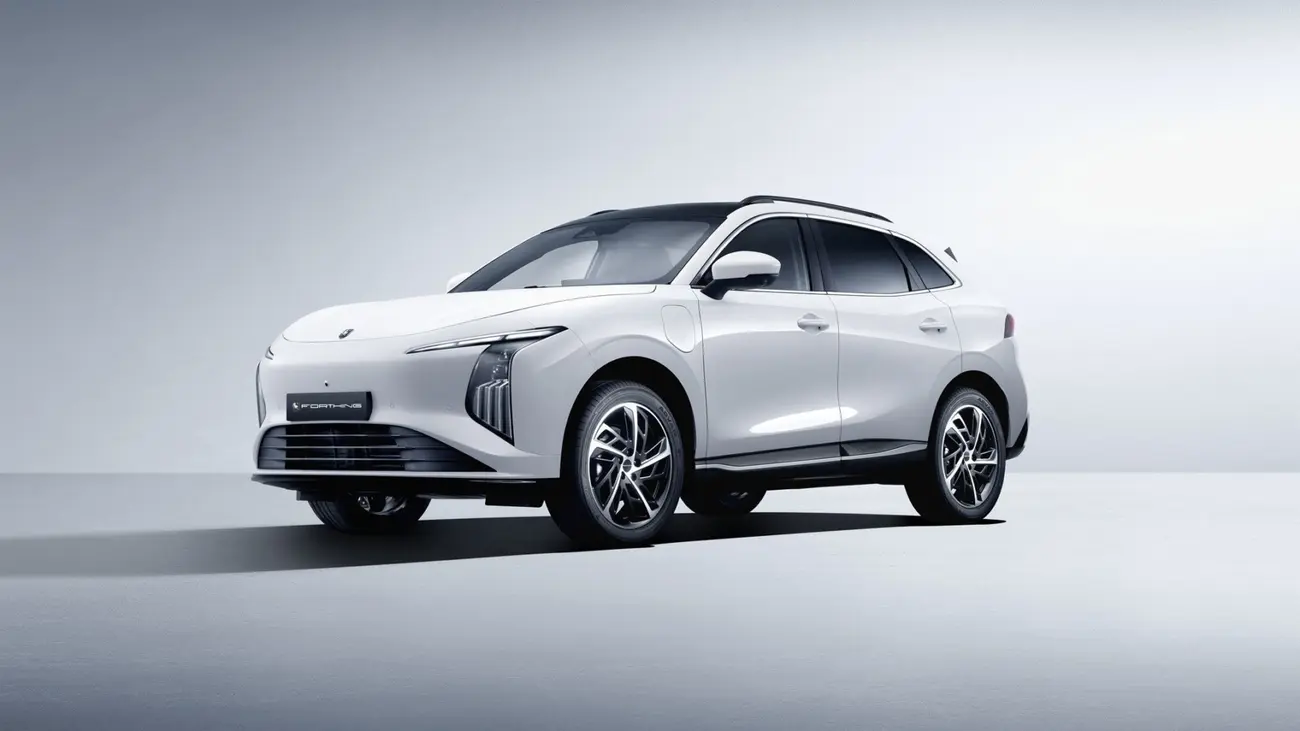
Forthing 5 (Friday) EV: €40,995 and a whole new generation
A smaller battery, more range and twice the voltage. The second-generation Forthing 5 (Friday) has been orderable in Germany since 23 October 2026, priced from €40,995. That is the first hard number for the Forthing 5 BEV's Europe price, and it is a useful benchmark for anyone working out the likely Forthing 5 price in Portugal.
The naming is confusing. In Germany the car is the Forthing 5 BEV; in China and in Portugal the previous generation was sold as the Forthing Friday. The brand belongs to Dongfeng Liuzhou Motor (part of the Dongfeng group) and already has an importer here, so a Portuguese launch of this version looks likely. Nothing is confirmed yet.
New Forthing Friday 2026: what changes from the previous generation
The biggest change sits under the floor. The Friday we know used a 400-volt architecture and a battery of roughly 86 kWh (85.9 kWh). The new car moves to 800 volts and a 75 kWh LFP (lithium iron phosphate) battery. Less capacity, yet a lot more claimed range.
| Forthing 5 EV / Friday (1st gen) | Forthing 5 BEV (2nd gen) | |
|---|---|---|
| Architecture | 400 V | 800 V |
| Battery | ~86 kWh | 75 kWh LFP |
| WLTP range | 371 km | 501 km |
| Power | 150 kW (204 hp) | 200 kW (272 hp) |
| 20-80 % charge | 45 minutes | under 18 minutes |
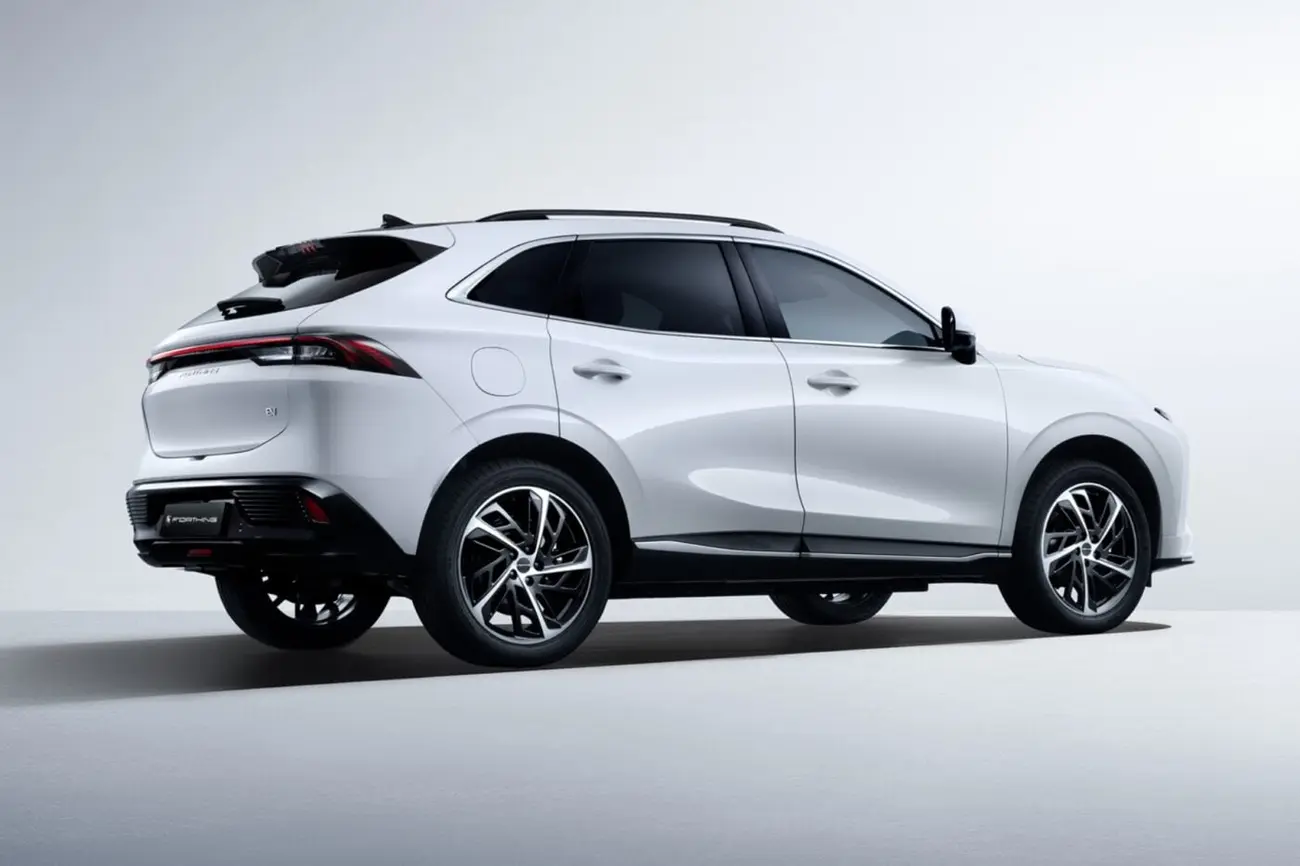
Gaining 130 km of rated range from a smaller pack points to a much more efficient car: claimed WLTP consumption is 17.2 kWh/100 km. Power is up by 50 kW, and fast-charging time is more than halved. The front end and lights have also been redesigned.
A word on the old model's range. Some Portuguese material for the Friday quoted around 510 km, which doesn't match the 371 km WLTP figure published in Germany for the same car. If you're comparing listings, always check which test cycle a range figure comes from.
Forthing 5 specs and range at a glance
Germany gets a single trim with no options. All five paint colours come at no extra cost.
| Spec | Forthing 5 BEV |
|---|---|
| Price (Germany) | from €40,995 (excl. delivery and registration) |
| Motor | permanent-magnet synchronous, front axle |
| Power / torque | 200 kW (272 hp) / 360 Nm |
| Drive | front-wheel drive |
| Top speed | 180 km/h (limited) |
| 0-100 km/h | not published |
| Battery | 75 kWh LFP, liquid cooling and heating |
| Architecture | 800 V |
| WLTP range | 501 km combined / 696 km city |
| WLTP consumption | 17.2 kWh/100 km |
| DC charging | 20-80 % in under 18 min; 160 kW peak (Chinese figure) |
| Regeneration | 3 levels |
| Drive modes | Eco, Standard/Comfort, Sport, Sport+ |
| Length / width / height | 4,546 / 1,860 / 1,680 mm |
| Wheelbase | 2,715 mm |
| Boot | 410 l / 1,420 l with rear seats folded |
| Kerb / gross weight | 1,925 kg / 2,371 kg |
| Wheels | 19-inch, 235/55 R19 |
| Warranty | 3 years, unlimited km |
At 4.55 metres, it sits in the same size class as a VW Tiguan or Jeep Compass. The 410-litre boot works for a family, though it's not among the biggest in the segment.
Standard equipment, no options list
The kit list is long for the money. As standard, the Forthing 5 comes with:
- Power front seats with heating, ventilation and massage
- Panoramic roof with electric sunshade
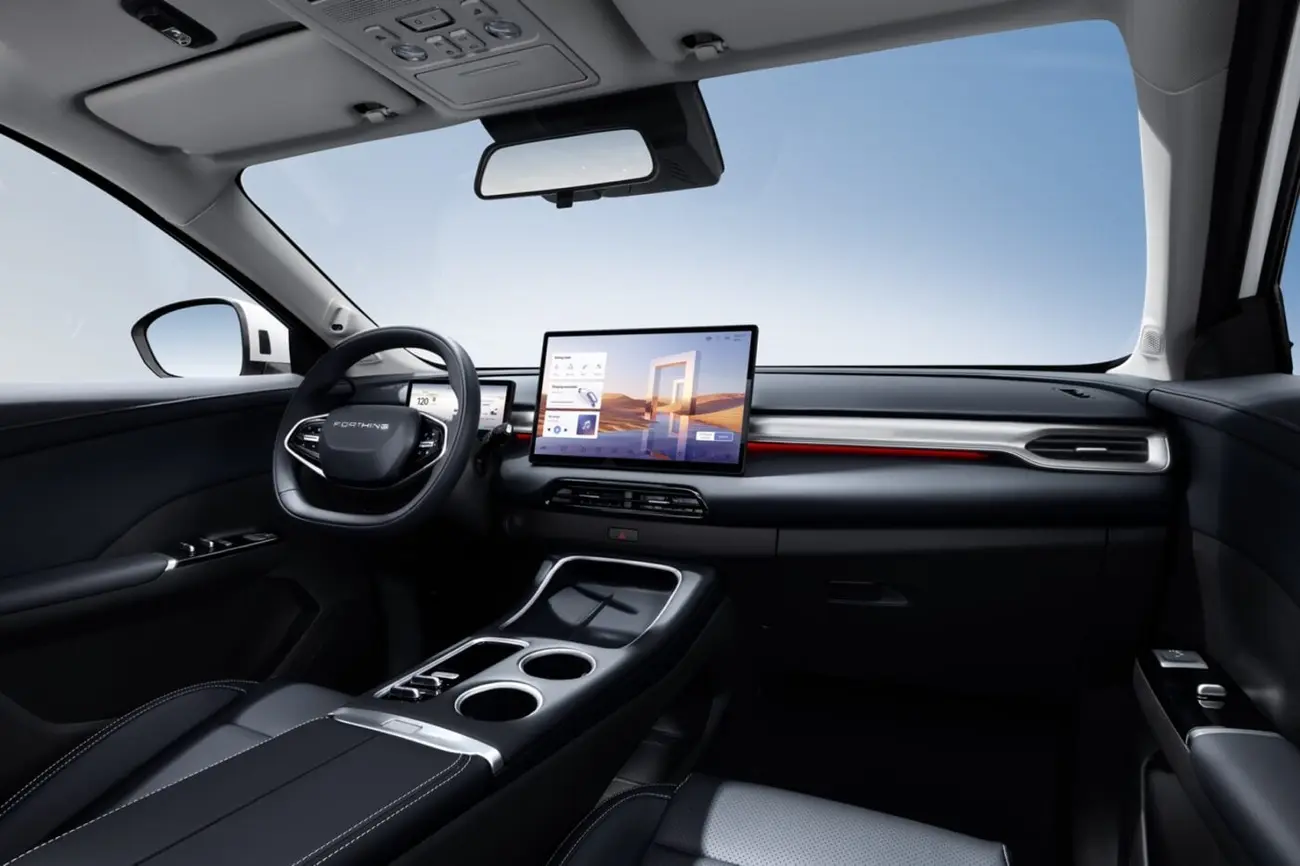
- 15.6-inch central touchscreen (replacing the old car's twin 10.25" screens) and digital instrument cluster
- Apple CarPlay and Android Auto, DAB radio, six speakers
- 50 W wireless phone charging and a 220 V socket
- Dual-zone automatic climate control and power tailgate
- Adaptive cruise control, emergency braking, lane-keeping assist, blind-spot monitoring, rear cross-traffic alert
- 360° camera plus front and rear parking sensors
Forthing 5 range: 501 km WLTP, but what about the motorway?
The 501 km combined WLTP figure is the brochure number, and the 696 km city figure shows how far it can stretch in slow urban traffic. For open roads, German site ElektroQuatsch quotes motorway consumption of 23.3 kWh/100 km. That works out to roughly 322 km of real range at motorway speeds, before cold, rain or air conditioning take their share.
In practice, Lisbon to Porto (about 310 km) is right at the limit on a single charge. A short stop halfway at a fast charger on the MOBI.E network (Portugal's national public charging network) sorts it out. Lisbon to the Algarve is more comfortable.
One question is still open: nobody has said whether 75 kWh is gross or usable capacity. A reader on electrive.net claims usable capacity is only 66.5 kWh, but that is unverified.
800 V charging: 18 minutes, with caveats
Dropping from 45 to under 18 minutes for a 20-80 % charge is the upgrade you'll notice most. On a long trip, it means a coffee stop rather than a sit-down lunch while you wait.
There's a catch. The 160 kW peak figure comes from China, and the German importer's data sheet gives no maximum charging power or charging times. electrive.com ran the numbers: 18 minutes for 20-80 % of 75 kWh implies an average of about 150 kW, which is modest for an 800 V car. AC charging power hasn't been published either.
Forthing 5 vs Tesla Model Y and BYD Sealion 7
At German prices, the Forthing lands in a crowded part of the market. Rival prices come from a comparison published in May 2026 and may have changed since, so check current configurators before you decide.
| Model (German prices) | Price | WLTP range | Power | DC charging (peak) |
|---|---|---|---|---|
| Forthing 5 BEV | €40,995 | 501 km | 272 hp | 160 kW (Chinese figure) |
| Tesla Model Y Standard RWD | €39,990 | 534 km | not published | 250 kW |
| Tesla Model Y Long Range RWD | €46,990 | 657 km | not published | 250 kW |
| BYD Sealion 7 Comfort RWD | €47,990 | 482 km | 313 hp | 150 kW |
Against the Tesla Model Y Standard, the Forthing costs about €1,000 more and has less rated range. It makes up for it with equipment: massaging, ventilated seats, a panoramic roof and CarPlay/Android Auto, which Tesla doesn't offer. Tesla counters with the Supercharger network and a higher, proven peak charging rate.
Against the BYD Sealion 7 Comfort, the Forthing is roughly €7,000 cheaper with similar WLTP range. The BYD is more powerful and has a bigger boot (520 l plus a 58 l frunk). It also wins clearly on warranty: 6 years or 150,000 km, versus 3 years with unlimited mileage for the Forthing. One German source lists the Sealion 7 from around €49,990, a reminder of how fast these prices move.
Forthing Friday price in Portugal: what to expect
Forthing is already in Portugal. Grupo Auto-Industrial has been the exclusive importer since 2024, through its company Solmotor, and the initial line-up included the S7, the U-Tour and the first-generation Friday (150 kW, 85.9 kWh BYD battery). In April 2025 the brand had 5 dealers and was aiming for around 15 by the end of that year.
The old Friday's Portuguese price isn't clear. Guia do Automóvel lists about €45,907, while 4gnews reported €51,500. Neither figure is confirmed by the brand, and a gap of almost €6,000 is too big to ignore.
So how much will the Forthing 5 cost in Portugal? There's no official price yet. A simple calculation helps: if the Portuguese importer used the same pre-VAT price, Germany's €40,995 (at 19 % VAT) becomes roughly €42,400 with Portugal's 23 % VAT. Electric cars are exempt from ISV (Portugal's vehicle purchase tax) and IUC (the annual road tax), so there's nothing else to add. In reality, Portuguese pricing depends on the importer's strategy, shipping costs and margins, and could land above this estimate.
For companies, an EV under the €62,500 legal threshold allows VAT recovery and avoids autonomous taxation, which makes the Forthing 5 worth a look as a fleet car.
Is the Forthing 5 coming to Portugal?
No announcement yet. With the importer already up and running and the Friday already on sale here, the second generation is likely to follow, but there's no confirmed date or price.
There's also the naming question. At the 2026 Paris Motor Show, electrive.com described an SUV called the TK5 with the same specs as the Forthing 5 BEV: 75 kWh, 800 V and under 18 minutes for 20-80 %. It looks very much like the same car under another name, but the brand hasn't confirmed it. So it could reach Portugal as the Friday, the Forthing 5 or the TK5.
Frequently Asked Questions
There is no official Portuguese price yet. In Germany the new generation starts at €40,995 including 19% VAT; with the same base price and Portugal's 23% VAT it would come to roughly €42,400, with no ISV or IUC to add because it is electric. That is only an estimate: the final price is up to the importer, and the previous-generation Friday was quoted in Portugal at anywhere from €45,907 to €51,500, figures the brand has not confirmed.
No date has been announced. Forthing has had an exclusive Portuguese importer since 2024 (Grupo Auto-Industrial, through Solmotor) and already sold the first-generation Friday here, so the 800 V version is likely to follow, but it is not confirmed. It could arrive as the Friday, the Forthing 5 or the TK5, the name used at the 2026 Paris Motor Show for a model with identical specs.
The new generation moves from 400 V to 800 V and swaps the roughly 86 kWh battery for a 75 kWh LFP pack. Despite the smaller battery, WLTP range rises from 371 km to 501 km and power from 150 kW (204 PS) to 200 kW (272 PS). The brand says 20-80% fast charging drops from 45 minutes to under 18 minutes.
Based on the 23.3 kWh/100 km motorway consumption cited by German site ElektroQuatsch, range works out at around 322 km, against 501 km on the combined WLTP cycle and 696 km in the city. That makes a Lisbon-Porto trip (about 310 km) possible but tight, and cold weather or air conditioning will cut it further. It is also still unclear whether the 75 kWh figure is usable or gross capacity.
In Germany the Forthing 5 BEV comes with a 3-year, unlimited-mileage warranty, well short of BYD's 6 years or 150,000 km and Tesla's 4 years or 80,000 km; Portuguese terms for the new version have not been announced yet. The brand is sold through the Solmotor network, which had 5 dealers in April 2025 and was aiming for around 15 by the end of that year.
Is the Forthing 5 worth it?
On paper, the package is strong: 272 hp, 501 km WLTP, 800 V and top-spec equipment with no extras to pay for, all for around €41,000 in Germany. For a Chinese electric SUV under €41,000, it's hard to ask for more on the spec sheet.
The weak points are just as clear:
- Short warranty: 3 years, against 6 years/150,000 km at BYD and 4 years/80,000 km at Tesla.
- Charging still unconfirmed: no official peak power, charging curve or usable battery capacity.
- Service network: a little-known brand with few dealers. VISION mobility raises this concern for fleets in Germany, and in Portugal the network is still growing.
- No official 0-100 km/h, a sign the spec sheet is still incomplete.
If the Portuguese price lands near €42,000 and the battery warranty is convincing, the Forthing 5 could shake up the shortlist for anyone weighing a Model Y or a Sealion 7. Until then, the numbers to watch are Solmotor's official price and real-world charging data.