
Ford Puma Gen-E 2026 in Portugal: Motor, 46.8 kWh Battery, Trims and Price
Published: 02/11/2026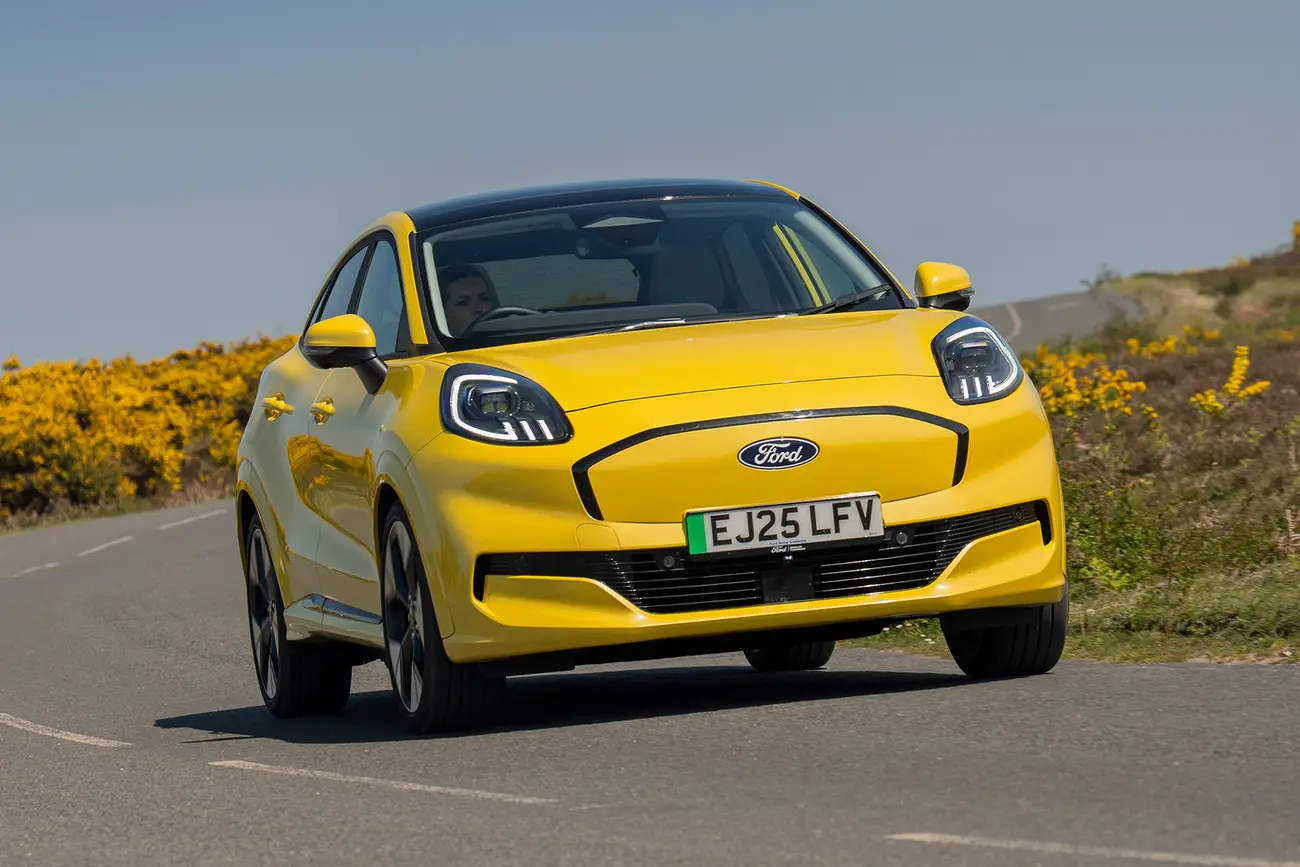
Ford Puma Gen-E 2026: one motor, a bigger battery
An extra 41 km of range, with the same motor and the same entry-level spec: that's the short version of the Ford Puma Gen-E 2026 update. Ford swapped the 43 kWh usable battery for a 46.8 kWh pack, lifting WLTP range from 376 to 417 km. Italian data for the 2027 model year puts it at up to 419 km. For anyone looking at the Ford Puma Gen-E 2026 in Portugal, that closes much of the gap to its main rivals.
One question comes up early: which version is the most powerful? None of them. Every trim shares exactly the same motor. What changes is the equipment, the wheels and a few aerodynamic details, and those nudge consumption up or down a little.
The 168 hp motor: what it's like to drive
There's a single electric motor on the front axle, rated at 124 kW (168 PS) with 290 Nm of torque. It does 0-100 km/h in 8.0 seconds and tops out at 160 km/h.
In practice that's plenty for pulling out of a roundabout without hesitation and joining the A1 or A2 motorway comfortably. It isn't a sports car, but European road tests agree on one thing: the Puma Gen-E keeps the petrol Puma's agility. Steering and suspension are well judged, and British reviewers rate it sharper than the Renault 4 E-Tech and the Jeep Avenger Electric, and quicker than the Peugeot e-2008.
Ford Puma Gen-E battery 46.8 kWh: what changed from 43 kWh
The battery didn't get physically bigger. Gross capacity is still 53 kWh, but a redesigned internal pack layout raised usable capacity from 43 to 46.8 kWh. Chemistry is NMC on a 400 V architecture, and the battery warranty runs for 8 years or 160,000 km.
| Puma Gen-E (2024-2025) | Puma Gen-E 2026 | |
|---|---|---|
| Battery gross / usable | 53 / 43 kWh | 53 / 46.8 kWh |
| WLTP range | 376 km (17" wheels) | 417 km (up to 419 km for MY27) |
| Max DC charging | 100 kW | 100 kW |
| 10-80% on DC | 23 min | 26 min |
| Power / torque | 124 kW (168 PS) / 290 Nm | 124 kW (168 PS) / 290 Nm |
There's a small trade-off. With more energy to fill and the same 100 kW peak, a 10-80% charge now takes 26 minutes instead of 23. Three extra minutes at a charger is a fair price for over 40 km of additional range.
Ford Puma Gen-E range: WLTP versus the real world
The 417 km WLTP figure is the brochure number. The Premium trim, on bigger wheels, drops to 404 km according to Italian data. EV Database's real-world estimate for the 46.8 kWh battery is around 300 km in mixed driving.
| Scenario (EV Database estimate) | Cold (-10 °C) | Mild (23 °C) |
|---|---|---|
| City | 290 km | 450 km |
| Motorway at 110 km/h | 210 km | 275 km |
| Combined | 250 km | 345 km |
What about proper motorway driving? electrive.com's long-term test, still on the 43 kWh battery, recorded about 16 kWh/100 km at 120-130 km/h, good for roughly 270 km. On mild-weather rural roads, consumption fell to around 14 kWh/100 km.
Even with the new pack, a Lisbon-Porto run (about 310 km) at motorway speeds still needs one charging stop. For a daily commute between Setúbal and Lisbon, or Braga and Porto, you'll have range to spare for the whole week.
Ford Puma Gen-E range in winter
This is the weak spot. Below freezing with a cold-soaked car, electrive measured over 20 kWh/100 km and around 200 km of range. The Puma Gen-E has no heat pump, which hurts more in cold climates. Portugal's winters are mild across most of the country, so the penalty will be far smaller than in Germany. Still, if you live in Trás-os-Montes or near the Serra da Estrela, factor it in.
How long does the Ford Puma Gen-E take to charge?
- Wallbox or 11 kW AC point: 0-100% in about 5 hours. On a 7.4 kW wallbox, allow 7h30.
- Domestic socket (2.3 kW): about 24 hours. Fine for an emergency, not for daily use.
- DC fast charger: 100 kW peak, with 10-80% in 26 minutes according to Ford. EV Database estimates 24 minutes on a 150 kW or faster unit and 46 minutes on a 50 kW one.
electrive's test showed the car holding 100 kW up to roughly 50% charge, then dropping to about 50 kW between 75% and 88%. On MOBI.E, Portugal's national public charging network, that means it pays to arrive low and leave around 80% rather than charging to full.
The navigation system plans charging stops and preconditions the battery on the way to a fast charger. Plug & Charge is supported too, so compatible chargers start a session without cards or apps. V2L, the ability to power external devices from the battery, isn't offered.
Ford Puma Gen-E trims and versions: Gen-E, Premium, BlueCruise Edition and Black Edition
The 2027 range has four trims. Since the motor is identical across all of them, the choice comes down to equipment and a small difference in consumption driven by wheel size:
| Trim | WLTP consumption | What sets it apart |
|---|---|---|
| Gen-E | 13.0 kWh/100 km | Entry trim, most efficient |
| Premium | 13.7 kWh/100 km | Larger wheels, more equipment |
| BlueCruise Edition | 13.7 kWh/100 km | BlueCruise as standard |
| Black Edition | 13.6 kWh/100 km | Blacked-out styling |
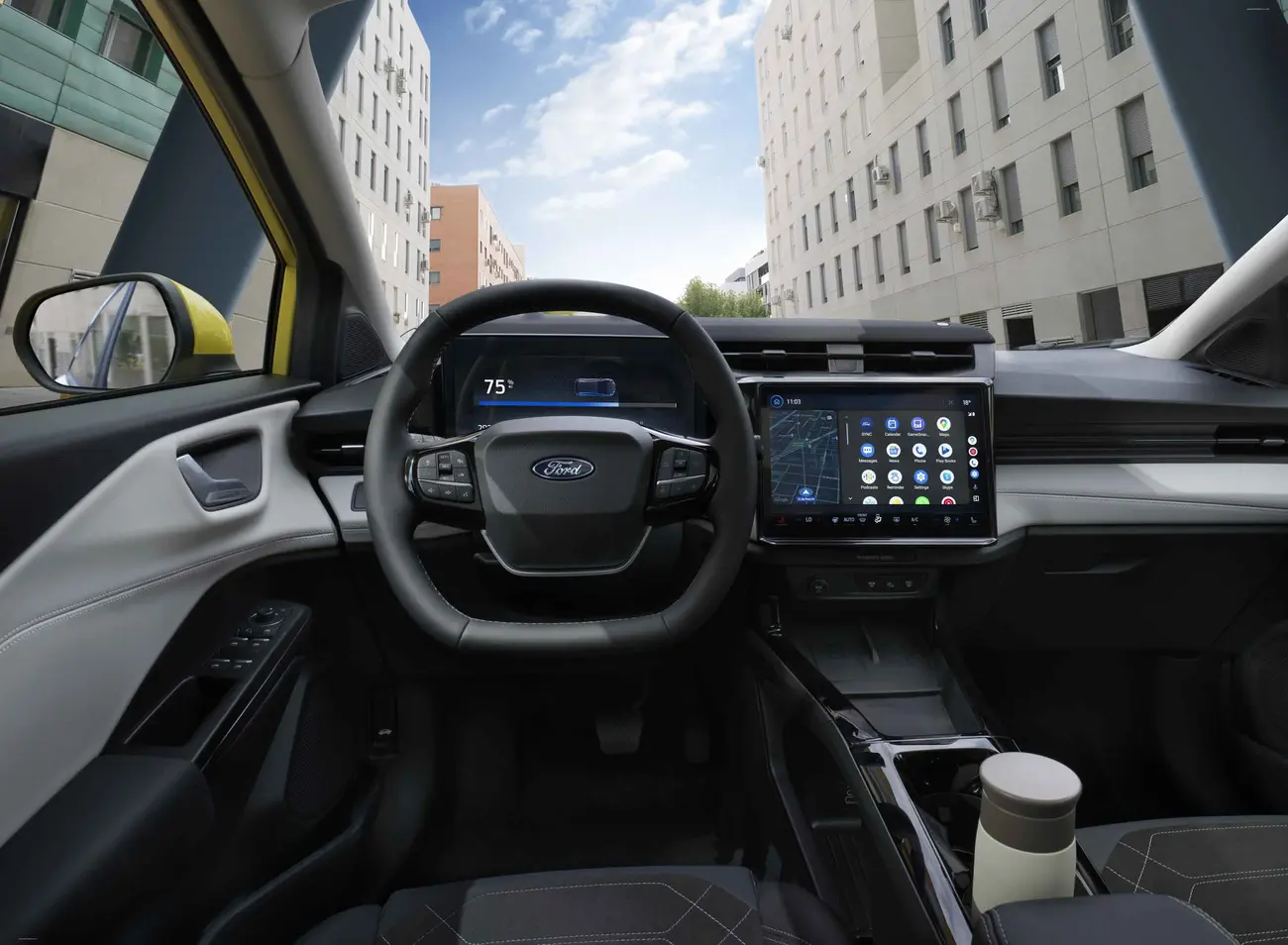
At the French launch, the base car already came with automatic climate control, a wireless phone charger and a rear camera on 17" wheels. Premium added matrix LED headlights, Level 2 driver assistance, a 10-speaker 650 W B&O sound system and 18" wheels (19" optional). Every version gets a 12" touchscreen and a 12.8" digital cluster, with wireless Android Auto and Apple CarPlay.
Premium or BlueCruise Edition?
BlueCruise is Ford's hands-free driving system for pre-mapped motorways, known as "Blue Zones". You still need to keep your eyes on the road. The Puma is the smallest Ford to get it. It's standard on the BlueCruise Edition and available on other trims through a monthly or annual subscription.
Before paying for it, check which Portuguese motorways are covered by Blue Zones. Ford quotes more than 135,000 km of mapped roads across Europe, but our sources don't include a Portugal-specific list. If you rarely drive on motorways, the Premium remains the more sensible pick.
The 523-litre boot: its biggest advantage
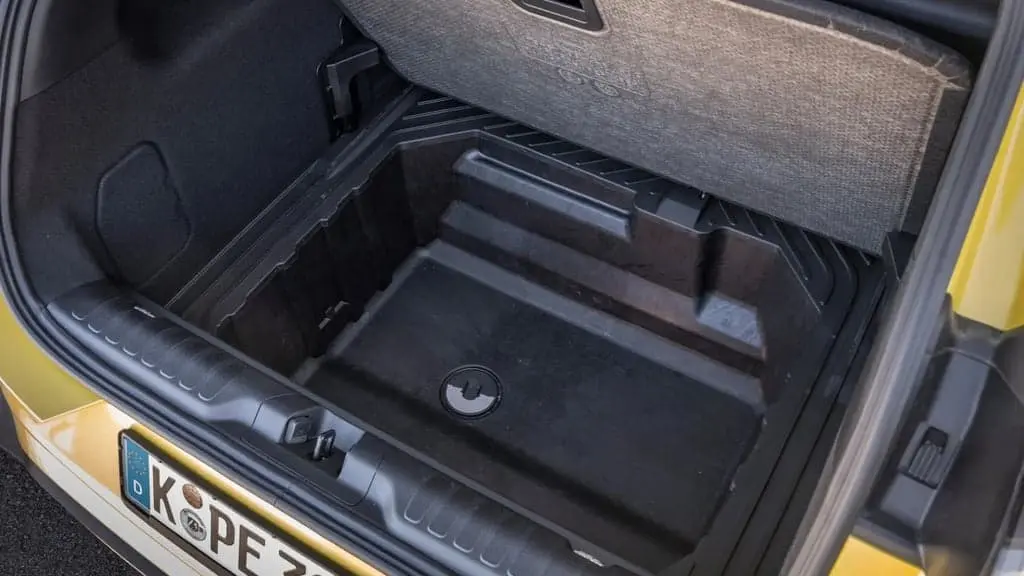
If there's one reason to choose the Puma Gen-E over its rivals, it's the boot. You get 523 litres, including the 145-litre Gigabox under the floor. That space is washable and has a drain plug, so it handles sandy surf gear or muddy camping kit. There's also a 43-litre frunk up front for charging cables. Fold the seats and capacity reaches 1,283 litres.
The rear seats are less impressive. European tests flag limited headroom for tall adults, and the Renault 4 is clearly roomier in the back. At 4.21 metres long, the Puma is easy to park in Lisbon or Porto, and it can tow up to 750 kg.
Ford Puma Gen-E price in Portugal: what we know
There's no confirmed official Portuguese price yet for the Puma Gen-E 2026 with the 46.8 kWh battery. The only documented figures for our market are the 2024 launch prices, for the 43 kWh car: €35,842 for the base version and €38,179 for the Premium.
For reference, here's what it currently costs elsewhere in Europe:
| Country | Starting price | Notes |
|---|---|---|
| Italy | €33,250 | 2027 range |
| Netherlands | €33,395 | Orders since March 2026 |
| Germany | €36,900 | Premium from €39,400 |
| France | €33,990 | 2024 launch price; Premium €36,490 |
| Portugal | €35,842 | 2024 launch price; Premium €38,179 |
In 2024, Ford Portugal charged about €1,850 more than France for the base version. If a similar gap holds against Italian and Dutch pricing, the Puma Gen-E 2026 should land close to those launch figures. Treat that as an estimate, not a confirmed price. It's worth asking a dealer for a quote, as brand campaigns often bring the list price down considerably.
On the tax side, as a fully electric car it's exempt from ISV (Portugal's vehicle registration tax) and IUC (the annual road tax). Companies can deduct VAT on EVs priced up to €62,500, which covers every Puma Gen-E trim. It's also worth checking whether a Fundo Ambiental (the state environmental fund) incentive is open when you buy.
Ford Puma Gen-E vs Renault 4, Peugeot e-2008 and Jeep Avenger
| Ford Puma Gen-E 2026 | Renault 4 E-Tech | Peugeot e-2008 | |
|---|---|---|---|
| Usable battery | 46.8 kWh | 52 kWh | 54 kWh |
| Power | 168 PS | 150 PS | 156 PS |
| WLTP range | 417 km | about 400 km | 406 km |
| Boot | 523 L + 43 L frunk | 420 L | n/a |
| DC charging | 100 kW | 100 kW | n/a |
Renault 4 E-Tech: won Auto Express's head-to-head thanks to rear space, slightly longer range and styling. That test still used the 43 kWh Puma. With the new battery, the range gap all but disappears, and the Puma still has the bigger boot and more power.
Peugeot e-2008: more rear room and a bigger battery, but it launched in France at €40,250, well above the Puma. It's also slower.
Jeep Avenger Electric: official range sits slightly below the updated Puma, and the boot is smaller. The Puma is also more agile on twisty roads.
Beyond this trio, the market keeps moving. In Germany the Volvo EX30 offers batteries up to 69 kWh for not much more money, and the 52 kWh Renault 5 is an option if you don't need as much boot space.
Is a used Ford Puma Gen-E worth it?
The 43 kWh Puma Gen-E was on sale from late 2024 until March 2026, so that's the version you'll find on the used market. For mostly urban driving and daily trips under 100 km, it's an appealing buy: same motor, a battery warranty of 8 years or 160,000 km, and only about 40 km less WLTP range than the new car. If you regularly drive long distances, the 2026 model is worth the difference.
Frequently Asked Questions
Ford Portugal has not yet confirmed official pricing for the 2026 Puma Gen-E with the 46.8 kWh battery. The documented figures are the 2024 launch prices for the 43 kWh car: EUR 35,842 for the base version and EUR 38,179 for the Premium. For comparison, the base car costs EUR 33,250 in Italy and EUR 36,900 in Germany. As a fully electric car, it pays no ISV registration tax or IUC road tax, and companies can deduct VAT because every version is below the EUR 62,500 cap.
No. None of the Puma Gen-E versions has a heat pump, so it uses more energy in cold weather. In electrive.com's test of the 43 kWh car, consumption went above 20 kWh/100 km below freezing and range fell to about 200 km. For the 46.8 kWh battery, EV Database estimates about 250 km of mixed driving and 210 km on the motorway at -10 °C, compared with 345 km and 275 km at 23 °C.
On a DC fast charger, Ford quotes 10-80% in 26 minutes with a 100 kW peak. EV Database estimates 24 minutes on a 150 kW or faster charger and 46 minutes on a 50 kW unit. At home, an 11 kW wallbox charges from 0 to 100% in about 5 hours, and a 7.4 kW wallbox takes about 7.5 hours. A full charge from a 2.3 kW domestic socket takes about 24 hours.
Cars sold from late 2024 to March 2026 have the 43 kWh usable battery and 376 km WLTP range (17-inch wheels). The 2026 models, on sale since spring 2026, have 46.8 kWh usable and 417 km WLTP, or up to 419 km for MY27. Check the WLTP range on the certificate of conformity or in the car's documents. Both have the same 168 hp motor and the same 8-year or 160,000 km battery warranty.
The Peugeot e-2008 has a bigger battery (54 kWh) and 406 km WLTP range, but the 2026 Puma Gen-E claims more range (417 km) from 46.8 kWh because it is more efficient. The Puma also has more power (168 hp vs 156 hp) and a 523-litre boot plus a 43-litre frunk. In France, the e-2008 launched at EUR 40,250, against EUR 33,990 for the Puma. The e-2008's main advantage is rear-seat space.
Who the electric Ford Puma is for
The Ford Puma Gen-E 2026 makes the most sense as the main car for a family living in or around a city, or as a second car alongside something bigger for road trips. The boot is among the best in the segment, it's enjoyable to drive, and 417 km of WLTP range removes day-to-day range anxiety. If you drive Lisbon to the Algarve every weekend, you'll miss a bigger battery and a heat pump. The next thing to watch is the final price Ford Portugal sets for the new battery, because that will decide how it stacks up against the Renault 4.